At the moment, there are no entries available for display




Elements of sustainable banking
At the heart of the Bank’s sustainable banking pillar are three interconnected elements, as illustrated in the Figure 16 below, which together guide how value is created for stakeholders while balancing financial, social and environmental priorities.
Elements of sustainable banking Figure – 16
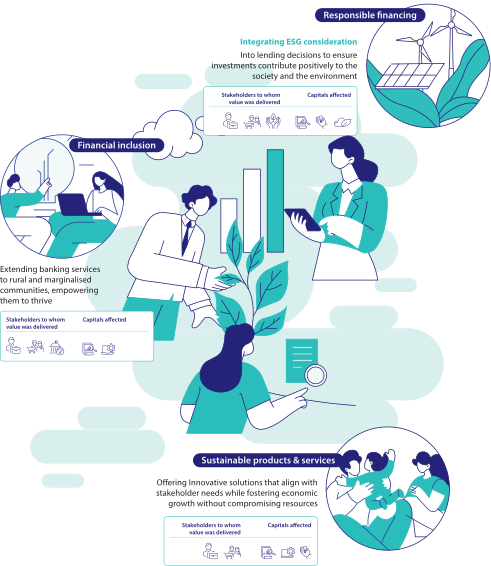
Responsible financing
Why responsible financing matters
Responsible financing matters because it is where sustainability most directly meets the Bank’s balance sheet, translating sustainability priorities into asset quality, capital strength, liquidity resilience, funding access, and long-term franchise value. For a systemically important lender, sustainability is inseparable from the core function of financial intermediation: decisions on who is financed, on what terms, and under what risk disciplines shape economic activity and resilience, influencing inclusion, enterprise development, environmental outcomes and systemic stability.
For Commercial Bank of Ceylon PLC, responsible financing is therefore the practical link between sustainability priorities and financial performance. Lending and investment decisions directly affect the Bank’s risk profile (credit, operational, legal and reputational risk), earnings resilience through portfolio quality and funding stability, and long-term license-to-operate through trust.
Our approach to responsible financing
Our approach operates on a clear strategic logic: financial resilience provides the foundation for responsible credit allocation, while disciplined lending, in turn, reinforces that resilience.
Key developments during 2025
In 2025, the Bank strengthened its responsible finance agenda by advancing Green and Blue Finance, scaling green finance capabilities, enhancing ESG and climate considerations into credit decisions, progressing its Climate Transition Plan, and expanding lending to priority sectors.
This approach is delivered through four mutually reinforcing priorities as illustrated in the Figure 17 below:
Our approach to responsible financing Figure – 17
1
Scaling sustainable finance
Action & Delivery
Expanding Green & Blue Finance through targeted products and sectoral financing.
Key Enablers
Sustainable Bond Framework, Green finance taxonomy, IFC support, and Staff training.
2
Embedding risk oversight
Action & Delivery
Integrating ESG/Environmental & Social (E&S) into core credit underwriting and portfolio oversight.
Key Enablers
Risk-based screening, E&S covenants and sector specific guidelines

3
Climate transition plan
Action & Delivery
Setting a baseline for financed emissions and aligning lending, investments, and operations with national decarbonisation targets through defined actions, timelines, and measurable goals.
Key Enablers
Partnership for Carbon Accounting Financials (PCAF) membership, portfolio-level analytics, sector-wise decarbonisation policies and opportunities, defined targets, and assessment of borrowers’ transition strategies.
4
Inclusive development
Action & Delivery
Prioritising SMEs, women-led enterprises, and rural segments.
Key Enablers
Job creation, innovation, and rural economic resilience.
The Bank’s sustainable finance approach is aligned with relevant global and local frameworks, including the United Nations Sustainable Development Goals (SDGs), the Central Bank of Sri Lanka’s Sustainable Finance Roadmap and related guidance, and the Sri Lanka Banks’ Association Sustainable Banking Principles, positioning responsible financing as a deliberate strategy to align financial growth with sustainable development objectives rather than a narrow compliance exercise.
Driving sustainability through Green and Blue Finance
The Bank continued to scale its Green and emerging Blue finance portfolio as a strategic priority supporting the transition to a low-carbon, climate-resilient economy as illustrated in the Figure below.
Financing sustainability – Green and Blue Figure – 18
Driving sustainability through
Green and Blue Finance
Advancing Sustainable Finance in 2025
Commercial Bank strengthened its sustainable finance agenda through capital market innovation, portfolio expansion, and capital building.
Tier II Green Bond Issuance


Rs. 15 Bn.
raised
Oversubscribed on opening day
Fully utilised to fund eligible Green projects
Basel III
Compliant Tier II
Green
Bond
Expanding Green & Blue Finance


Green Finance
Renewable energy
Sustainable buildings
Climate–resilient agriculture
Circular economy
Sustainable fisheries
Water conservation
Eco–tourism
Blue Finance
Staff training & Capability building


25
programs in 2025
825
employees trained in 2025
Green Finance Taxonomy
ESG & climate risk management
Strategic alignment
National
decarbonisation pathways
 Central
Bank's Sustainable Finance Roadmap
Central
Bank's Sustainable Finance Roadmap
 Sustainable
Development Goals (SDGs)
Sustainable
Development Goals (SDGs)
National
decarbonisation pathways Central
Bank's Sustainable Finance Roadmap Sustainable
Development Goals (SDGs)
In 2025, the Bank issued a Basel III-compliant Tier II Green Bond, raising Rs. 15 Bn., and was oversubscribed on the opening day. The proceeds were fully deployed by December 31, 2025, to finance and refinance eligible green projects in line with the Bank’s Sustainable Bond Framework, as detailed in the table below.
Eligible green projects and utilisation
Table 06
| Category | Eligible Category (as per Prospectus) | Amount Utilised (Rs. Bn.) as of December 31, 2025 |
No. of Eligible Green Projects |
| Refinance | Financing the Solar Projects – Solar Energy Technologies for Buildings (Installation, Maintenance & Repair) |
2.94 | 647 |
| Financing the Solar Projects – Solar Power (Photovoltaic Technology) Plant Developments (Electricity Generation) |
3.38 | 6 | |
| Financing for Green Buildings (Acquisition & Ownership of Real Estate with Green Certification) |
0.06 | 2 | |
| Financing for the Purchase & Usage of Passenger Vehicles with Low Carbon Emission | 1.06 | 126 | |
| Finance | Financing the Solar Projects – Solar Energy Technologies for Buildings (Installation, Maintenance & Repair) |
2.16 | 317 |
| Financing the Solar Projects – Solar Power (Photovoltaic Technology) Plant Developments (Electricity Generation) |
3.55 | 9 | |
| Financing for Green Buildings (Acquisition & Ownership of Real Estate with Green Certification) |
0.05 | 1 | |
| Financing for the Purchase & Usage of Passenger Vehicles with Low Carbon Emission | 1.8 | 222 | |
| |
15.00 | 1,330 |
Green Bond Impact Report as of December 31, 2025
Following the utilisation of Rs. 15 Bn. in Green Bond proceeds across 1,330 eligible projects, the Bank achieved a total emission reduction of 134,128 tCO₂e during the year. This performance represents a significant improvement compared to the previous year, reflecting a 229% growth in emission reductions attributable to the green finance portfolio.
This substantial increase demonstrates the effectiveness of the Bank’s green financing strategy. It also highlights the positive environmental impact generated by expanding sustainable lending activities funded by Green Bond proceeds. The strengthened green asset base has materially enhanced the Bank’s contribution to climate mitigation efforts and reinforces its ongoing commitment to sustainable finance and low-carbon development.
Looking ahead, the Bank is promoting Blue Finance across Personal and Corporate Banking, with products supporting sustainable fisheries, eco-tourism, and water/waste management solutions.
The Figure 19 below outlines the Bank’s key green finance metrics, portfolio growth and its 2030 target.
Green finance metrics and targets Figure – 19
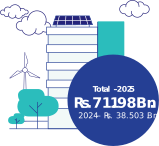
Rs. 71.198 Bn.
Green finance portfolio
(2024: Rs. 38.503 Bn.)85%
Green finance portfolio growth
100%
Green bond allocation as at December 31, 2025
(financing 50%/refinancing 50%)Green finance target:
To enhance green finance
portfolio up to Rs. 100 Bn. by 2030

Commercial Bank of Ceylon's Rs. 15 Bn. Green Bond was oversubscribed on its opening day, reflecting strong investor confidence in the Bank's sustainability-driven lending initiatives.
Composition of the Green Finance portfolio Figure – 20
Renewable Energy Projects
(Solar, Hydro, Wind, Biomass)
(Solar, Hydro, Wind, Biomass)
Rs. 40.154 Bn. (57%)
2024 – Rs. 21.774 Bn. (57%)

Environmentally friendly transportation and related services
Rs. 10.865 Bn. (15%)
2024 – Rs. 1.558 Bn. (4%)
Climate smart agriculture
Rs. 5.119 Bn. (7%)
2024 – Rs. 9.063 Bn. (24%)
Green Building Development, Construction, Operations, and maintenance
projects
Rs. 10.943 Bn. (15%)
2024 – Rs. 1.305 Bn. (3%)
Water saving consultancy and related service providers
Rs. 0.428 Bn. (1%)
2024 – Rs. 0.557 Bn. (1%)

Other Green loans and advances
Rs. 3.689 Bn. (5%)
2024 – Rs. 4.247 Bn. (11%)
Scaling Green Finance capability
In parallel with portfolio growth, the Bank has been strengthening its capability to scale sustainable finance in a structured and credible manner. During the year, the IFC supported the Bank in laying foundations for portfolio decarbonisation, strengthening internal readiness to expand sustainable finance into emerging areas such as blue finance and financing solutions for green SMEs.
This support has contributed to the development of internal frameworks, capability building, and pipeline readiness, enabling the Bank to broaden the scope of sustainable financing over time while maintaining alignment with credit risk, capital, and liquidity considerations.
Embedding ESG and climate into credit decisions
Responsible financing requires ESG and climate-related risks to be incorporated into credit decision-making in a consistent, risk-based manner. The Bank integrates environmental and social considerations into lending to strengthen credit outcomes and reduce tail risks that may not be captured through traditional financial analysis. This is implemented through a Group Environmental and Social Risk Management Policy and a comprehensive Environmental and Social Management System (ESMS), with ESG requirements embedded in credit processes from origination through monitoring.
Risk screening and due diligence
The Bank utilises formal frameworks to categorise environmental and social risks into three levels: Category A (High), Category B (Medium), and Category C (Low), using sector-specific guidance to directly influence underwriting and approval decisions.
Enhanced Due Diligence, stricter documentation, specific loan conditions, and ongoing monitoring are triggered based on two specific criteria:
- Risk-Based Trigger – For proposals involving sectors with inherently high E&S risk (Category A), enhanced due diligence is applied regardless of the facility amount and tenure.
- Threshold-Based Trigger – E&S due diligence is mandatory for all credit proposals that exceed predefined financial thresholds and tenure, ensuring coverage of the large corporate portfolio.
To ensure objectivity and consistency, all assessments with a High Risk (Category A) categorisation and due diligence requirement undergo independent review by the Integrated Risk Management Department.
This approach reduces the likelihood of credit impairments linked to regulatory non-compliance, project delays, community opposition, or environmental liabilities. It also reduces the risk of reputational shocks that can increase funding costs or constrain growth.
As illustrated in the Figure 21, ESG integration during 2025 moved beyond policy articulation to deeper operational embedding within core credit processes. The enhancements reflect a structured approach to risk identification, client engagement and governance oversight, strengthening the Bank’s ability to proactively manage E&S within its large corporate portfolio while safeguarding long-term asset quality and portfolio resilience.
ESG integration key developments in 2025 Figure – 21
Enhanced ESG risk scoring

Applied high, medium, low ESG risk categories to large corporate credit assessments

Sustainability-related covenants

Tracked compliance with non-financial conditions like environmental approvals & labour
standards

Stricter sector monitoring

Monitored high-risk sectors & clients with environmental or social impacts
Governance oversight

Enhanced senior representation on climate & risk committees
ESG integration metrics Figure – 22
Number of facility papers screened for E&S risk during the year 2025
13,335
2024 – 10,727

E&S risk category wise distribution of lending proposals screened in 2025
High 23 Proposals
(0.17%)
Medium 2,496 Proposals
(18.72%)
Low 10,816 Proposals
(81.11%)
Climate transition plan
As part of its responsible financing agenda, the Bank is in the process of developing a comprehensive Climate Transition Plan in partnership with IFC, aligned with national decarbonisation pathways. As the first Sri Lankan bank to join the PCAF, the Bank has commenced measuring its financed emissions and established a framework to manage and reduce emissions associated with lending and investment portfolios. For details on the Climate Transition Plan, including core focus areas, please refer to Section 1.2 – Strategy in the SLFRS Sustainability-related Financial Disclosures.
Lending to priority sectors
As illustrated in Figure 23, the Bank continued to prioritise lending to high-impact sectors that support inclusive economic growth, enterprise development, and national economic resilience, while maintaining prudent credit standards and risk discipline. SMEs, women-led enterprises, and underserved segments remained central to the Bank’s priority sector financing strategy, reflecting their importance in job creation, innovation, and broad-based economic participation.
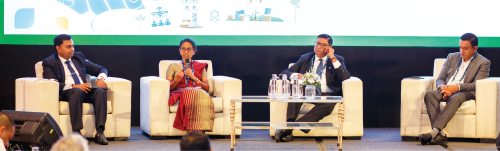
Panel discussion at the
ComBank Summit 2025 – ‘ForwardTogether’, bringing together cross-sector leaders to advance Sri Lanka’s sustainability priorities and the UN SDGs.
Lending to priority sectors Figure – 23
Supporting Small and Medium Enterprises (SMEs)

Largest SME lender for
5th consecutive year
5th consecutive year
30.3% of the total SME loans disbursed by
banks in Sri Lanka in 2024
23.6% growth in SME loans in 2025
Expanded lending across manufacturing, trade, agriculture, tourism & more
Supporting Exporters

Financed working capital, capacity expansion & tech upgrades for exporters
Expanded export sector competitiveness and foreign exchange generation
Empowering Women
Entrepreneurs
Entrepreneurs

Specialised financing solutions and advisory support for women led enterprises
Promoted gender-inclusive economic participation by reducing barriers to
finance
Expanding Microfinance and
Rural Outreach
Rural Outreach

Extended microfinance services to underserved and low-income communities
Fostered grassroots entrepreneurship and livelihood enhancement in rural areas
Operational enablers: Digitalisation and capability building
Digitalisation supports responsible financing by strengthening the control environment, improving traceability, and enabling more efficient origination and monitoring as lending volumes scale. In 2025, key developments included:
- Digitally enabled credit workflows: Progress towards a seamless, digital credit environment through the use of digital instructions and a Document Management System (DMS) for scanning and archiving credit files, improving efficiency, auditability, and control traceability while reducing processing friction.
- System-enabled monitoring: Stronger delinquency oversight and early intervention through system-generated alerts and automated exposure reporting.
- Digital corporate platforms and data capture: Wider adoption of corporate digital platforms supporting lower-paper trade flows and improved data capture, including ComBank Trade Link and Host-to-Host (H2H) connectivity.
Responsible financing also depends on the capability of relationship teams, credit officers, and risk functions to identify and manage ESG and climate-related risks consistently. During 2025, the Bank strengthened readiness through:
- STAFF Training: 25 training programmes engaging 825 staff, covering green finance taxonomy application, case-based learning, integration of ESG and climate considerations into credit assessment.
- Client-facing awareness initiatives: Sustainability and green finance education embedded into engagement with customer segments including SMEs and women entrepreneurs.
- Specialist capability development: Training in blue finance delivered with support from the IFC.
Metrics and targets
To enable assessment of progress and discipline in responsible financing, the Bank monitors and reports the following key performance indicators, aligned to portfolio growth, underwriting controls, resilience and execution capacity:
Sustainable finance scaling and allocation discipline
- Sustainable/green bond proceeds allocation: percentage allocated and eligible categories financed, including split between financing and refinancing. (See Table 6).
- Green finance portfolio: portfolio size and growth, with sector segmentation where relevant (especially renewable energy). (See Figure 20).
ESG/E&S and climate risk integration in underwriting
- Total number of facility papers screened for E&S risk during the year 2025. (See Figure 22).
- Risk distribution: E&S risk category wise distribution of lending proposals screened in 2025 (low/medium/high) (See Figure 22).

Outlook for 2026
In 2026, the Bank’s responsible financing agenda will focus on scaling priority lending while maintaining strong credit standards, measurement capability, and balance sheet resilience. Key priorities include:
- Scaling green and blue lending while maintaining credit standards: Focus will remain on expanding green finance alongside the promotion of Blue Finance across Personal and Corporate Banking. Blue Finance offerings will support sustainable fisheries, eco-tourism, and water and waste management solutions, broadening the Bank’s sustainable asset base. Growth across both green and blue portfolios will be supported by consistent ESG screening, covenant monitoring where relevant, and close attention to concentration signals and asset quality trends.
- Strengthening climate risk measurement and disclosure readiness: The Bank will continue to expand climate analytics, including financed emissions measurement coverage and portfolio-level assessment of physical and transition risks, to support progressively more decision-relevant climate disclosures.
- Keeping funding and capital planning aligned with asset tenor and risk: As longer-tenor green and infrastructure assets grow, balance sheet alignment will remain a priority, including disciplined allocation and reporting under the sustainable bond framework, maintenance of liquidity buffers, and stress resilience to support continuity of lending through adverse conditions.
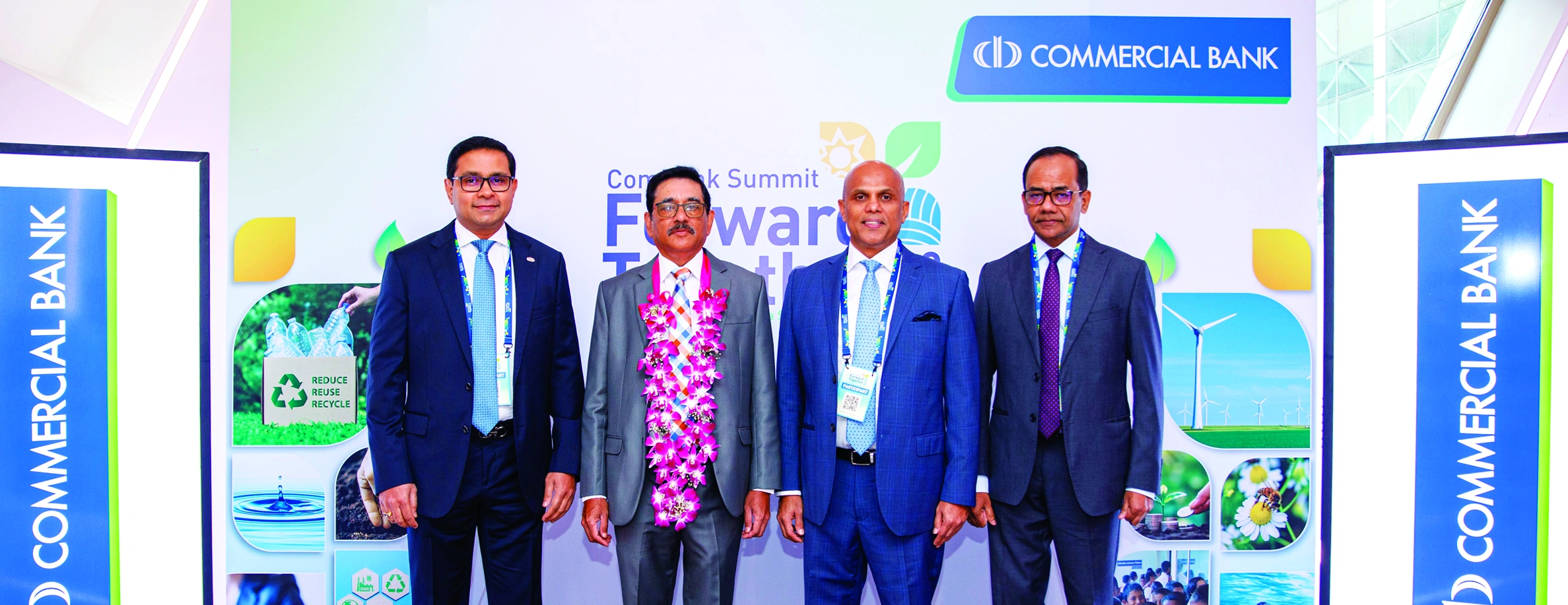
Commercial Bank of Ceylon hosted
Sri Lanka’s first-ever bank-led national sustainability summit – ‘ForwardTogether 2025’, bringing together policymakers, global organisations, business leaders, and youth to advance the country’s climate-resilient and inclusive future.
Financial inclusion
Why financial inclusion matters
Financial inclusion determines who can participate in the formal economy and how effectively households and enterprises access financial services. When individuals and small businesses lack access to secure savings, affordable credit, payments, and risk protection, their ability to manage cash flow, invest, and grow is constrained. This often leads to reliance on informal or high-cost channels, reinforcing vulnerability and limiting economic mobility. At a system level, exclusion weakens economic efficiency by keeping activity outside formal financial channels, reducing transparency, limiting policy transmission, and slowing enterprise development.
For a systemically important bank such as ours, financial inclusion is integral to core banking. By ensuring access that is safe, affordable and usable, we strengthen household resilience, support productive enterprise, expand our customer base, and enhance financial system stability over time.
Our approach to financial inclusion
At Commercial Bank, our approach is grounded in the view that financial inclusion is a reflection of conduct. Inclusion improves when access, usability and adoption are embedded into products, channels, credit processes and service design rather than treated as add-ons.
In practice, this approach is delivered through three reinforcing priorities as illustrated in the Figure 24 below:
Our approach to financial inclusion Figure – 24

1
Expanding practical access
Action & delivery
Minimising physical, digital, and service-related barriers to formal banking.
Key enablers
Balanced channel strategy: Combining branch reach, alternative service points, and digital delivery and create market opportunities through beyond banking services.
2
Prioritising underserved segments
Action & delivery
Using targeted approaches to extend participation among households and enterprises with structural barriers.
Key enablers
Core business integration: Focusing on areas where inclusion strengthens real-economic activity and financial depth.
3
Supporting sustained use
Action & delivery
Enabling customers to use financial services confidently and responsibly once access is established.
Key enablers
Capability building: Strengthening financial/digital literacy and building long-term trust.
Key developments during 2025
During the year 2025, the Bank strengthened its financial inclusion agenda through a structured approach that integrated expanded access, priority segment focus and digital enablement within core banking operations as shown in the diagram below.
Closing the Financial inclusion gap Figure – 25
Agriculture & Micro Finance Units (AMFU)
64 Units
2025 Achievement
2024: 32 Units

Frictionless credit services
Digital part-payments for pawning reduced the need for repeated physical visits.
Rural & last-mile accessibility
Broadened Agricultural Reach
Branch Coverage
Pawning Access
7 New BranchesSME empowerment & credit convenience
SME Growth Platforms
Leveraged the
 platform and SME trade fairs for
engagement.
platform and SME trade fairs for
engagement.
Multi-channel delivery model
Integrates physical branches, digital onboarding, and ComBank Shakthi Agency Banking Services.
Adoption and literacy enablers
Deployed financial and digital literacy initiatives to support sustained participation.
Expanding access
As illustrated in the Figure 26 below, the Bank’s multi-channel architecture integrates branch networks, ATMs, alternative service points and digital platforms to ensure inclusive and reliable access to financial services. By combining physical infrastructure with digital capability, the Bank addresses geographic distance, mobility constraints and documentation barriers that may otherwise limit participation.
The architecture of financial inclusion: Multi-channel access Figure – 26
A multi–layered architecture combining traditional, digital, and agency models to overcome barriers of distance and documentation, ensuring access to essential financial services for underserved households and enterprises.
Bridging the distance Gap
Last-mile agency banking
Controlled alternative service points enable core transactions like cash deposits and bill payments.
Field-based rural engagement
Specialised delivery models provide closer monitoring and support for agriculture and microfinance customers.
Extended service availability
Saturday banking and MiniComs reduce the need for repeated physical visits.

Removing barriers to entry
Seamless Digital Onboarding
Fully digital journeys remove location and documentation barriers while maintaining regulatory controls.
Targeted eligibility adjustments
Reinstated moderate-income loan categories and refined criteria for retired armed forces personnel.
Data-driven channel calibration
Internal tracking of digital usage helps refine the future mix of service channels.


Network of delivery points in Sri Lanka and Bangladesh
Network of delivery points in Sri Lanka Figure – 27


Number of
Branches
Branches
272

Automated Teller Machines
(Off-site* = 211)
486

Cash Recycler Machines
(Off-site* = 38)
468

Cash Deposit
Machines
Machines
20

Automated Cheque
Deposit Machines
Deposit Machines
20
Network of delivery points in Bangladesh Figure – 28

Number of
Branches/Sub Branches/SMEs/OBUs
Branches/Sub Branches/SMEs/OBUs
20
Automated Teller Machines
(Off-site = 7)
24
Last-mile access is strengthened through Agency Banking and other alternative service points, enabling core transactions such as deposits, withdrawals, bill payments and transfers beyond traditional branches. Field-based engagement models further support agriculture and microfinance customers, enhancing origination, monitoring and ongoing servicing in rural and livelihood-linked segments.
Extended service availability, including Saturday banking and MiniComs, improves convenience, while digital channels enable part-payments and routine transactions remotely. Fully digital onboarding reduces time and location constraints while maintaining regulatory safeguards. Internal tracking of digital usage supports data-driven calibration of the Bank’s channel mix.
Targeted eligibility refinements, including the reinstatement of moderate-income personal loan categories and adjusted pension-based lending criteria for retired armed forces personnel, further remove structural barriers to credit access.
Through this integrated approach, the Bank continues to refine its channel mix, balancing physical reach, alternative delivery models and seamless digital journeys to close remaining access gaps and advance financial inclusion.
Priority inclusion segments
Defining priority inclusion segments is a strategic choice as targeted inclusion broadens the customer base, deepens financial intermediation, and reduces informality. We focus on segments such as SMEs, agriculture and rural livelihoods, microenterprises, and women where structural barriers are material and where inclusion through core banking activity supports sustainable participation.
Small and Medium-Sized Enterprises (SMEs)
SMEs remain central to the Bank’s inclusive growth strategy, reflecting their vital role in employment generation, entrepreneurship and broad-based economic participation. In 2025, the Bank further strengthened its SME franchise through targeted innovation, structured access mechanisms and digital integration, scaling support while maintaining disciplined risk management and long-term sustainability, as outlined.
- AI-Powered credit
underwriting – Transforming SME lending
The Bank introduced Sri Lanka’s first AI-powered SME credit underwriting solution. The model strengthens credit assessment through data-driven analytics, enabling faster approvals, improved operational efficiency and enhanced portfolio risk management. By improving underwriting precision while accelerating turnaround times, the solution supports scalable SME growth within prudent risk parameters. - Distributor financing
under Supply Chain Finance (SCF)
The Bank launched its first Distributor Financing solution, developed in consultation with the IFC, to address funding gaps within corporate supply and distribution networks. The structure enables SMEs to access competitively priced financing by leveraging the credit strength of anchor corporates. A secure, digitally enabled platform supports end-to-end transaction automation, real-time invoice processing and faster settlements. This reduces cash-conversion cycles, enhances transparency and auditability, and creates a more resilient and efficient supply chain ecosystem. - Sustained market
leadership in SME Lending
In 2024, the Bank was the largest participating SME lender, accounting for 30.3% of total SME loans extended by 16 state and private sector banks (Source: Ministry of Finance data). As the country’s largest SME lender for five consecutive years, the segment remained a core inclusion priority in 2025, representing approximately 19.0% of total loans and advances. - Expanding access through
credit guarantees
Through active participation in the National Credit Guarantee Institution Limited (NCGIL) scheme, the Bank enabled eligible MSMEs to obtain financing without traditional collateral requirements, while maintaining disciplined risk standards. - Improving affordability
and tenor
To address affordability and repayment-tenor constraints, the Bank granted 360 refinance-backed facilities totalling Rs. 3.97 Bn. in 2025 under programmes including SMILE-III, E FRIENDS-II, SMELoC/SMELoC2, MANUSAVI, MSME Re-Energize and MSME NPL WC. These structured schemes widened access while preserving portfolio quality. - Digital enablement and
ecosystem integration
Digital platforms such as Commercial Bank LEAP GlobalLinker further enhanced SME connectivity, expanded market access and strengthened ecosystem participation – complementing the Bank’s financing and supply chain initiatives.
Building on the Bank’s broader SME financial inclusion initiatives outlined above, the Figure 29 below illustrates how digital enablement through Commercial Bank LEAP GlobalLinker complements access, affordability, and value chain integration efforts.
LEAP GlobalLinker Figure – 29
Generated transaction volume of
Rs. 29.7 Mn.
during 2025
749
new members to the platform totalling to 14,000 members
400+
E-stores Including International Level 50 Stores
Integrated as logistic partners to the platform


Enabled QR payments to facilitate transactions
Extended collaboration with Ministry of Industries, Small Enterprises Development Authority,
National Enterprises Development Authority and EDB
The table below summarises the Bank’s structured approach to SME inclusion during 2025, highlighting key initiatives across credit innovation, supply chain integration, market leadership, access expansion, affordability support and digital enablement.
SME inclusion, innovation, and market integration – 2025
Table – 07
| Strategic Area | Initiative | Key Highlights/Impact |
| Credit Innovation | AI-Powered SME Credit Underwriting (First in Sri Lanka – 2025) |
Data-driven credit assessment; faster turnaround times; improved operational efficiency; strengthened portfolio risk management; scalable SME inclusion within prudent risk parameters |
| Supply Chain Finance | Distributor Financing (Developed with IFC Consultation) |
Affordable financing for distributors within corporate networks; leverages anchor corporate credit strength; secure digital platform; real-time invoice processing; reduced cash-conversion cycles; enhanced transparency and auditability |
| Market Leadership | Largest SME Lender – Five Consecutive Years |
30.3% of total SME loans extended by 16 state & private sector banks (Source: Ministry of Finance data); SMEs represented 19.0% of total loans and advances portfolio of the Bank in 2025 |
| Access to Finance | NCGIL Credit Guarantee Scheme | Enabled collateral-free financing for eligible MSMEs while maintaining prudent risk standards |
| Affordability & Tenor | Refinance & Interest Subsidy Programmes | 360 refinance-backed facilities granted in 2025 under SMILE-III, E FRIENDS-II, SMELoC/SMELoC2, MANUSAVI, MSME Re-Energize and MSME NPL WC |
| Digital Enablement | Commercial Bank LEAP GlobalLinker | Strengthened SME connectivity, expanded market access and enhanced ecosystem integration |
SME trade fair (March 2025)
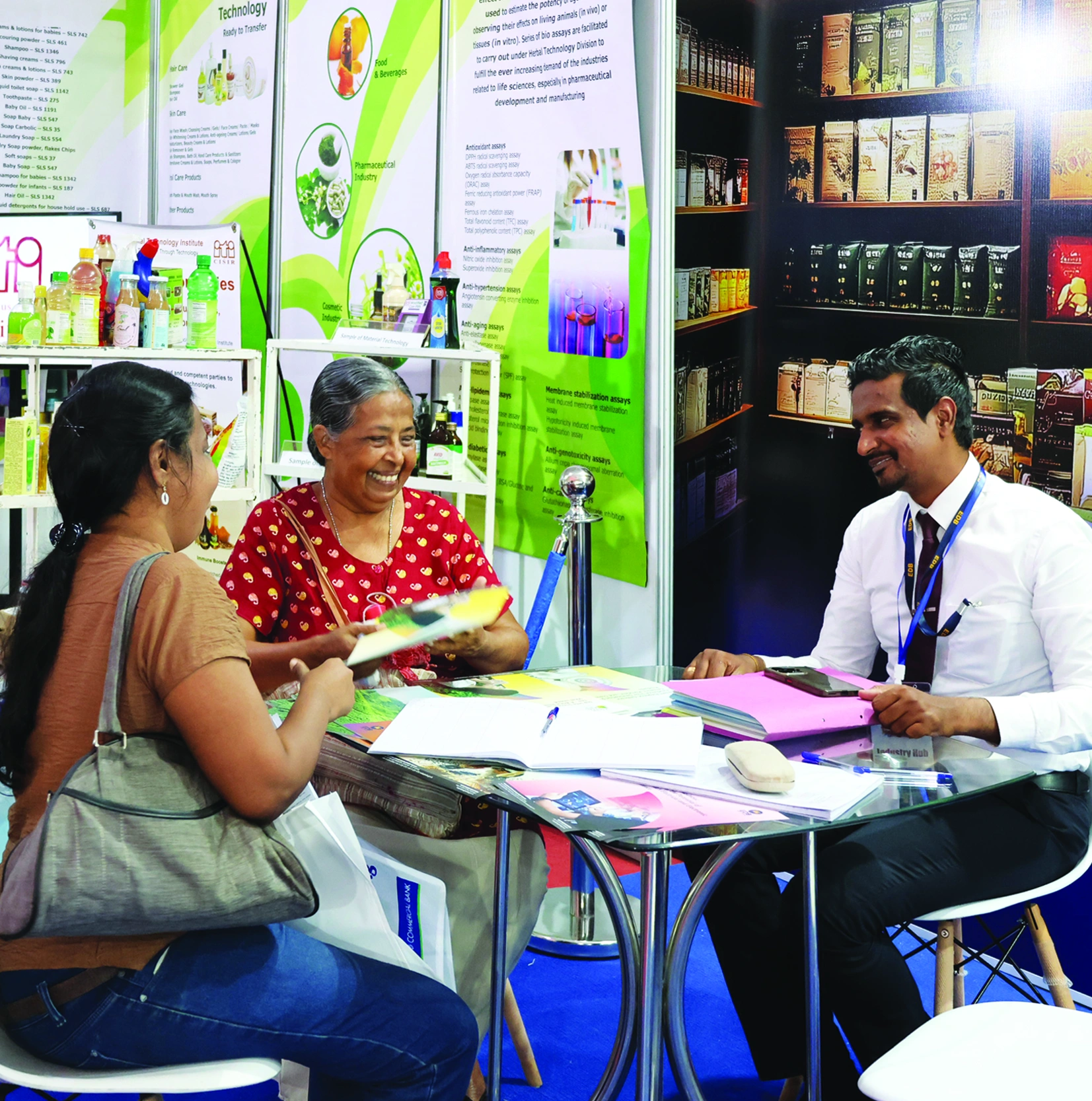
Commercial Bank of Ceylon brought together nearly 200 SMEs from across Sri Lanka,
at its third SME Trade Fair at BMICH, creating a platform for entrepreneurs to showcase products,
connect with industry partners, and access expert guidance.
The Bank successfully hosted its Annual SME Trade Fair for the third consecutive year, providing a dynamic platform for SMEs to showcase and sell their products directly to customers. The three-day event featured over 200 stalls across 13 diverse sectors and attracted more than 14,000 visitors, generating over 8 million in transactions.
Beyond sales opportunities, the Trade Fair enabled SMEs to build business connections, strengthen brand visibility, and access financial, technical and advisory support from Government regulatory authorities and development agencies. Special awareness sessions were conducted to help entrepreneurs scale and strengthen their businesses, while a dedicated Banking Services Area offered card-based payment facilities, digital banking solutions and retail banking products to support seamless transactions and financial access.
Agriculture, microenterprises, and rural livelihoods
Agriculture, microfinance, and rural customers were explicitly prioritised within the Development Credit Department’s mandate, recognising persistent geographic, income volatility, and scale-related barriers to access. Inclusion for these segments was supported through a combination of AMFU field presence and Agency Banking, improving reach to customers distant from branch infrastructure and supporting continuity of service delivery.
The inclusive financing efforts were further strengthened by the microfinance product offerings under the Dirishakthi brand offering financial as well as nonfinancial services to the communities.
The Bank maintained dedicated microfinance and development-oriented lending portfolios, including Micro and Divisaru facilities, providing scale-based evidence of sustained engagement with low-income and rural customers. These portfolios support participation in the formal financial system through core credit intermediation rather than ad-hoc or charitable mechanisms.
Beyond access, inclusion is reflected in the Bank’s ability to sustain and scale development-oriented portfolios over time. In 2025, development lending (Industrial and Agriculture) expanded to Rs. 166.78 Bn., while inclusion-linked portfolios such as Micro Loans (Rs. 5.54 Bn.; see Table 08 for details) and Divisaru Micro Savings (Rs. 2.80 Bn.) continued to grow, providing balance-sheet evidence that underserved segment engagement is integrated into core intermediation rather than episodic initiatives.
Number and amount of loans outstanding that qualify for programmes designed to promote small business and community development
(Commercial Banks Sustainability Accounting Standard – FN-CB-240a.1 & FN-CB-240a.2)
Inclusion-linked micro-loans
Table – 08
| Total | Non-accrual | |||
| As at December 31, | Number of loans |
Balance outstanding (Rs. Mn.) |
Number of loans |
Balance outstanding (Rs. Mn.) |
| New Comprehensive Rural Credit Scheme |
7,686 | 2,989 | 732 | 26 |
| Dirishakthi New Loans | 7,480 | 2,030 | 421 | 44 |
| Dirishakthi Micro Housing Loan | 298 | 114 | 1 | 0 |
| Dirishakthi New (Special) | 452 | 113 | 395 | 19 |
| ADB Tea Loans (Below Rs. 1.0 Mn.) | 244 | 85 | 5 | 2 |
| Anagi Loans (Below Rs. 1.0 Mn.) | 176 | 55 | 8 | 3 |
| Dirishakthi NCGIL | 71 | 47 | 1 | 1 |
| Microfinance – Kapruka Ayojana | 121 | 42 | 10 | 0 |
| Other schemes | 1,435 | 62 | 1,165 | 13 |
| 17,963 | 5,536 | 2,738 | 108 | |
Women empowerment
The Bank reinforced its commitment to women’s economic empowerment by promoting financial inclusion, expanding development programmes, and enhancing gender-responsive service delivery. The Women Banking agenda focused on empowering women customers and entrepreneurs, broadening access to financial and digital services, and fostering a supportive, inclusive workplace for female employees across the Bank.
Through comprehensive outreach and capacity-building initiatives, the Bank enabled women to strengthen their financial knowledge, develop business skills, build confidence, and engage more effectively in economic activities within their communities.
Financial literacy & business skills development
A series of financial literacy and financial management programmes were delivered for women entrepreneurs, supporting the adoption of improved financial practices and more informed business decision-making. In parallel, targeted skill development initiatives focusing on entrepreneurship, leadership, innovation and building sustainable business models were conducted to strengthen enterprise capability. Collectively, these programmes reached over 700 women entrepreneurs during the year, enhancing both financial confidence and long-term business resilience.
Women’s Day 2025 – Island-wide Celebration and Impact
To commemorate International Women’s Day 2025, the Bank conducted 14 simultaneous regional events across all districts, comprising six trade fairs and eight capacity-building programmes that benefited over 1,200 women entrepreneurs. These initiatives enhanced market access, product visibility and business knowledge at scale.
Under the ‘Anagi’ platform, more than 500 women participated in workshops and seminars, while 200 stalls showcased women-led products and services at trade fairs held at multiple locations. Training programmes covering financial literacy, business management and digital skills were conducted across several regions, reinforcing the Bank’s commitment to inclusive growth, with women representing approximately 50% of its SME customer base.
School outreach and youth empowerment
The Bank conducted leadership and entrepreneurship programmes in girls’ schools, encouraging young women to explore future opportunities, develop leadership qualities, and cultivate an entrepreneurial mindset from an early age. During the year, these initiatives reached over 850 school girls, fostering early confidence, aspiration and future economic participation.
Health & wellbeing initiatives
In recognition of the importance of women’s health, the Bank conducted breast cancer awareness sessions for women entrepreneurs, employees and community members. These programmes promoted early detection and facilitated access to expert medical guidance. During the year, the initiative recorded over 2,500 female participants, strengthening awareness and preventive health engagement across stakeholder groups.
Women in the remittance economy
Recognising women as key managers of remittance inflows, the Bank launched a Women’s Entrepreneurship Workshop to strengthen financial capability and enterprise readiness. Participants received financial literacy training, business modelling guidance and digital banking knowledge, with access to credit through the ‘Anagi’ Entrepreneurship Loan Scheme. Piloted at the Narammala Branch Training Centre, the programme engaged over 100 women, supporting their transition from remittance recipients to income-generating entrepreneurs and strengthening household resilience.
Dedicated Women’s Banking Centre
A key milestone was the launch of the Bank’s first dedicated Women’s Banking Centre in the Northern Region. The Centre provides tailored financial solutions and advisory support within a focused and enabling environment, designed specifically to cater to the unique needs of female customers. Managed by a dedicated team of female staff, the Centre named ‘Anagi Women’s Banking Centre’ was opened in Jaffna. It features special amenities including a lactation room, children’s play area, dedicated pawning unit, counselling unit and cafeteria, while offering the full range of financial products and services available at any Commercial Bank branch.
Through this initiative, the Bank reinforces its commitment to diversity, equity and inclusion, promoting gender equality and empowering women. The ‘Anagi Women’s Banking Centre’ aims to go beyond traditional banking by creating a safe, supportive and welcoming space that addresses the specific needs, preferences and challenges faced by women, enabling them to take greater control of their financial wellbeing.
Empowering the Global Workforce: Bridging the Gap to Financial Inclusion
In 2025, the Bank strengthened its partnership with the Sri Lanka Bureau of Foreign Employment (SLBFE) by integrating financial literacy modules into mandatory pre-departure training for migrant workers. The programme equipped participants with the knowledge and tools to manage overseas earnings responsibly and plan for long-term financial security.
By facilitating onsite account opening prior to departure, the Bank promoted an early habit of savings and provided access to formal remittance and foreign currency banking services. During the year, 95 training sessions were conducted, reaching 4,720 participants and supporting their transition from short-term income generation to long-term wealth creation.
Youth and early-stage customers
Younger and first-time customers were prioritised through digitally native account offerings, including Flash and Flash Teen accounts, lowering entry barriers to formal banking at early stages of financial participation. Access to unsecured credit for younger customers was also broadened through personal loan products designed to meet rental and housing-related needs, addressing common early-stage financial constraints within a structured credit framework. These offerings were complemented by targeted savings accounts, school and university outreach, career guidance, scholarships, and dynamic brand initiatives including collaborations with young sports icons and sponsorships of technology and sports events. The Bank also promotes entrepreneurship among school children connecting with their entrepreneur clubs and creating market access through the SME Trade Fair and Commercial Bank LEAP GlobalLinker.

ComBank opens its first dedicated Women’s Banking Centre at the Jaffna branch.
Together, these efforts established a comprehensive ecosystem supporting financial inclusion, as shown in the Figure 30 below:
Empowering the next generations: The youth banking ecosystem
Figure – 30
Digital innovation & financial support
The “Flash” digital ecosystem
A dedicated app featuring “Flash Fam” to support the financial journey of teenagers.

9,000 +
New “Vibes” accounts
Successful digital-first campaigns for youth savings products driving massive monthly engagement.
Targeted lending for students
Specialised personal loans for education financing and apartment rental support.

Brand engagement & career growth
Strategic brand ambassadors
Partnering with young sports icons to build brand resonance.
Sponsoring future innovators
Main sponsor for “Coolest Projects Sri Lanka 2025,” highlighting youth AI and robotics.
Education to employment pipeline
School outreach program leading into career guidance and the Graduate Trainee Program.
The Bank’s financial inclusion agenda is supported by a robust framework that integrates capability building, digital platforms, strategic partnerships, and strong internal systems, as illustrated in Figure 31 below. Together, these enablers expand access responsibly, strengthen customer confidence, and ensure sustainable and well-governed inclusive growth.
Enablers of financial inclusion
Figure – 31

Capability building
- Financial and digital literacy programs for SMEs, microfinance customers and women
- Strengthens understanding of banking services, promotes responsible usage, and helps reduce financial distress
- Focuses on empowering customers to engage confidently with formal financial channels

Internal readiness &
digital tools
- Centralised appraisal support, specialist help desks, and targeted staff training in agriculture, microfinance, and SME evaluation
- AI-supported SME credit underwriting and performance dashboards track field-level activity and outcomes
- Enhances operational scale, turnaround time, service quality, and risk oversight
- Commercial Bank LEAP GlobalLinker platform: Enables SMEs to create digital profiles, connect with buyers, and access B2B networks
- Structured onboarding and training support adoption across regions, including beyond major urban centers
- SME Trade Fair (March 2025): Connects enterprises with customers, banking services, and advisory support
- Ecosystem-based inclusion reduces execution risk, supports informed investment decisions, and promotes reliable project execution

Platforms & ecosystems
- Collaboration with the IFC and participation in credit guarantee schemes
- Extends reach to underserved segments while maintaining sound credit discipline
- Leverages external expertise and risk-sharing mechanisms to strengthen inclusion

Partnerships
Managing financial inclusion delivery risks
Scaling inclusion-linked channels and partner ecosystems introduces execution risks that must be managed to protect customer trust and the Bank’s risk profile. Key areas include service quality and customer protection in agency banking and ecosystem arrangements (including fraud/cash controls and after-sales delivery risk), consistency of underwriting and monitoring as outreach expands, and the operational complexity of refinance scheme documentation and claims. The Bank addresses these through strengthened training and appraisal standards, tighter monitoring frequency and structured performance governance, and reinforced partner/agent governance and branch enablement to improve utilisation, compliance and service outcomes.
Metrics and targets
To enable a clearer assessment of progress, discipline and scalability, the Bank monitors following indicators over time.
Access and reach: Expand the Bank’s physical and digital presence to enhance financial inclusion and accessibility for underserved segments
Bank’s physical and digital presence
Table – 09
| Initiative | 2025 achievements | 2026 target |
| AMFU Units & branch coverage |
Added new 32 AMFU units, totalling to 64 AMFU units, covering 93 branches | Expand to 100 AMFU units |
| Shakthi Agency Banking | 4 agents onboarded across targeted districts | Expand to 100 agents |
| Pawning services expansion | 7 new branch locations | Further expand access points and service hours |
| Digital onboarding | ComBank Digital surpassed 1.75 million users | Retail and Business products with Online onboarding |
Priority segments (scale and quality): Focus the Bank’s lending portfolio on SMEs, microenterprises, and women-led initiatives to drive inclusive growth
Bank’s Lending portfolio on SMEs
Table – 10
| Segment | 2025 performance | 2026 target |
| SME loans and advances | 19% of total Loans and advances; portfolio growth: 23.6% | Maintain sustainable growth and quality, scaling digital and AI driven SME customer journey and experience |
| National Credit Guarantee Insurance Limited (NCGIL) backed lending to MSMEs | 353 facilities; Loan value: Rs. 1.465 Bn.; Women-led: 46 loans, Rs. 167 Mn. | Reach 1,000 beneficiaries nationally; continue leadership in MSME financing |
| Micro/Divisaru Portfolio | Portfolio: Rs. 5.54 Bn., Divisaru Savings: Rs. 2.80 Bn. | Sustain portfolio quality and expand scale |
Adoption and capability: Implement financial and digital literacy initiatives alongside platform-based adoption programs to drive meaningful usage
Financial and digital literacy initiatives
Table – 11
| Initiative | 2025 achievements | 2026 target |
| Financial/Digital literacy | Conducted financial literacy programs for over 630 MSMEs Empowered over 485 Women through Training & Outreach |
Continue building financial and digital literacy among customers and staff to ensure effective utilisation of services |
| Commercial Bank LEAP GlobalLinker Platform | 749 new members onboarded; 400+ quality e-stores developed; 50 international-level e-stores; integrated payment aggregator (PayMedia) and QR payment solutions | Increase platform adoption as the ecosystem for authentic Sri Lankan SMEs, regional spread, and transactional activity |
Outlook for 2026
In 2026, the Bank’s financial inclusion agenda will continue to embed access, prioritisation, and adoption within its core business model. Key priorities include:
- Closing remaining access gaps through calibrated expansion and optimisation of physical, agency, and digital delivery channels
- Deepening engagement with priority segments, particularly SMEs and rural livelihoods, while maintaining prudent credit standards
- Strengthening adoption and sustained usage through targeted capability-building, platform development, and internal delivery readiness
Our objective remains to translate access into meaningful and sustained participation in the formal financial system, reinforcing both commercial performance and the Bank’s role in supporting economic resilience.
Sustainable products and services
Why sustainable products and services matters
Sustainable products and services translate the Bank’s sustainability priorities into actionable financing and funding decisions, shaping real-economy impact while strengthening the Bank’s portfolio and balance sheet. By embedding clear eligibility, structuring, and governance criteria, these offerings drive measurable, bankable outcomes in environmental transition, resilience, and inclusive growth. Sustainable products and services matter because they define how sustainability is translated into financing decisions, shaping both real-economy outcomes and the Bank’s balance sheet.
For the Bank, sustainable products and services are therefore the practical mechanism that connects sustainability priorities to measurable outcomes, supporting transition and resilience priorities while strengthening portfolio resilience. This sub-pillar complements Responsible Financing and Financial Inclusion: while Responsible Financing focuses on risk discipline and portfolio stewardship, and Financial Inclusion expands access and usage, Sustainable Products and Services focuses on product design, eligibility discipline and credible classification.
Our approach to sustainable products and services
The Bank’s approach is grounded in designing sustainability-aligned finance as an extension of mainstream banking, subject to the same underwriting, pricing, portfolio oversight and governance disciplines as conventional products. Our approach is anchored in a simple logic: clear product architecture and eligibility discipline enable credible sustainable finance, and credible sustainable finance strengthens portfolio resilience.
This approach is delivered through three mutually reinforcing priorities:
Define and safeguard "What qualifies"
- Disciplined eligibility & classification
- Protects balance sheet integrity
- Mitigates greenwashing risk

↓
Design financeable products & propositions
- Transition and resilience solutions
- Support key sectors & productivity

↓
Mobilise sustainable funding & instruments
- Use-of-proceeds frameworks
- Investor confidence & capital access
- Tracking & transparency

The Bank’s approach is aligned to relevant global and local frameworks, including the UN SDGs, the Central Bank of Sri Lanka’s Sustainable Finance Roadmap and related guidance, and the Sri Lanka Banks’ Association Sustainable Banking Principles.
The Bank’s sustainable products, services, and solutions
From pioneering green financing models to digitalising customer journeys and expanding access to finance for SMEs, women entrepreneurs and underserved communities, the Bank translates its sustainability priorities into practical financing and funding solutions.
The Figure 32 shows how climate-aligned lending, digital platforms, inclusive banking, trade support and risk management work together to generate real-economy impact. Collectively, these offerings strengthen portfolio quality and balance sheet resilience while delivering measurable outcomes in environmental transition, economic resilience and inclusive growth.

Visa and Commercial Bank
revolutionised digital payments in Sri Lanka by enabling Google Pay for their cardholders.
Driving sustainable growth
Figure – 32
Environmental transition
Resilience
Inclusive growth
Digital innovation


Green finance products
& climate solutions
& climate solutions
Green Loans & Leases
Renewable energy/Green transport/Energy efficiency
Green Home Loans
Green buildings/Certified homes
Diribala Green Development Loan
Rooftop solar for SMEs & corporates
Shariah-compliant Green Energy Financing
Utility-scale solar projects (11 MW)

Digital banking &
sustainable platforms
sustainable platforms
Internet & mobile banking
Convenient/Secure access
Digital account opening & Digital KYC
Paperless onboarding
e-Statements & notifications
Go Green/Real-time updates
Online loan processing & approval

Inclusive banking &
access solutions
access solutions
SME Supply Chain Financing
Working capital & trade support
Anagi Women's Banking
Empowering women entrepreneurs on finance literacy
ComBank Shakthi Agency Banking
Last-mile access/Rural & underserved
Commercial Bank LEAP GlobalLinker Platform
SME digital market access

Export & global
professional banking
professional banking
Global Service Centre/ Remittances
Expatriate Banking/Remittances
Exports/Trade finance
Working capital/Market expansion

Risk management,
treasury, and FX solutions
treasury, and FX solutions
FX hedging & advisory
Risk mitigation
Treasury & market solutions
Corporate & SME support
Green Finance products & climate solutions
Renewable energy financing remained the anchor of the green portfolio, supporting utility-scale solar, wind, hydro and biomass projects, as well as rooftop solar for households and businesses, including related grid infrastructure. The Bank also expanded lending for environmentally friendly transportation, green buildings and certified Green Home Loans, energy-efficient renovations, and climate-smart agriculture (see the Figure 20 – Composition of the green finance portfolio as at December 31, 2025).
Through targeted products and propositions outlined in the Figure 33 below, the Bank continues to advance renewable energy adoption, low-carbon solutions and climate-aligned lending in support of national decarbonisation goals.
Key Green Financing products and proposition
Figure – 33
Green Loans
Key features
Competitive interest rates; flexible security; promotes efficient resource use
Eligible activities
Solar panels, Energy efficient lighting for households, Energy-efficient household equipment
Up to 7 yearsTarget segments
Individuals
Green Leases
Key features
Competitive rentals; no additional security; promotes low-carbon transport and machinery
Eligible activities
Hybrid and electric vehicles, solar panels, energy-efficient machinery and equipment
Up to 7 yearsTarget segments
Individuals, SMEs, corporates

Green Home Loans
Key features
Competitive interest rates; Up to 100% financing; Promotes Green initiatives; Concession on documentation charges
Eligible activities
Construction of residential house and purchase of property with Green building certificate
Up to 15 yearsAll the green initiatives
Up to 07 yearsTarget segments
Households, Individuals
Diribala Green Development Loan
Key features
Concessional pricing; grace period
Eligible activities
Rooftop solar projects for businesses and SMEs; approved ADB rooftop solar schemes
Up to 8 years (Incl. grace period)Target segments
SMEs, corporates, business proprietors
Tenor
Digital banking products & sustainable service platforms
Digitalisation remains a core enabler of sustainability, enhancing customer experience through secure and convenient access to financial services. By expanding digital channels, the Bank broadens financial inclusion while strengthening transaction transparency, operational accuracy and service reliability. Key initiatives, spanning customer-facing digital platforms and internal process automation are summarised in Figure 34 below:
Digital banking products & sustainable service platforms
Figure – 34
Internet & mobile banking platforms
Purpose
Enable secure, remote access to banking services
Scope/Activities
Digital onboarding, fund transfers, bill payments, loan applications, account management
Impact/Benefits
Enhanced convenience and accessibility; reduced branch visits and travel-related emissions; improved financial inclusion
Digital account opening & DKYC
Purpose
Simplify customer onboarding
Scope/Activities
Remote identity verification, paperless documentation submission
Impact/Benefits
Faster account activation; reduced paper consumption; improved compliance accuracy
e-Statements & digital notifications
Purpose
Reduce paper-based communication
Scope/Activities
Electronic statements, SMS/email alerts, app-based notifications
Impact/Benefits
Lower paper and printing costs; real-time transparency; improved customer awareness

Online loan origination & approval workflows
Purpose
Improve speed and accuracy of credit processing
Scope/Activities
Automated credit evaluation, digital documentation, workflow tracking
Impact/Benefits
Reduced turnaround time; improved data accuracy; enhanced audit trail and risk monitoring
Automated back-office processing
Purpose
Streamline internal operations
Scope/Activities
Process automation in reconciliation, reporting and routine administrative tasks
Impact/Benefits
Reduced manual errors; operational efficiency; lower resource consumption
Digital payment ecosystem (QR/Contactless)
Purpose
Promote cash-light transactions
Scope/Activities
QR payments, contactless card payments, digital merchant onboarding
Impact/Benefits
Greater transaction security; reduced cash handling; expanded access for small businesses
ComBank Digital – Performance and Sustainability Impact (2025)
As at 2025, ComBank Digital continues to demonstrate strong growth and adoption, achieving 56% digital penetration with a user base of 1.8 million customers. During the year, the platform facilitated 74 million transactions valued at Rs. 7.5 Tn., supported an investment portfolio of Rs. 470 Bn., generated Rs. 2 Bn. in revenue, and enabled 55 million monthly customer interactions.
This digital expansion has also strengthened the Bank’s sustainability agenda by transforming traditionally manual branch processes into seamless digital services. Beyond operational efficiency, these advancements enhance customer convenience, accessibility and financial inclusion, enabling clients to transact anytime, anywhere. The impact of digitalisation across key services is summarised below:
Technology Towards Sustainability – Digitalisation Impact
Table – 12
| Service | Digital adoption % |
Paper savings |
| Investments | 66 | 684,000+ |
| Standing Orders | 96 | 2,740,000+ |
| Loans Against FD | 27 | 24,000+ |
| Secondary CASA Opening | 16 | 62,000+ |
| eSlips | 13 | 1,100,000+ |
Collectively, these initiatives illustrate how technology enables the Bank to deliver scalable growth while promoting inclusive access and more sustainable operations.
Inclusive banking products & access solutions
The Bank strengthened inclusive growth through targeted financing and digital ecosystems for SMEs, women entrepreneurs, and underserved communities, as outlined under the Financial Inclusion pillar. These sustainable offerings are summarised in Figure 35 below:
Inclusive banking products & access solutions
Figure – 35
SME Supply Chain Financing
Purpose
Improve working capital access and strengthen production networks
Key activities/Features
Financing for distributors and dealers within corporate value chains
Target beneficiaries/Impact
SMEs, corporate partners; enhanced competitiveness and supply chain resilience
Commercial Bank LEAP
GlobalLinker platform
GlobalLinker platform
Purpose
Empower SMEs with digital tools and market access
Key activities/Features
Networking, e-commerce solutions, digital onboarding, virtual events, business knowledge resources
Target beneficiaries/Impact
SMEs; increased connectivity, market reach, and digital transformation

Anagi Women's Banking
Purpose
Promote women entrepreneurship and financial empowerment
Key activities/Features
Entrepreneurship loans, financial literacy programs, capacity-building
Target beneficiaries/Impact
Women entrepreneurs; enhanced business skills, access to finance, economic empowerment
ComBank Shakthi Agency Banking
Purpose
Expand last-mile financial access
Key activities/Features
Agent-based banking services in rural and underserved areas
Target beneficiaries/Impact
Rural communities; improved financial inclusion and access to banking services
Export & Global Professional Banking Solutions
To support foreign currency inflows and strengthen economic resilience, the Bank provides a range of specialised services for Sri Lankan professionals overseas, corporate clients, and exporters, as summarised in Figure 36 below:
Export & Global Professional Banking Solutions
Figure – 36
Global Service Center/Remittances
Purpose
Provide personalised banking and remittance services to Sri Lankans abroad
Key services/Activities
Account management, remittances, and digital banking support
Target beneficiaries/Impact
Sri Lankan professionals overseas; improved access, convenience, and financial planning

Exports/Trade Finance
Purpose
Support exporters' working capital and global market participation
Key services/Activities
Trade finance solutions for priority export sectors such as tea, cinnamon, and spices
Target beneficiaries/Impact
Exporters; strengthened working capital access, expanded global market reach
Risk management, treasury, and FX solutions
The Bank supported corporate and SME clients with hedging solutions to manage risks amidst geopolitical and macroeconomic uncertainty, while actively participating in debt capital markets to mobilise sustainable finance. Key initiatives in risk management, FX advisory, and sustainable capital market support are summarised in Figure 37 below:
Risk management, treasury, and FX solutions
Figure – 37
Risk management & hedging solutions
Purpose
Help clients navigate geopolitical and macroeconomic volatility
Key Activities
FX risk advisory, hedging strategies, research-driven predictive analytics
Target beneficiaries/Impact
Corporate and SME clients; improved risk mitigation, optimised FX margins, increased transactional FX volumes

Debt Capital Markets & ESG financing
Purpose
Mobilise capital for sustainable projects
Key Activities
Book runner for ESG bond issuance, structuring Green and social finance instruments
Target beneficiaries/Impact
Corporate and social projects; access to sustainable funding, bridged finance demand with capital market supply
Targets and metrics
Green finance target and progress
As disclosed under the Responsible Finance Pillar, the Bank has established a target to expand its green finance portfolio to Rs. 100 Bn. by 2030, in alignment with the CBSL Green Finance Taxonomy and applicable regulatory directions.
Progress against this commitment is monitored through established governance structures, including the Sustainability Working Committee and the Executive Sustainability Committee, with oversight provided by the Board Sustainability Committee (BSC). Sustainable finance performance is reported quarterly to the regulator and regularly communicated to the Board, ensuring accountability and transparency in delivery.
As at December 31, 2025, the Bank’s green finance portfolio stood at Rs. 71.198 Bn., reflecting steady growth momentum and positioning the Bank well on track to achieve its 2030 target (see Figure 19 on Sustainable banking).
Outlook for 2026
Looking ahead, the Bank will continue scaling sustainable products and services while maintaining clear definitions, disciplined eligibility, and robust governance. Key priorities include aligning product eligibility with portfolio classification, enhancing tracking and reporting through tools such as CAFI and ongoing capability building, complying with the CBSL Green Finance Taxonomy and regulatory expectations, and advancing sustainable funding with strong use-of-proceeds governance.
These efforts ensure sustainability-aligned offerings deliver real environmental and social impact while remaining fully integrated with the Bank’s risk, return, and governance disciplines, reinforcing credibility with customers, regulators, and investors.