At the moment, there are no entries available for display

1. Reporting Entity
1.1 Corporate information
Commercial Bank of Ceylon PLC (the Bank) is a public limited liability company listed on the Colombo Stock Exchange (CSE), incorporated on June 25, 1969 under the Companies Ordinance No. 51 of 1938, and domiciled in Sri Lanka. It is a licensed commercial bank regulated under the Banking Act No. 30 of 1988 and amendments thereto (Banking Act). The Bank was re-registered under the Companies Act No. 07 of 2007 on January 23, 2008, under the Company Registration No. PQ 116. The registered office of the Bank is situated at “Commercial House”, No. 21, Sir Razik Fareed Mawatha, Colombo 01, Sri Lanka.
The ordinary shares of the Bank (both Ordinary Voting and Non-Voting shares) have a primary listed on the CSE. The unsecured subordinated debentures and green bonds of the Bank are also listed on the CSE.
The staff strength of the Group and the Bank was as follows: Table – 100
| As at December 31, | 2025 | 2024 |
| Group | 6,799 | 6,300 |
| Bank | 5,726 | 5,461 |
Corporate information is presented in the inner back cover of this Annual Report.
1.2 Consolidated Financial Statements
The Consolidated Financial Statements as at and for the year ended December 31, 2025, comprise the Bank (Parent Company) and its Subsidiaries (together referred to as the “Group” and individually as “Group entities”) and the Group’s interest in its Associate (which was divested after reporting date).
The Bank does not have an identifiable parent of its own. The Bank is the ultimate parent of the Group.
1.3 Principal business activities, nature of operations of the Group and ownership by the Bank in its subsidiaries and associate
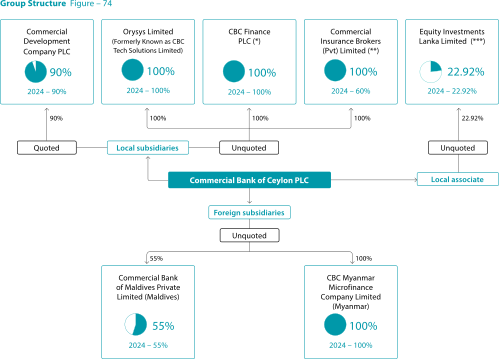
(*) As per the Companies Act No. 07 of 2007, CBC Finance PLC (formerly known as CBC Finance Limited) was listed on the Colombo Stock Exchange, through the listing of its Debentures, with effect from December 11, 2025. However, shares of the CBC Finance PLC remain unlisted.
(**) During the year 2025, Commercial Insurance Brokers (Pvt) Limited became a fully owned subsidiary of the Bank as disclosed in Note 36 on page 376.
(***) Subsequent to the reporting date, the Bank divested its entire equity interest of Equity Investments Lanka Limited as disclosed in Note 42 on page 400.
Principal business activities and nature of business operations of the Group Table – 101
| Entity | Principal business activities |
| Commercial Bank of Ceylon PLC | Banking and related activities covering a comprehensive range of products including dealing in government securities and treasury-related products, bancassurance and Islamic banking products and services etc. |
| Local subsidiaries | |
| Commercial Development Company PLC (CDC) | Property development, related ancillary services and providing manpower needs for various support services which are unrelated to providing core banking services to the customers of the Bank (parent). |
| Orysys Limited | Providing Information & Communication Technology (ICT) related products, services and solutions to the corporate sector. |
| CBC Finance PLC | Granting of lease facilities, hire purchase, mortgage loans and other credit facilities and accepting deposits. |
| Commercial Insurance Brokers (Pvt) Limited (CIBL) | Providing professional service and handling all insurance portfolios of individuals as well as many leading and reputed organisations in Sri Lanka engaged in diverse business activities. |
| Foreign subsidiaries | |
| Commercial Bank of Maldives Private Limited (CBM) | Offering of an extensive range of banking and related financial including dealing in government securities and treasury-related products etc. |
| CBC Myanmar Microfinance Company Limited | Operating as a non-deposit taking microfinance institution throughout Myanmar providing micro financial services to the lower segment of the market, and to engage in all activities reasonably allowed by the Microfinance Supervisory Authority of Myanmar. |
| Local associate | |
| Equity Investments Lanka Limited | Project financing in the form of Equity, Quasi Equity and other corporate debt instruments of new and existing ventures in Sri Lanka. Subsequent to the reporting date, the Bank divested its entire equity interest of Equity Investments Lanka Limited as disclosed in Note 42 on page 400. |
2. Basis of Accounting
2.1 Statement of compliance
The Consolidated Financial Statements of the Group and the separate Financial Statements of the Bank, have been prepared in accordance with the Sri Lanka Accounting Standards (Accounting Standards), laid down by The Institute of Chartered Accountants of Sri Lanka (CA Sri Lanka). These Financial Statements, except for information on cash flows have been prepared following the accrual basis of accounting.
The Accounting Standards comprise:
- Sri Lanka Financial Reporting Standards (SLFRS);
- Sri Lanka Accounting Standards (LKAS);
- Statements of Recommended Practices (SoRPs);
- Statement of Alternate Treatment (SoATs) and
- Financial Reporting Guidelines issued by CA Sri Lanka.
These Accounting Standards along with FAQs issued are available at the website of CA Sri Lanka – www.casrilanka.com.
Details of the Material Accounting Policies followed by the Group during the year are given in Notes 6 to 10 on pages 329 to 339.
2.2 Responsibility for Financial Statements
The Board of Directors of the Bank is responsible for the preparation and presentation of the Financial Statements of the Group and the Bank as per the provisions of the Companies Act and Sri Lanka Accounting Standards.
The Board of Directors acknowledges its responsibility for Financial Statements as set out in the “Annual Report of the Board of Directors”, “Statement of Directors’ Responsibility for Financial Reporting” and the certification on the Statement of Financial Position on pages 4, 264 and 309, respectively.
These Financial Statements include the following components:
- Income Statement and a Statement of Profit or Loss and Other Comprehensive Income (OCI) – which provides the information on the financial performance of the Group and the Bank for the year under review. Refer pages 307 and 308;
- Statement of Financial Position (SOFP) – which provides the information on the financial position of the Group and the Bank as at the year end. Refer page 309;
- Statement of Changes in Equity- which depicts all changes in shareholders’ funds during the year under review of the Group and the Bank. Refer pages 310 to 317;
- Statement of Cash Flows – which provides the information to the users, on the ability of the Group and the Bank to generate cash and cash equivalents and utilisation of those cash flows. Refer page 318;
- Notes to the Financial Statements comprising Material Accounting Policies and other explanatory information. Refer pages 319 to 470.
2.3 Approval of Financial Statements by the Board of Directors
The Financial Statements of the Group and the Bank for the year ended December 31, 2025 (including comparatives for 2024), were approved and authorised for issue by the Board of Directors in accordance with Resolution of the Directors on February 26, 2026 (The Financial Statements of the Group and the Bank for the year ended December 31, 2024, were approved and authorised for issue by the Board of Directors on February 28, 2025).
2.4 Basis of measurement
The Financial Statements of the Group have been prepared on the historical cost basis except for the following material items stated in the SOFP.
Basis of measurement Table – 104
| Items | Basis of measurement | Note Number/s |
| Financial instruments measured at fair value through profit or loss including derivative financial instruments | Fair value | 31, 32 & 44 |
| Financial assets measured at fair value through other comprehensive income | Fair value | 35 |
| Land and buildings | Measured at cost at the time of acquisition and subsequently at revalued amounts which are the fair values at the date of revaluation | 38 |
| Investment Property | Measured at cost at the time of acquisition and subsequently at fair value | 39 |
| Defined benefit obligation | Net liability for defined benefit obligations are recognised as the present value of the defined benefit obligation, less net total of the plan assets, plus unrecognised actuarial gains, less unrecognised past service cost, and unrecognised actuarial losses | 48 |
| Equity settled share-based payment arrangements | Fair value on grant date | 52 |
2.5 Going concern basis of accounting
These financial statements have been prepared on a going concern basis, which assumes that the Group will be able to discharge its liabilities.
The Group has recognised a profit after tax of Rs. 60.938 Bn. for the year ended December 31, 2025 and, as at the date total assets exceeds the total liabilities by Rs. 337.586 Bn.
The Management has made an assessment of its ability to continue as a going concern and is satisfied that it has the resources to continue in business for the foreseeable future. In making this assessment, the Group has considered any material uncertainties associated with the economic conditions and its possible impact on the business operations, projections of profitability, regulatory capital requirements and funding needs.
Considering a wide range of factors including history of profitable operations, strong liquidity positions and the availability of stable external funding sources, diversified lending profile and the initiatives taken to strengthen risk monitoring at borrower level, the Management is satisfied that the going concern basis is appropriate.
During the reporting period, improved macro-economic conditions in Sri Lanka have supported prudent credit expansion across the Bank’s core portfolios, resulting in increased profitability and enhanced financial resilience. These factors further support the Management’s conclusion that the Group/Bank has adequate resources to continue on a going concern basis for the foreseeable future.
Further, the Management is not aware of any material uncertainties that may cast significant doubt upon the Group’s ability to continue as a going concern. Therefore, the Financial Statements of the Group continue to be prepared on a going concern basis.
2.6 Functional and presentation currency
Items included in these Financial Statements are measured using the currency of the primary economic environment in which the Bank operates (the functional currency).
Each entity in the Group determines its own functional currency and items included in the Financial Statements of these entities are measured using that functional currency. There was no change in the Group’s presentation and functional currency during the year under review.
These Financial Statements are presented in Sri Lankan Rupees, the Group’s functional and presentation currency.
The information presented in US Dollars in the Section on “Investor information and performance trends” on pages 210 and 211 does not form part of the Financial Statements and is made available solely for the information of stakeholders.
2.7 Presentation of Financial Statements
These Financial Statements have been presented in compliance with the requirements of the Companies Act No. 07 of 2007 and amendments thereto (Companies Act) and the Banking Act and provide appropriate disclosures as required by the Listing Rules of the CSE.
The formats used in the preparation and presentation of the Financial Statements and the disclosures made therein also comply with the specified formats prescribed by the CBSL in the Circular No. 05 of 2024 dated December 31, 2024, on “Publication of Annual and Quarterly Financial Statements and Other Disclosures by Licensed Banks”. The Bank also published annual and quarterly financial information and other disclosures in the Annual Report, Press and the Website in compliance with the aforementioned Circular.
The assets and liabilities of the Group presented in the SOFP are grouped by nature and listed in an order that reflects their relative liquidity and maturity pattern.
No adjustments have been made for inflationary factors affecting the Financial Statements.
An analysis on recovery or settlement within 12 months and more than 12 months from the reporting date is presented in >Note 60 on pages 426 and 427.
2.8 Rounding
The amounts in the Financial Statements have been rounded-off to the nearest rupees thousands, except where otherwise indicated as permitted by the Sri Lanka Accounting Standard – LKAS 1 on “Presentation of Financial Statements” (LKAS 1).
2.9 Offsetting
Financial assets and financial liabilities are offset and the net amount reported in the SOFP, only when there is a legally enforceable right to offset the recognised amounts and there is an intention to settle on a net basis or to realise the assets and settle the liabilities simultaneously. Income and expenses are not offset in the Income Statement, unless required or permitted by an Accounting Standard or Interpretation (issued by the IFRS Interpretations Committee and Standard Interpretations Committee) and as specifically disclosed in the Material Accounting Policies of the Group.
2.10 Materiality and aggregation
Each material class of similar items is presented separately in the Financial Statements. Items of dissimilar nature or function are presented separately, unless they are immaterial as permitted by the LKAS 1 and amendments to the LKAS 1 on “Disclosure Initiative” which was effective from January 01, 2016.
2.11 Comparative information
Comparative information including quantitative, narrative and descriptive information is disclosed in respect of the previous period in the Financial Statements in order to enhance the understanding of the current period’s Financial Statements and to enhance the inter period comparability. The presentation and classification of the Financial Statements of the previous year are amended, where relevant for better presentation and to be comparable with those of the current year.
2.12 Use of judgements and assumptions & estimates
In preparing these Financial Statements in conformity with Accounting Standards, the Management has made judgements, estimates and assumptions about the future, including climate related risks and opportunities which affect the application of Accounting Policies and the reported amounts of assets, liabilities, income and expenses. Actual results may differ from these estimates. Estimates and underlying assumptions are reviewed on an ongoing basis and are consistent with the Group’s risk management and climate related commitments where appropriate.
Revisions to accounting estimates are recognised prospectively.
Significant areas of critical judgements, assumptions and estimation uncertainty, in applying the Accounting Policies that have material effects on the amounts recognised in the Financial Statements of the Group and the Bank are as follows:
A. JudgementsInformation about judgements made in applying the Accounting Policies that have material effects on the amounts recognised in these Financial Statements is included in Notes 2.12.1 to 2.12.4 below.
2.12.1 Determination of control over investees
Management applies its judgement to determine whether the control indicators set out in Note 36 on page 376 indicates that the Group controls the investees.
2.12.2 Classification of financial assets and liabilities
The Material Accounting Policy Information of the Group provides scope for financial assets to be classified and subsequently measured into different categories, namely, at Amortised Cost (AC), Fair Value through Other Comprehensive Income (FVOCI) and Fair Value Through Profit or Loss (FVTPL) based on the following criteria;
- The Group’s business model for managing the financial assets as set out in Note 7.1.3.1 on page 331.
- The contractual cash flow characteristics of the financial assets as set out in Note 7.1.3.2 on page 331.
2.12.3 Classification of investment property
Management uses its judgment to determine whether a property qualifies as an investment property. A property that is held either to earn rental income or for capital appreciation or both and thus generates cash flows largely independently of the other assets held by the Group are classified as Investment Property. On the other hand, a property used in the production or supply of goods and services or for administrative purposes and thus generates cash flows that are attributable not only to that property but also to other assets used in the production or supply process are classified as Property, Plant & Equipment. The Group assesses on an annual basis, the accounting classification of its investment properties, taking into consideration the current use of such properties.
2.12.4 Determination of Expected Credit Loss (ECL)
Management uses judgement in establishing the criteria for determining whether credit risk on financial assets has increased significantly since initial recognition, determining the methods for incorporating forward looking information into the measurement of ECL and selection and approval of models used to measure ECL.
B. Assumptions and estimation uncertaintiesInformation about assumptions and estimation uncertainties that have a significant risk of resulting in material adjustments are included in Notes 2.12.5 to 2.12.15 below.
2.12.5 Fair value of financial instruments with significant unobservable inputs
The fair values of financial assets and financial liabilities recognised on the SOFP, for which there is no observable market price are determined using a variety of valuation techniques that include the use of mathematical models. The Group measures fair value using the fair value hierarchy that reflects the significance of input used in making measurements. Methodologies used for valuation of financial instruments and fair value hierarchy are stated in Note 27 on pages 356 to 360.
2.12.6 Impairment losses on financial assets
The measurement of impairment losses across the categories of financial assets under Sri Lanka Accounting Standard – SLFRS 9 on "Financial Instruments" (SLFRS 9) requires judgement, in particular, the estimation of the amount and timing of future cash flows and collateral values when determining impairment losses.
Accordingly, the Group reviews its individually significant loans and advances portfolio at each reporting date to assess whether an impairment loss should be recognised in the Income Statement. In particular, the Management’s judgement is required in the estimation of the amount and timing of future cash flows when determining the impairment loss. In estimating these cash flows, Management makes judgements about a borrower’s financial situation and the net realisable value of any underlying collateral. Each impaired asset is assessed on its merits, and the workout strategy and estimate of cash flows considered recoverable. These estimates are based on assumptions about a number of factors and hence actual results may differ, resulting in future changes to the impairment allowance made. A collective impairment provision is established for groups of homogeneous loans and advances that are not considered individually significant.
As per SLFRS 9, the Group’s ECL calculations are outputs of complex models with a number of underlying assumptions regarding the choice of variable inputs and their interdependencies. Elements of the Group’s ECL models that are considered accounting judgements and estimates include:
- Criteria for qualitatively assessing whether there has been a Significant Increase in Credit Risk (SICR) and if so, allowances for financial assets measured on a Life Time Expected Credit Loss (LTECL) basis.
- Segmentation of financial assets when their ECL is assessed on a collective basis.
- Various statistical formulas and the choice of inputs used in the development of ECL models.
- Associations between macro-economic inputs, such as GDP growth, inflation, interest rates, exchange rates and unemployment and the effect of these inputs on Probability of Default (PDs), Loss Given Default (LGD) and Exposure at Default (EAD).
- Forward-looking macro-economic scenarios and their probability weightings.
As such, the accuracy of the impairment provision depends on the model assumptions and parameters used in determining the ECL calculations.
Early observations of payment behaviour of expiries for this year were considered in the assessment of the changes in the risk of default occurring over the expected life of a financial instrument when determining staging and is a key input in determining migration.
Refer Note 18 on page 345 for details.
2.12.7 Impairment of non-financial assets
The Group assesses whether there are any indicators of impairment for an asset or a Cash Generating Unit (CGU) at each reporting date or more frequently, if events or changes in circumstances necessitate to do so. This requires the estimation of the Value In Use (VIU) of such individual assets or the CGUs. Estimating VIU requires the Management to make an estimate of the expected future cash flows from the asset or the CGU and also to select a suitable discount rate in order to calculate the present value of the relevant future cash flows. This valuation requires the Group to make estimates about expected future cash flows and discount rates and hence, they are subject to uncertainty.
Refer Note 7.6 on page 335 for details.
2.12.8 Revaluation of property, plant and equipment
The Group measures land and buildings at revalued amounts with changes in fair value being recognised in Equity through OCI. The Group engages independent professional valuers to assess fair value of land and buildings in terms of Sri Lanka Accounting Standard – SLFRS 13 on “Fair Value Measurement” (SLFRS 13). The key assumptions used to determine the fair value of the land and building and sensitivity analyses are provided in Notes 38.5 (b) and 38.5 (c) on pages 386 to 391.
2.12.9 Useful lifetime of the property, plant and equipment
The Group reviews the residual values, useful lives and methods of depreciation of Property, Plant and Equipment at each reporting date. Judgement of the Management is exercised in the estimation of these values, rates, methods and hence they are subject to uncertainty.
Refer Note 20 on page 350.
2.12.10 Fair valuation of investment property
Fair valuation of the investment property is ascertained by independent valuations carried out by Chartered valuation surveyors, who have recent experience in valuing properties at similar locations and categories. They have made reference to market evidence of transaction prices for similar properties, with appropriate adjustments for size and location. The key assumptions used to determine the fair value of investment property are provided in detail in Note 39 on page 393.
2.12.11 SLFRS 16 – leases
2.12.11.1 Determination of the lease term for lease contracts with renewal and termination options (Group as a lessee)
The Group determines the lease term as the non-cancellable term of the lease, together with any periods covered by an option to extend the lease if it is reasonably certain to be exercised, or any periods covered by an option to terminate the lease, if it is reasonably certain not to be exercised.
The Group has several lease contracts that include extension and termination options. The Group applies judgement in evaluating whether it is reasonably certain whether or not to exercise the option to renew or terminate the lease.
2.12.11.2 Estimating the incremental borrowing rate
As the Group cannot readily determine the interest rate implicit in the lease, it uses its Incremental Borrowing Rate (“IBR”) to measure the lease liabilities. The IBR is the rate of interest that the Group would have to pay to borrow over a similar term, and with a similar security, the funds necessary to obtain an asset of a similar value to the right-of-use asset in a similar economic environment.
The IBR therefore reflects what the Group ‘would have to pay’, which requires estimation when no observable rates are available (or when they need to be adjusted to reflect the terms and conditions of the lease). The Group estimates the IBR using observable input when available and is required to make certain entity-specific adjustments.
2.12.12 Recognition of Deferred tax assets
Deferred tax assets are recognised in respect of tax losses to the extent that it is probable that future taxable profit will be available and can be utilised against such tax losses. Judgement is required to determine the amount of deferred tax assets that can be recognised, based upon the likely timing and level of future taxable profits, together with future tax-planning strategies.
Refer Note 41 on page 398 for details.
2.12.13 Key actuarial assumptions relating to Defined benefit obligation
The costs of the defined benefit plans are determined using an actuarial valuation. The actuarial valuation involves making assumptions about discount rates, expected rates of return on assets, future salary increases, mortality rates, future pension increase, etc. Due to the long-term nature of these plans, such estimates are subject to significant uncertainty.
The Bank generally uses similar long-term treasury bond rate as the discount rate for the purpose of assessing the present value of future obligations.
Refer Note 48 on pages 404 to 413 for the assumptions used.
2.12.14 Impact of climate risk
Climate risks can lead to potential negative impact on the Group arising from climate change. Climate related risks have an impact on principal risk categories such as credit, liquidity, market and operational risks,
but due to pervasive nature has been identified and managed by the Group on an overall basis.
The Group distinguishes between physical and transition risks. Physical risks arise as the result of acute weather events and transition risks arise as a result of measures taken to mitigate the effects of climate change and transition to a low carbon economy.
The Group and its customers are exposed to the physical risks from climate change and risks of transitioning to a net-zero economy. Most climate-related physical risks are expected to manifest over a term that is generally longer than the maturity of most of the outstanding exposures. The following balances may be impacted by physical and transition risks:
ECL : Customers and portfolios with exposure to climate risk may have a resultant deterioration in creditworthiness, which has an impact on ECL. On the whole, the Group is of the view that the counterparties who have exposures to climate risk are not expected to be materially impacted by physical or transition risks associated with climate change. To address the potential adverse impact on ECL arising from customers affected by the Cyclone Ditwah that occurred in Sri Lanka in November 2025, the Bank performed comprehensive assessments and incorporated the necessary modelled and post model adjustments to its ECL estimates as at the reporting date. Further details are disclosed in Note 18 on pages 345 to 349.
Fair value measurement : The Bank has assumed that any climate change variables incorporated in fair value measurement are those that market participants would consider when pricing the asset or liability, in line with SLFRS 13.
2.12.15 Provisions for liabilities, commitments and contingencies
The Group receives legal claims in the normal course of business. Management has made judgements as to the likelihood of any claim succeeding in making provisions. The time of concluding legal claims is uncertain, as is the amount of possible outflow of economic benefits. Timing and cost ultimately depends on the due processes in respective legal jurisdictions.
Information about significant areas of estimation uncertainty and critical judgements in applying Accounting Policies other than those stated above that have material effects on the amounts recognised in the Consolidated Financial Statements are described in Notes 7.10 to 7.15 on pages 337.
2.13 Events after the reporting period
Events after the reporting period are those events, favourable and unfavourable, that occur between the reporting date and the date when the Financial Statements are authorised for issue.
In this regard, all material and important events that occurred after the reporting period have been considered and appropriate disclosures are made in Note 68 on page 470, where necessary.
3. Financial Risk Management
3.1 Introduction and overview
Like any other business model, risk is inherent in the Bank’s activities too and attempts to manage through a process of ongoing identification, measurement and monitoring, subject to risk limits and controls are adopted to mitigate possible consequences arising out of volatile and fluid outcomes in the internal and external environment.
The process of risk management is identified as critical to maintain Bank’s continuing profitability. Managing the changing stakeholder dynamics whilst preserving culture and value system of the Bank is considered as a priority in the business operation.
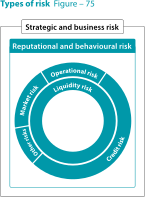
The Group has exposure mainly to the following broad risk categories arising out of its business activities that are undertaken in its day to day functions:
- Strategic and business risk;
- Credit risk;
- Liquidity risk;
- Market risk;
- Operational risk;
- Conduct risk and reputational risk;
- Environmental, social risk and climate risk.
- Documentation of Procedures: Operational execution is guided by a hierarchy of Board approved Policies, Operation Manuals, and Circular Instructions to ensure clear lines of management responsibility and accountability.
- Risk Transfer: For low probability, high impact events, the Bank adopts a risk transfer strategy by obtaining insurance policies against uncontrollable risks such as natural disasters and fraud, which are reviewed annually by the Operational Risk Management Unit.
- Ethical Standards: The control environment is reinforced by the upkeep of high standards of ethics and integrity, supported by continuous staff training to build a risk-aware culture across all cross-sections of the Bank.
- Governance
- Critical System Availability
- Cybersecurity
- Change Management
- DR/BCP Planning
- Third-Party Service Failures
3.2 Bank’s risk management framework
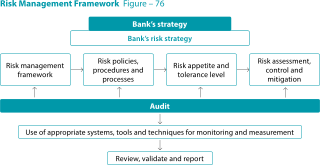
The Board of Directors of the Bank has the overall responsibility for the establishment and oversight of the Group/Bank’s Risk Management Framework.
The Risk Management Framework of the Group/Bank translates overall risk appetite on business activities in a holistic approach to provide the guidance required for convergence of strategic and risk perspectives of the Group/Bank.
The Group’s risk management policies are established to identify and analyse the risks faced by the Group, to set appropriate risk limits and controls to monitor risks and adherence to limits. The Risk Management Policy Framework constitutes the Credit Policy, Lending Guidelines, Credit Risk Review Policy, ALM Policy including Contingency Funding Plan, Foreign Exchange Policy, Operational Risk Policy, IT Risk Policy, Market Risk Policy, Stress Testing Policy, Financial & Risk Management Disclosure Policy, Group Conduct Risk Management Policy, Group Environmental and Social Policy and Group Reputational Risk Management Policy etc., which have been firmly established to provide control and guidance for decision-making throughout the Group in a uniform manner.
The Committee structure embedded to the Risk Management Framework acts as a fact finding and decision-making authority through deliberations and arriving at consensus arising out of multiple points
of views.
The Risk Management Committees effectively deliberate on matters at hand to provide guidance to the business lines with a view to managing risk in accordance with the strategic goals and risk appetite of the Bank.
The Board of Directors of the Bank has formed the Board Integrated Risk Management Committee (BIRMC) as a mandatory Board sub-Committee, as per Banking Act Directions No. 05 of 2024 on Corporate Governance. The performance of the Committee and the duties and roles of members are reviewed by the Board annually or more frequently, if warranted.
The Management has set up Executive Integrated Risk Management Committee (EIRMC) before the BIRMC. The meetings of the EIRMC are conducted on a monthly basis to discuss Credit, Operational, Market, IT and Environmental and Social risk matters of the Bank. Assets and Liabilities Committee (ALCO), that convene at least once a fortnight, gives priority for liquidity, funding and profitability in line with the changes taken place in the market.
Risk Control Self-Assessment (RCSA) framework is adopted to identify risks involved in business activities of the Bank and to implement appropriate risk mitigatory measures after assessing criticality of such risks. The Integrated Risk Management Department (IRMD) carries out semi-annual and quarterly Bank-wide RCSA exercise focusing on adherence to laws, regulations, and regulatory guidelines as well as internal controls and approved policies.
Further, the Internal Audit function of the Bank independently monitors and evaluates the risk management function of the Bank and provides its views on the adequacy of the Risk Management Framework to the Board Audit Committee (BAC).
Strategic and business risk
Bank’s inability to keep up with the evolving market dynamics, resulting in loss of market share and failure to achieve strategic goals in line with its Vision and Mission is identified as Strategic risk.
Business risk refers to any risk that arises from the Bank’s long-term business strategies and affects its profitability, and relatively short term in nature.
Management of strategic and business risk
Corporate planning and budgeting process and continuous evaluation of their alignment with the Bank’s Vision, Mission and the risk appetite facilitate management of strategic risk. In the annual Internal Capital Adequacy Assessment Process (ICAAP) exercise of the Bank, detailed scorecard-based qualitative models are used to measure and monitor strategic risk of the Bank. This scorecard-based approach takes a number of variables into account, including the size and sophistication level of the Bank, the nature and complexity of its operations and highlights the areas that require focus to mitigate potential strategic risks.
Business risk of the Bank is managed through its day-to-day decisions made by the line managers and also at different Management Committees in identifying, assessing and remediating such risks.
Also, in line with the Banking Act Direction No. 09 of 2021, commencing from 2022, the Bank being the largest private sector bank in the industry designated as a Domestic Systemically Important Bank (D-SIB), has developed its Recovery Plan (RCP). The Bank has commenced the review of RCP on a quarterly basis commencing from 2023. This plan outlines the Bank's transition from Business-As-Usual (BAU) to different degrees of elevated risk conditions, highlighting the preparedness to the recovery actions, if the financial deterioration occurs and is not rectified.
Credit risk
The risk that the Bank will incur a loss due to its customers or counterparties failing to discharge their contractual obligations, is considered generally under the credit risk assessment.
The Bank manages and controls credit risk by setting limits on the amount of risk it is willing to accept for individual counterparties, groups of counterparties, geographies, business sectors, and industries by monitoring exposures and possible adverse external factors in relation to such limits.
Management of credit risk
Lending Guidelines of the Bank have been formulated based on evolving practices of lending to provide expected granularity of credit assessment and thereby, to ensure strict attention to risks emanating from lending proposals at the time of initiation, analysis, and approval. In addition, Lending Guidelines ensures objective assessment of acceptability of collateral as well as limits on exposures and concentration levels to various sectors, counterparties, geographies and segments etc.
A robust risk grading system in line with the Basel guidelines on rating of facilities and counterparties is adopted by the Bank for evaluation of credit proposals. This risk grading framework consists of 10 grades of gradually escalating continuum of risks as indicators for the Lending Officers to evaluate and arrive at suitable risk reward trade-offs in their propositions. These risk grades were validated by internationally accepted consultants and are reviewed by the IRMD regularly.
Credit Risk Review function covers over 30% of the advances portfolio, including non performing credit facilities of the Bank using the Loan Review Mechanism (LRM). This continuous exercise provides reasonable assurance that all major credit risks embedded in the operation of lending is carried out in line with the stipulated guidelines and within the risk appetite framework of the Bank.
Early Warning Signals (EWS) system which is currently being adopted based on Machine Learning/Regression analysing, Prediction model to assist Lending Officers. This will facilitate the detection of problematic advances, while also providing insights to identify potential lending opportunities. This tool is used to maintain the quality of the Loan Book of the Bank.
Portfolio level credit risk analyses are taken up at monthly EIRMC meetings as well as quarterly at BIRMC meetings. Individual credit proposals evaluated by the Lending Officers are approved by the Authorising Officers within the hierarchy in delegated authority levels whilst ensuring a minimum of the Four Eyes Principle, when approving them. Approval levels are escalated based on delegated authority levels attached to exposure levels, final risk ratings, and changes of risk appetite for specific industries as well as negative deviation of performance levels as compared to previous facilities extended to borrowers.
The Executive Credit Committee (ECC) and the Board Credit Committee (BCC) are responsible for approving credit facilities with high value while the Board will be the ultimate authority for approving facilities exceeding predetermined threshold levels. Deliberations take place at the BCC level on facilities being considered for approval beyond the specified threshold and recommendations for approval of the Board are made based on quantum of exposures at various levels.
The IRMD provides risk approval for individual proposals above predetermined threshold levels, consequent to a rigorous independent risk evaluation guided by Credit Policy, Lending Guidelines, and Circular Instructions within a limit framework stemming from risk appetite of the Bank.
The Expected Credit Loss (ECL) model introduced under the SLFRS 9 replaced the Incurred Loss Model, which was considered inadequate in recognising credit losses in a proactive manner and had failed in accurately estimating the credit losses during economic stress conditions. Accordingly, the Bank also had duly adopted the ECL modelling in impairment computations. IRMD involves in independent oversight on Individually Significant Loans (ISLs) to improve accuracy of cash flow projections bringing in a more robust and specific approach to the classification, recognition and measurement of credit facilities. The Bank has also taken into consideration the guidance included in the Banking Act Directions No. 13 of 2021 issued by the CBSL. Upgrading of restructured and rescheduled credit facilities shall only be carried out by the IRMD and shall be independent from the credit facility review mechanism.
Liquidity risk
The risk that the Bank will encounter difficulty in meeting obligations associated with the financial liabilities that are settled by delivering cash or another financial asset is focused on this risk domain. Liquidity risk arises because of the possibility that the Bank might be unable to meet its payment obligations or not receiving what is due to the Bank when they fall due under both normal and stress circumstances.
To limit this risk, Management has arranged diversified funding sources in addition to its core deposit base and adopted a policy of managing assets with liquidity in mind and monitoring future cash flows and liquidity on a daily basis. The Bank has reviewed and strengthened its internal control processes and contingency plans for managing liquidity risk.
Management of liquidity risk
Market Risk Management Policy and the ALM Policy of the Bank approved by the Board of Directors set the tone for managing liquidity risk of the Bank. Liquidity risk of the Bank is given utmost priority when managing a wide range of other risks because it is considered as the most critical risk for any financial institution.
The Bank’s Treasury Department is entrusted with managing liquidity of the Bank on a real time basis to ensure smooth functioning of business activities of all other business units of the Bank. Additionally, a team of members of the Corporate Management, comprising the Deputy General Manager - Treasury, Assistant General Manager - Treasury and the Chief Risk Officer, carefully analyse liquidity position of the Bank taking in to consideration, both short-term and medium-term cash flow gaps, more frequently.
Access to a substantial stable Current Account and Savings Account (CASA) base due to its wide branch network and the top of the mind perception created among the depositors, provide immense strength to the Bank in managing liquidity. Also, the growing balance sheet size, higher rating and continuous rapport maintained with local and international counterparty banks have helped immensely to the Bank to maintain adequate foreign currency liquidity amidst stressed market conditions.
Having an adequate buffer of High Quality Liquid Assets (HQLA) at the disposal of the Bank is another plus factor for the Bank. The strength of such portfolio is amply reflected in the Basel III computation the Bank carries out for arriving at Liquidity Coverage Ratio (LCR) and Net Stable Funding Ratio (NSFR) as per the CBSL Directions that recorded very healthy results as compared to regulatory minimum threshold levels.
The Bank has experienced accumulation of rupee liquidity above the minimum regulatory requirements as a result of sluggish economic performance of the country since 2020. However, having adopted many strategies to invest excess liquidity at optimum yields but in staggered maturities and thereby to minimise the negative impact on the bottom line as well as liquidity, the Bank is mindful about the excessive exposure to the Government by way of the Government Securities. As such, the Bank has focused on revitalising the steady expansion of its Loan Book throughout year 2025.
Contingency funding plans are in force, constant monitoring of salient liquidity ratios and scenario-based stress testing being carried out regularly would enable the Bank to take proactive measures towards overcoming an adverse liquidity position that may arise on a future date. The regular stress testing is conducted under a variety of scenarios covering both normal and more severe market conditions.
Market risk
The risk that the fair value or future cash flows of financial instruments will fluctuate due to changes in market variables such as interest rates, foreign exchange rates and equity prices comes under the ambit of Market risk. The market risk management is to manage and control market risk exposure within acceptable parameters to ensure the Group’s solvency while optimising the return on risk. The Bank classifies exposures to Market Risk into either Trading or Non-Trading portfolios (Banking Book) and manages each of those portfolios separately.
The Market risk for the Trading portfolio is monitored and managed closely having paid attention to the changes on the prices of market.
Management of market risk
Market Risk Management Policy, ALM Policy and Foreign Exchange Risk Policy are the three main policies that constitute the framework governing the Market Risk Management function of the Bank. Due to business model adopted by the Bank, exposure to equity and commodity risk was kept at bay throughout the year.
However, Interest Rate Risk arising from the Banking Book as well as Trading Book and Foreign Exchange Risk arising from dealing in assets and liabilities denominated in currencies other than local currency, continued to expose the Bank to associated risk elements.
Declining interest rates throughout 2025 posed challenges to the Net Interest Margin (NIM), despite a renewed appetite for advances driven with the recent economic reforms introduced in the country.
Interest Rates of the Banking Book is subjected to varying degrees of rate shocks to stimulate and identify impact on earnings perspective in such rate scenarios. The results of such predictions could assist the Bank in formulating strategies to manage the financial position in an effective manner with the limited choices available in the local market.
Trading Book too was subjected to Value at Risk (VaR) framework internally carried out by the Bank on a regular basis. The Bank also carried out sensitivity analysis on a regular basis to ascertain the impact on portfolios maintained, mainly in Government Securities and marking to market of such portfolios to reflect fair value of underlying assets for the decision-making process.
The Bank acknowledges inherent limitations in VaR, particularly within the volatile Sri Lankan market where price movements may deviate from standard economic fundamentals. The framework’s reliance on historical data may fail to capture rapid market shifts, while calculations can be skewed by transitory, non-permanent triggers. Furthermore, as VaR represents only a fraction of potential unrealised gains or losses and significant portfolios are not held for speculative purposes, divestment decisions are based on a holistic portfolio view rather than VaR metrics alone.
Forex positions are subjected to continuous sensitivity analysis to provide insights to possible losses arising from currency appreciation/depreciation, as the reporting currency of the Bank, being Sri Lankan Rupees.
Operational risk
The risk that the Bank will incur a loss due to failure of systems, processes, human errors, frauds or external events is focused on this risk domain. When controls fail to operate effectively, operational risks can cause damage to reputation, have legal or regulatory implications or lead to financial loss. The Bank cannot expect to eliminate all operational risks, but it endeavours to manage these risks through a control framework and by monitoring, escalating, reporting and responding to potential risks.
Circular Instructions and Operational Risk Management Policy play a major part in bringing together business practices with accepted benchmarks to ensure minimum disruption to processes, personnel, technology and infrastructure.
Internal Control Framework and audit function with firmly established “three lines of defences” serve the Bank to manage operational risk at current acceptable levels.
The Bank defines IT Risk as the exposure to loss resulting from technological disruptions or cyber-attacks. To mitigate this, Bank IT Risk Management policy directly supports Financial Risk Management objectives. It ensures that the systems governing assets and liabilities remain reliable, available, and
Management of operational risk
The Bank maintains a strong internal operational risk culture overseen by the Board of Directors and Corporate Management, utilising a robust internal control framework defined by the “three lines of defences” model. The first line, Business Line Management, is responsible for implementing robust controls such as checking and authorising transactions at the source. The second line, the Risk Management function, reviews the effectiveness of these controls and monitors Key Risk Indicators (KRIs), while the third line, Internal Audit, provides independent review and challenge. Specific control standards implemented across the Group include the effective segregation of duties, dual authorisations for high-value and important transactions, strict access controls for systems, and regular end of day reconciliation and balancing.
Compliance with these standards is supported by:
Management of IT related operational risk
IT Risk of the Bank is managed through strict monitoring of key IT risk Indicators defined in IT Risk management policy covering following six key IT risk indicators.
In alignment with the CBSL Directions No. 16 of 2021 and No. 02 of 2025, IT risk exposures and cybersecurity incidents are reviewed monthly and reported to the EIRMC and BIRMC.
Bank IT Risk exposure also review annually by external assessment including ISO 27001:2022, ISO 20000:2018, PCIDSS etc. Controls included to effective segregation of duties, access authorisation procedures, staff education and assessment processes.
Outsourcing risk related to IT services is managed through regular monthly reviews of IT incidents and system downtime attributable to outsourced service providers, together with bi-annual Risk RCSAs of third-party IT service providers.
Conduct risk and reputational risk
A well-established framework, developed over decades, mitigates risk associated with mis-selling, unethical business practices, professional misbehaviour and governance deficiencies etc.
The risk that the Bank’s reputation will be damaged by one or more than one reputation event, as reflected from negative publicity about the Bank’s business practices, conduct or financial condition. Such negative publicity, whether true or not, may impair public confidence in the Bank, result in costly litigation, or lead to a decline in its customer base, business or revenue.
Management of the Conduct and Reputational risk is underpinned by a comprehensive policy framework approved by the Board of Directors.
Refer Note 66 on pages 437 to 469 for “Financial risk review”.
Environmental and social risk
The Bank’s Environmental and Social Management System (ESMS) is a mature and well-established framework that integrates Environmental and Social (E&S) considerations into lending and investment decisions. Aligned with the E&S related country regulations and CBSL’s Sustainable Finance Roadmap, the ESMS addresses key factors such as resource efficiency, pollution prevention, labour practices, community health and safety, biodiversity conservation, and governance, supporting both financial stability and long-term sustainability.
Guided by internationally recognised standards such as the IFC Performance Standards, the Bank evaluates Environmental, Social & Governance (ESG)and climate-related impacts of financed activities and considers their implications for borrowers’ financial performance and resilience. The outcomes of these assessments inform credit structuring decisions, including promoter equity requirements, lending terms, covenants, and pricing, where appropriate.
Climate risk
In line with the effective adoption of SLFRS S1 and SLFRS S2 which are Disclosure Standards in year 2025, the Bank has strengthened its approach to climate-related risk management through a dedicated Climate Risk Assessment and Management Framework. Climate risks are assessed in two categories in line with Disclosure standards:
Physical Risks – Arising from acute and chronic climate events such as floods, droughts, rising temperatures, and sea-level rise.
Transition Risks – Resulting from the shift to a low-carbon economy, including changes in regulation, technology, market preferences, and reputational considerations.
Climate-related risks may affect the Bank’s portfolio through higher credit losses arising from climate-induced disruptions to borrower operations, volatility in asset and collateral valuations, changes in risk-weighted assets, and shifts in sector-level exposures, particularly in climate-sensitive or carbon-intensive sectors.
ESG and climate risk assessments are conducted at borrower and asset levels and aggregated to develop an integrated portfolio-level ESG and climate risk view, supporting regulatory disclosures and strategic risk management. The Bank is also in the process of developing qualitative models to assess the linkage between borrowers’ financial performance and climate-related risks. These models will rely on expert judgment, scorecards, sector heat maps, questionnaires, and narrative assessments, with the objective of progressively incorporating climate risk considerations into internal credit assessments, subject to data availability, model validation, and governance approvals. By leveraging its mature ESMS and advancing climate risk analytics, the Bank remains committed to responsible financing and building a climate-resilient portfolio.
Management of environmental and social risks & climate risk
Environmental, social, and climate-related risks are managed within the Bank’s overall Risk Management Framework through clearly defined governance structures, roles, and responsibilities.
A team within the IRMD oversees implementation, supported by continuous training for credit analysts and access to sector-specific expertise and analytical tools.
The Bank actively monitors portfolio exposure to climate-related physical and transition risks, as well as environmentally sensitive and carbon-intensive sectors, applying sector specific guidelines and mitigation measures where necessary.
Emerging E&S and climate risk trends are continuously incorporated into risk screening, monitoring, and portfolio analysis processes to enhance resilience and support sustainable growth.
Transparency, continuous improvement, and stakeholder engagement underpin the Bank’s approach.
A detailed description of governance, identification, assessment, monitoring, reporting, and mitigation of environmental, social, and climate-related risks is provided in the section “Risk Governance and Management” on pages 273 to 296.
4. Fair Value Measurement
“Fair value” is the price that would be received to sell an asset or paid to transfer a liability in an orderly transaction between market participants at the measurement date in the principal or, in its absence, the most advantageous market to which the Group has access at that date. The fair value of a liability reflects its non-performance risk.
When one is available, the Group measures the fair value of an instrument using the quoted price in an active market for that instrument. A market is regarded as active if transactions for the asset or liability take place with sufficient frequency and volume to provide pricing information on an ongoing basis.
If there is no quoted pricing in an active market, then the Group uses valuation techniques that maximise the use of relevant observable inputs and minimise the use of unobservable inputs. The chosen valuation technique incorporates all of the factors that market participants would take into account in pricing a transaction.
The fair value of an asset or a liability is measured using the assumptions that market participants would use when pricing the asset or liability, assuming that market participants act in their economic best interest.
The Group recognises transfers between levels of the fair value hierarchy as of the end of the reporting period during which the change has occurred.
A fair value measurement of a non-financial asset takes into account a market participant’s ability to generate economic benefits by using the asset in its highest and best use or by selling it to another market participant that would use the asset in its highest and best use. External professional valuers are involved for valuation of significant assets such as land and buildings.
An analysis of fair value measurement of financial and non-financial assets and liabilities is provided in Note 27 on pages 356 to 360.
5. Changes in Material Accounting Policies
There were no new or amended standards and interpretations that were required to be incorporated into the Financial Statements with effect from January 01, 2025.
Material Accounting Policies
The Material Accounting Policies set out in Notes 6 to 10 on pages 329 to 339 below have been applied consistently to all periods presented in the Financial Statements of the Group except as specified in Note 2.11 on page 322.
These Accounting Policies have been applied consistently by the Group and there were no changes to Material Accounting Policies. The Group has adopted Sustainability Disclosure Standard – SLFRS S1 on “General Requirements for Disclosure of Sustainability-related Financial Information” (SLFRS S1) and SLFRS S2 on “Climate-related Disclosures” (SLFRS S2) during the year.
As these are Disclosure Standards, the related disclosures have been disclosed in the relevant sections of this Annual Report as appropriate and they do not form part of these Financial Statements.
Set out below is an index of Material Accounting Policies, the details of which are available on the pages that follow:
Index of Material Accounting Policy Information Table – 103
| Note | Description | Reference to the Notes in Financial Statements |
| 6 | Material Accounting Policies – General | |
| 6.1 | Basis of consolidation | |
| 6.2 | Foreign currency | |
| 7 | Material Accounting Policies – Recognition of assets and liabilities | |
| 7.1 | Financial instruments – Initial recognition, classification and subsequent measurement |
26 |
| 7.2 | Non-current assets (or disposal groups) classified as held for sale | 42 |
| 7.3 | Property, plant and equipment | 38 |
| 7.4 | Investment property | 39 |
| 7.5 | 30.1 Movement in provision for impairment during the year | 40 |
| 7.6 | Impairment of non-financial assets | 36.1 |
| 7.7 | Dividends payable | 25 |
| 7.8 | Employee benefits | 48.2 to 48.5 |
| 7.9 | Other liabilities and provisions | 48 |
| 7.10 | Restructuring | |
| 7.11 | Onerous contracts | |
| 7.12 | Bank levies | |
| 7.13 | Financial guarantees, letters of credit and undrawn loan commitments | 57 |
| 7.14 | Commitments | 57 |
| 7.15 | Contingent liabilities and commitments | 57 |
| 7.16 | Stated capital and reserves | 51,53,54 & 55 |
| 7.17 | Earnings per Share (EPS) | 24 |
| 7.18 | Operating segments | 61 |
| 7.19 | Fiduciary assets | |
| 8 | Material Accounting Policies – Recognition of income and expense | |
| 8.1 | Interest income and interest expense | 13 |
| 8.2 | Fee and commission income and fee and commission expense | 14 |
| 8.3 | Net gains/(losses) from trading | 15 |
| 8.4 | Net gains/(losses) from derecognition of financial assets | 16 |
| 8.5 | Dividend income | 15 & 17 |
| 8.6 | Leases | 33.3, 38 & 48.1 |
| 8.7 | Rental income and rental expenses | 17 & 21 |
| 9 | Material Accounting Policies – Taxes and levies | |
| 9.1 | Income tax expense | 23,41 & 47 |
| 9.2 | Crop Insurance Levy (CIL) | |
| 9.3 | Withholding Tax (WHT) on dividends distributed by the Bank, subsidiaries and associate |
25 |
| 9.4 | Taxes on Financial Services | 22 |
| 9.5 | Value Added Tax (VAT) and Social Security Contribution Levy (SSCL) | |
| 9.6 | Introduction of New Tax Reforms | |
| 10 | Material Accounting Policies – Statement of cash flows | |
| 10.1 | Statement of Cash Flows |
6. Material Accounting Policies – General
6.1 Basis of consolidation
The Group’s Financial Statements comprise, Consolidated Financial Statements of the Bank and its Subsidiaries in terms of the Sri Lanka Accounting Standard – SLFRS 10 on “Consolidated Financial Statements” (SLFRS 10) and the proportionate share of the profit or loss and net assets of its associate in terms of the Sri Lanka Accounting Standard – LKAS 28 on “Investments in Associates and Joint Ventures” (LKAS 28). The Bank’s Financial Statements comprise the amalgamation of the Financial Statements of the Domestic Banking Unit, the Offshore Banking Centre and the international operations of the Bank.
6.1.1 Business combinations
Business combinations are accounted for using the acquisition method when control is transferred to the Group as per Sri Lanka Accounting Standard – SLFRS 3 on “Business Combinations” (SLFRS 3). In determining whether a particular set of activities and assets is a business, the Bank assesses whether the set of assets and activities acquired includes, at a minimum, an input and substantive process and whether the acquired set has ability to produce outputs. The consideration transferred in the acquisition and identifiable net assets acquired are measured at fair value. Any goodwill that arises is tested annually for impairment (Refer Note 7.6 on page 335). Any gain on a bargain purchase is recognised in profit or loss immediately. Transaction costs are expensed as incurred, except if they are related to the issue of debt or equity securities.
The consideration transferred does not include amounts related to the settlement of pre-existing relationships. Such amounts are generally recognised in profit or loss.
Any contingent consideration is measured at fair value at the date of acquisition. If an obligation to pay contingent consideration that meets the definition of a financial instrument is classified as equity, then it is not re-measured and settlement is accounted for within equity. Otherwise, subsequent changes in the fair value of the contingent consideration are recognised in profit or loss.
6.1.2 Non-Controlling Interests (NCI)
Details of NCI are given in Note 56 on page 423.
6.1.3 Subsidiaries
Details of the Bank’s subsidiaries, how they are accounted in the Financial Statements of the Bank and their contingencies are set out in Notes 36 and 57.4 (a) on pages 376 to 377 and 425.
6.1.4 Loss of control
When the Group loses control over a subsidiary, it derecognises the assets and liabilities of the subsidiary, and any related NCI and other components of equity. Any resulting gain or loss is recognised in profit or loss. Any interest retained in the former subsidiary is measured at fair value when control is lost.
Subsequently, it is accounted for as an associate or in accordance with the Group’s accounting policy for financial instruments depending on the level of influence retained.
6.1.5 Associates
Details of the associate, how it is accounted in the Financial Statements of the investee, together with its fair values and the Group’s share of contingent liabilities of the associate is set out in Notes 37 and 57.4 (b) on pages 378 to 379 and 425.
6.1.6 Transactions eliminated on consolidation
Intra-group balances, transactions and any unrealised income and expenses (except for foreign currency transaction gains or losses) arising from intra-group transactions are eliminated in preparing the Consolidated Financial Statements. Unrealised gains arising from transactions with equity accounted investees are eliminated against the investment to the extent of the Group’s interest in the investee. Unrealised losses are eliminated in the same way as unrealised gains, but only to the extent that there is no evidence of impairment.
6.2 Foreign currency
6.2.1 Foreign currency transactions and balances
Foreign currency transactions are translated into the functional currency, which is Sri Lankan Rupees, using the exchange rates prevailing at the dates of the transactions. In this regard, the Bank’s practice is to use the middle rate of exchange ruling at the date of the transaction.
Monetary assets and liabilities denominated in foreign currencies as at the reporting date are translated into the functional currency at the middle exchange rate of the functional currency ruling as at the reporting date. The foreign currency gain or loss on monetary items is the difference between amortised cost in the functional currency as at the beginning of the year adjusted for effective interest and payments during the year and the amortised cost in foreign currency translated at the exchange rate as at the reporting date.
Non-monetary assets and liabilities denominated in foreign currencies that are measured at fair value are translated into the functional currency at the spot exchange rate at the date that the fair value was determined. Non-monetary items that are measured in terms of historical cost in a foreign currency are translated using the exchange rate as at the date of the transaction.
Foreign currency differences arising on translation are generally recognised in profit or loss. However, foreign currency differences arising from the translation of the following items are recognised in OCI:
- Equity instruments in respect of which an election has been made to present subsequent changes fair value through other comprehensive income
- A financial liability designated as a hedge of the net investment in a foreign operation to the extent that the hedge is effective; and
- Qualifying cash flow hedges to the extent that the hedge is effective.
6.2.2 Foreign currency translations
The Group’s Consolidated Financial Statements are presented in Sri Lankan Rupees, which is also the Bank’s Functional Currency. The Financial Statements of the Offshore Banking Centre of the Bank and the Financial Statements of the foreign operations of the Bank have been translated into the Group’s Presentation Currency as explained under Notes 6.2.3 and 6.2.4 below.
6.2.3 Transactions of the offshore banking centre
These are recorded in accordance with Note 6.2.1 above, except the application of the annual weighted average exchange rate for translation of the Income Statement and the Statement of Profit or Loss and Other Comprehensive Income. Net gains and losses are dealt through the profit or loss.
6.2.4 Foreign operations
The results and financial position of foreign operations that have a functional currency different from the Bank’s presentation currency are translated into the Bank’s presentation currency as follows:
- Assets and liabilities, including goodwill and fair value adjustments arising on acquisition, are translated at the rates of exchange ruling as at the reporting date.
- Income and expenses are translated at the average exchange rate for the period, unless this average rate is not a reasonable approximation of the rate prevailing at the transaction date, in which case income and expenses are translated at the exchange rates ruling at the transaction date.
- All resulting exchange differences are recognised in the OCI and accumulated in the Foreign Currency Translation Reserve (Translation Reserve), which is a separate component of Equity, except to the extent that the translation difference is allocated to the NCI.
When a foreign operation is disposed of such that the control is lost, the cumulative amount in the translation reserve related to that foreign operation is reclassified to profit or loss as part of the gain or loss on disposal. If the Group disposes of only part of its interest in a subsidiary that includes a foreign operation while retaining control, then the relevant proportion of the cumulative amount of the translation reserve is reattributed to NCI.
7. Material Accounting Policies – Recognition of assets and liabilities
7.1 Financial instruments – initial recognition, classification and subsequent measurement
7.1.1 Date of recognition
The Group initially recognises loans and advances, deposits and subordinated liabilities, etc., on the date on which they are originated. All other financial instruments (including regular-way purchases and sales of financial assets) are recognised on the trade date, which is the date on which the Group becomes a party to the contractual provisions of the instrument.
7.1.2 Initial measurement of financial instruments
The classification of financial instruments at initial recognition depends on their cash flow characteristics and the business model for managing the instruments. Refer Notes 7.1.3 and 7.1.4 for further details on classification of financial instruments.
A financial asset or financial liability is measured initially at fair value plus or minus transaction costs that are directly attributable to its acquisition or issue, except in the case of financial assets and financial liabilities at fair value through profit or loss as per SLFRS 9 and trade receivables that do not have a significant financing component as defined in Sri Lanka Accounting Standard – SLFRS 15 on “Revenue from contracts with customers” (SLFRS 15).
Transaction cost in relation to financial assets and financial liabilities at fair value through profit or loss are dealt with through the Income Statement.
Trade receivables that do not have a significant financing component are measured at their transaction price at initial recognition as defined in SLFRS 15.
When the fair value of financial instruments (except trade receivables that do not have a significant financing component) at initial recognition differs from the transaction price, the Group accounts for the Day 1 profit or loss, as described below.
7.1.2.1 “Day 1” profit or loss
When the transaction price of the instrument differs from the fair value at origination and fair value is based on a valuation technique using only inputs observable in market transactions, the Group recognises the difference between the transaction price and fair value in net gains/(losses) from trading. In those cases, where the fair value is based on models for which some inputs are not observable, the difference between the transaction price and the fair value is deferred and is only recognised in profit or loss when the inputs become observable, or when the instrument is derecognised.
The ‘Day 1 loss’ arising in the case of loans granted to employees at concessionary rates under uniformly applicable schemes is deferred and amortised using Effective Interest Rates (EIR) in ‘Interest income’ and ‘Personnel expenses’ over the remaining service period of the employees or tenure of the loan whichever is shorter in line with SLFRS 9 and Sri Lanka Accounting Standard – LKAS 19 on “Employee Benefits” (LKAS 19).
Refer Notes 13 and 19 on pages 340 and 349.
7.1.3 Classification and subsequent measurement of financial assets
As per SLFRS 9, the Group classifies all of its financial assets based on the business model for managing the assets and the assets’ contractual terms. Accordingly, the financial assets are measured at either;
- Amortised cost
- Fair value through other comprehensive income (FVOCI)
- Fair value through profit or loss (FVTPL)
The subsequent measurement of financial assets depends on their classification.
7.1.3.1 Business model assessment
The Group makes an assessment of the objective of a business model in which an asset is held at a portfolio level and not assessed on instrument-by-instrument basis because this best reflects the way the business is managed and information is provided to management. The information considered includes:
- the stated policies and objectives for the portfolio and the operation of those policies in practice. In particular, whether management’s strategy focuses on earning contractual interest revenue, maintaining a particular interest rate profile, matching the duration of the financial assets to the duration of the liabilities that are funding those assets or realising cash flows through the sale of the assets;
- how the performance of the portfolio is evaluated and reported to the Group’s management;
- the risks that affect the performance of the business model (and the financial assets held within that business model) and how those risks are managed;
- how managers of the business are compensated – e.g. whether compensation is based on the fair value of the assets managed or the contractual cash flows collected; and
- the frequency, volume and timing of sales in prior periods, the reasons for such sales and its expectations about future sales activity. However, information about sales activity is not considered in isolation, but as part of an overall assessment of how the Group’s stated objective for managing the financial assets is achieved and how cash flows are realised.
The business model assessment is based on reasonably expected scenarios without taking “worst case” or “stress case” scenarios into account. If cash flows after initial recognition are realised in a way that is different from the Group’s original expectations, the Group does not change the classification of the remaining financial assets held in that business model, but incorporates such information when assessing newly originated or newly purchased financial assets going forward.
7.1.3.2 Assessment of whether contractual cash flows are Solely Payments of Principal and Interest (SPPI test)
As a second step of its classification process the Group assesses the contractual terms of financial assets to identify whether they meet the SPPI test.
For the purposes of this assessment, ‘principal’ is defined as the fair value of the financial asset on initial recognition and may change over the life of the financial asset (for example, if there are repayments of principal or amortisation of the premium/discount).
‘Interest’ is defined as consideration for the time value of money and for the credit risk associated with the principal amount outstanding during a particular period of time and for other basic lending risks and costs, as well as profit margin.
In contrast, contractual terms that introduce a more than de minimis exposure to risks or volatility in the contractual cash flows that are unrelated to a basic lending arrangement do not give rise to contractual cash flows that are solely payments of principal and interest on the principal amount outstanding. In such cases, the financial asset is required to be measured at FVTPL.
In assessing whether the contractual cash flows are solely payments of principal and interest on principal amount outstanding, the Group considers the contractual terms of the instrument. This includes assessing whether the financial asset contains a contractual term that could change the timing or amount of contractual cash flows such that it would not meet this condition. In making the assessment, the Group considers:
- contingent events that would change the amount and timing of cash flows;
- leverage features;
- prepayment and extension terms;
- terms that limit the Group’s claim to cash flows from specified assets; and
- features that modify consideration of the time value of money.
The Group holds a portfolio of long-term fixed rate loans for which the Group has the option to propose to revise the interest rate at periodic reset dates. These reset rights are limited to the market rate at the time of revision. The borrowers have an option to either accept the revised rate or redeem the loan at par without penalty. The Group has determined that the contractual cash flows of these loans are solely payments of principal and interest because the option varies the interest rate in a way that is consideration for the time value of money, credit risk, other basic lending risks and costs associated with the principal amount outstanding.
Non-recourse loans
In some cases, loans made by the Group that are secured by collateral of the borrower, limit the Group’s claim to cash flow of the underlying collateral (non-recourse loans). The Group applies the adjustment in assessing whether the non-recourse loans meet the SPPI criterion. The Group typically considers the following information when making the judgements:
- whether the contractual arrangement specifically defines the amounts and dates of the cash payments of the loan;
- the fair value of the collateral relative to the amount of the secured financial asset;
- the ability and willingness of the borrower to make contractual payment, notwithstanding a decline in the value of collateral;
- whether the borrower is an individual or a substantive operating entity or is a special- purpose entity;
- the Group’s risk of loss on the asset relative to a full-recourse loan;
- the extent to which the collateral represents all or substantial portions of the borrower’s assets
- whether the Group will benefit from any upside from the underlying assets.
Refer Notes 7.1.3.3 to 7.1.3.5 below for details on different types of financial assets recognised on the SOFP.
7.1.3.3 Financial assets measured at amortised cost
A financial asset is measured at amortised cost if it meets both of the following conditions and is not designated as at FVTPL:
- The asset is held within a business model whose objective is to hold assets to collect contractual cash flows; and
- The contractual terms of the financial asset give rise on specified dates to cash flows that are solely payments of principal and interest on the principal amount outstanding.
Financial assets measured at amortised cost are given in Notes 7.1.3.3.1 to 7.1.3.3.6 below.
7.1.3.3.1 Loans and advances to other customers
Loans and advances to other customers include amounts due from loans and advances and lease receivables from the customers of the Group.
Details of “Loans and advances to other customers” are given in Note 33 on pages 368 to 371.
7.1.3.3.2 Securities purchased under resale agreements (reverse repos)
When the Group purchases a financial asset and simultaneously enters into an agreement to resale the asset (or a similar asset) at a fixed price on a future date (reverse repo), the arrangement is accounted for as a financial asset in the SOFP reflecting the transaction’s economic substance as a loan granted by the Group. Subsequent to initial recognition, these securities issued are measured at amortised cost using the EIR with the corresponding interest income/ receivable being recognised as interest income in profit or loss.
Details of “Securities purchased under resale agreements” are given in the SOFP on page 309.
7.1.3.3.3 Debt and other financial instruments measured at amortised cost
Details of “Debt and other financial instruments measured at amortised cost” are given in Note 34 on page 371.
7.1.3.3.4 Cash and cash equivalents
Details of “Cash and cash equivalents” are given in Note 28 on page 360.
7.1.3.3.5 Balances with central banks
Details of “Balances with central banks” are given in Note 29 on page 361.
7.1.3.3.6 Placement with banks
Details of “Placement with banks” are given in Note 30 on page 362.
7.1.3.4 Financial assets measured at FVOCI
Financial assets at FVOCI include debt and equity instruments measured at fair value through other comprehensive income.
For financial assets measured at FVOCI refer Notes 7.1.3.4.1 and 7.1.3.4.2.
7.1.3.4.1 Debt instruments measured at FVOCI
Debt instruments are measured at FVOCI if they are held within a business model whose objective is to hold for collection of contractual cash flows and selling financial assets, where the asset’s contractual cash flows represent payments that are solely payments of principal and interest on principal outstanding. Details of “Debt instruments at FVOCI” are given in Note 35 on page 374.
7.1.3.4.2 Equity instruments designated at FVOCI
Upon initial recognition, the Group elects to classify irrevocably some of its equity instruments held for strategic and regulatory purposes as equity instruments at FVOCI. Details of “Equity instruments at FVOCI” are given in Note 35 on page 374.
7.1.3.5 Financial assets measured at FVTPL
All financial assets other than those classified at amortised cost or FVOCI are classified as measured at FVTPL. Financial assets measured at FVTPL include financial assets that are held for trading or managed and whose performance is evaluated on a fair value basis because they are neither held to collect contractual cash flows nor held both to collect contractual cash flows and to sell. Details of “Financial assets measured at FVTPL” are given in Note 7.1.3.5.1 below.
7.1.3.5.1 Financial assets held for trading
Details of “Financial Assets held for trading” are given in Note 32 on pages 363 to 367.
7.1.3.5.1.1 Derivatives recorded at FVTPL
Details of “Derivative financial assets” recorded at fair value through profit or loss are given in Note 31 on page 362.
7.1.4 Classification and subsequent measurement of financial liabilities
The Group classifies financial liabilities, other than financial guarantees and loan commitments into one of the following categories:
- Financial liabilities at FVTPL, and within this category as –
- Held-for-trading; or
- Designated at FVTPL;
- Financial liabilities measured at amortised cost.
The subsequent measurement of financial liabilities depends on their classification.
Refer Notes 7.1.4.1 and 7.1.4.2 as detailed below:
7.1.4.1 Financial liabilities at FVTPL
Financial liabilities at FVTPL include financial liabilities held for trading and financial liabilities designated upon initial recognition as at FVTPL. Refer Note 7.1.4.1.1 below.
7.1.4.1.1 Financial liabilities held for trading
Details of “Derivative financial liabilities” classified under financial liabilities held for trading are given in Note 44 on page 401.
7.1.4.2 Financial liabilities at amortised cost
Financial liabilities of the Group that are not measured at FVTPL are classified as financial liabilities at amortised cost under “Due to banks”, “Securities sold under repurchase agreements”, “Due to depositors”, “Other borrowings” or “Subordinated liabilities” as appropriate, where the substance of the contractual arrangement results in the Group having an obligation either to deliver cash or another financial asset to the holder, or to satisfy the obligation other than by the exchange of a fixed amount of cash or another financial asset for a fixed number of own equity shares.
The Group classifies capital instruments as financial liabilities or equity instruments in accordance with the substance of the contractual terms of the instrument.
After initial recognition, such financial liabilities are subsequently measured at amortised cost using the EIR method. Amortised cost is calculated by taking into account any discount or premium on acquisition and fee or costs that are an integral part of the EIR.
The EIR amortisation is included in “Interest expense” in profit or loss. Gains and losses too are recognised in profit or loss when the liabilities are derecognised as well as through the EIR amortisation process.
7.1.4.2.1 Due to banks
Details of “Due to banks” are given in Note 43 on page 401.
7.1.4.2.2 Securities sold under repurchase agreements (repos)
When the Group sells a financial asset and simultaneously enters into an agreement to repurchase the asset (or a similar asset) at a fixed price on a future date (repos), the arrangement is accounted for as a financial liability in the SOFP reflecting the transaction’s economic substance as a deposit. Subsequent to initial recognition, these securities are measured at amortised cost using the EIR with the corresponding interest payable being recognised as “Interest expense” in profit or loss.
Details of “Securities sold under repurchase agreements (repos)” are given in the SOFP on page 309.
7.1.4.2.3 Due to depositors
Details of “Due to depositors” are given in Note 45 on page 402.
7.1.4.2.4 Other Borrowings
Details of “Other Borrowings” are given in Note 46 on page 403.
7.1.4.2.5 Subordinated liabilities
Details of “Subordinated liabilities” are given in Note 50 on page 414.
7.1.5 Derivatives held for risk management purposes and hedge accounting
Derivatives held for risk management purposes include all derivative assets and liabilities that are not classified as trading assets and liabilities. Derivatives held for risk management purposes are measured at fair value in the SOFP.
The Group designates certain derivatives held for risk management as well as certain non-derivative financial instruments as hedging instruments in qualifying hedging relationships. On initial designation of the hedge, the Group formally documents the relationship between the hedging instrument and hedged item, including risk management objective and strategy in undertaking the hedge, together with the method that will be used to assess the effectiveness of the hedging relationship. The Group makes an assessment, both at inception of the hedge relationship and on an ongoing basis, of whether the hedging instrument is expected to be highly effective in offsetting the changes in fair value or cash flow of the respective hedged item during the period for which the hedge is designated, and whether the actual results of each hedge are within a range of 80% to 125%. The Group makes an assessment for a cash flow hedge of a forecast transaction, of whether the forecast transaction is highly probable to occur and presents an exposure to variations in cash flows that could ultimately affect profit or loss.
7.1.6 Reclassification of financial assets and liabilities
Financial assets are not reclassified subsequent to their initial recognition, except and only in those rare circumstances when the Group changes its objective of the business model for managing such financial assets which may include the acquisition, disposal or termination of a business line.
Financial liabilities are not reclassified as such reclassifications are not permitted by SLFRS 9.
7.1.6.1 Timing of reclassification of financial assets
Consequent to the change in the business model, the Bank reclassifies all affected assets prospectively following the change in the business model (the reclassification date). Accordingly, prior periods are not restated.
7.1.7 Derecognition of financial assets and financial liabilities
7.1.7.1 Financial assets
The Group derecognises a financial asset (or where applicable a part of thereof) when the contractual rights to the cash flows from the financial asset expire or it transfers the rights to receive the contractual cash flows in a transaction in which substantially all risks and rewards of ownership of the financial asset are transferred or in which the Group neither transfers nor retains substantially all risks and rewards of ownership and it does not retain control of the financial asset.
On derecognition of a financial asset, the difference between the carrying amount of the asset (or the carrying amount allocated to the portion of the asset derecognised) and the sum of the consideration received (including any new asset obtained less any new liability assumed) and any cumulative gain or loss that had been recognised in OCI is recognised in profit or loss.
However, cumulative gain/loss recognised in OCI in respect of equity investment securities designated as at FVOCI is not recognised in profit or loss on derecognition of such securities.
Any interest in transferred financial assets that qualify for derecognition that is created or retained by the Group is recognised as a separate asset or liability.
7.1.7.2 Financial liabilities
The Group derecognises a financial liability when its contractual obligations are discharged, cancelled or expired.
7.1.8 Modification of financial assets
If the terms of a financial asset are modified, the Group evaluates whether the cash flows of the modified asset are substantially different. If the cash flows are substantially different, then the contractual rights to cash flows from the original financial asset are deemed to have expired. In this case, the original financial asset is derecognised and a new financial asset is recognised at fair value.
If the cash flows of the modified asset carried at amortised cost are not substantially different, then the modification does not result in derecognition of the financial asset. In this case, the Group recalculates the gross carrying amount of the financial asset and recognises the amount arising from adjusting the gross carrying amount as a modification gain or loss in profit or loss. If such a modification is carried out because of financial difficulties of the borrower, then the gain or loss is presented together with impairment losses measured using a pre modification interest rate. In other cases, it is presented as interest income.
7.1.9 Offsetting of financial instruments
Financial assets and financial liabilities are offset and the net amount reported in the SOFP if, and only if, there is a currently enforceable legal right to offset the recognised amounts and there is an intention to settle on a net basis, or to realise the assets and settle the liabilities simultaneously.
Income and expenses are presented on a net basis only when permitted under SLFRSs, or for gains and losses arising from a group of similar transactions such as in the Group’s trading activity.
7.1.10 Amortised cost and gross carrying amount
The ‘amortised cost’ of a financial asset or financial liability is the amount at which the financial asset or financial liability is measured on initial recognition minus the principal repayments, plus or minus the cumulative amortisation using the EIR method of any difference between that initial amount and the maturity amount and, for financial assets, adjusted for any ECL allowance.
The ‘gross carrying amount of a financial asset’ is the amortised cost of a financial asset before adjusting for any ECL allowance.
7.1.11 Fair value of financial instruments
Fair value measurement of financial instruments including the fair value hierarchy is explained in Notes 4 and 27 on pages 328 and 356.
7.1.12 Identification and measurement of impairment of financial assets
7.1.12.1 Overview of the ECL principles
The Group records an allowance for ECL for loans and advances to other customers, debt and other financial instruments measured at amortised cost, debt instruments measured at FVOCI, any other financial assets measured at amortised cost, loan commitments and financial guarantee contracts.
SLFRS 9 outlines a “three-stage” model for impairment based on changes in credit quality since initial recognition.
- Stage 1: A financial asset that is not originally credit impaired on initial recognition is classified in Stage 1. Financial instruments in Stage 1 have their ECL measured at an amount equal to the proportion of lifetime expected credit losses (LTECL) that result from default events possible within next 12 months (12M ECL).
- Stage 2: If a significant increase in credit risk (SICR) since origination is identified, the financial asset is moved to Stage 2 and the Group records an allowance for LTECL. Refer Note 7.1.12.2 for a description on how the Group determines when a SICR has occurred.
- Stage 3: If a financial asset is credit-impaired, it is moved to Stage 3 and the Group recognises an allowance for LTECL, with probability of default at 100%. Refer Note 7.1.12.3 for a description on how the Group defines default and credit impaired assets.
The key judgements and assumptions adopted by the Group in addressing the requirements of SLFRS 9 are discussed below:
7.1.12.2 Significant Increase in Credit Risk (SICR)
When determining whether the risk of default on a financial instrument has increased significantly since initial recognition, the Group considers reasonable and supportable information that is relevant and available without undue cost or effort. This includes both quantitative and qualitative information analysis, based on the Group’s historical experience and expert credit assessment and including forward looking information.
The Group considers an exposure to have significantly increased credit risk when contractual payments of a customer are more than 30 days past due in accordance with the rebuttable presumption in SLFRS 9.
The Group individually reviews at each reporting date, loans and advances above a predefined threshold to identify whether the credit risk has increased significantly since origination, before an exposure is in default. Such indicators include, inter-alia:
- When the risk rating of a customer or an instrument has been downgraded to B+ by an external credit rating agency and/or when there is a two-notch downgrade in the banks internal rating system.
- When reasonable and supportable forecasts of future economic conditions directly affect the performance of a customer/group of customers, portfolios or instruments.
- When there is a significant change in the geographical locations or natural catastrophes that directly impact the performance of a customer/group of customers or an instrument.
- When the value of collateral is significantly reduced and/or realisability of collateral is doubtful.
- Frequent changes in the Board of Directors and senior management of an institutional customer.
- Delay in the commencement of business operations/projects by more than two years from the originally agreed date.
- ;A fall of 50% or more in the turnover and/or profit before tax of the customer when compared to the previous year for two consecutive years.
- Adverse financial ratios compared to the industry norms.
- Erosion in net-worth by more than 25% when compared to the previous year.
- Number of times credit facilities are restructured.
- Modification of terms resulting in concessions, including extensions, deferment of payments, waiver of covenants etc., due to credit deterioration.
- Any other indicator that the Group believes which indicate an SICR as per expert credit judgement.
Credit facilities/exposures which have one or more of the above indicators are treated as facilities with SICR and assessed accordingly in ECL computations. The Group also considers the conditions stipulated in the Directions issued by the CBSL on identifying SICR criteria for assessing credit facilities for ECL computations. The Group regularly monitors the effectiveness of the criteria used to identify SICR to confirm that the criteria is capable of identifying SICR before an exposure is in default.
For debt instruments having an external credit rating, which are measured at amortised cost or at FVOCI, the Group determines SICR based on the generally accepted investment/non-investment grade definitions published by international rating agencies. Debt instruments are moved to stage 2, if their credit risk increases to the extent that they are no longer considered under investment grade.
7.1.12.3 Definition of default and credit impaired assets
The Group considers loans and advances to other customers be defaulted when:
- The borrower is unlikely to pay its obligations to the Group in full, without recourse by the Group to actions such as realising security (if any is held); or
- The borrower becomes 90 days past due on its contractual payments.
- The borrower is deceased/insolvent.
In addition, the Group classifies the financial investments under stage 3 when the external credit rating assigned to the particular investment is “default”.
In assessing whether a borrower is in default, the Group reviews its individually significant loans and advances above a predefined threshold at each reporting date. Further, as per “CBSL Banking act Directions No. 13 of 2021”, Non-Performing credit facilities (NPCF) mean all the credit facilities where the contractual payments of a customer are past due for more than 90 days or has remained in excess of the sanctioned limit for more than 90 days, and any other credit facilities classified as stage 3 credit facility under SLFRS 9.
7.1.12.4 Movement between the stages
Financial assets can be transferred between the different categories (other than POCI) depending on their relative change in credit risk since initial recognition. Financial instruments are transferred out of stage 2 if their credit risk is no longer considered to be significantly increased since initial recognition based on the assessments described in Note 7.1.12.2 and also as per the Policy on Upgrading of Credit Facilities of the Bank. Financial instruments are transferred out of stage 3 when they no longer exhibit any evidence of credit impairment as described in Note 7.1.12.3 and also as per the Policy on Upgrading of Credit Facilities of the Bank. The Bank has developed a comprehensive Policy on Upgrading of Credit Facilities in line with the CBSL Banking act Directions No. 13 of 2021. Accordingly, credit facilities other than restructured and rescheduled facilities are upgraded to a better stage if all due contractual payments associated with such credit facility as at the date of upgrading are fully settled. Restructured and rescheduled facilities are gradually upgraded upon satisfactory repayment for a stipulated period according to the policy while exercising prudence principle.
7.1.12.5 Grouping financial assets measured on collective basis
The Group calculates ECL either on a collective or an individual basis. Asset classes where the Group calculates ECL on individual basis include:
- Credit impaired facilities and facilities identified with SICR which are impaired based on the individual impairment assessment
- The treasury, trading and interbank relationships (such as due from Banks, money at call and short notice, placements with Banks, government securities, investments in debentures etc.)
Those financial assets for which, the Group determines that no provision is required under individual impairment are then collectively assessed for ECL. For the purpose of ECL calculation on collective basis, financial assets are grouped on the basis of similar risk characteristics. Loans and advances to other customers are grouped in to homogeneous portfolios, based on a combination of product and customer characteristics.
Details of the ECL calculation are given in Note 18 on pages 345 to 349.
7.2 Non-current assets (or disposal groups) classified as held for sale
The Group intends to recover the value of non-current assets (or disposal groups) classified as held for sale as at the reporting date principally through a sale transaction rather than through continuing use. This condition is regarded as met only when the sale is highly probable, the asset or disposal group is available-for-sale in its present condition, the management has committed to the sale, and the sale is expected to have been completed within one year from the date of classification.
As per the Sri Lanka Accounting Standard – SLFRS 5 on “Non-current Assets Held for Sale and Discontinued Operations”, (SLFRS 5) these assets are measured at the lower of the carrying amount and fair value, less costs to sell. Thereafter, the Group assesses at each reporting date or more frequently if events or changes in circumstances indicate that the investment or a group of investment is impaired. The Group recognises an impairment loss for any initial or subsequent write down of the assets to fair value less costs to sell and also recognises a gain for any subsequent increase in fair value less costs to sell of an asset, only to the extent of the cumulative impairment losses that have been recognised previously. Impairment loss is first allocated to goodwill, and then to the remaining assets and liabilities on a pro rata basis, except that no loss is allocated to financial assets, deferred tax assets or employee benefit assets which continue to be measured in accordance with the Group’s other accounting policies. As a result, once classified, the Group neither amortises nor depreciates the assets classified as held for sale.
In the Income Statement of the reporting period and of the comparable period of the previous year, income and expenses from discontinued operations are reported separately from income and expenses from continuing operations, down to the level of profit after taxes, even when the Group retains an NCI in a subsidiary after the sale. The resulting profit or loss (after taxes) is reported separately in the Income Statement.
7.3 Property, plant and equipment
Details of “Property, plant and equipment” are given in Note 38 on pages 380 to 392.
7.3.1 Depreciation
Details of “Depreciation” are given in Note 20 on page 350.
7.3.2 Borrowing costs
As per the Sri Lanka Accounting Standard – LKAS 23 on “Borrowing Costs” (LKAS 23), the Group capitalises borrowing costs that are directly attributable to the acquisition, construction or production of a qualifying asset as part of the cost of the asset. A qualifying asset is an asset which takes a substantial period of time to get ready for its intended use or sale. Other borrowing costs are recognised in the profit or loss in the period in which they occur.
7.4 Investment property
Investment properties are initially measured at cost, including transaction costs. The Group subsequently measures investment properties under fair value model. Any gain or loss arising from a change in fair value and the rental income from the investment property is recognised under “Net other operating income”.
Details of “Investment Property” are given in Note 39 on pages 393 to 396.
7.5 Intangible assets
Details of “Intangible assets” are given in Note 40 on pages 396 and 397.
Amortisation recognised during the year in respect of intangible assets is included under the item of “Amortisation of intangible assets” under “Depreciation and amortisation” in profit or loss.
Refer Note 20 on page 350.
7.6 Impairment of non-financial assets
At each reporting date, the Group reviews the carrying amounts of its non-financial assets (other than investment properties and deferred tax assets) to determine whether there is any indication of impairment. If any such indication exists, then the asset’s recoverable amount is estimated. Goodwill is tested annually for impairment.
For impairment testing, assets are grouped together into the smallest group of assets that generates cash inflows from continuing use that is largely independent of the cash inflows of other assets or CGUs. Goodwill arising from a business combination is allocated to CGUs or groups of CGUs that are expected to benefit from the synergies of the combination.
The “recoverable amount” of an asset or CGU is the greater of its VIU and its fair value less costs to sell. VIU is based on the estimated future cash flows, discounted to their present value using a pre-tax discount rate that reflects current market assessments of the time value of money and the risks specific to the asset or CGU.
An impairment loss is recognised if the carrying amount of an asset or CGU exceeds its recoverable amount.
The Group’s corporate assets do not generate separate cash inflows and are used by more than one CGU. Corporate assets are allocated to CGUs on a reasonable and consistent basis and tested for impairment as part of the testing of the CGUs to which the corporate assets are allocated.
Impairment losses are recognised in profit or loss. They are allocated first to reduce the carrying amount of any goodwill allocated to the CGU, and then to reduce the carrying amounts of the other assets in the CGU on a pro rata basis.
An impairment loss in respect of goodwill is not reversed. For other assets, an impairment loss is reversed only to the extent that the asset’s carrying amount does not exceed the carrying amount that would have been determined, net of depreciation or amortisation, if no impairment loss had been recognised.
7.7 Dividends payable
Dividends on ordinary shares are recognised as a liability and deducted from equity when they are recommended and declared by the Board of Directors and approved by the shareholders. Interim dividends are deducted from Equity when they are declared and no longer at the discretion of the Bank.
Dividends for the year, that are approved after the reporting date and not provided for, are disclosed as an event after the reporting period in accordance with the Sri Lanka Accounting Standard – LKAS 10 on “Events after the reporting period” (LKAS 10) in Note 68 on page 470.
7.8 Employee benefits
7.8.1 Defined Benefit Plans (DBPs)
A DBP is a post-employment benefit plan other than a Defined Contribution Plan (DCP) as defined in LKAS 19.
7.8.1.1 Defined benefit pension plans
7.8.1.1.1 Description of the plans and employee groups covered
The Bank operates two types of Defined Benefit Pension Plans for its employees as described below:
(a) The Bank has an approved Pension Fund, which was established in 1992. As per the Deed of Trust, only those employees who were less than 45 years of age as at January 01, 1992 were covered by the Pension Fund in order to leave a minimum contribution for a period of 10 years before they are eligible to draw pension from the Pension Fund. Further, only the employees those who joined the Bank before January 01, 2000, became eligible for this pension scheme.
During 2006, the Bank offered a restructured pension scheme to convert the DBP to a DCP for the pensionable employees of the Bank and over 99% of them accepted it. As a result, the above Pension Fund now covers only those employees who did not opt for the restructured pension scheme and those employees who were covered by the Pension Fund which was established in 1992, but retired before the restructured pension scheme came into effect;
(b) Provision for pensions has been made for those employees who retired before January 01, 2000, and on whose behalf the Bank could not make contributions to the Retirement Pension Fund for more than 10 years. This liability although not funded has been provided for in full in the Financial Statements;
The subsidiaries of the Bank do not operate Pension Funds.
The Bank’s net obligation in respect of Defined Benefit Pension Plans is calculated separately for each plan by estimating the amount of future benefit that employees have earned in the current and prior periods, discounting that amount and deducting the fair value of any plan assets, as per LKAS 19 as detailed in Note 48 on pages 404 to 413.
The past service cost is recognised as an expense on a straight-line basis over the period until the benefits become vested. If the benefits are already vested following the introduction of, or changes to, a pension plan, past service cost is recognised immediately.
7.8.1.1.2 Recognition of actuarial gains or losses
Actuarial gains or losses are recognised in the OCI in the period in which they arise.
7.8.1.1.3 Recognition of retirement benefit obligation
The defined benefit asset or liability comprises the present value of the defined benefit obligation, less past service cost not yet recognised and the fair value of the plan assets out of which the obligations are to be settled directly. The value of any asset is restricted to the sum of any past service cost not yet recognised and the present value of any economic benefits available in the form of refunds from the plan or reductions in the future contributions to the plan.
The calculation of defined benefit obligations is performed annually by a qualified actuary using the Projected Unit Credit Method. When the calculation results in a potential asset for the Group, the recognised asset is limited to the present value of economic benefits available in the form of any future refunds from the plan or reductions in future contributions to the plan. To calculate the present value of economic benefits, consideration is given to any applicable minimum funding requirements.
Remeasurement of the net defined benefit liability, which comprises actuarial gains and losses, the return on plan assets (excluding interest) and the effect of the asset ceiling (if any, excluding interest), are recognised immediately in OCI. The Group determines the net interest expense/ (income) on the net defined benefit liability/ (asset) for the period by applying the discount rate used to measure the defined benefit obligation at the beginning of the annual period to the then net-defined benefit liability/(asset), taking into account any changes in the net-defined benefit liability/(asset) during the period as a result of contributions and benefit payments. Net interest expense and other expenses related to DBPs are recognised in profit or loss.
When the benefits of a plan are changed or when a plan is curtailed, the resulting change in benefit that relates to past service or the gain or loss on curtailment is recognised immediately in profit or loss. The Group recognises gains and losses on the settlement of a DBP when the settlement occurs.
Amounts recognised in profit or loss as expenses on DBPs and provisions made on DBPs together with the details of valuation methods are given in Notes 19 and 48 on pages 349 and 350 and 404 to 413, respectively.
7.8.2 Defined Contribution Plans (DCPs)
A DCP is a post-employment plan under which an entity pays fixed contributions into a separate entity and will have no legal or constructive obligations to pay a further amount. Obligations to DCPs are recognised in the profit or loss as the related service is provided. Prepaid contributions are recognised as an asset to the extent that a cash refund or a reduction in future payments is available. The Group has four such plans as explained in Notes 7.8.2.1, 7.8.2.2, 7.8.2.3 and 7.8.2.4.
Amounts recognised in profit or loss as expenses on DCPs are given in Note 19 on page 349.
7.8.2.1 Defined contribution pension plan
As explained in Note 7.8.1.1.1 (a), during 2006, the Bank restructured its pension scheme which was a DBP to a DCP. This restructured plan was offered on a voluntary basis to the eligible employees of the Bank. The scheme provides for lump sum payments instead of commuted/monthly pensions to the eligible employees at the point of their separation, in return for surrendering their pension rights. The lump sum offered consisted of a past service package and a future service package. The shortfall on account of the past service package in excess of the funds available in the Pension Fund was borne by the Bank in 2006.
The future service package includes monthly contributions to be made by the Bank for the employees who accepted the offer, to be made during their remaining period of service, at predetermined contribution rates to be applied on their salaries, which are estimated to increase for this purpose at 10% p.a. based on the salary levels that prevailed as at the date of implementation of this scheme. In addition, interest to be earned on the assets of the DCP is also allocated to the employees who opted for the restructured pension scheme.
The assets of this Fund are held separately from those of the Bank and are independently administered by the Trustees as per the provisions of the Trust Deed.
7.8.2.2 Employees’ Provident Fund
The Bank and employees contribute to an approved Private Provident Fund at 12% and 8% respectively, on the salaries of each employee. In addition, the employees may voluntarily contribute an excess amount. Other local entities of the Group and their employees contribute at the same percentages as above to the Employees’ Provident Fund managed by the CBSL.
7.8.2.3 Employees’ Trust Fund
The Bank and other local entities of the Group contribute at the rate of 3% of the salaries of each employee to the Employees’ Trust Fund managed by the CBSL.
7.8.2.4 Defined Contribution Pension Fund (DCPF)
Defined Contribution Pension Fund (DCPF) was established on March 01, 2020, which is managed by a Board of Trustees consisting of representatives of Employee Organisations and the Management.
Employees who joined since the year 2000, and who are not covered under the Restructured Pension Scheme of the Bank and are in the service of the Bank as at March 01, 2020 are eligible for the new DCPF. The initial lump sum, based on Gratuity entitlement as at February 29, 2020, is being transferred to the accounts opened in the names of individual eligible employees. Further, all the eligible employees who joined the Bank on or after March 01, 2020 are also covered under this DCPF.
The Bank contributes monthly, a percentage equivalent of 7.5% of the monthly salary of each eligible employee starting from March 01, 2020 until cessation of employment to the DCPF.
Employees cannot withdraw money from the DCPF before cessation of employment. In the event of early separation prior to retirement (excluding death), eligible employees are entitled to withdraw the accumulated amounts in their respective DCPF accounts. However, the eligible employees are not entitled to receive any DCPF payment where the completed service is less than 5 years (similar to the Gratuity payments are done in case of a separation as per the Gratuity Act at the point of termination and separation). In the event of death of an employee whilst in service, the accumulated funds in the members account will be released in full to the nominated parties/legal heirs as the case may be, where the completed service is more than 5 years.
7.8.3 Terminal benefits
Termination benefits are expensed at the earlier of when the Group can no longer withdraw the offer of those benefits and when the Group recognises costs for a restructuring. If benefits are not expected to be wholly settled within 12 months of the reporting date, then they are discounted.
7.8.4 Short-term employee benefits
Short-term employee benefits are expensed as the related service is provided. A liability is recognised for the amount expected to be paid if the Group has a present legal or constructive obligation to pay this amount as a result of past service provided by the employee and the obligation can be estimated reliably.
7.8.5 Share-based payment arrangements
Share-based payment arrangements in which the Bank receives services as consideration for its own equity instruments are accounted for as equity-settled share-based payment transactions, regardless of how the equity instruments are obtained by the Bank. Executive Employees of the Bank receive remuneration in the form of share-based payment transactions, whereby employees render services as consideration for equity instruments (equity-settled transactions). The Group does not operate any cash-settled share-based payment transactions.
The Group applies the requirements of the Sri Lanka Accounting Standard – SLFRS 2 on “Share-based Payment” (SLFRS 2) in accounting for equity-settled share-based payment transactions, if any, that were granted after January 01, 2012 and had not vested at the same date. As per SLFRS 2, on the grant date, fair value of equity-settled share-based payment awards (i.e., share options) granted to employees is recognised as personnel expense, with a corresponding increase in equity, over the period in which the employees unconditionally become entitled to the awards. The amount recognised as an expense is adjusted to reflect the number of share awards for which the related service and non-market performance vesting conditions are expected to be met, so that the amount ultimately recognised as an expense is based on the number of share awards that do meet the related service and non-market performance conditions at the vesting date. For share-based payment awards with non-vesting conditions, the grant date fair value of the share-based payment is measured to reflect such conditions and there is no true-up for differences between expected and actual outcomes.
The Employee Share Option Plans – 2023, which were granted are subjected to the above accounting treatment.
The details of Employee Share Option Plans are given in Note 52 on pages 417 to 419.
The dilutive effect of outstanding options is reflected as additional share dilution in the computation of diluted earnings per share as disclosed in Note 24.1 and Note 24.2 on pages 353 and 354.
7.9 Other liabilities and provisions
Details of “Other liabilities and provisions” are given in Note 48 on pages 404 to 413.
7.10 Restructuring
Provision for restructuring is recognised when the Group has approved a detailed and formal restructuring plan, and the restructuring either has commenced or has been announced publicly. Future operating losses arising on such restructuring are not provided for.
The Group does not have any provision for restructuring as at the reporting date.
7.11 Onerous contracts
A provision for onerous contracts is recognised when the expected benefits to be derived by the Group from a contract are lower than the unavoidable cost of meeting its obligations under the contract. The provision is measured at the present value of the lower of the expected cost of terminating the contract and the expected net cost of continuing with the contract. Before a provision is established, the Group recognises any impairment loss on the assets associated with that contract.
The Group does not have any onerous contracts as at the reporting date.
7.12 Bank levies
A provision for bank levies is recognised when the condition that triggers the payment of the levy is met. If a levy obligation is subject to a minimum activity threshold so that the obligating event is reaching a minimum activity, then a provision is recognised when that minimum activity threshold is reached.
7.13 Financial guarantees, letters of credit and undrawn loan commitments
“Financial guarantees” are contracts that require the Group to make specified payments to reimburse the holder for a loss that it incurs because a specified debtor fails to make payment when it is due in accordance with the terms of a debt instrument. Undrawn loan commitments and letters of credits are commitments under which, over the duration of the commitment, the Bank is required to provide a loan with pre-specified terms to the customer.
Financial guarantees are initially recognised in the Financial Statements (within other liabilities and provisions) at fair value, being the premium received. Subsequent to initial recognition, the Group’s liability under each guarantee is measured at the higher of the amount initially recognised less cumulative amortisation recognised in the income statement and ECL provision, if appropriate.
The premium received is recognised in profit or loss in Note 14.1 on “Fee and commission income” on a straight-line basis over the life of the guarantee.
The nominal contractual value of financial guarantees including performance bond guarantees, letters of credit and undrawn loan commitments, where the loan agreed to be provided is on market terms, are not recorded on in the SOFP, but included as part of contingent liabilities and commitments. The nominal values of these instruments together with the corresponding ECLs are disclosed in Note 57 on page 423.
Loan commitments at below market interest rates are initially measured at fair value and subsequently measured at the higher of the amount of the ECL allowance and the amount initially recognised less the cumulative amount of income recognised, when appropriate.
7.14 Commitments
All discernible risks are accounted for in determining the amount of known liabilities as explained in Note 7.9 above.
Details of the Commitments are given in Note 57 on page 423.
7.15 Contingent liabilities and commitments
A detailed list of “Contingent liabilities and commitments” and “Litigation against the Bank” are given in Notes 57 and 59 on pages 423 and 425.
7.16 Stated capital and reserves
Details of the “Stated capital and reserves” are given in Notes 51, 53, 54 and 55 to the Financial Statements on pages 416 to 417 and 419 to 422.
7.17 Earnings per Share (EPS)
Details of “Basic and Diluted EPS” are given in Note 24 on page 353.
7.18 Operating segments
Details of “Operating segments” are given in Note 61 on pages 428 and 429.
7.19 Fiduciary assets
The Bank provides trust and other fiduciary services that result in the holding or investing of assets on behalf of its clients. Assets held in a fiduciary capacity are not reported in these Financial Statements as they do not belong to the Bank.
8. Material Accounting Policies – Recognition of income and expense
Details of “Income and expense” are given in Notes 12 to 21 on pages 340 to 351.
8.1 Interest income and interest expense
Details of “Interest income and Interest expense” are given in Note 13 on pages 340 to 342.
8.2 Fee and commission income and fee and commission expense
Details of “Fee and commission income and commission expense” are given in Note 14 on page 343.
8.3 Net gains/ (losses) from trading
Details of “Net gains/ (losses) from trading” are given in Note 15 on page 344.
8.4 Net gains/(losses) from derecognition of financial assets
Details of “Net gains/ (losses) from derecognition of financial assets” are given in Note 16 on page 344.
8.5 Dividend income
Dividend income is recognised when the right to receive income is established. Usually, this is the ex-dividend date for quoted equity securities.
Dividends are presented in net gains/(losses) from trading, net other operating income based on the underlying classification of the equity investment.
Details of “Dividend income” are given in Notes 15 and 17 on pages 344 and 345.
8.6 Leases
The Group assesses at the inception of a contract, whether a contract is, or contains, a lease if the contract conveys the right to control the use of an identified asset for a period of time in exchange for consideration as per the guidelines of SLFRS 16. This assessment considers whether, throughout the period of use, the lessee has both the right to obtain all of the economic benefits from the use of the identified asset and the right to direct how and for what purpose the identified asset is used.
After the assessment of whether a contract is, or contains, a lease, the Group determines whether it contains additional lease or non-lease (service) components based on the detailed guidance provided in SLFRS 16. Accordingly, the right to use of an identifying asset is a separate lease component if the lessee can benefit from the use of underlying asset either on its own or together with other resources readily available to the lessee and the underlying asset is neither highly dependent on, nor highly interrelated with, the other underlying assets in the contract.
8.6.1 Group as a lessee
As per SLFRS 16, when the Group has determined that a contract contains a lease component and one or more additional lease components or non-lease components, the consideration in the contract is allocated to each lease component on the basis of relative stand-alone price of the lease component and the aggregate stand-alone price of the non-lease components.
At the commencement date, the Group recognises right-of-use of an asset and a lease liability which is measured at the present value of the lease payments that are payable on that date. Lease payments are discounted using the IBR.
After initial recognition, the Group applies cost model for the right-of-use of an asset and depreciate the asset from commencement date to the end of the useful life of the underlying asset. Where the right does not transfer the ownership of the asset, the Group depreciates it from commencement date to the earlier of the end of the useful life of the right-of-use asset or end of the lease term. In addition, interest expense on the lease liability is recognised in the profit or loss.
Details of “Right-of-use asset” and “Lease liability” are given in Notes 38 and 48 respectively, on pages 380 and 404.
8.6.2 Group as a lessor
Similar to above, at the commencement of the contract, the Group determines whether the contract contains a lease component and one or more additional lease components or non-lease components. When there is one or more additional lease or non-lease component, the Group allocates consideration based on the guidelines given in SLFRS 15.
8.6.2.1 Finance leases – Group as a lessor
As per SLFRS 16, a lease which transfers substantially all the risks and rewards incidental to ownership of an underlying asset is classified as a finance lease. At the commencement date, the Group recognises assets held under finance lease in the SOFP and present them as a lease receivable at an amount equal to the net investment in the lease. Net investment in the lease is arrived at by discounting lease payments receivable at the interest rate implicit in the lease, i.e. the rate of interest which causes present value of lease payments to equal to the fair value of the underlying asset and initial direct costs. The Group’s net investment in lease is included in Note 33 “Loans and advances to other customers”. The finance income receivable is recognised in “interest income” over the periods of the leases so as to achieve a constant rate of return on the net investment in the leases.
8.6.2.2 Operating leases – Group as a lessor
As per SLFRS 16, a lease is classified as an operating lease if it does not transfer substantially all the risks and rewards incidental to ownership of an underlying asset. The Group recognises lease payments from operating leases as income on straight-line basis. Initial direct costs incurred in negotiating operating leases are added to the carrying amount of the leased asset and are recognised over the lease term on the same basis as rental income. Contingent rents are recognised as revenue in the period in which they are earned.
8.7 Rental income and rental expenses
Rental income and rental expense are recognised in profit or loss on an accrual basis.
9. Material Accounting Policies – Taxes and levies
9.1 Income tax expense
9.1.1 Current tax
Details of “Income tax expense” are given in Note 23 on pages 352 and 353.
9.1.2 Deferred tax
Details of “Deferred tax assets and liabilities” are given in Note 41 on pages 398 and 399.
9.1.3 Tax exposures
In determining the amount of current and deferred tax, the Group considers the favourable/adverse impact to the current tax liability and deferred tax liability due to assessments, revision to legislature etc. Such changes to tax liabilities could impact the tax expense in the period in which such revision is considered, as an over or under provision.
9.2 Crop Insurance Levy (CIL)
In accordance with the provisions of Section 14 of Finance Act No. 12 of 2013, the CIL is payable to the National Insurance Trust Fund by institutions licensed under the Banking Act No. 30 of 1988. The levy is calculated at a rate of 1% of the net profit after tax.
9.3 Withholding Tax (WHT) on dividends distributed by the Bank, subsidiaries and associate
9.3.1 WHT on dividends distributed by the Bank
A prevailing Withholding Tax (WHT) rate of 15% applies to all dividend distributions made by the Bank to both resident and non-resident shareholders. Under the existing tax regulations, dividend paid will be exempt in the hands of shareholders to the extent that such dividend payment is attributable to, or derived from dividend received by the Bank or another resident company. Dividend paid out of profit is liable to 15% WHT and will not be subjected to income tax, further.
9.3.2 WHT on dividends distributed by the subsidiaries and associate
Dividend income derived by the Bank from its subsidiaries and associate is subject to WHT at the rate of 15%, which will be a final tax for the Bank.
9.4 Taxes on Financial Services
Value Added Tax on Financial Services (VAT FS) and Social Security Contribution Levy on Financial Services (SSCL FS) is calculated in accordance with Value Added Tax Act No. 14 of 2002, Social Security Contribution Levy Act No. 25 of 2022 and amendments thereto and the Government Gazette No. 2316/13 dated January 24, 2023 (the Gazette).
The value addition attributable to the Taxes on supply of Financial Services is derived by adjusting the accounting profit (before Taxes on Financial Services and Income Tax) with staff emoluments (both monetary and non-monetary benefits) and economic depreciation determined as per rates prescribed in the Gazette. Prevailing statutory VAT FS and SSCL FS rates are 18% and 2.5% respectively.
Pursuant to the Social Security Contribution Levy (Amendment) Act, No. 24 of 2025 dated December 17, 2025, the SSCL FS is slated for abolition, upon the rate of VAT FS increasing to 20.5%. However, the corresponding amendment to the VAT Act has not yet been enacted.
The amount of VAT FS and SSCL FS charged in determining the profit or loss for the period is given in Note 22 on page 351.
9.5 Value Added Tax (VAT) and Social Security Contribution Levy (SSCL)
Non-Financial Services are made liable on the turnover to VAT and SSCL at the rate of 18% and 2.5% respectively.
The VAT rate has been increased from 15% to 18% with effect from January 01, 2024.
Further, certain goods and services which were previously exempt from VAT has been made liable at the rate of 18% effective January 01, 2024.
As per Value Added Tax (Amendment) Act No.04 of 2025, Simplified Value Added Tax (SVAT) scheme was abolished with effect from October 01, 2025 and replaced by a Risk Based Refund Scheme (RBRS). Consequently, customers previously registered under the SVAT scheme have been treated as standard VAT registered persons and VAT is being charged at the rate of 18%.
9.6 Introduction of New Tax Reforms
As per Government Budget proposals for 2026 announced in Parliament on November 06, 2025, a proposal to reduce existing VAT and SSCL registration threshold to Rs. 36 Mn. from Rs. 60 Mn. per annum, effective from April 01, 2026. Aforementioned proposal pending enactment is likely to increase the overhead cost of the Bank.
10. Material Accounting Policies – Statement of Cash Flows
10.1 Statement of Cash Flows
The Statement of Cash Flows is prepared using the “Indirect Method” of preparing cash flows in accordance with the Sri Lanka Accounting Standard – LKAS 7 on “Statement of Cash Flows” (LKAS 7). Gross cash and cash equivalents comprise of short-term, highly liquid investments that are readily convertible to known amounts of cash and are subject to an insignificant risk of changes in value. Cash and cash equivalents as referred to in the Statement of Cash Flows are comprised of those items as explained in Note 28 on page 360.
The Statement of Cash Flows is given on page 318.
11. New or Amended Accounting Standards issued, but not yet effective as at the reporting date
The following new or amended standards and interpretations have been issued, but not yet effective, as at the reporting date of the Consolidated Financial Statements. These are not expected to result in material impact to the Group on adoption.
Sri Lanka Accounting Standard – SLFRS 18 on “Presentation and Disclosure in Financial Statements” (SLFRS 18)
SLFRS 18 is a new accounting standard for presentation and disclosure in Financial Statements with effect from January 01, 2027. SLFRS 18 will replace the Sri Lanka Accounting Standard – LKAS 1 on “Presentation of Financial Statements” and applies to the Group effective from January 01, 2027. The new accounting standard introduces the following key new requirements.
- Entities are required to classify all income and expenses into five categories in the Statement of Profit or Loss, namely operating, investing, financing, discontinued operations and income tax categories. Entities are also required to present a newly defined operating profit sub totals. Entities’ net profit will not change.
- Management – defined Performance Measures (MPMs) are disclosed in a single note in the Financial Statements.
- Enhanced guidance is provided on how to group information in the Financial Statements.
In addition, all entities are required to use the operating profit subtotals as the starting point for the Statement of Cashflows when presenting operating cashflows under indirect method.
The Group is still in the process of assessing the impact of the new accounting standards, particularly with respect to the structure of the Group’s Income Statement, the Statement of Cashflows and the additional disclosures required for MPMs. The Group is also assessing the impact on how information is grouped in the Financial Statements including items currently labelled as ‘other’.
Sri Lanka Accounting Standard – SLFRS 19 on “Subsidiaries without Public Accountability” (SLFRS 19)
SLFRS 19 is a new accounting standard for subsidiaries to apply the recognition, measurement, and presentation requirements of full SLFRS Standards while applying a reduced set of disclosure requirements in Financial Statements with effect from January 01, 2027. The Group does not expect this will result in a material impact on its Consolidated Financial Statements. However, this may have an impact on the separate Financial Statements of the subsidiaries of the Bank as appropriate.
12. Gross income
Gross income is recognised to the extent that it is probable that the economic benefits will flow to the Group and the revenue can be reliably measured.
GROUP |
BANK |
||||||
| For the year ended December 31, | Note | 2025 Rs. ’000 |
2024 Rs. ’000 | 2025 Rs. ’000 |
2024 Rs. ’000 |
||
| Interest income | 13.1 | 301,366,595 | 275,217,117 | 293,614,476 | 269,596,222 | ||
| Fee and commission income | 14.1 | 42,592,091 | 34,480,523 | 40,958,424 | 33,246,118 | ||
| Net gains/(losses) from trading | 15 | 272,311 | (2,201,010) | 272,311 | (2,201,010) | ||
| Net gains/(losses) from derecognition of financial assets | 16 | 2,808,159 | (41,016,836) | 2,808,159 | (41,016,836) | ||
| Net other operating income | 17 | 18,141,736 | 8,026,916 | 17,157,967 | 7,319,151 | ||
| Total | 365,180,892 | 274,506,710 | 354,811,337 | 266,943,645 | |||
13. Net interest income
Interest income and expense are recognised in the Income Statement using the Effective Interest Rate (EIR) method.
Interest income and expense presented in the Income Statement include:
- Interest income on financial assets measured at amortised cost (AC) calculated using EIR method;
- Interest income on financial assets measured at fair value through other comprehensive income (FVOCI) calculated using EIR method;
- Interest income on financial assets measured at fair value through profit or loss (FVTPL) calculated using EIR method;
- Interest expense on financial liabilities measured at amortised cost calculated using EIR method;
- Interest expense on financial liabilities measured at FVTPL calculated using EIR method.
Effective Interest Rate (EIR)
The EIR is the rate that exactly discounts estimated future cash receipts or payments through the expected life of the financial instrument to:
- the gross carrying amount of the financial asset; or
- the amortised cost of the financial liability.
When calculating the EIR for financial instruments other than credit-impaired assets, the Bank estimates future cash flows considering all contractual terms of the financial instrument, but not Expected Credit Losses (ECLs). For credit-impaired financial assets which are classified under Stage 3, a credit-adjusted EIR is calculated using estimated future cash flows including ECLs. The credit-adjusted EIR is the interest rate that, at original recognition, discounts the estimated future cash flows (including credit losses) to the amortised cost.
The calculation of the EIR includes transaction costs and fees paid or received that are an integral part of the EIR.
For financial assets that were credit-impaired on initial recognition, interest income is calculated by applying the credit-adjusted EIR to the amortised cost of the asset. The calculation of interest income does not revert to a gross basis, even if the credit risk of the asset improves.
Overdue interest on loans and advances is recognised on cash basis.
GROUP |
BANK |
||||||
| For the year ended December 31, | Note | 2025 Rs. ’000 |
2024 Rs. ’000 |
2025 Rs. ’000 |
2024 Rs. ’000 |
||
| Interest income | 13.1 | 301,366,595 | 275,217,117 | 293,614,476 | 269,596,222 | ||
| Less: Interest expense | 13.2 | 160,406,053 | 157,082,433 | 157,320,369 | 155,037,883 | ||
| Net interest income | 140,960,542 | 118,134,684 | 136,294,107 | 114,558,339 | |||
13.1 Interest income
GROUP |
BANK |
||||||
| For the year ended December 31, | Note | 2025 Rs. ’000 |
2024 Rs. ’000 |
2025 Rs. ’000 |
2024 Rs. ’000 |
||
| Cash and cash equivalents | 550,281 | 1,125,854 | 549,013 | 1,125,232 | |||
| Balances with central banks | 111,642 | 110,417 | 78,211 | 88,365 | |||
| Placements with banks | 7,346,786 | 7,130,174 | 7,113,945 | 7,051,124 | |||
| Securities purchased under resale agreements | 2,364,546 | 2,684,252 | 2,271,382 | 2,667,926 | |||
| Financial assets recognised through profit or loss | 10,220,744 | 8,035,069 | 10,220,744 | 8,035,069 | |||
| Derivative financial instruments | 39,362 | 57,329 | 39,362 | 57,329 | |||
| Other financial instruments | 10,181,382 | 7,977,740 | 10,181,382 | 7,977,740 | |||
| Financial assets at amortised cost – Loans and advances to other customers | 173,971,386 | 142,983,240 | 168,470,184 | 138,967,018 | |||
| Financial assets at amortised cost – Debt and other financial instruments(*) | 85,196,026 | 80,585,703 | 83,500,118 | 79,372,456 | |||
| Financial assets measured at fair value through other comprehensive income | 20,552,184 | 29,320,257 | 20,490,647 | 29,194,610 | |||
| Interest accrued on impaired loans and advances to other customers |
33.2 (a) & 33.2 (b) | 1,053,000 | 3,242,151 | 920,232 | 3,094,422 | ||
| Total | 301,366,595 | 275,217,117 | 293,614,476 | 269,596,222 | |||
(*) This includes interest accrued on the USD Step-Up Bond and PDI Bond at the EIR following the restructuring and derecognition of SLISBs in 2024. Refer Note 16.1 on page 344.
13.2 Interest expense
GROUP |
BANK |
||||||
| For the year ended December 31, | Note | 2025 Rs. ’000 |
2024 Rs. ’000 |
2025 Rs. ’000 |
2024 Rs. ’000 |
||
| Due to banks | 1,693,813 | 1,378,050 | 1,166,376 | 1,257,854 | |||
| Derivative financial liabilities | 54,177 | 77,988 | 54,177 | 77,988 | |||
| Securities sold under repurchase agreements | 9,151,158 | 10,835,036 | 9,153,289 | 10,836,964 | |||
| Financial liabilities at amortised cost – due to depositors | 138,781,237 | 136,232,636 | 136,263,447 | 134,314,759 | |||
| Refinance borrowings | 825,777 | 759,123 | 825,777 | 759,123 | |||
| Subordinated liabilities | 9,230,001 | 7,242,090 | 9,219,413 | 7,242,090 | |||
| Interest expense on lease liabilities | 48.1 | 669,890 | 557,510 | 637,890 | 549,105 | ||
| Total | 160,406,053 | 157,082,433 | 157,320,369 | 155,037,883 | |||
13.3 Net interest income from Government Securities
Interest income and interest expense on Government Securities given in the Notes 13.3 (a), 13.3 (b) and 13.3 (c) have been extracted from interest income and interest expense given in Notes 13.1 and 13.2 respectively and disclosed separately, as required by the guidelines issued by the CBSL.
13.3 (a) Net interest income from Sri Lanka Government Securities
GROUP |
BANK |
|||
| For the year ended December 31, | 2025 Rs. ’000 |
2024 Rs. ’000 |
2025 Rs. ’000 |
2024 Rs. ’000 |
| Interest income | 100,429,429 | 106,784,031 | 100,274,728 | 106,642,058 |
| Securities purchased under resale agreements | 347,708 | 535,494 | 254,544 | 519,168 |
| Financial assets recognised through profit or loss | 487,318 | 257,248 | 487,318 | 257,248 |
| Financial assets at amortised cost – Debt and other financial instruments | 79,042,219 | 76,671,032 | 79,042,219 | 76,671,032 |
| Financial assets measured at fair value through other comprehensive income | 20,552,184 | 29,320,257 | 20,490,647 | 29,194,610 |
| Less: Interest expense | 9,150,509 | 10,834,199 | 9,152,640 | 10,836,127 |
| Securities sold under repurchase agreements | 9,150,509 | 10,834,199 | 9,152,640 | 10,836,127 |
| Net interest income | 91,278,920 | 95,949,832 | 91,122,088 | 95,805,931 |
13.3 (b) Net interest income from Bangladesh Government Securities
GROUP |
BANK |
|||||
| For the year ended December 31, | 2025 Rs. ’000 |
2024 Rs. ’000 |
2025 Rs. ’000 |
2024 Rs. ’000 |
||
| Interest income | 15,031,687 | 11,943,617 | 15,031,687 | 11,943,617 | ||
| Securities purchased under resale agreements | 2,016,838 | 2,148,758 | 2,016,838 | 2,148,758 | ||
| Financial assets recognised through profit or loss | 9,694,064 | 7,720,492 | 9,694,064 | 7,720,492 | ||
| Financial assets at amortised cost – Debt and other financial instruments | 3,320,785 | 2,074,367 | 3,320,785 | 2,074,367 | ||
| Less: Interest expense | 649 | 837 | 649 | 837 | ||
| Securities sold under repurchase agreements | 649 | 837 | 649 | 837 | ||
| Net interest income | 15,031,038 | 11,942,780 | 15,031,038 | 11,942,780 | ||
13.3 (c) Net interest income from Maldives Government Securities
GROUP |
BANK |
||||
| For the year ended December 31, | 2025 Rs. ’000 |
2024 Rs. ’000 |
2025 Rs. ’000 |
2024 Rs. ’000 |
|
| Interest income | 1,696,728 | 1,208,172 | – | – | |
| Financial assets at amortised cost – Debt and other financial instruments | 1,696,728 | 1,208,172 | – | – | |
| Net interest income | 1,696,728 | 1,208,172 | – | – | |
14. Net fee and commission income
Fee and commission income and expense which are integral to the EIR of a financial asset or financial liability are capitalised and included in the measurement of the EIR and recognised in the Income Statement over the expected life of the instrument.
Other fee and commission income, including account servicing fees, investment management fees, sales commission, and placement fees are recognised as the related services are performed. If a loan commitment is not expected to result in the drawdown of a loan, then the related loan commitment fees are recognised on a straight-line basis over the commitment period.
Other fee and commission expense relate mainly to transaction and service fees, which are expensed as the services are received.
The Group applies SLFRS 15 where applicable by adopting five step model for revenue recognition as required by the said Standard.
The applicability of SLFRS 15 for the Bank is limited to fee and commission income.
GROUP |
BANK |
|||||
| For the year ended December 31, | Note | 2025 Rs. ’000 |
2024 Rs. ’000 |
2025 Rs. ’000 |
2024 Rs. ’000 |
|
| Fee and commission income | 14.1 | 42,592,091 | 34,480,523 | 40,958,424 | 33,246,118 | |
| Less: Fee and commission expense | 14.2 | 13,616,570 | 10,834,345 | 13,462,222 | 10,716,909 | |
| Net fee and commission income | 28,975,521 | 23,646,178 | 27,496,202 | 22,529,209 | ||
14.1 Fee and commission income
GROUP |
BANK |
||||
| For the year ended December 31, | 2025 Rs. ’000 |
2024 Rs. ’000 |
2025 Rs. ’000 |
2024 Rs. ’000 |
|
| Loans and advances related services | 4,379,316 | 2,790,229 | 3,840,275 | 2,443,884 | |
| Credit and debit cards related services | 19,940,099 | 16,483,201 | 19,762,230 | 16,362,344 | |
| Trade and remittances related services | 9,133,412 | 8,866,944 | 8,576,635 | 8,347,892 | |
| Deposits related services | 2,777,363 | 1,735,944 | 2,750,614 | 1,703,661 | |
| Guarantees related services | 1,645,653 | 1,587,025 | 1,643,047 | 1,581,554 | |
| Other financial services | 4,716,248 | 3,017,180 | 4,385,623 | 2,806,783 | |
| Total | 42,592,091 | 34,480,523 | 40,958,424 | 33,246,118 | |
14.2 Fee and commission expense
GROUP |
BANK |
|||
| For the year ended December 31, | 2025 Rs. ’000 |
2024 Rs. ’000 |
2025 Rs. ’000 |
2024 Rs. ’000 |
| Loans and advances related services | 125,202 | 108,119 | 110,406 | 85,951 |
| Credit and debit cards related services | 12,943,655 | 10,343,217 | 12,830,197 | 10,256,276 |
| Trade and remittances related services | 167,677 | 103,075 | 141,583 | 94,748 |
| Other financial services | 380,036 | 279,934 | 380,036 | 279,934 |
| Total | 13,616,570 | 10,834,345 | 13,462,222 | 10,716,909 |
15. Net gains/(losses) from trading
Net gains/(losses) from trading comprise gains less losses related to trading assets and trading liabilities, and include all realised and unrealised fair value changes, related capital gains and losses, dividend income, and foreign exchange gains/(losses) from trading assets and trading liabilities.
GROUP |
BANK |
||||||
| For the year ended December 31, | 2025 Rs. ’000 |
2024 Rs. ’000 |
2025 Rs. ’000 |
2024 Rs. ’000 |
|||
| Derivative financial instruments | (1,806,984) | (3,504,340) | (1,806,984) | (3,504,340) | |||
| Net foreign exchange losses from banks and other customers | (1,808,732) | (3,544,959) | (1,808,732) | (3,544,959) | |||
| Net mark-to-market gains | 1,748 | 40,619 | 1,748 | 40,619 | |||
| Financial assets recognised through profit or loss – measured at fair value | |||||||
| Government Securities | 802,921 | 352,179 | 802,921 | 352,179 | |||
| Net mark-to-market gains | 603,473 | 334,715 | 603,473 | 334,715 | |||
| Net capital gains | 199,448 | 17,464 | 199,448 | 17,464 | |||
| Equities | 1,276,374 | 951,151 | 1,276,374 | 951,151 | |||
| Net mark-to-market gains | 841,852 | 846,874 | 841,852 | 846,874 | |||
| Net capital gains | 333,316 | 34,519 | 333,316 | 34,519 | |||
| Dividend income | 101,206 | 69,758 | 101,206 | 69,758 | |||
| Total | 272,311 | (2,201,010) | 272,311 | (2,201,010) | |||
16. Net gains/(losses) from derecognition of financial assets
Net gains/(losses) from derecognition of financial assets comprise all realised gains less losses related to debt instruments measured at FVOCI and financial assets measured at amortised cost.
GROUP |
BANK |
|||||
| For the year ended December 31, | Note | 2025 Rs. ’000 |
2024 Rs. ’000 |
2025 Rs. ’000 |
2024 Rs. ’000 |
|
| Financial assets measured at fair value through other comprehensive income | ||||||
| Government Securities | 2,808,159 | 4,090,697 | 2,808,159 | 4,090,697 | ||
| Net capital gains | 2,808,159 | 4,090,697 | 2,808,159 | 4,090,697 | ||
| Financial assets at amortised cost – Debt and other financial instruments |
||||||
| Government Securities | – | (45,107,533) | – | (45,107,533) | ||
| Derecognition loss on restructuring of SLISBs | 16.1 | – | (45,107,533) | – | (45,107,533) | |
| Total | 2,808,159 | (41,016,836) | 2,808,159 | (41,016,836) | ||
16.1 Derecognition loss on restructuring of SLISBs
Sri Lanka’s economic downturn, which began in 2019, led the country to seek IMF support to restore macroeconomic stability, conditional on a debt restructuring programme. As part of this process, the restructuring of SLISBs was completed on December 20, 2024. Eligible bondholders were given a choice to select either the Global Bonds Option or the Local Bonds Option.
The Bank chose the Local Bonds Option as it offered a significantly lower principal haircut compared to the Global Bonds Option, albeit with lower coupon rates and extended maturities. Before restructuring, the Bank’s SLISBs had a face value of USD 517.080 Mn. and past due interest (PDI) of USD 82.411 Mn.
Under the Local Bonds Option, 30% of the portfolio was converted into LKR Bonds amounting to Rs. 45.033 Bn., while the remaining 70% was converted into a USD Step-Up Bond of USD 325.760 Mn., after a 10% haircut. The Step-Up Bond allows repayment in LKR if USD servicing is not feasible. To settle past due interest, a USD-denominated PDI Bond of USD 68.420 Mn. was issued, along with an Exchange Fee Bond of USD 9.602 Mn. for consenting to the restructuring. As the modification was considered substantial as per SLFRS 9, the existing SLISBs were derecognised and the new bonds were recognised at the fair value. The resulting derecognition loss of Rs. 45.108 Bn. was recognised in the Income Statement during the year 2024.
17. Net other operating income
Net other operating income includes net foreign exchange gains/(losses), dividend income from equity instruments designated at fair value through other comprehensive income, dividend income from group entities, net gains/(losses) on disposal of property, plant and equipment, net gains/(losses) on fair valuation of investment properties and rental and other income.
GROUP |
BANK |
|||||
| For the year ended December 31, | Note | 2025 Rs. ’000 |
2024 Rs. ’000 |
2025 Rs. ’000 |
2024 Rs. ’000 |
|
| Net gains/(losses) on sale of property, plant and equipment | 17.1 | 25,515 | 15,939 | 13,487 | 2,197 | |
| Net gains/(losses) on revaluation of foreign currency assets and liabilities |
16,369,100 | 6,956,434 | 16,036,081 | 6,534,955 | ||
| Dividend income from subsidiaries | – | – | 75,600 | 93,600 | ||
| Dividend income from other equity securities | 64,334 | 72,612 | 64,086 | 72,383 | ||
| Gain on fair valuation of investment properties | 39 | 10,400 | 3,500 | – | – | |
| Loss on sale of investment property | (2,900) | (3,225) | – | – | ||
| Rental and other income | 17.2 | 1,675,287 | 981,656 | 968,713 | 616,016 | |
| Total | 18,141,736 | 8,026,916 | 17,157,967 | 7,319,151 | ||
17.1 Net gains/(losses) on sale of property, plant and equipment
The net gains/(losses) on sale of property, plant and equipment are determined as the difference between the carrying amount of the assets at the time of disposal and the proceeds of disposal, net of incremental disposal costs. This is recognised as an item in "net other operating income" in the year in which the Group transfers control of the asset to the buyer.
17.2 Rental and other income
Rental and other income is recognised in the Income Statement on an accrual basis.
18. Impairment charges/(reversal) and other losses
Impairment charges as per SLFRS 9
The Group recognises loss allowances for Expected Credit Loss (ECL) on the following financial instruments that are not measured at FVTPL:
- Cash and cash equivalents;
- Foreign currency balances with central banks other than the operating currency;
- Placements with banks;
- Loans and advances to other customers;
- Financial assets at amortised cost-debt and other financial instruments;
- Debt instruments at fair value through other comprehensive income;
- Loan commitments and financial guarantee contracts.
- PD – The probability of default represents the likelihood of a borrower defaulting on its financial obligations (as per Note 7.1.12.3) either over the next 12-months (12m PD) or over the remaining lifetime (Lifetime PD) of the obligation. PD estimates are estimates at a certain date and Days Past Due (DPD) is the primary input into the determination of the term structure of PD for exposures. DPD is determined by counting the number of days since the due date. The Group employs statistical models to analyse the data collected and generates estimates of the remaining lifetime PD of exposures and how these are expected to change as a result of the passage of time.
- LGD – The loss given default is an estimate of the loss arising in the case where a default occurs at a given time. It is based on the difference between the contractual cash flows due and those that the Group would expect to receive, including from the realisation of any collateral. The Group estimates LGD parameters based on historical recovery rates of claims against defaulted counterparties. They are calculated on a discounted cash flow basis using EIR as the discounting factor. LGD is usually expressed as a percentage of the EAD.
- EAD – The exposure at default represents the expected exposure in the event of a default. The Group estimates EAD, taking into account the repayment of principal and interest from the reporting date to the default event together with any expected drawdowns of committed facilities. To calculate EAD for a Stage 1 loan, the Group assesses the possible default events within 12 months. To calculate EAD of all other loans, default events over the lifetime of the financial instruments are considered.
- Loans and advances on which credit risk has not increased significantly since the initial recognition.
- Debt instruments that are determined to have low credit risk at the reporting date.
- Financial assets that are not credit-impaired at the reporting date: as the present value of all cash shortfalls (i.e. the difference between the cash flows due to the entity in accordance with the contract and the cash flows that the Group expects to receive);
- Financial assets that are credit-impaired at the reporting date: as the difference between the gross carrying amount and the present value of expected cash flows;
- Undrawn loan commitments: as the present value of the difference between the contractual cash flows that are due to the Group if the commitment is drawn down and the cash flows that the Group expects to receive;
- Financial guarantee contracts: the expected payments to reimburse the holder less any amounts that the Group expects to recover.
No impairment loss is recognised on equity investments.
The Group assesses the credit risk and estimates unbiased and probability-weighted ECL, and incorporates all available information relevant to the assessment, including information about past events, current conditions and reasonable and supportable forecasts of economic conditions at the reporting date. In addition, the estimation of ECL takes into account the time value of money.
Impairment charges on loans and advances to other customers
For customers who are having exposures above the predefined threshold (Individually Significant Customers), the Group individually assesses for Significant Increase in Credit Risk (SICR). If a particular loan is individually impaired, the amount of the loss is measured as the difference between the asset’s carrying amount and the present value of estimated future cash flows. The exposures below the predefined threshold are assessed collectively.
The Group computes ECL using three main components; a Probability of Default (PD), a Loss Given Default (LGD) and the Exposure At Default (EAD) under the collective assessment. These parameters are generally derived from internally developed statistical models and historical data and then adjusted to reflect forward-looking information.
Impairment charges on financial investments
Impairment charges on financial investments include ECL on debt instruments at FVOCI and financial assets at amortised cost.
The Group considers PDs published by the external sources (Eg: Bloomberg)
LGD for debt securities issued by the government of Sri Lanka in rupees is considered as 0%, LGDs for foreign currency denominated securities issued by the government of Sri Lanka are considered at a minimum of 20%. For all other instruments LGD is considered as 45% in accordance with the guideline issued by the Central Bank of Sri Lanka.
EAD of the financial investment is considered as the gross carrying amount in order to reflect repayment pattern of the instrument.
Credit cards and revolving facilities
The Group’s product offering includes a variety of corporate and retail overdraft and credit cards facilities. The Group reviews the sanction limits at least annually and therefore has the right to cancel and/or reduce the limits. Therefore, the Group calculates only the 12-month ECL(12m ECL) allowance on these facilities. The EAD is arrived by taking the maximum of either sanction limit adjusted for Credit Conversion Factor (CCF) and the gross carrying amount of the loan (utilised amount). EAD of Stage 3 contracts are limited to the gross carrying amount which is the utilised amount since it is assumed that the Group freeze the limits of those contracts up to the utilised amount. The expected 12-month default probabilities are applied to EAD and multiplied by the expected LGD and discounted by an approximation to the original EIR.
Undrawn loan commitments
When estimating Life Time ECL (LTECL) for undrawn loan commitments, the Group estimates the expected portion of the loan commitment that will be drawn down over its expected life. The ECL is then based on the present value of the expected shortfalls in cash flows if the loan is drawn down. The expected cash shortfalls are discounted at an approximation to the expected EIR of the loan. For loan commitments and letters of credit, the allowances for ECLs are recognised within “other liabilities and provisions”.
Financial guarantee contracts
The Bank’s liability under each guarantee is measured at the higher of the amount initially recognised less cumulative amortisation recognised in the Income Statement, and the ECL provision. For this purpose, the Bank estimates ECLs based on the present value of the expected payments to reimburse the holder for a credit loss that it incurs. The shortfalls are discounted by the risk-adjusted interest rate relevant to the exposure. The allowances for ECLs related to financial guarantee contracts are recognised within “other liabilities and provisions”.
Forward-looking information
The Group incorporates forward-looking information into both its assessment as to whether the credit risk of an instrument has increased significantly since its initial recognition and its measurement of ECL. The Group also obtained experienced credit judgement from economic experts and Credit and Risk Management Departments to formulate a base case, a best case and a worst case scenario. The base case represents a most-likely outcome and is aligned with information used by the Group for strategic planning and budgeting. The Group has identified and documented key drivers of credit risk both quantitative and qualitative for various portfolio segments. Quantitative economic factors are based on economic data and forecasts published by the CBSL, other reliable sources and statistical models.
| Quantitative drivers of credit risk | Qualitative drivers of credit risk |
| GDP growth rate | Status of industry business |
| Unemployment rate | Regulatory impact |
| Interest rate (AWPLR) | Government policies |
| Rate of inflation | Average loan to value ratio |
| Exchange rate |
The Bank assigns a weightage of 80% for the quantitative factors and a weightage of 20% for the qualitative factors as mentioned above, when incorporating forward-looking information to the measurement of ECL.
The calculation of ECLs
The Group measures loss allowance at an amount equal to LTECL, except for following, which are measured as 12m ECL.
The Group considers a debt instrument to have a low credit risk when they have an "investment grade" credit risk rating.
ECLs are measured as follows:Financial assets that are not credit-impaired at the reporting date
As described above, the Group calculates 12m ECL allowance based on the expectation of a default occurring in the 12 months following the reporting date. These expected 12-month default probabilities are applied to EAD and multiplied by the economic factor adjustment, expected LGD and discounted by an approximation to the original EIR. When the financial asset has shown a SICR since origination, the Group records an allowance for LTECLs based on PDs estimated over the lifetime of the instrument.
Financial assets that are credit-impaired at the reporting date
For the credit impaired facilities assessed under individual basis, impairment is computed as the difference between the asset’s gross carrying amount and the present value of estimated future cash flows. The expected future cash flows are based on the estimate made by credit risk officers' as at the reporting date, reflecting reasonable and supportable assumptions and projections of future recoveries and expected future receipts of interest. The Group regularly reviews the assumptions for projecting future cash flows.
Further, the loans and advances identified as credit impaired in note 7.1.12.3 will be assessed for impairment with 100% PD. For the credit impaired facilities assessed under collective basis, LGDs are considered as the impairment ratio.
Collateral valuation
The Group seeks to use collateral, where possible, to mitigate its risks on financial assets. The collateral comes in various forms such as cash, gold, Government Securities, Letters of Credit/Guarantees, real estate, other non-financial assets and credit enhancements such as netting agreements, etc.
Write-off of financial assets
Loans and debt securities are written off (either partially or in full) when there is no realistic prospect of recovery. This is generally the case when the Group determines that the borrower does not have assets or sources of income that could generate sufficient cash flows to repay the amounts subject to the write-off. However, financial assets that are written off could still be subject to enforcement activities in order to comply with the Group’s procedures for recovery of amounts due. Any subsequent recoveries o/a loans written off are netted off within “Impairment charges/(reversal) and other losses”.
Post Model Adjustments (PMA) – Management overlay
As at the reporting date, the expected impacts of the economic uncertainties have been captured via the modelled outcome as well as post model adjustments reflecting the considerable uncertainty remaining in the modelled outcome given the unprecedented impacts in the economy. Although the credit model inputs and assumptions, including forward-looking macro-economic assumptions, were revised in response to any possible adverse scenarios, the fundamental credit model mechanics and methodology underpinning the Group’s calculation of ECL have remained consistent with prior periods.
Due to the high level of economic uncertainty prevailed in 2022, the Bank introduced the concept of post model adjustments to ECL for loans in risk elevated industries based on adverse GDP movements and increase in DPD trends within the industry and loans under review post moratoriums to capture unforeseeable events that cannot be assessed using modelled outcomes. Under the collective assessment, customers operating in risk elevated industries including tourism & hospitality, construction & infrastructure development, few sub sectors under industrial, agriculture and personal loan categories were assessed for Lifetime ECL. < /p>
Exposures outstanding from the borrowers operating in these industries have been classified as stage 2 at minimum.
Furthermore, in response to the Bank’s expectations of economic impacts due to uncertainties following the effects of Cyclone Ditwah occurred in Sri Lanka during November 2025, key assumptions used in the calculation of ECL have been revised as a post model adjustment considering the detailed assessment made on affected customers and based on the debt relief requests.
The Bank assesses the adequacy of these post model adjustments at each reporting date.
Scenario probability weighting (Bank)
| Sri Lankan operations | Bangladesh operations | |||
| As at December 31, | 2025 % |
2024 % | 2025 % |
2024 % |
| Best case | 5 | 5 | 5 | 5 |
| Base case | 40 | 30 | 15 | 15 |
| Worst case | 55 | 65 | 80 | 80 |
In response to improved macro-economic conditions reflected in the key economic indicators of Sri Lanka, the Bank decided to adjust the probability weightages of macro-economic scenarios by increasing the weight to base case scenario, while reducing the emphasis on worst case scenario. This measure reflects the strengthened outlook while maintaining resilience against potential uncertainties in Sri Lankan operations during the year 2025. Furthermore, the Bank continued to apply the same probability weightages of macro-economic scenarios of Bangladesh operations during the year 2025 as a prudential measure.
Refer Note 2.12.6 on page no 322 for detailed explanation on significant assumptions and estimates used with the objective of capturing the impact of economic uncertainties to ECL provisions.
GROUP |
BANK |
|||||
| For the year ended December 31, | Note | 2025 Rs. ’000 |
2024 Rs. ’000 |
2025 Rs. ’000 |
2024 Rs. ’000 |
|
| Loans and advances to other customers | 33.2 (a) & 33.2 (b) | 23,314,734 | 23,254,356 | 22,687,763 | 22,816,296 | |
| Other financial assets | 1,809,708 | (86,756,674) | 1,818,159 | (87,221,649) | ||
| Off-balance sheet credit exposures | 57.3 (a) & 57.3 (b) | (1,729,262) | 83,687 | (1,732,758) | 79,414 | |
| Receivables from Special Incentive Schemes | 42.1 | (770,597) | 935,789 | (770,597) | 935,789 | |
| Total impairment charges/(reversal) | 18.1 & 18.2 | 22,624,583 | (62,482,842) | 22,002,567 | (63,390,150) | |
| Assets classified as held for sale | 37.1 | 30,997 | – | 17,199 | – | |
| Recoveries o/a loans written off (*) | (494,328) | (469,104) | (422,462) | (387,935) | ||
| Direct write-offs | 955,245 | 188,028 | 908,811 | 175,081 | ||
| Total | 23,116,497 | (62,763,918) | 22,506,115 | (63,603,004) | ||
(*) For a better presentation and to be comparable with the current year classification, the Group and the Bank have netted off the Recoveries o/a loans written off for the year ended December 31, 2024 amounting to Rs. 469.104 Mn. and Rs. 387.935 Mn. of the Group and the Bank respectively, within “Impairment charges/(reversal) and other losses”. Until December 31, 2024, this amount had been reported separately under “Net other operating income”.
18.1 Impairment charges/(reversal) to the Income Statement – Group
| For the year ended December 31, | 2025 | 2024 | |||||||
| Note | Stage 1 Rs. ’000 |
Stage 2 Rs. ’000 |
Stage 3 Rs. ’000 |
Total Rs. ’000 |
Stage 1 Rs. ’000 |
Stage 2 Rs. ’000 |
Stage 3 Rs. ’000 |
Total Rs. ’000 |
|
| Cash and cash equivalents | 28.1 | 25,353 | – | – | 25,353 | (6,109) | – | – | (6,109) |
| Balances with Central Banks | 29.1 | (98,577) | – | – | (98,577) | 128,013 | – | – | 128,013 |
| Placements with banks | 30.1 | 196,730 | – | – | 196,730 | 109,235 | – | – | 109,235 |
| Financial assets at amortised cost – loans and advances to other customers |
33.2 (a) | 2,314,506 | 7,353,906 | 13,646,322 | 23,314,734 | (2,344,783) | (5,373,860) | 30,972,999 | 23,254,356 |
| Financial assets at amortised cost – debt and other financial instruments |
34.1 (a) | 28,345 | (36,026) | – | (7,681) | 226,709 | (87,214,522) | – | (86,987,813) |
| Financial assets measured at fair value through other comprehensive income | 35.2 | – | 1,693,883 | – | 1,693,883 | – | – | – | – |
| Receivables from Special Incentive Schemes | 42.1 | – | (770,597) | – | (770,597) | – | 935,789 | – | 935,789 |
| Contingent liabilities and commitments | 57.3 (a) | 84,931 | (108,046) | (1,706,147) | (1,729,262) | (573,063) | (194,861) | 851,611 | 83,687 |
| Total | 2,551,288 | 8,133,120 | 11,940,175 | 22,624,583 | (2,459,998) | (91,847,454) | 31,824,610 | (62,482,842) | |
18.2 Impairment charges/(reversal) to the Income Statement – Bank
| For the year ended December 31, | Note | 2025 | 2024 | ||||||
| Note |
Stage 1 Rs. ’000 |
Stage 2 Rs. ’000 |
Stage 3 Rs. ’000 |
Total Rs. ’000 |
Stage 1 Rs. ’000 |
Stage 2 Rs. ’000 |
Stage 3 Rs. ’000 |
Total Rs. ’000 |
|
| Cash and cash equivalents | 28.1 | 25,403 | – | – | 25,403 | (6,746) | – | – | (6,746) |
| Balances with Central Banks | 29.1 | – | – | – | – | – | – | – | – |
| Placements with banks | 30.1 | 149,614 | – | – | 149,614 | (3,547) | – | – | (3,547) |
| Financial assets at amortised cost – loans and advances to other customers (*) |
33.2 (b) | 2,249,761 | 7,101,344 | 13,336,658 | 22,687,763 | (2,314,729) | (5,484,152) | 30,615,177 | 22,816,296 |
| Financial assets at amortised cost – debt and other financial instruments |
34.1 (b) | (14,715) | (36,026) | – | (50,741) | 3,166 | (87,214,522) | – | (87,211,356) |
| Financial assets measured at fair value through other comprehensive income | 35.2 | – | 1,693,883 | – | 1,693,883 | – | – | – | – |
| Receivables from Special Incentive Schemes | 42.1 | – | (770,597) | – | (770,597) | – | 935,789 | – | 935,789 |
| Contingent liabilities and commitments | 57.3 (b) | 81,435 | (108,046) | (1,706,147) | (1,732,758) | (577,336) | (194,861) | 851,611 | 79,414 |
| Total | 2,491,498 | 7,880,558 | 11,630,511 | 22,002,567 | (2,899,192) | (91,957,746) | 31,466,788 | (63,390,150) | |
(*) In order to address the potential impact to the ECL following the effects of Cyclone Ditwah, the Bank applied required adjustments when projecting cash flows under the individual impairment assessment.
Under the collective assessment, the Bank provided additional impairment provisions as a management overlay for the customers in specific product portfolios classified under stage 1 and stage 2 who could have possibly impacted as a result of the aforementioned Cyclone Ditwah. Accordingly, the impairment charges of the Bank increased by Rs 1.159 Bn.
As explained on page no 347 under post-model adjustments, the Bank’s cumulative additional impairment provision under management overlays for loans in risk elevated industries and loans under review post moratoriums as of December 31, 2025 was Rs 0.630 Bn. (Rs. 0.852 Bn. as at December 31, 2024).
Accordingly, the total of the aforementioned management overlays are amounted to Rs 1.789 Bn.(Rs. 0.852 Bn. as at December 31, 2024).
Further, the Bank performed a comprehensive assessment of individually significant customers as at December 31, 2025, and based on the assessment, those customers who have been impaired due to the SICR or default indicators were moved from Stage 1 to Stage 2 or Stage 3 based on the higher credit risk, as applicable. The Bank continued to review the key assumptions used in the impairment computation against individually significant customers classified under Stages 2 and 3 during the year.
Accordingly, the impairment charge on loans and advances during the year 2025 amounted to Rs. 22.688 Bn (Rs. 22.816 Bn in 2024).
19. Personnel expenses
See Note 7.8 on pages 335 to 337.
GROUP |
BANK |
|||||
| For the year ended December 31, | Note | 2025 Rs. ’000 |
2024 Rs. ’000 |
2025 Rs. ’000 |
2024 Rs. ’000 |
|
| Salary and bonus | 19.1 | 23,743,524 | 22,083,675 | 22,569,108 | 21,215,708 | |
| Contributions to defined contribution plans | 2,782,798 | 2,548,342 | 2,715,444 | 2,502,984 | ||
| Contributions to defined benefit plans - Funded schemes | 103,533 | 83,650 | 103,533 | 83,650 | ||
| Gratuity fund | 48.5.3 (d) | 83,959 | 75,640 | 83,959 | 75,640 | |
| Pension fund | 48.5.1 (d) | 15,927 | 6,877 | 15,927 | 6,877 | |
| W&OP Fund | 48.5.2 (d) | 3,647 | 1,133 | 3,647 | 1,133 | |
| Contributions to defined benefit plans – Unfunded schemes | 73,870 | 73,310 | 28,550 | 31,395 | ||
| Gratuity fund | 48.2 (b) | 45,320 | 41,915 | – | – | |
| Pension fund and W&OP Fund | 48.3 (c) | 28,550 | 31,395 | 28,550 | 31,395 | |
| Equity-settled share-based payment expense | 19.2 & 55.5 | 16,861 | 22,180 | 16,861 | 22,180 | |
| Other expenses | 19.3 | 3,466,496 | 3,096,301 | 3,407,443 | 3,057,953 | |
| Total | 30,187,082 | 27,907,458 | 28,840,939 | 26,913,870 | ||
19.1 Salary, bonus, and pension costs
Salary, bonus, and contributions to defined contribution/benefit plans, reported above also include amounts paid to and contribution made on behalf of Executive Directors.19.2 Share-based payment
The Bank has equity-settled share-based compensation plans, the details of which are given in Note 52 on page 417.19.3 Other expenses
This includes expenses such as overtime payments, leave encashment benefits, medical and hospitalisation charges, expenses incurred on staff training/recruitment and staff welfare activities, etc.20. Depreciation and amortisation
Depreciation
Depreciation is calculated to write-off the cost of items of property, plant and equipment less their estimated residual values using the straight-line method over their estimated useful lives and is recognised in the Income Statement. Freehold land is not depreciated. Right-of-use assets are depreciated over the useful lives of the assets. However, if there is no reasonable certainty that the Group will obtain the ownership by the end of the lease term, the assets are depreciated over the shorter of the estimated useful lives and the lease terms.
The estimated useful lives of the property, plant and equipment of the Bank as at December 31, 2025 are as follows:
| Class of asset | Depreciation % Per Annum | Useful lives (years) |
| Freehold and leasehold buildings | 2.5 | 40 |
| Motor vehicles | 20 | 5 |
| Computer equipment | 20 | 5 |
| Office equipment, furniture, and fixtures | ||
| Office equipment | 20 | 5 |
| Office interior work | 20 | 5 |
| Furniture and fittings | 10 | 10 |
The above rates are compatible with the rates used by all Group entities, and these rates have not been changed during the year.
The depreciation rates are determined separately for each significant part of an item of property, plant and equipment and depreciation commences when it is available for use, i.e., when it is in the location and condition necessary for it to be capable of operating in the manner intended by the Management. Depreciation of an asset ceases at the earlier of the date that the asset is classified as held for sale or the date that the asset is derecognised.
All classes of property, plant and equipment together with the reconciliation of carrying amounts and accumulated depreciation at the beginning and at the end of the year together with other relevant information are given in Note 38 on pages 380 to 392.
Depreciation methods, useful lives, and residual values are reassessed at each reporting date and adjusted, if required.
Amortisation of intangible assets
Intangible assets are amortised using the straight-line method to write down the cost over its estimated useful economic lives from the date on which it is available for use, at the rates specified below:
| Class of asset | Amortisation % per annum | Useful lives (years) |
| Computer software | 20 | 5 |
| Trademarks | 20 | 5 |
The above rates are compatible with the rates used by all Group entities, and these rates have not been changed during the year.
The unamortised balances of intangible assets with finite lives are reviewed for impairment whenever there is an indication for impairment and recognised in the Income Statement to the extent that they are no longer probable of being recovered from the expected future benefits.
Amortisation method, useful lives, and residual values are reviewed at each reporting date and adjusted, if required.
GROUP |
BANK |
|||||
| For the year ended December 31, | Note | 2025 Rs. ’000 |
2024 Rs. ’000 |
2025 Rs. ’000 |
2024 Rs. ’000 |
|
| Depreciation of property, plant and equipment | 38.1 to 38.4 | 2,628,980 | 2,205,505 | 2,450,814 | 2,043,168 | |
| Depreciation of right-of-use assets | 38.1 to 38.4 | 1,935,030 | 1,415,409 | 2,067,807 | 1,539,983 | |
| Amortisation of computer software | 40.1 | 1,327,680 | 1,116,289 | 1,300,782 | 1,086,580 | |
| Total | 5,891,690 | 4,737,203 | 5,819,403 | 4,669,731 | ||
21. Other operating expenses
These expenses are recognised in the Income Statement on the basis of a direct association between the cost incurred and the earning of specific items of income. All expenses incurred in running the business and in maintaining the property, plant and equipment in a state of efficiency are charged to the Income Statement.
GROUP |
BANK |
||||
| For the year ended December 31, | Note | 2025 Rs. ’000 |
2024 Rs. ’000 |
2025 Rs. ’000 |
2024 Rs. ’000 |
| Directors’ fees | 21.1 | 189,060 | 155,128 | 128,920 | 101,522 |
| Auditors’ remuneration | 54,681 | 47,852 | 46,335 | 38,644 | |
| Audit fees and expenses | 30,484 | 26,138 | 23,638 | 19,665 | |
| Audit-related fees and expenses | 14,213 | 12,281 | 13,061 | 11,970 | |
| Non-audit fees and expenses | 9,984 | 9,433 | 9,636 | 7,009 | |
| Professional and legal expenses | 2,545,641 | 1,971,740 | 3,562,457 | 2,788,721 | |
| Deposit insurance premium paid to the Central Banks | 2,154,596 | 1,879,248 | 2,135,103 | 1,863,529 | |
| Donations including contribution made to the CSR Trust Fund | 351,213 | 220,888 | 351,160 | 220,791 | |
| Establishment expenses | 3,924,662 | 3,898,218 | 3,545,138 | 3,542,512 | |
| Maintenance of property, plant, and equipment | 4,992,103 | 4,468,786 | 4,979,407 | 4,466,572 | |
| Office administration expenses | 7,212,270 | 6,551,837 | 5,182,117 | 5,047,481 | |
| Total | 21,424,226 | 19,193,697 | 19,930,637 | 18,069,772 | |
21.1 Directors’ fees
Directors' fees represent the fees paid to both Executive and Non-Executive Directors of the Group and the Bank.
22. Taxes on financial services
Refer Note 9.4 on page 339.
GROUP |
BANK |
|||||
| For the year ended December 31, | Note |
2025 Rs. ’000 |
2024 Rs. ’000 |
2025 Rs. ’000 |
2024 Rs. ’000 |
|
| Value Added Tax | 9.4 | 15,706,847 | 17,306,021 | 15,534,038 | 17,215,756 | |
| Social Security Contribution Levy | 9.4 | 2,043,844 | 2,400,654 | 2,019,843 | 2,388,117 | |
| Total | 17,750,691 | 19,706,675 | 17,553,881 | 19,603,873 | ||
23. Income tax expense
Income tax expense comprises of current tax expense/(reversal) and deferred tax expense/(reversal). Income tax expense is recognised in the Income Statement, except to the extent it relates to items recognised directly in Equity or in OCI.
Current tax
“Current tax” comprises the best estimate of expected tax payable to or (recoverable from) taxation authorities for the year and any adjustment to the tax payable or (recoverable) in respect of previous years. It is measured using tax rates enacted or substantively enacted, as at the reporting date in countries where the group operates. “Current tax” also include any tax expense arising from dividend income.
Accordingly, provision for taxation is made on the basis of the accounting profit for the year, as adjusted for taxation purposes, in accordance with the relevant statutes of tax jurisdictions in countries where the group operates. Major components of tax expense, the effective tax rates and a reconciliation between the profit before tax and tax expense, is computed as required by the Sri Lanka Accounting Standard – LKAS 12 on “Income Taxes”.
Deferred tax
Deferred tax is recognised in respect of temporary differences between the carrying amounts of assets and liabilities as per Statement of Financial Position and the amount of such assets or liabilities considered for taxation purposes.
Deferred tax liabilities are the amounts of income taxes payable in future periods in respect of taxable temporary differences. Deferred tax liability is not recognised for:
- temporary differences on the initial recognition of goodwill, assets or liabilities in a transaction that is not a business combination and that affects neither accounting nor taxable profit or loss;
- temporary differences related to investments in subsidiaries to the extent that it is probable that they will not reverse in the foreseeable future.
- temporary differences at the time of the transaction, does not give rise to equal taxable and deductible temporary differences.
Deferred tax assets are recognised for deductible temporary, carried forward unused tax losses and carried forward unused tax credits to the extent that it is probable that future taxable profits will be
available, against which they can be used. Deferred tax assets are reassessed at each reporting date and are reduced to the extent that it is no longer probable that the related tax benefit will be realised.
Deferred tax asset or liability is measured at the tax rates that are expected to be applied to temporary differences when they reverse, using tax rates enacted or substantively enacted as at the reporting date.
The measurement of deferred tax reflects the tax consequences to the Group as at the reporting date in relation to temporary difference in carrying amount of its assets and liabilities recorded in the Statement of Financial Position and the tax base.
Application of International Financial Reporting Interpretations Committee – IFRIC 23 on "Uncertainty Over Income Tax Treatments" (IFRIC 23)
IFRIC 23 was applied in determining taxable profit, tax bases, unused tax losses, unused tax credits, and tax rates in cases where uncertainty existed regarding income tax treatments. However, the application of IFRIC 23 did not have a material impact on the financial statements, and therefore, no additional disclosures were required.
Entity-wise breakup of income tax expense in the Income Statement is as follows:
| Applicable tax rate | GROUP |
BANK |
||||||
| For the year ended December 31, | Note | 2025 % |
2024 % |
2025 Rs. ’000 |
2024 Rs. ’000 |
2025 Rs. ’000 |
2024 Rs. ’000 |
|
| Current tax | 33,534,655 | 20,281,459 | 32,486,616 | 19,561,899 | ||||
| Sri Lanka operation | 30 | 30 | 20,833,939 | 7,744,334 | 20,833,939 | 7,744,334 | ||
| Sri Lanka operation | 15(*) | – | 1,137,826 | – | 1,137,826 | – | ||
| Bangladesh operation | 40 | 40 | 9,632,838 | 11,179,539 | 9,632,838 | 11,179,539 | ||
| Head office cost remittance tax of Bangladesh operation |
35 | 35 | 857,117 | 619,211 | 857,117 | 619,211 | ||
| Withholding tax on dividends received | 15 | 15 | 24,896 | 18,815 | 24,896 | 18,815 | ||
| Commercial Development Company PLC | 30 | 30 | 126,009 | 104,609 | – | – | ||
| Orysys Limited | 30 | 30 | 73,571 | 39,953 | – | – | ||
| CBC Finance PLC | 30 | 30 | 157,223 | – | – | – | ||
| Commercial Bank of Maldives Private Limited | 25 | 25 | 645,714 | 552,016 | – | – | ||
| CBC Myanmar Microfinance Company Limited | 22 | 22 | 17,442 | – | – | – | ||
| Commercial Insurance Brokers (Pvt) Limited | 30 | 30 | 28,080 | 22,982 | – | – | ||
| Under/(over) provision | 47 | (21,362) | 70,942 | (23,161) | 70,265 | |||
| In respect of prior years | (21,362) | 70,942 | (23,161) | 70,265 | ||||
| Deferred tax impact | 41.1 | (1,663,389) | 21,769,544 | (1,572,975) | 21,828,943 | |||
| Net (Origination) and reversal of deferred tax assets | (1,520,306) | 21,394,869 | (1,425,410) | 21,505,240 | ||||
| Net Origination and (reversal) of deferred tax liabilities | (143,083) | 374,675 | (147,565) | 323,703 | ||||
| Total | 31,849,904 | 42,121,945 | 30,890,480 | 41,461,107 | ||||
| Effective tax rate (including deferred tax) (%) | 34.33 | 43.07 | 34.56 | 43.40 | ||||
| Effective tax rate (excluding deferred tax) (%) | 36.12 | 20.81 | 36.32 | 20.55 | ||||
(*) The Inland Revenue (Amendment) Act No. 02 of 2025, repealed the previous tax exemption on "foreign-source income" and "service exports". Accordingly, gains and profits derived from services rendered to persons outside Sri Lanka or from any foreign source, are taxable at a concessionary rate of 15% from Year of Assessment 2025/2026, provided the payments are received in foreign currency and remitted to Sri Lanka through the banking system.
23.1 Reconciliation of the accounting profit to income tax expense
A reconciliation between taxable income and the accounting profit multiplied by the statutory tax rates is given below:
GROUP |
BANK |
|||||
| For the year ended December 31, | Note | 2025 Rs. ’000 |
2024 Rs. ’000 |
2025 Rs. ’000 |
2024 Rs. ’000 |
|
| Accounting profit before tax from operations | 92,787,421 | 97,808,357 | 89,377,771 | 95,534,611 | ||
| Tax effect at the statutory income tax rate | 28,631,290 | 33,284,692 | 27,656,457 | 32,559,566 | ||
| Sri Lankan operation of the Bank | 18,085,058 | 21,797,660 | 18,085,058 | 21,797,660 | ||
| Bangladesh operation of the Bank | 9,571,399 | 10,761,906 | 9,571,399 | 10,761,906 | ||
| Subsidiaries | 974,833 | 725,126 | – | – | ||
| Tax effect of exempt income | (1,764,622) | (4,105,876) | (1,720,567) | (3,960,568) | ||
| Tax effect of non-deductible expenses | 16,958,099 | 20,279,548 | 16,406,923 | 20,036,586 | ||
| Tax effect of tax deductible expenses | (11,172,125) | (29,814,931) | (10,738,210) | (29,711,711) | ||
| Head office cost remittance tax of Bangladesh operation | 857,117 | 619,211 | 857,117 | 619,211 | ||
| Under/(over) provision of taxes in respect of prior years | 47 | (21,362) | 70,942 | (23,161) | 70,265 | |
| Withholding tax on dividends received | 24,896 | 18,815 | 24,896 | 18,815 | ||
| Deferred tax impact | 41.1 | (1,663,389) | 21,769,544 | (1,572,975) | 21,828,943 | |
| Net (Origination) and reversal of deferred tax assets | (1,520,306) | 21,394,869 | (1,425,410) | 21,505,240 | ||
| Net Origination and (reversal) of deferred tax liabilities | (143,083) | 374,675 | (147,565) | 323,703 | ||
| Income tax expense reported in the Income Statement at the effective income tax rate |
31,849,904 | 42,121,945 | 30,890,480 | 41,461,107 | ||
24. Earnings Per Share (EPS)
The Group computes basic and diluted EPS for its ordinary shares. Basic EPS is calculated by dividing the profit or loss that is attributable to ordinary shareholders of the Group by the weighted average number of ordinary shares outstanding during the period. Diluted EPS is calculated by dividing the profit or loss that is attributable to ordinary shareholders of the Group by the weighted average number of ordinary shares outstanding, adjusted for the effects of all potentially dilutive ordinary shares, which comprise share options granted to employees under Employee Share Option Plans (ESOPs).
Details of Basic and Diluted EPS are given below:
24.1 Basic and diluted earnings per ordinary share
GROUP |
BANK |
|||||
| Note | 2025 | 2024 | 2025 | 2024 | ||
| Amount used as the numerator: | ||||||
| Profit for the year attributable to equity holders of the Bank (Rs. ’000) |
60,110,183 | 55,073,240 | 58,487,291 | 54,073,504 | ||
| Number of ordinary shares used as the denominator: | ||||||
| Weighted average number of ordinary shares for Basic EPS | 24.2 | 1,630,737,051 | 1,451,581,210 | 1,630,737,051 | 1,451,581,210 | |
| Weighted average number of ordinary shares for Diluted EPS | 24.2 | 1,637,426,012 | 1,453,756,779 | 1,637,426,012 | 1,453,756,779 | |
| Basic earnings per ordinary share (Rs.) | 36.86 | 37.94 | 35.87 | 37.25 | ||
| Diluted earnings per ordinary share (Rs.) | 36.71 | 37.88 | 35.72 | 37.20 | ||
24.2 Weighted average number of ordinary shares for basic and diluted Earnings Per Share
| Note | Outstanding number of shares | Weighted average number of shares | ||||
| 2025 | 2024 | 2025 | 2024 | |||
| Number of shares in issue as at January 01, | 1,610,298,304 | 1,314,121,128 | 1,610,298,304 | 1,314,121,128 | ||
| Add: Number of shares satisfied in the form of issue and allotment of new shares from first & final dividend for 2023 |
51.1 | – | 24,845,073 | – | 24,845,073 | |
| Add: Number of shares satisfied in the form of issue and allotment of new shares from first & final dividend for 2024 |
51.1 | 18,902,458 | – | 18,902,458 | 18,902,458 | |
| Add: Number of shares exercised in the form of Right issue in 2024 | 51.1 | – | 268,201,389 | – | 92,331,626 | |
| 1,629,200,762 | 1,607,167,590 | 1,629,200,762 | 1,450,200,285 | |||
| Add: Number of shares issued under ESOP – 2019 | 51.1 | – | 2,407,265 | – | 1,223,888 | |
| Add: Number of shares issued under ESOP – 2023 | 51.1 | 6,302,872 | 723,449 | 1,536,289 | 157,037 | |
| Number of ordinary shares for basic earnings per ordinary share calculation |
1,635,503,634 | 1,610,298,304 | 1,630,737,051 | 1,451,581,210 | ||
| Add: Bonus element on number of outstanding options under ESOP 2023 as at the year end |
– | – | 6,688,961 | 2,175,569 | ||
| Number of ordinary shares for diluted earnings per ordinary share calculation |
1,635,503,634 | 1,610,298,304 | 1,637,426,012 | 1,453,756,779 | ||
25. Dividends on ordinary shares
Refer Note 7.7 on page 335.
GROUP and Bank |
|||||||||
| Cash dividend | Scrip dividend | Total | |||||||
| Note | 2025 Rs. ’000 |
2024 Rs. ’000 |
2025 Rs. ’000 |
2024 Rs. ’000 |
2025 Rs. ’000 |
2024 Rs. ’000 |
|||
| Dividends for 2023 | |||||||||
| First and final dividend | 25.1 | – | 5,913,644 | – | 2,628,286 | – | 8,541,930 | ||
| Dividends for 2024 | |||||||||
| First and final dividend | 25.2 | 12,079,859 | – | 3,221,296 | – | 15,301,155 | – | ||
| Total amount paid during the year | 15,301,155 | 8,541,930 | |||||||
25.1 Dividends for 2023
The Bank did not declare cash dividends during the year 2023 (for the year ended December 31, 2023), in conformity with the restrictions imposed by the Central Bank of Sri Lanka on payment of cash dividends for the financial year 2023, as per the instructions given in the Banking Act Direction No. 01 of 2023, dated February 2, 2023, on “Restrictions on Discretionary Payments of Licensed Banks”.
The Board of Directors of the Bank recommended and paid a first and final dividend of Rs. 6.50 per share to be paid and satisfied in the form of Rs. 4.50 per share in cash and Rs. 2.00 per share in the form of issue and allotment of new shares for both voting and non-voting ordinary shareholders' of the Bank for the year ended December 31, 2023, and these new shares were listed on April 15, 2024.
This dividend was recommended and paid after the Financial Statements for the year 2023 were finalised and audited by the Bank's external auditors and in compliance with the instructions given in the Banking Act Direction No. 01 of 2023.
25.2 Dividends for 2024
The Board of Directors of the Bank recommended and paid a first and final dividend of Rs. 9.50 per share, consisting of Rs. 7.50 per share in cash (a regular cash dividend of Rs. 5.50 per share and a special cash dividend of Rs. 2.00 per share) and Rs. 2.00 per share in the form of the issue and allotment of new shares to both voting and non-voting ordinary shareholders of the Bank for the year ended December 31, 2024, and these new shares were listed on April 11, 2025.
25.3 Dividends for 2025
The Board of Directors of the Bank has recommended the payment of a first and final dividend of Rs. 10.50 per share to be paid and satisfied in the form of Rs. 8.00 per share in cash and Rs. 2.50 per share in the form of issue and allotment of new shares for both voting and non-voting ordinary shareholders of the Bank for the year ended December 31, 2025, subject to the applicable WHT as disclosed in Note 9.3.1 on page 339.
The above first and final dividend recommended by the Board of Directors is to be approved at the forthcoming Annual General Meeting to be held on March 31, 2026 and in accordance with provisions of LKAS 10, the first and final dividend referred to above has not been recognised as a liability as at the year end as disclosed in Note 7.7 on page 335.
26. Classification of financial assets and financial liabilities
The tables below provide a reconciliation between line items in the Statement of Financial Position and categories of financial assets and financial liabilities of the Group and the Bank:
26.1 Classification of financial assets and financial liabilities – Group
| As at December 31, 2025 | As at December 31, 2024 | |||||||||
| Financial instruments recognised through profit or loss (FVTPL) | Financial instruments at amortised cost (AC) | Financial instruments at fair value through other comprehensive income (FVOCI) | Total | Financial instruments recognised through profit or loss (FVTPL) | Financial instruments at amortised cost (AC) | Financial instruments at fair value through other comprehensive income (FVOCI) | Total | |||
| Note | Rs. ’000 | Rs. ’000 | Rs. ’000 | Rs. ’000 | Rs. ’000 | Rs. ’000 | Rs. ’000 | Rs. ’000 | ||
| Financial assets | ||||||||||
| Cash and cash equivalents | 28 | – | 88,857,011 | – | 88,857,011 | – | 89,615,459 | – | 89,615,459 | |
| Balances with Central Banks | 29 | – | 47,890,989 | – | 47,890,989 | – | 55,989,574 | – | 55,989,574 | |
| Placements with banks | 30 | – | 110,223,171 | – | 110,223,171 | – | 101,104,941 | – | 101,104,941 | |
| Securities purchased under resale agreements |
– | 21,746,102 | – | 21,746,102 | – | 28,655,962 | – | 28,655,962 | ||
| Derivative financial assets | 31 | 5,422,850 | – | – | 5,422,850 | 4,264,271 | – | – | 4,264,271 | |
| Financial assets recognised through profit or loss – measured at fair value |
32 | 111,753,532 | – | – | 111,753,532 | 91,677,346 | – | – | 91,677,346 | |
| Financial assets at amortised cost – loans and advances to other customers |
33 | – | 1,958,360,596 | – | 1,958,360,596 | < – | 1,421,004,171 | – | 1,421,004,171 | |
| Financial assets at amortised cost – debt and other financial instruments |
34 | – | 732,853,697 | – | 732,853,697 | – | 701,751,287 | – | 701,751,287 | |
| Financial assets measured at fair value through other comprehensive income | 35 | – | – | 219,011,462 | 219,011,462 | – | – | 303,218,395 | 303,218,395 | |
| Total financial assets | 117,176,382 | 2,959,931,566 | 219,011,462 | 3,296,119,410 | 95,941,617 | 2,398,121,394 | 303,218,395 | 2,797,281,406 | ||
| Financial liabilities | ||||||||||
| Due to banks | 43 | – | 43,098,281 | – | 43,098,281 | – | 25,376,564 | – | 25,376,564 | |
| Derivative financial liabilities | 44 | 1,263,165 | – | – | 1,263,165 | 837,497 | – | – | < 837,497 | |
| Securities sold under repurchase agreements | – | 107,950,168 | – | 107,950,168 | – | 112,461,472 | – | 112,461,472 | ||
| Financial liabilities at amortised cost – due to depositors | 45 | – | 2,700,027,141 | – | 2,700,027,141 | – | 2,306,079,421 | – | 2,306,079,421 | |
| Financial liabilities at amortised cost – other borrowings | 46 | – | 14,426,414 | – | 14,426,414 | – | 14,273,156 | – | 14,273,156 | |
| Subordinated liabilities | 50 | – | 74,586,565 | – | 74,586,565 | – | 57,707,677 | – | 57,707,677 | |
| Total financial liabilities | 1,263,165 | 2,940,088,569 | – | 2,941,351,734 | 837,497 | 2,515,898,290 | – | 2,516,735,787 | ||
26.2 Classification of financial assets and financial liabilities – Bank
| As at December 31, 2025 | As at December 31, 2024 | |||||||||
| Financial instruments recognised through profit or loss (FVTPL) | Financial instruments at amortised cost (AC) | Financial instruments at fair value through other comprehensive income (FVOCI) | Total | Financial instruments recognised through profit or loss (FVTPL) | Financial instruments at amortised cost (AC) | Financial instruments at fair value through other comprehensive income (FVOCI) | Total | |||
| Note | Rs. ’000 | Rs. ’000 | Rs. ’000 | Rs. ’000 | Rs. ’000 | Rs. ’000 | Rs. ’000 | Rs. ’000 | ||
| Financial assets | ||||||||||
| Cash and cash equivalents | 28 | – | 84,937,446 | – | 84,937,446 | – | 86,848,291 | – | 86,848,291 | |
| Balances with Central Banks | 29 | – | 38,802,321 | – | 38,802,321 | – | 45,702,086 | – | 45,702,086 | |
| Placements with banks | 30 | – | 102,457,000 | – | 102,457,000 | – | 99,300,303 | – | 99,300,303 | |
| Securities purchased under resale agreements | – | 20,353,118 | – | 20,353,118 | – | 28,655,962 | – | 28,655,962 | ||
| Derivative financial assets | 31 | 5,422,850 | – | – | 5,422,850 | 4,264,271 | – | – | 4,264,271 | |
| Financial assets recognised through profit or loss – measured at fair value | 32 | 111,753,532 | – | – | 111,753,532 | 91,677,346 | – | – | 91,677,346 | |
| Financial assets at amortised cost – loans and advances to other customers | 33 | – | 1,903,430,445 | – | 1,903,430,445 | – | 1,384,524,660 | – | 1,384,524,660 | |
| Financial assets at amortised cost – debt and other financial instruments | 34 | – | 689,347,677 | – | 689,347,677 | – | 667,709,691 | – | 667,709,691 | |
| Financial assets measured at fair value through other comprehensive income | 35 | – | – | 217,991,351 | 217,991,351 | – | – | 301,584,142 | 301,584,142 | |
| Total financial assets | 117,176,382 | 2,839,328,007 | 217,991,351 | 3,174,495,740 | 95,941,617 | 2,312,740,993 | 301,584,142 | 2,710,266,752 | ||
| Financial liabilities | ||||||||||
| Due to banks | 43 | – | 29,724,059 | – | 29,724,059 | – | 21,306,752 | – | 21,306,752 | |
| Derivative financial liabilities | 44 | 1,263,165 | – | – | 1,263,165 | 837,497 | – | – | 837,497 | |
| Securities sold under repurchase agreements | – | 110,462,494 | – | 110,462,494 | – | 112,470,392 | – | 112,470,392 | ||
| Financial liabilities at amortised cost – due to depositors |
45 | – | 2,608,851,844 | – | 2,608,851,844 | – | 2,236,566,800 | – | 2,236,566,800 | |
| Financial liabilities at amortised cost – other borrowings | 46 | – | 14,426,414 | – | 14,426,414 | – | 14,273,156 | – | 14,273,156 | |
| Subordinated liabilities | 50 | – | 73,322,023 | – | 73,322,023 | – | 57,707,677 | – | 57,707,677 | |
| Total financial liabilities | 1,263,165 | 2,836,786,834 | – | 2,838,049,999 | 837,497 | 2,442,324,777 | – | 2,443,162,274 | ||
27. Fair value measurement
The Group measures the fair value using the following fair value hierarchy, which reflects the significance of the inputs used in making the measurement. An analysis of fair value measurement of financial and non-financial assets and liabilities is provided below:
Level 1
Inputs that are quoted market prices (unadjusted) in an active market for identical instruments.
When available, the Group measures the fair value of an instrument using active quoted prices or dealer price quotations, without any deduction for transaction costs. A market is regarded as active if transactions for asset or liability take place with sufficient frequency and volume to provide pricing information on an ongoing basis.
Level 2
Inputs other than quoted prices included within Level 1 that are observable either directly (i.e., as prices) or indirectly (i.e., derived from prices).
This category includes instruments valued using;
- quoted prices in active markets for similar instruments,
- quoted prices for identical or similar instruments in markets that are considered to be less active, or
- other valuation techniques in which almost all significant inputs are directly or indirectly observable from market data.
Level 3
Inputs that are unobservable.
This category includes all instruments for which the valuation technique includes inputs not based on observable data and the unobservable inputs have a significant effect on the instrument’s valuation.
This category includes instruments that are valued based on quoted prices of similar instruments for which significant unobservable adjustments or assumptions are required to reflect difference between the instruments.
Valuation techniques include net present value and discounted cash flow models, comparison with similar instruments for which observable market prices exist. Assumptions and inputs used in valuation techniques include risk-free and benchmark interest rates, risk premiums in estimating discount rates, bond and equity prices, foreign exchange rates, expected price volatilities and corrections.
Observable prices or model inputs such as market interest rates are usually available in the market for listed equity securities and Government Securities such as Treasury Bills and Treasury Bonds. Availability of observable prices and model inputs reduces the need for Management judgement and estimation while reducing uncertainty associated in determining the fair values.
Models are adjusted to reflect the spread for bid and ask prices to reflect costs to close out positions, credit and debit valuation adjustments, liquidity spread and limitations in the models. Also, profit or loss calculated when such financial instruments are first recorded (“Day 1” profit or loss) is deferred and recognised only when the inputs become observable or on derecognition of the instrument.
27.1 Assets and liabilities measured at fair value and fair value hierarchy
The following table provides an analysis of assets and liabilities measured at fair value as at the reporting date, by the level in the fair value hierarchy into which the fair value measurement is categorised. These amounts were based on the values recognised in the Statement of Financial Position:
GROUP |
BANK |
||||||||
| As at December 31, 2025 | Note |
Level 1 Rs. ’000 |
Level 2 Rs. ’000 |
Level 3 Rs. ’000 |
Total Rs. ’000 |
Level 1 Rs. ’000 |
Level 2 Rs. ’000 |
Level 3 Rs. ’000 |
Total Rs. ’000 |
| Non-financial assets | |||||||||
| Property, plant and equipment | |||||||||
| Land and buildings | 38 | – | – | 17,756,895 | 17,756,895 | – | – | 16,081,182 | 16,081,182 |
| Investment properties | 39 | – | – | 775,060 | 775,060 | – | – | – | – |
| Total non-financial assets at fair value | – | – | 18,531,955 | 18,531,955 | – | – | 16,081,182 | 16,081,182 | |
| Financial assets | |||||||||
| Derivative financial assets | – | 5,422,850 | – | 5,422,850 | – | 5,422,850 | – | 5,422,850 | |
| Currency swaps | – | 4,986,665 | – | 4,986,665 | – | 4,986,665 | – | 4,986,665 | |
| Forward contracts | – | 433,638 | – | 433,638 | – | 433,638 | – | 433,638 | |
| Spot contracts | – | 2,547 | – | 2,547 | – | 2,547 | – | 2,547 | |
| Financial assets recognised through profit or loss – measured at fair value | 32 | 111,753,532 | – | – | 111,753,532 | 111,753,532 | – | – | 111,753,532 |
| Government securities | 106,521,563 | – | – | 106,521,563 | 106,521,563 | – | – | 106,521,563 | |
| Equity shares | 5,231,969 | – | – | 5,231,969 | 5,231,969 | – | – | 5,231,969 | |
| Financial assets measured at fair value through other comprehensive income | 35 | 217,858,559 | – | 1,152,903 | 219,011,462 | 216,840,953 | – | 1,150,398 | 217,991,351 |
| Government securities | 217,423,347 | – | – | 217,423,347 | 216,405,741 | – | – | 216,405,741 | |
| Equity securities | 435,212 | – | 1,152,903 | 1,588,115 | 435,212 | – | 1,150,398 | 1,585,610 | |
| Total financial assets at fair value | 329,612,091 | 5,422,850 | 1,152,903 | 336,187,844 | 328,594,485 | 5,422,850 | 1,150,398 | 335,167,733 | |
| Total assets at fair value | 329,612,091 | 5,422,850 | 19,684,858 | 354,719,799 | 328,594,485 | 5,422,850 | 17,231,580 | 351,248,915 | |
| Financial liabilities | |||||||||
| Derivative financial liabilities | 44 | – | 1,263,165 | – | 1,263,165 | – | 1,263,165 | – | 1,263,165 |
| Currency swaps | – | 769,839 | – | 769,839 | – | 769,839 | – | 769,839 | |
| Forward contracts | – | 492,025 | – | 492,025 | – | 492,025 | – | 492,025 | |
| Spot contracts | – | 1,301 | – | 1,301 | – | 1,301 | – | 1,301 | |
| Total liabilities at fair value | – | 1,263,165 | – | 1,263,165 | – | 1,263,165 | – | 1,263,165 | |
| GROUP | Bank | ||||||||
| As at December 31, 2024 | Note | Level 1 Rs. ’000 |
Level 2 Rs. ’000 |
Level 3 Rs. ’000 |
Total Rs. ’000 |
Level 1 Rs. ’000 |
Level 2 Rs. ’000 |
Level 3 Rs. ’000 |
Total Rs. ’000 |
| Non-financial assets | |||||||||
| Property, plant and equipment | |||||||||
| Land and buildings | 38 | – | – | 18,419,003 | 18,419,003 | – | – | 16,238,809 | 16,238,809 |
| Investment properties | 39 | – | – | 743,900 | 743,900 | – | – | – | – |
| Total non-financial assets at fair value | – | – | 19,162,903 | 19,162,903 | – | – | 16,238,809 | 16,238,809 | |
| Financial assets | |||||||||
| Derivative financial assets | 31 | – | 4,264,271 | – | 4,264,271 | – | 4,264,271 | – | 4,264,271 |
| Currency swaps | – | 3,777,948 | – | 3,777,948 | – | 3,777,948 | – | 3,777,948 | |
| Forward contracts | – | 483,255 | – | 483,255 | – | 483,255 | – | 483,255 | |
| Spot contracts | – | 3,068 | – | 3,068 | – | 3,068 | – | 3,068 | |
| Financial assets recognised through profit or loss – measured at fair value |
32 | 91,677,346 | – | – | 91,677,346 | 91,677,346 | – | – | 91,677,346 |
| Government securities | 87,741,168 | – | – | 87,741,168 | 87,741,168 | – | – | 87,741,168 | |
| Equity shares | 3,936,178 | – | – | 3,936,178 | 3,936,178 | – | – | 3,936,178 | |
| Financial assets measured at fair value through other comprehensive income | 35 | 302,215,830 | – | 1,002,565 | 303,218,395 | 300,583,935 | – | 1,000,207 | 301,584,142 |
| Government securities | 301,882,131 | – | – | 301,882,131 | 300,250,236 | – | – | 300,250,236 | |
| Equity securities | 333,699 | – | 1,002,565 | 1,336,264 | 333,699 | – | 1,000,207 | 1,333,906 | |
| Total financial assets at fair value | 393,893,176 | 4,264,271 | 1,002,565 | 399,160,012 | 392,261,281 | 4,264,271 | 1,000,207 | 397,525,759 | |
| Total assets at fair value | 393,893,176 | 4,264,271 | 20,165,468 | 418,322,915 | 392,261,281 | 4,264,271 | 17,239,016 | 413,764,568 | |
| Financial liabilities | |||||||||
| Derivative financial liabilities | 44 | – | 837,497 | – | 837,497 | – | 837,497 | – | 837,497 |
| Currency swaps | – | 394,036 | – | 394,036 | – | 394,036 | – | 394,036 | |
| Interest rate swaps – LKR | – | 1,748 | – | 1,748 | – | 1,748 | – | 1,748 | |
| Forward contracts | – | 437,278 | – | 437,278 | – | 437,278 | – | 437,278 | |
| Spot contracts | – | 4,435 | – | 4,435 | – | 4,435 | – | 4,435 | |
| Total liabilities at fair value | – | 837,497 | – | 837,497 | – | 837,497 | – | 837,497 | |
27.2 Level 3 fair value measurement
Property, Plant and Equipment (PPE)
Reconciliation from the beginning balance to the ending balance for the land and buildings in the Level 3 of the fair value hierarchy is given in Notes 38.1 to 38.4 on pages 381 to 384.
Reconciliation of Revaluation Reserve pertaining to land and buildings categorised as Level 3 in the fair value hierarchy is given in the Statement of Changes in Equity on pages 310 to 317.
Note 38.5 (b) on page 386 provides information on significant unobservable inputs used in measuring fair value of land and buildings categorised as Level 3 in the fair value hierarchy.
Note 38.5 (c) on page 391 provides details of valuation techniques used and sensitivity of fair value measurement to changes in significant unobservable inputs.
Investment properties
Reconciliation from the beginning balance to the ending balance for the investment properties in the Level 3 of the fair value hierarchy is available in Note 39 on page 393.
Note 39.1 (b) on page 395 provides information on significant unobservable inputs used in measuring fair value of investment properties categorised as Level 3 in the fair value hierarchy.
Note 39.1 (c) on page 396 provides details of valuation techniques used and sensitivity of fair value measurement to changes in significant unobservable inputs.
Equity securities – Unquoted shares
The Bank used net asset based valuation technique in measuring the fair value of unquoted shares measured at FVOCI as at December 31, 2025. Refer Note 35.3 on pages 375 and 376.
27.3 Financial instruments not measured at fair value and fair value hierarchy
Methodologies and assumptions used to determine fair value of financial instruments which are not recorded at fair value in the Statement of Financial Position are as follows:
Fixed rate financial instruments
The fair value of fixed rate financial assets and liabilities carried at amortised cost (e.g. fixed rate loans and advances, due to depositors, subordinated liabilities) are estimated based on the Discounted Cash Flow approach. This approach employs the current market interest rates of similar financial instruments in measuring the fair value.
Financial instruments for which fair value approximates carrying value
For financial assets and liabilities with short-term maturities or with short-term re-pricing intervals, it is assumed that the carrying amounts approximate to their fair value. This assumption is also applied to demand deposits and savings deposits which do not have a specific maturity.
The following table sets out the fair value of financial assets and liabilities not measured at fair value and related fair value hierarchy used:
GROUP |
BANK |
||||||||||
| As at December 31, 2025 | Note | Level 1 | Level 2 | Level 3 | Total fair value | Total carrying amount | Level 1 | Level 2 | Level 3 | Total fair value | Total carrying amount |
| Rs. ’000 | Rs. ’000 | Rs. ’000 | Rs. ’000 | Rs. ’000 | Rs. ’000 | Rs. ’000 | Rs. ’000 | Rs. ’000 | Rs. ’000 | ||
| Financial assets | |||||||||||
| Cash and cash equivalents | 28 | – | 88,857,011 | – | 88,857,011 | 88,857,011 | – | 84,937,446 | – | 84,937,446 | 84,937,446 |
| Balances with Central Banks | 29 | – | 47,890,989 | – | 47,890,989 | 47,890,989 | – | 38,802,321 | – | 38,802,321 | 38,802,321 |
| Placements with banks | 30 | – | 110,223,171 | – | 110,223,171 | 110,223,171 | – | 102,457,000 | – | 102,457,000 | 102,457,000 |
| Securities purchased under resale agreements | – | 21,746,102 | – | 21,746,102 | 21,746,102 | – | 20,353,118 | – | 20,353,118 | 20,353,118 | |
| Financial assets at amortised cost – loans and advances to other customers | 33 | – | 1,931,967,208 | – | 1,931,967,208 | 1,958,360,596 | – | 1,877,037,057 | – | 1,877,037,057 | 1,903,430,445 |
| Financial assets at amortised cost – debt and other financial instruments (*) | 34 | 638,070,961 | 118,406,062 | – | 756,477,023 | 732,853,697 | 594,564,941 | 118,406,062 | – | 712,971,003 | 689,347,677 |
| Total financial assets | 638,070,961 | 2,319,090,543 | – | 2,957,161,504 | 2,959,931,566 | 594,564,941 | 2,241,993,004 | – | 2,836,557,945 | 2,839,328,007 | |
| Financial liabilities | |||||||||||
| Due to banks | 43 | – | 43,098,281 | – | 43,098,281 | 43,098,281 | – | 29,724,059 | – | 29,724,059 | 29,724,059 |
| Securities sold under repurchase agreements |
– | 107,950,168 | – | 107,950,168 | 107,950,168 | – | 110,462,494 | – | 110,462,494 | 110,462,494 | |
| Financial liabilities at amortised cost – due to depositors | 45 | – | 2,701,943,812 | – | 2,701,943,812 | 2,700,027,141 | – | 2,610,768,515 | – | 2,610,768,515 | 2,608,851,844 |
| Financial liabilities at amortised cost – other borrowings | 46 | – | 14,426,414 | – | 14,426,414 | 14,426,414 | – | 14,426,414 | – | 14,426,414 | 14,426,414 |
| Subordinated liabilities | 50 | – | 83,842,986 | – | 83,842,986 | 74,586,565 | – | 82,578,444 | – | 82,578,444 | 73,322,023 |
| Total financial liabilities | – | 2,951,261,661 | – | 2,951,261,661 | 2,940,088,569 | – | 2,847,959,926 | – | 2,847,959,926 | 2,836,786,834 | |
(*) USD Step-Up Bond, PDI Bond and Domestic Dollar Bond (DDB) were reported under level 2 as at December 31, 2025. Total fair value of the Bonds amounted to Rs. 82.644 Bn. (Carrying value – Rs. 80.391 Bn.)
GROUP |
BANK |
||||||||||
| As at December 31, 2024 | Note | Level 1 | Level 2 | Level 3 | Total fair value | Total carrying amount | Level 1 | Level 2 | Level 3 | Total fair value | Total carrying amount |
| Rs. ’000 | Rs. ’000 | Rs. ’000 | Rs. ’000 | Rs. ’000 | Rs. ’000 | Rs. ’000 | Rs. ’000 | Rs. ’000 | Rs. ’000 | ||
| Financial assets | |||||||||||
| Cash and cash equivalents | 28 | – | 89,615,459 | – | 89,615,459 | 89,615,459 | – | 86,848,291 | – | 86,848,291 | 86,848,291 |
| Balances with Central Banks | 29 | – | 55,989,574 | – | 55,989,574 | 55,989,574 | – | 45,702,086 | – | 45,702,086 | 45,702,086 |
| Placements with banks | 30 | – | 101,104,941 | – | 101,104,941 | 101,104,941 | – | 99,300,303 | – | 99,300,303 | 99,300,303 |
| Securities purchased under resale agreements |
– | 28,655,962 | – | 28,655,962 | 28,655,962 | – | 28,655,962 | – | 28,655,962 | 28,655,962 | |
| Financial assets at amortised cost – loans and advances to other customers | 33 | – | 1,405,823,539 | – | 1,405,823,539 | 1,421,004,171 | – | 1,369,344,028 | – | 1,369,344,028 | 1,384,524,660 |
| Financial assets at amortised cost – debt and other financial instruments(*) | 34 | 642,152,910 | 102,241,490 | – | 744,394,400 | 701,751,287 | 608,111,314 | 102,241,490 | – | 710,352,804 | 667,709,691 |
| Total financial assets | 642,152,910 | 1,783,430,965 | – | 2,425,583,875 | 2,398,121,394 | 608,111,314 | 1,732,092,160 | – | 2,340,203,474 | 2,312,740,993 | |
| Financial liabilities | |||||||||||
| Due to banks | 43 | – | 25,376,564 | – | 25,376,564 | 25,376,564 | – | 21,306,752 | – | 21,306,752 | 21,306,752 |
| Securities sold under repurchase agreements |
– | 112,461,472 | – | 112,461,472 | 112,461,472 | – | 112,470,392 | – | 112,470,392 | 112,470,392 | |
| Financial liabilities at amortised cost – due to depositors | 45 | – | 2,311,417,549 | – | 2,311,417,549 | 2,306,079,421 | – | 2,241,904,928 | – | 2,241,904,928 | 2,236,566,800 |
| Financial liabilities at amortised cost – other borrowings | 46 | – | 14,273,156 | – | 14,273,156 | 14,273,156 | – | 14,273,156 | – | 14,273,156 | 14,273,156 |
| Subordinated liabilities | 50 | – | 66,484,748 | – | 66,484,748 | 57,707,677 | – | 66,484,748 | – | 66,484,748 | 57,707,677 |
| Total financial liabilities | – | 2,530,013,489 | – | 2,530,013,489 | 2,515,898,290 | – | 2,456,439,976 | – | 2,456,439,976 | 2,442,324,777 | |
(*) USD Step-Up Bond and PDI Bond were reported under level 2 as at December 31, 2024. Total fair value of the Bonds amounted to Rs. 79.890 Bn. (Carrying value – Rs. 73.801 Bn.)
27.4 Valuation techniques and inputs in measuring fair values
The table below provides information on the valuation techniques and inputs used in measuring the fair values of derivative financial assets and liabilities in the Level 2 of the fair value hierarchy, as given in Note 27.1 on page 357.
| Type of financial instruments | Fair value as at December 31, 2025 (Rs. ’000) | Valuation technique | Significant valuation inputs |
| Derivative financial assets | 5,422,850 | Adjusted forward rate approach This approach considers the present value of projected forward exchange rate as at the reporting date as the fair value. The said forward rate is projected, based on the spot exchange rate and the forward premium/discount calculated using extrapolated interest rates of the currency pairs under consideration. In computing the present value, interest rate differential between two currencies under consideration is used as the discount rate. |
|
| Derivative financial liabilities | 1,263,165 |
|
28. Cash and cash equivalents
Cash and cash equivalents include cash in hand, demand placements with banks and money at call/short notice and highly liquid financial assets with original maturities within three months or less from the date of acquisition. These are subject to an insignificant risk of changes in fair value and are used by the Group in the management of its short-term commitments. These items are brought to Financial Statements at face values or the gross values, where appropriate. There were no cash and cash equivalents held by the Group companies that were not available for use by the Group. Cash and cash equivalents are carried at amortised cost in the SOFP.
GROUP |
BANK |
||||
| As at December 31, | Note | 2025 Rs. ’000 |
2024 Rs. ’000 |
2025 Rs. ’000 |
2024 Rs. ’000 |
| Cash in hand | 59,072,000 | 50,582,374 | 56,761,194 | 49,202,117 | |
| Coins and notes held in local currency | 48,402,213 | 43,711,424 | 48,053,650 | 43,604,057 | |
| Coins and notes held in foreign currency | 10,669,787 | 6,870,950 | 8,707,544 | 5,598,060 | |
| Balances with banks | 24,277,356 | 38,966,215 | 22,667,643 | 37,578,353 | |
| Local banks | 951 | 85,076 | – | – | |
| Foreign banks | 24,276,405 | 38,881,139 | 22,667,643 | 37,578,353 | |
| Money at call and at short notice | 5,542,054 | 75,016 | 5,542,054 | 75,016 | |
| Gross cash and cash equivalents (*) | 88,891,410 | 89,623,605 | 84,970,891 | 86,855,486 | |
| Less: Provision for impairment | 28.1 | 34,399 | 8,146 | 33,445 | 7,195 |
| Net cash and cash equivalents | 88,857,011 | 89,615,459 | 84,937,446 | 86,848,291 | |
(*) Gross cash and cash equivalents are reported in the Statement of Cash Flows.
28.1 Movement in provision for impairment during the year
GROUP |
BANK |
||||
| Note | 2025 Rs. ’000 |
2024 Rs. ’000 |
2025 Rs. ’000 |
2024 Rs. ’000 |
|
| Movement in Stage 1 impairment | |||||
| Balance as at January 01, | 8,146 | 14,951 | 7,195 | 14,585 | |
| Charge/(reversal) to the Income Statement | 18.1 & 18.2 | 25,353 | (6,109) | 25,403 | (6,746) |
| Exchange rate variance on foreign currency provisions | 900 | (696) | 847 | (644) | |
| Balance as at December 31, | 34,399 | 8,146 | 33,445 | 7,195 | |
The maturity analysis of cash and cash equivalents is given in Note 60 on pages 426 and 427.
29. Balances with Central Banks
These balances consist of Statutory/Non-statutory balances with Central Banks and are carried at amortised cost in the SOFP. Balances with Central Banks of the Group denominated in foreign currencies other than respective national currency are subject to ECL.
GROUP |
BANK |
||||
| As at December 31, | Note | 2025 Rs. ’000 |
2024 Rs. ’000 |
2025 Rs. ’000 |
2024 Rs. ’000 |
| Statutory balances with Central Banks | |||||
| Balances with Central Bank of Sri Lanka | 18,339,681 | 19,727,132 | 18,339,681 | 19,727,132 | |
| Balances with Bangladesh Bank | 19,762,501 | 20,373,800 | 19,762,501 | 20,373,800 | |
| Balances with Maldives Monetary Authority | 4,938,069 | 5,147,458 | – | – | |
| Non-statutory balances with Central Banks | |||||
| Balances with Central Bank of Sri Lanka | 700,139 | 5,601,154 | 700,139 | 5,601,154 | |
| Balances with Maldives Monetary Authority | 4,180,906 | 5,264,718 | – | – | |
| Total | 47,921,296 | 56,114,262 | 38,802,321 | 45,702,086 | |
| Less: Provision for impairment | 29.1 | 30,307 | 124,688 | – | – |
| Net balances with central Banks | 47,890,989 | 55,989,574 | 38,802,321 | 45,702,086 | |
29.1 Movement in provision for impairment during the year
GROUP |
BANK |
||||
| Note | 2025 Rs. ’000 |
2024 Rs. ’000 |
2025 Rs. ’000 |
2024 Rs. ’000 |
|
| Movement in Stage 1 impairment | |||||
| Balance as at January 01, | 124,688 | – | – | – | |
| Charge/(reversal) to the Income Statement | 18.1 & 18.2 | (98,577) | 128,013 | – | – |
| Exchange rate variance on foreign currency provisions | 4,196 | (3,325) | – | – | |
| Balance as at December 31, | 30,307 | 124,688 | – | – | |
The maturity analysis of balances with Central Banks is given in Note 60 on pages 426 and 427.
Balances with Central Bank of Sri Lanka
The Monetary Law Act requires that all commercial banks operating in Sri Lanka to maintain a statutory reserve on all deposit liabilities denominated in Sri Lankan Rupees. As required by the provisions of Section 93 of the Monetary Law Act, a cash balance is maintained with the Central Bank of Sri Lanka. As at December 31, 2025, the minimum cash reserve requirement was 2.00% of the rupee deposit liabilities and this rate was applicable from August 16, 2023. There is no reserve requirement for foreign currency deposits liabilities in Sri Lanka.
Balances with Bangladesh Bank
The Bank’s Bangladesh operation is required to maintain the Statutory Liquidity Requirement on time and demand liabilities (both local and foreign currencies), partly in the form of a Cash Reserve Requirement and the balance by way of foreign currency and/ or in the form of unencumbered securities held with the Bangladesh Bank. As per the Bangladesh Bank regulations, the Statutory Liquidity Requirement as at December 31, 2025, was 17.00% for Domestic Banking Unit (DBU) and 13.00% for Off-shore Banking Unit (OBU) (17.00% for DBU and 13.00% for OBU in 2024) on time and demand liabilities (both local and foreign currencies), which includes a Cash Reserve Requirement of 4.00% only to the DBU (4.00% on DBU in 2024) and the balance 13.00% is permitted to be maintained in foreign currency and/or also in unencumbered securities held with the Bangladesh Bank for both DBU and OBU (13.00% for both DBU and OBU in 2024).
Balances with Maldives Monetary Authority
According to the Banking Act No. 24 of 2010, the CBM is required to maintain a statutory reserve for all deposit liabilities denominated in both foreign and local currencies, excluding interbank deposits of other banks in the Maldives, letters of credit, and margin deposits. As per the regulations set by the Maldives Monetary Authority (MMA), the Minimum Reserve Requirement (MRR) as of December 31, 2025, was 10.00% for deposits denominated in Maldivian Rufiyaa and 5.00% for deposits denominated in USD (10.00% for Maldivian Rufiyaa and 7.50% for USD in December 31, 2024).
30. Placements with banks
GROUP |
BANK |
||||
| As at December 31, | Note | 2025 Rs. ’000 |
2024 Rs. ’000 |
2025 Rs. ’000 |
2024 Rs. ’000 |
| Placements – Within Sri Lanka | 11,265,208 | 4,836,942 | 6,968,880 | 4,836,942 | |
| Placements – Outside Sri Lanka | 99,310,398 | 96,415,672 | 95,675,598 | 94,501,028 | |
| Gross placements with banks | 110,575,606 | 101,252,614 | 102,644,478 | 99,337,970 | |
| Less: Provision for impairment | 30.1 | 352,435 | 147,673 | 187,478 | 37,667 |
| Net placements with banks | 110,223,171 | 101,104,941 | 102,457,000 | 99,300,303 | |
30.1 Movement in provision for impairment during the year
GROUP |
BANK |
||||
| Note | 2025 Rs. ’000 |
2024 Rs. ’000 |
2025 Rs. ’000 |
2024 Rs. ’000 |
|
| Movement in Stage 1 impairment | |||||
| Balance as at January 01, | 147,673 | 41,565 | 37,667 | 41,396 | |
| Charge/(reversal) to the Income Statement | 18.1 & 18.2 | 196,730 | 109,235 | 149,614 | (3,547) |
| Exchange rate variance on foreign currency provisions | 8,032 | (3,127) | 197 | (182) | |
| Balance as at December 31, | 352,435 | 147,673 | 187,478 | 37,667 | |
The maturity analysis of placements with banks is given in Note 60 on pages 426 and 427.
31. Derivative financial assets
The Bank uses derivatives such as interest rate swaps, foreign currency swaps, forward foreign exchange contracts, currency options, etc. Derivative financial assets are recorded at fair value. Changes in the fair value of derivatives are included in “Net gains/(losses) from trading” in the Income Statement.
Under SLFRS 9, embedded derivatives are not separated from a host financial asset and are classified entirely based on the business model and their contractual terms.
Derivatives embedded in non-financial host contracts are treated separately and recorded at fair value if their economic characteristics and risks are not closely related to those of the host contract, a separate instrument with the same terms as embedded derivative would meet the definition of derivative and the host contract is not itself held for trading or designated at fair value through profit or loss. The embedded derivatives separated from the host are carried at fair value in the trading portfolio with changes in fair value recognised in the Income Statement.
In accordance with SLFRS 9, the Bank classifies spot contracts as derivative financial instruments. Despite the typical shorter settlement period, spot contracts share similar characteristics with forward contracts, as both involve an agreement to exchange financial instruments at a future date for a predetermined price. These contracts are typically settled within a future date and value of the asset changes in response to market fluctuations and their settlement is deferred.
As such, spot contracts are recognised as derivative assets or liabilities in the Statement of Financial Position, depending on the net position at the reporting date. The Bank measures these contracts at fair value, with changes in fair value recognised in Income Statement, consistent with the accounting treatment of other derivatives under SLFRS 9.
GROUP |
BANK |
|||||||
| As at December 31, | 2025 Rs. ’000 |
2024 Rs. ’000 |
2025 Rs. ’000 |
2024 Rs. ’000 |
||||
| Derivative financial assets – Held for trading | ||||||||
| Foreign currency derivatives | 5,422,850 | 4,264,271 | 5,422,850 | 4,264,271 | ||||
| Currency swaps | 4,986,665 | 3,777,948 | 4,986,665 | 3,777,948 | ||||
| Forward contracts | 433,638 | 483,255 | 433,638 | 483,255 | ||||
| Spot contracts | 2,547 | 3,068 | 2,547 | 3,068 | ||||
| Total | 5,422,850 | 4,264,271 | 5,422,850 | 4,264,271 | ||||
The maturity analysis of derivative financial assets is given in Note 60 on pages 426 and 427.
32 Financial assets recognised through profit or loss – measured at fair value
This includes financial assets that are held for trading purposes. The financial assets are classified as held for trading if:
- They are acquired principally for the purpose of selling in the near term; or They are held as part of portfolio that is managed together for short-term profit or position taking; or
- They form part of derivative financial instruments entered into by the Group that are not financial guaranteed contracts or designated as hedging instruments in effective hedging relationships.
Financial assets held for trading are measured at fair value through profit or loss in the SOFP. Interest and dividend income are recorded in “Interest Income” and “Net gains/(losses) from trading” respectively in the Income Statement, according to the terms of the contract, or when the right to receive the payment has been established.
Financial assets held for trading include instruments such as Government and other debt securities and equity instruments that have been acquired principally for the purpose of selling in the near term.Further as per SLFRS 9, financial assets recognised through profit or loss includes all financial assets other than those classified under FVOCI and amortised cost.
GROUP |
BANK |
||||
| As at December 31, | Note | 2025 Rs. ’000 |
2024 Rs. ’000 |
2025 Rs. ’000 |
2024 Rs. ’000 |
| Government securities | 32.1 | 106,521,563 | 87,741,168 | 106,521,563 | 87,741,168 |
| Equity securities | 5,231,969 | 3,936,178 | 5,231,969 | 3,936,178 | |
| Equity securities – Sri Lanka | 32.2 | 4,983,180 | 3,936,178 | 4,983,180 | 3,936,178 |
| Equity securities – Bangladesh | 32.3 | 248,789 | – | 248,789 | – |
| Total | 111,753,532 | 91,677,346 | 111,753,532 | 91,677,346 | |
The maturity analysis of financial assets recognised through profit or loss is given in Note 60 on pages 426 and 427.
32.1 Government securities
GROUP |
BANK |
|||||||
| As at December 31, | 2025 Rs. ’000 |
2024 Rs. ’000 |
2025 Rs. ’000 |
2024 Rs. ’000 |
||||
| Government securities – Sri Lankan Rupee | 8,230,993 | 2,082,562 | 8,230,993 | 2,082,562 | ||||
| Treasury Bonds | 8,230,993 | 2,082,562 | 8,230,993 | 2,082,562 | ||||
| Government securities – Bangladesh Taka | 98,290,570 | 85,658,606 | 98,290,570 | 85,658,606 | ||||
| Treasury Bills | 52,777,079 | 78,506,332 | 52,777,079 | 78,506,332 | ||||
| Treasury Bonds | 45,513,491 | 7,152,274 | 45,513,491 | 7,152,274 | ||||
| Total | 106,521,563 | 87,741,168 | 106,521,563 | 87,741,168 | ||||
32.2 Equity securities – Sri Lanka – Group and Bank
| As at December 31, 2025 | As at December 31, 2024 | ||||||||
| Sector/Name of the Company | Number of shares | Market price | Market value | Cost of the investment | Number of shares | Market price | Market value | Cost of the investment | |
| Rs. | Rs. ’000 | Rs. ’000 | Rs. | Rs. ’000 | Rs. ’000 | ||||
| Application Software | |||||||||
| hSenid Business Solutions Limited | 1,520,900 | 17.50 | 26,616 | 29,080 | 1,520,900 | 12.20 | 18,555 | 29,080 | |
| Subtotal | 26,616 | 29,080 | 18,555 | 29,080 | |||||
| Automobiles and Components | |||||||||
| Kelani Tyres PLC | 305,500 | 89.60 | 27,373 | 23,425 | 305,500 | 83.50 | 25,509 | 23,425 | |
| Subtotal | 27,373 | 23,425 | 25,509 | 23,425 | |||||
| Banks | |||||||||
| Cargills Bank PLC | 3,500,000 | 9.60 | 33,600 | 34,836 | – | – | – | – | |
| DFCC Bank PLC | 4,211 | 148.00 | 623 | 277 | 4,156 | 113.75 | 473 | 270 | |
| Hatton National Bank PLC | 548,858 | 398.50 | 218,720 | 94,439 | 436,706 | 319.75 | 139,637 | 60,937 | |
| Hatton National Bank PLC (Non-voting) | 412,944 | 318.75 | 131,626 | 82,743 | 264,967 | 256.75 | 68,030 | 28,281 | |
| National Development Bank PLC | 598,763 | 141.25 | 84,575 | 69,094 | 614,391 | 113.25 | 69,580 | 65,827 | |
| Nations Trust Bank PLC | 233,296 | 313.00 | 73,022 | 14,635 | 460,102 | 186.50 | 85,809 | 28,004 | |
| Sampath Bank PLC | 901,682 | 146.50 | 132,096 | 83,178 | 634,640 | 118.25 | 75,046 | 28,937 | |
| Seylan Bank PLC | 1,314 | 105.00 | 138 | 60 | 1,314 | 77.90 | 102 | 60 | |
| Seylan Bank PLC (Non-voting) | – | – | – | – | 275,000 | 57.00 | 15,675 | 12,375 | |
| Subtotal | 674,400 | 379,262 | 454,352 | 224,691 | |||||
| Capital Goods | |||||||||
| Access Engineering PLC | – | – | – | – | 500,000 | 34.50 | 17,250 | 12,557 | |
| Central Industries PLC | – | – | – | – | 40,000 | 151.50 | 6,060 | 5,096 | |
| Colombo Dockyard PLC | – | – | – | – | 75,000 | 65.90 | 4,943 | 16,685 | |
| Hemas Holdings PLC | 5,000,000 | 34.70 | 173,500 | 73,787 | 1,350,000 | 103.25 | 139,388 | 99,612 | |
| John Keells Holdings PLC | 4,830,000 | 21.70 | 104,811 | 81,664 | 4,030,000 | 22.60 | 91,078 | 63,635 | |
| Renuka Holdings PLC | 124,434 | 48.90 | 6,085 | 3,275 | 124,434 | 18.40 | 2,290 | 3,275 | |
| Renuka Holdings PLC (Non-voting) | 285,445 | 39.50 | 11,275 | 5,175 | 285,445 | 13.90 | 3,968 | 5,175 | |
| Subtotal | 295,671 | 163,901 | 264,977 | 206,035 | |||||
| Consumer Durables and Apparel | |||||||||
| Hayleys Fabric PLC | 680,789 | 40.70 | 27,708 | 30,361 | 161,839 | 55.00 | 8,901 | 7,606 | |
| Teejay Lanka PLC | 1,406,491 | 34.90 | 49,087 | 61,267 | 1,000,000 | 52.40 | 52,400 | 43,459 | |
| Subtotal | 76,795 | 91,628 | 61,301 | 51,065 | |||||
| Consumer Services | |||||||||
| Galadari Hotels Lanka PLC | 388,455 | 18.50 | 7,186 | 7,039 | 361,675 | 18.20 | 6,582 | 6,796 | |
| John Keells Hotels PLC | 267,608 | 22.90 | 6,128 | 3,473 | 267,608 | 20.60 | 5,513 | 3,473 | |
| Tal Lanka Hotels PLC | 212,390 | 40.90 | 8,687 | 6,625 | 212,390 | 22.10 | 4,694 | 6,625 | |
| Subtotal | 22,001 | 17,137 | 16,789 | 16,894 | |||||
| Diversified Financials | |||||||||
| Central Finance Company PLC | 564,000 | 268.00 | 151,152 | 92,229 | 644,898 | 190.00 | 122,531 | 70,062 | |
| Ceylon Investment PLC | 25,000 | 124.00 | 3,100 | 1,344 | 301,403 | 73.40 | 22,123 | 16,199 | |
| Citizen Development Business Finance PLC (Non-voting) |
105,390 | 300.25 | 31,643 | 3,398 | 105,390 | 172.25 | 18,153 | 3,398 | |
| LOLC Holdings PLC | 24,236 | 560.00 | 13,572 | 13,730 | 10,000 | 690.25 | 6,903 | 4,391 | |
| LB Finance PLC | 150,000 | 155.25 | 23,288 | 12,847 | 278,272 | 89.50 | 24,905 | 23,267 | |
| People’s Leasing & Finance PLC | 1,333,484 | 25.00 | 33,337 | 16,563 | 2,186,316 | 17.00 | 37,167 | 28,113 | |
| VISA Inc. | 19,424 | USD.350.71 | 2,111,779 | – | 19,424 | USD.316.04 | 1,798,657 | – | |
| Subtotal | 2,367,871 | 140,111 | 2,030,439 | 145,430 | |||||
| Energy | |||||||||
| Lanka IOC PLC | 525,000 | 129.00 | 67,725 | 66,592 | 200,000 | 125.75 | 25,150 | 24,236 | |
| Subtotal | 67,725 | 66,592 | 25,150 | 24,236 | |||||
| Food and Staples Retailing | |||||||||
| Cargills (Ceylon) PLC | 120,000 | 767.00 | 92,040 | 27,724 | 179,920 | 420.00 | 75,566 | 41,568 | |
| Subtotal | 92,040 | 27,724 | 75,566 | 41,568 | |||||
| Food, Beverage and Tobacco | |||||||||
| Ceylon Cold Stores PLC | 1,428,135 | 155,667 | 86,605 | 1,400,000 | 83.60 | 117,040 | 78,893 | ||
| Ceylon Grain Elevators PLC | 150,000 | 400.00 | 60,000 | 10,893 | 250,000 | 189.50 | 47,375 | 18,156 | |
| Kotagala Plantations PLC | 302,625 | 10.10 | 3,057 | 9,172 | 302,625 | 8.90 | 2,693 | 9,172 | |
| Lanka Milk Foods (CWE) PLC | 1,100,000 | 67.80 | 74,580 | 13,328 | 2,500,000 | 46.80 | 117,000 | 28,933 | |
| Lion Brewery Ceylon PLC | 92,000 | 1,693.75 | 155,825 | 85,352 | 50,000 | 1,185.25 | 59,263 | 32,256 | |
| Melstacorp PLC | 245,960 | 174.00 | 42,797 | 9,814 | 245,960 | 123.00 | 30,253 | 9,814 | |
| Pelwatte Sugar Industries PLC | 12,300 | 0.10 | 1 | 351 | 12,300 | 0.10 | 1 | 351 | |
| Subtotal | 491,927 | 215,515 | 373,625 | 177,575 | |||||
| Health Care Equipment and Services | |||||||||
| Ceylon Hospitals PLC | 131,728 | 270.00 | 35,567 | 13,974 | 131,728 | 115.00 | 15,149 | 13,974 | |
| Ceylon Hospitals PLC (Non-voting) | 64,918 | 199.25 | 12,935 | 4,766 | 64,918 | 99.90 | 6,485 | 4,766 | |
| Subtotal | 48,502 | 18,740 | 21,634 | 18,740 | |||||
| Insurance | |||||||||
| Ceylinco Holdings PLC | 95,500 | 1,796.50 | 171,566 | 99,372 | 95,500 | 1,374.25 | 131,241 | 99,372 | |
| HNB Assurance PLC | 710,884 | 114.75 | 81,574 | 45,476 | 613,000 | 80.10 | 49,101 | 35,031 | |
| Subtotal | 253,140 | 144,848 | 180,342 | 134,403 | |||||
| Materials | |||||||||
| Chevron Lubricants Lanka PLC | 773,242 | 184.00 | 142,277 | 79,518 | 639,880 | 160.00 | 102,381 | 61,341 | |
| CIC Holdings PLC (Non-voting) | 2,040,500 | 26.10 | 53,257 | 7,391 | 408,100 | 67.00 | 27,343 | 7,391 | |
| Dipped Products PLC | 250,000 | 61.10 | 15,275 | 8,661 | 250,000 | 54.50 | 13,625 | 8,661 | |
| Ex-pack Corrugated Cartons PLC | 2,502,285 | 14.10 | 35,282 | 35,746 | 2,227,285 | 16.30 | 36,305 | 31,878 | |
| Haycarb PLC | 205,630 | 106.75 | 21,951 | 3,055 | 205,630 | 85.30 | 17,540 | 3,055 | |
| JAT Holdings PLC | 1,000,000 | 48.20 | 48,200 | 22,999 | 1,000,000 | 25.00 | 25,000 | 22,999 | |
| Subtotal | 316,242 | 157,370 | 222,194 | 135,325 | |||||
| Real Estate | |||||||||
| Overseas Realty Ceylon PLC | 183,320 | 38.70 | 7,094 | 2,717 | 183,320 | 24.50 | 4,491 | 2,717 | |
| Subtotal | 7,094 | 2,717 | 4,491 | 2,717 | |||||
| Retailing | |||||||||
| Singer (Sri Lanka) PLC | – | – | – | – | 370,911 | 26.00 | 9,644 | 5,676 | |
| Subtotal | – | – | – | – | 9,644 | 5,676 | |||
| Telecommunication Services | |||||||||
| Dialog Axiata PLC | 1,516,500 | 29.80 | 45,192 | 14,771 | 4,515,672 | 11.70 | 52,833 | 40,273 | |
| Subtotal | 45,192 | 14,771 | 52,833 | 40,273 | |||||
| Transportation | |||||||||
| Digital Mobility Solutions Lanka PLC | 1,100,000 | 149.25 | 164,175 | 47,204 | 1,400,000 | 67.50 | 94,500 | 60,077 | |
| Subtotal | 164,175 | 47,204 | 94,500 | 60,077 | |||||
| Utilities | |||||||||
| LVL Energy Fund PLC | 648,100 | 9.90 | 6,416 | 6,481 | 648,100 | 6.60 | 4,277 | 6,481 | |
| Subtotal | 6,416 | 6,481 | 4,277 | 6,481 | |||||
| Total | 4,983,180 | 1,546,506 | 3,936,178 | 1,343,691 | |||||
| Net mark to market gains/(losses) | 3,436,674 | 2,592,487 | |||||||
| Market value of equity securities | 4,983,180 | 3,936,178 | |||||||
32.3 Equity securities - Bangladesh – Group and Bank
| As at December 31, 2025 | As at December 31, 2024 | ||||||||
| Sector/Name of the Company | Number of shares | Market price | Market value | Cost of the investment | Number of shares | Market price | Market value | Cost of the investment | |
| Rs. | Rs. ’000 | Rs. ’000 | Rs. | Rs. ’000 | Rs. ’000 | ||||
| Banks | |||||||||
| City Bank PLC | 602,209 | 24.40 | 37,276 | 36,634 | – | – | – | – | |
| Prime Bank PLC | 700,847 | 28.70 | 51,026 | 50,632 | – | – | – | – | |
| Subtotal | 88,302 | 87,266 | – | – | |||||
| Fuel & Power | |||||||||
| MJL Bangladesh PLC | 95,293 | 90.50 | 21,878 | 21,533 | – | – | – | – | |
| Subtotal | 21,878 | 21,533 | – | – | |||||
| Pharmaceuticals & Chemicals | |||||||||
| Marico Bangladesh Ltd. | 5,253 | 2,673.50 | 35,627 | 36,675 | – | – | – | – | |
| Square Pharmaceuticals PLC | 110,504 | 198.60 | 55,673 | 58,334 | – | – | – | – | |
| Subtotal | 91,300 | 95,009 | – | – | |||||
| Telecommunication | |||||||||
| Robi Axiata PLC | 344,653 | 28.20 | 24,656 | 24,800 | – | – | – | – | |
| Subtotal | 24,656 | 24,800 | – | – | |||||
| Textile | |||||||||
| Envoy Textiles Limited | 184,114 | 48.50 | 22,653 | 22,575 | – | – | – | – | |
| Subtotal | 22,653 | 22,575 | – | – | |||||
| Total | 248,789 | 251,183 | – | – | |||||
| Net mark to market gains/(losses) | (2,394) | – | |||||||
| Market value of equity securities | 248,789 | – | |||||||
32.4 Industry/Sector composition of equity securities – Sri Lanka – Group and Bank
| As at December 31, 2025 | As at December 31, 2024 | ||||||
| Industry/Sector | Market value | Cost of the investment | Market value | Cost of the investment | |||
| Rs. ’000 | Rs. ’000 | % | Rs. ’000 | Rs. ’000 | % | ||
| Application Software | 26,616 | 29,080 | 0.53 | 18,555 | 29,080 | 0.47 | |
| Automobiles and Components | 27,373 | 23,425 | 0.55 | 25,509 | 23,425 | 0.65 | |
| Banks | 674,400 | 379,262 | 13.53 | 454,352 | 224,691 | 11.54 | |
| Capital Goods | 295,671 | 163,901 | 5.93 | 264,977 | 206,035 | 6.73 | |
| Consumer Durables and Apparel | 76,795 | 91,628 | 1.54 | 61,301 | 51,065 | 1.56 | |
| Consumer Services | 22,001 | 17,137 | 0.44 | 16,789 | 16,894 | 0.43 | |
| Diversified Financials | 2,367,871 | 140,111 | 47.53 | 2,030,439 | 145,430 | 51.58 | |
| Energy | 67,725 | 66,592 | 1.36 | 25,150 | 24,236 | 0.65 | |
| Food and Staples Retailing | 92,040 | 27,724 | 1.85 | 75,566 | 41,568 | 1.92 | |
| Food, Beverage and Tobacco | 491,927 | 215,515 | 9.87 | 373,625 | 177,575 | 9.49 | |
| Health Care Equipment and Services | 48,502 | 18,740 | 0.97 | 21,634 | 18,740 | 0.55 | |
| Insurance | 253,140 | 144,848 | 5.08 | 180,342 | 134,403 | 4.58 | |
| Materials | 316,242 | 157,370 | 6.35 | 222,194 | 135,325 | 5.64 | |
| Real Estate | 7,094 | 2,717 | 0.14 | 4,491 | 2,717 | 0.11 | |
| Retailing | – | – | 0.00 | 9,644 | 5,676 | 0.25 | |
| Telecommunication Services | 45,192 | 14,771 | 0.91 | 52,833 | 40,273 | 1.34 | |
| Transportation | 164,175 | 47,204 | 3.29 | 94,500 | 60,077 | 2.40 | |
| Utilities | 6,416 | 6,481 | 0.13 | 4,277 | 6,481 | 0.11 | |
| Subtotal | 4,983,180 | 1,546,506 | 100.00 | 3,936,178 | 1,343,691 | 100.00 | |
| Net mark to market gains/(losses) | 3,436,674 | 2,592,487 | |||||
| Market value of equity securities | 4,983,180 | 4,983,180 | 100.00 | 3,936,178 | 3,936,178 | 100.00 | |
32.5 Industry/Sector composition of equity securities – Bangladesh – Group and Bank
| As at December 31, 2025 | As at December 31, 2024 | ||||||
| Industry/Sector | Market value | Cost of the investment | Market value | Cost of the investment | |||
| Rs. ’000 | Rs. ’000 | % | Rs. ’000 | Rs. ’000 | % | ||
| Banks | 88,302 | 87,266 | 35.49 | – | – | – | |
| Fuel & Power | 21,878 | 21,533 | 8.79 | – | – | – | |
| Pharmaceuticals & Chemicals | 91,300 | 95,009 | 36.70 | – | – | – | |
| Telecommunication | 24,656 | 24,800 | 9.91 | – | – | – | |
| Textile | 22,653 | 22,575 | 9.11 | – | – | – | |
| Subtotal | 248,789 | 251,183 | 100.00 | – | – | – | |
| Net mark to market gains/(losses) | (2,394) | – | |||||
| Market value of equity securities | 248,789 | 248,789 | 100.00 | – | – | – | |
33. Financial assets at amortised cost – loans and advances to other customers
Financial assets at amortised cost – loans and advances to other customers includes, Loans and Advances and Lease Receivables of the Group.
As per SLFRS 9, “Loans and advances to other customers” are assets that are held within a business model whose objective is to hold the assets in order to collect contractual cash flows and the contractual terms of the assets give rise on specific dates to cash flows that are solely payment of principal and interest on the principal outstanding.
When the Group is the lessor in a lease agreement that transfers substantially all risks and rewards incidental to ownership of the asset to the lessee, the arrangement is classified as a finance lease. Amounts receivable under finance leases, net of initial rentals received, unearned lease income and provision for impairment, are classified as lease receivable and are presented within “Loans and advances to other customers” in the Statement of Financial Position.
After initial measurement, “Loans and advances to other customers” are subsequently measured at gross carrying amount using the EIR, less provision for impairment, except when the Group designates loans and advances at fair value through profit or loss. EIR is calculated by taking into account any discount or premium on acquisition and fees and costs. The amortisation is included in “Interest Income”, while the losses arising from impairment are recognised in “Impairment charges and other losses” in the Income Statement.
GROUP |
BANK |
||||||
| As at December 31, | Note | 2025 Rs. ’000 |
2024 Rs. ’000 | 2025 Rs. ’000 |
2024 Rs. ’000 |
||
| Gross loans and advances | 2,085,502,258 | 1,525,506,779 | 2,027,759,602 | 1,486,900,686 | |||
| Stage 1 | 1,697,697,216 | 1,259,615,069 | 1,658,959,914 | 1,231,157,066 | |||
| Stage 2 | 253,588,344 | 134,044,765 | 240,339,231 | 128,005,669 | |||
| Stage 3 (*) | 134,216,698 | 131,846,945 | 128,460,457 | 127,737,951 | |||
| Less: Provision for impairment | 33.2 (a) & 33.2 (b) | 127,141,662 | 104,502,608 | 124,329,157 | 102,376,026 | ||
| Stage 1 | 8,776,293 | 6,368,507 | 8,537,951 | 6,198,064 | |||
| Stage 2 | 19,286,815 | 11,795,090 | 18,677,799 | 11,454,464 | |||
| Stage 3 | 99,078,554 | 86,339,011 | 97,113,407 | 84,723,498 | |||
| Net loans and advances | 1,958,360,596 | 1,421,004,171 | 1,903,430,445 | 1,384,524,660 | |||
(*) As at December 31, 2025, gross loans and advances in stage 3 include Rs. 427.645 Mn. (2024 – Rs. 556.765 Mn.) granted against guarantees issued by the Government of Sri Lanka.
The maturity analysis of loans and advances to other customers is given in Note 60 on pages 426 and 427.
33.1 Analysis of financial assets at amortised cost – loans and advances to other customers
33.1 (a) By product
GROUP |
BANK |
||||||
| As at December 31, | Note | 2025 Rs. ’000 |
2024 Rs. ’000 |
2025 Rs. ’000 |
2024 Rs. ’000 |
||
| Loans and advances | |||||||
| Overdrafts | 230,943,711 | 171,722,493 | 223,466,968 | 166,321,168 | |||
| Trade finance | 193,024,582 | 131,694,714 | 189,541,869 | 129,234,189 | |||
| Lease/hire purchase receivable | 33.3 | 98,215,317 | 58,483,268 | 93,018,681 | 53,343,220 | ||
| Credit cards | 26,007,346 | 21,548,269 | 25,675,194 | 21,310,018 | |||
| Pawning | 82,567,160 | 44,408,251 | 78,751,859 | 43,306,982 | |||
| Staff loans | 18,078,113 | 14,344,707 | 18,029,380 | 14,291,800 | |||
| Housing loans | 88,882,121 | 79,712,094 | 88,882,121 | 79,712,094 | |||
| Personal loans | 54,167,314 | 41,490,995 | 51,319,875 | 39,547,494 | |||
| Term loans | |||||||
| Short term | 385,353,035 | 299,609,844 | 376,528,426 | 295,547,277 | |||
| Long term | 835,623,759 | 597,105,117 | 809,905,429 | 578,899,417 | |||
| Bills of exchange | 72,639,800 | 65,387,027 | 72,639,800 | 65,387,027 | |||
| Total | 2,085,502,258 | 1,525,506,779 | 2,027,759,602 | 1,486,900,686 | |||
33.1 (b) By currency
GROUP |
BANK |
|||||
| As at December 31, | 2025 Rs. ’000 |
2024 Rs. ’000 |
2025 Rs. ’000 |
2024 Rs. ’000 |
||
| Sri Lankan Rupee | 1,536,472,244 | 1,093,621,178 | 1,510,475,671 | 1,079,777,264 | ||
| United States Dollar | 367,911,686 | 275,634,756 | 351,183,510 | 262,580,796 | ||
| Great Britain Pound | 1,689,313 | 1,563,647 | 1,689,313 | 1,563,647 | ||
| Euro | 18,154,212 | 21,619,397 | 18,154,212 | 21,619,397 | ||
| Australian Dollar | 290,635 | 164,304 | 290,635 | 164,304 | ||
| Japanese Yen | 1,319,161 | 708,232 | 1,319,161 | 708,232 | ||
| Bangladesh Taka | 144,362,824 | 120,091,044 | 144,362,824 | 120,091,044 | ||
| Maldivian Rufiyaa | 14,014,640 | 11,145,079 | – | – | ||
| Others | 1,287,543 | 959,142 | 284,276 | 396,002 | ||
| Total | 2,085,502,258 | 1,525,506,779 | 2,027,759,602 | 1,486,900,686 | ||
33.1 (c) By industry
GROUP |
BANK |
|||||
| As at December 31, | 2025 Rs. ’000 |
2024 Rs. ’000 |
2025 Rs. ’000 |
2024 Rs. ’000 |
||
| Agriculture and fishing | 181,851,687 | 146,676,140 | 181,114,278 | 146,237,707 | ||
| Arts, entertainment and recreation | 3,072,292 | 1,661,351 | 3,072,292 | 1,661,351 | ||
| Construction | 171,736,146 | 148,910,729 | 171,218,742 | 148,635,183 | ||
| Consumption and other | 226,124,076 | 162,974,984 | 225,038,849 | 154,138,161 | ||
| Education | 7,745,412 | 4,903,550 | 7,514,592 | 4,775,563 | ||
| Financial services | 140,052,833 | 63,918,912 | 142,075,250 | 65,279,025 | ||
| Healthcare, social services and support services | 63,889,889 | 39,852,015 | 63,795,202 | 39,113,251 | ||
| Information technology and communication services | 6,323,056 | 5,649,838 | 6,323,056 | 5,649,838 | ||
| Infrastructure development | 81,950,685 | 52,570,698 | 81,950,685 | 52,570,698 | ||
| Lending to overseas entities | 360,820,639 | 257,800,940 | 329,074,556 | 233,038,761 | ||
| Manufacturing | 267,109,503 | 232,312,113 | 266,349,092 | 231,962,217 | ||
| Professional, scientific, and technical activities | 12,727,156 | 9,311,352 | 10,374,567 | 8,240,647 | ||
| Tourism | 79,938,796 | 59,581,924 | 79,650,417 | 58,939,715 | ||
| Transport and storage | 30,788,604 | 28,303,044 | 29,103,074 | 27,913,330 | ||
| Wholesale and retail trade | 451,371,484 | 311,079,189 | 431,104,950 | 308,745,239 | ||
| Total | 2,085,502,258 | 1,525,506,779 | 2,027,759,602 | 1,486,900,686 | ||
33.2 Movement in provision for impairment during the year
33.2 (a) Group
| Stage 1 | Stage 2 | Stage 3 | Total | ||||||
| Note | 2025 Rs. ’000 |
2024 Rs. ’000 |
2025 Rs. ’000 |
2024 Rs. ’000 |
2025 Rs. ’000 |
2024 Rs. ’000 |
2025 Rs. ’000 |
2024 Rs. ’000 |
|
| Balance as at January 01, | 6,368,507 | 9,009,921 | 11,795,090 | 17,421,283 | 86,339,011 | 64,454,541 | 104,502,608 | 90,885,745 | |
| Charge/(reversal) to the Income Statement |
18.1 | 2,314,506 | (2,344,783) | 7,353,906 | (5,373,860) | 13,646,322 | 30,972,999 | 23,314,734 | 23,254,356 |
| Net write-off during the year | (602) | – | – | – | (1,251,377) | (3,500,721) | (1,251,979) | (3,500,721) | |
| Exchange rate variance on foreign currency provisions |
93,882 | (296,631) | 137,819 | (252,333) | 1,221,544 | (1,907,764) | 1,453,245 | (2,456,728) | |
| Interest accrued on impaired loans and advances |
13.1 | – | – | – | – | (1,053,000) | (3,242,151) | (1,053,000) | (3,242,151) |
| Other movements | – | – | – | – | 176,054 | (437,893) | 176,054 | (437,893) | |
| Balance as at December 31, | 8,776,293 | 6,368,507 | 19,286,815 | 11,795,090 | 99,078,554 | 86,339,011 | 127,141,662 | 104,502,608 | |
33.2 (b) Bank
| Stage 1 | Stage 2 | Stage 3 | Total | ||||||||||
| Note | 2025 Rs. ’000 |
2024 Rs. ’000 |
2025 Rs. ’000 |
2024 Rs. ’000 |
2025 Rs. ’000 |
2024 Rs. ’000 |
2025 Rs. ’000 |
2024 Rs. ’000 |
|||||
| Balance as at January 01, | 6,198,064 | 8,800,339 | 11,454,464 | 17,182,146 | 84,723,498 | 63,216,847 | 102,376,026 | 89,199,332 | |||||
| Charge/(reversal) to the Income Statement |
18.2 | 2,249,761 | (2,314,729) | 7,101,344 | (5,484,152) | 13,336,658 | 30,615,177 | 22,687,763 | 22,816,296 | ||||
| Net write-off during the year | – | – | – | – | (1,241,819) | (3,500,567) | (1,241,819) | (3,500,567) | |||||
| Exchange rate variance on foreign currency provisions | 90,126 | (287,546) | 121,991 | (243,530) | 1,209,856 | (1,873,534) | 1,421,973 | (2,404,610) | |||||
| Interest accrued on impaired loans and advances | 13.1 | – | – | – | – | (920,232) | (3,094,422) | (920,232) | (3,094,422) | ||||
| Other movements | – | – | – | – | 5,446 | (640,003) | 5,446 | (640,003) | |||||
| Balance as at December 31, | 8,537,951 | 6,198,064 | 18,677,799 | 11,454,464 | 97,113,407 | 84,723,498 | 124,329,157 | 102,376,026 | |||||
Details of the movement in the provision for impairment of loans and advances to other customers are given in note 66.1.1(c) on page 446 and 449.
33.3 Lease/hire purchase receivable
GROUP |
BANK |
||||||
| As at December 31, | Note | 2025 Rs. ’000 |
2024 Rs. ’000 |
2025 Rs. ’000 |
2024 Rs. ’000 |
||
| Gross lease/hire purchase receivable | 33.3 (a) & 33.3 (b) | 98,215,317 | 58,483,268 | 93,018,681 | 53,343,220 | ||
| Within one year | 32,523,354 | 21,713,666 | 30,529,282 | 19,776,242 | |||
| From one to five years | 64,950,135 | 36,526,702 | 61,747,571 | 33,324,078 | |||
| After five years | 741,828 | 242,900 | 741,828 | 242,900 | |||
| Less: Provision for impairment | 33.3 (c) (i) & 33.3 (c) (ii) | 2,290,342 | 1,587,509 | 1,855,168 | 1,213,120 | ||
| Stage 1 | 316,183 | 179,033 | 271,536 | 123,254 | |||
| Stage 2 | 446,209 | 269,519 | 352,880 | 190,647 | |||
| Stage 3 | 1,527,950 | 1,138,957 | 1,230,752 | 899,219 | |||
| Net lease/hire purchase receivable | 95,924,975 | 56,895,759 | 91,163,513 | 52,130,100 | |||
33.3 (a) Lease/hire purchase receivable – Group
| Within one year | One to five years | After five years | Total | |||||
| As at December 31, | 2025 Rs. ’000 |
2024 Rs. ’000 |
2025 Rs. ’000 |
2024 Rs. ’000 |
2025 Rs. ’000 |
2024 Rs. ’000 |
2025 Rs. ’000 |
2024 Rs. ’000 |
| Total lease/hire purchase receivable | 42,250,763 | 26,814,534 | 77,104,935 | 41,875,771 | 820,617 | 249,409 | 120,176,315 | 68,939,714 |
| Less: Unearned lease/hire purchase income | 9,727,409 | 5,100,868 | 12,154,800 | 5,349,069 | 78,789 | 6,509 | 21,960,998 | 10,456,446 |
| Gross lease/hire purchase receivable | 32,523,354 | 21,713,666 | 64,950,135 | 36,526,702 | 741,828 | 242,900 | 98,215,317 | 58,483,268 |
| Less: Provision for impairment | 1,405,934 | 1,054,004 | 879,452 | 527,675 | 4,956 | 5,830 | 2,290,342 | 1,587,509 |
| Stage 1 | 102,450 | 64,724 | 209,326 | 112,189 | 4,407 | 2,120 | 316,183 | 179,033 |
| Stage 2 | 154,846 | 108,670 | 291,051 | 160,025 | 312 | 824 | 446,209 | 269,519 |
| Stage 3 | 1,148,638 | 880,610 | 379,075 | 255,461 | 237 | 2,886 | 1,527,950 | 1,138,957 |
| Net lease/hire purchase receivable | 31,117,420 | 20,659,662 | 64,070,683 | 35,999,027 | 736,872 | 237,070 | 95,924,975 | 56,895,759 |
33.3 (b) Lease/hire purchase receivable – Bank
| Within one year | One to five years | After five years | Total | |||||
| As at December 31, | 2025 Rs. ’000 |
2024 Rs. ’000 |
2025 Rs. ’000 |
2024 Rs. ’000 |
2025 Rs. ’000 |
2024 Rs. ’000 |
2025 Rs. ’000 |
2024 Rs. ’000 |
| Total lease/hire purchase receivable | 39,257,099 | 23,944,919 | 72,817,582 | 37,554,017 | 820,617 | 249,409 | 112,895,298 | 61,748,345 |
| Less: Unearned lease/hire purchase income | 8,727,817 | 4,168,677 | 11,070,011 | 4,229,939 | 78,789 | 6,509 | 19,876,617 | 8,405,125 |
| Gross lease/hire purchase receivable | 30,529,282 | 19,776,242 | 61,747,571 | 33,324,078 | 741,828 | 242,900 | 93,018,681 | 53,343,220 |
| Less: Provision for impairment | 1,238,514 | 912,963 | 611,698 | 294,327 | 4,956 | 5,830 | 1,855,168 | 1,213,120 |
| Stage 1 | 85,273 | 43,711 | 181,856 | 77,423 | 4,407 | 2,120 | 271,536 | 123,254 |
| Stage 2 | 118,941 | 78,957 | 233,627 | 110,866 | 312 | 824 | 352,880 | 190,647 |
| Stage 3 | 1,034,300 | 790,295 | 196,215 | 106,038 | 237 | 2,886 | 1,230,752 | 899,219 |
| Net lease/hire purchase receivable | 29,290,768 | 18,863,279 | 61,135,873 | 33,029,751 | 736,872 | 237,070 | 91,163,513 | 52,130,100 |
33.3 (c) Movement in provision for impairment during the year
33.3 (c) (i) Group
| Stage 1 | Stage 2 | Stage 3 | Total | |||||
| 2025 Rs. ’000 |
2024 Rs. ’000 |
2025 Rs. ’000 |
2024 Rs. ’000 |
2025 Rs. ’000 |
2024 Rs. ’000 |
2025 Rs. ’000 |
2024 Rs. ’000 |
|
| Balance as at January 01, | 179,033 | 186,581 | 269,519 | 558,225 | 1,138,957 | 1,070,883 | 1,587,509 | 1,815,689 |
| Charge/(reversal) to the Income Statement | 136,824 | (6,508) | 176,140 | (287,845) | 398,360 | 214,036 | 711,324 | (80,317) |
| Net write-off during the year | – | – | – | – | (11,468) | (138,944) | (11,468) | (138,944) |
| Exchange rate variance on foreign currency provisions | 326 | (1,040) | 550 | (861) | 2,101 | (3,066) | 2,977 | (4,967) |
| Interest accrued on impaired loans and advances | – | – | – | – | – | (3,952) | – | (3,952) |
| Balance as at December 31, | 316,183 | 179,033 | 446,209 | 269,519 | 1,527,950 | 1,138,957 | 2,290,342 | 1,587,509 |
33.3 (c) (ii) Bank
| Stage 1 | Stage 2 | Stage 3 | Total | |||||
| 2025 Rs. ’000 |
2024 Rs. ’000 |
2025 Rs. ’000 |
2024 Rs. ’000 |
2025 Rs. ’000 |
2024 Rs. ’000 |
2025 Rs. ’000 |
2024 Rs. ’000 |
|
| Balance as at January 01, | 123,254 | 121,879 | 190,647 | 463,256 | 899,219 | 886,379 | 1,213,120 | 1,471,514 |
| Charge/(reversal) to the Income Statement | 147,956 | 2,415 | 161,683 | (271,748) | 340,900 | 158,802 | 650,539 | (110,531) |
| Net write-off during the year | – | – | – | – | (11,468) | (138,944) | (11,468) | (138,944) |
| Exchange rate variance on foreign currency provisions | 326 | (1,040) | 550 | (861) | 2,101 | (3,066) | 2,977 | (4,967) |
| Interest accrued on impaired loans and advances | – | – | – | – | – | (3,952) | – | (3,952) |
| Balance as at December 31, | 271,536 | 123,254 | 352,880 | 190,647 | 1,230,752 | 899,219 | 1,855,168 | 1,213,120 |
34. Financial assets at amortised cost – debt and other financial instruments
As per SLFRS 9, financial assets are measured at amortised cost if it meets both of the following conditions and is not designated at FVTPL:
- The asset is held within a business model whose objective is to hold assets to collect contractual cash flows; and
- The contractual terms of the financial asset give rise on specified dates to cash flows that are solely payments of
principal and interest on the principal amount outstanding.
After initial measurement, these assets are subsequently measured at amortised cost (gross carrying amount using the EIR, less provision for impairment). Amortised cost is calculated by taking into account any discount or premium on acquisition and fees and costs that are an integral part of the EIR. The amortisation is included in “Interest Income” while the losses arising from impairment are recognised in “Impairment charges/(reversal) and other losses” in the Income Statement.
GROUP |
BANK |
||||||
| As at December 31, | Note | 2025 Rs. ’000 |
2024 Rs. ’000 |
2025 Rs. ’000 |
2024 Rs. ’000 | ||
| Government Securities – Sri Lanka (**) | 643,077,613 | 637,668,561 | 643,077,613 | 637,501,204 | |||
| Treasury Bills | – | 167,357 | – | – | |||
| Treasury Bonds (*) | 561,289,128 | 562,344,083 | 561,289,128 | 562,344,083 | |||
| USD Step-Up Bond (*) | 65,787,619 | 58,209,958 | 65,787,619 | 58,209,958 | |||
| PDI Bond (*) | 14,445,292 | 16,947,163 | 14,445,292 | 16,947,163 | |||
| DDB | 1,555,574 | – | 1,555,574 | – | |||
| Government Securities – Bangladesh | 35,760,005 | 22,351,764 | 35,760,005 | 22,351,764 | |||
| Treasury Bills | 602,008 | 7,498,001 | 602,008 | 7,498,001 | |||
| Treasury Bonds | 35,157,997 | 14,853,763 | 35,157,997 | 14,853,763 | |||
| Government Securities – Maldives | 43,804,042 | 34,113,965 | – | – | |||
| Treasury Bills | 36,773,303 | 33,059,373 | – | – | |||
| Treasury Bonds | 7,030,739 | 1,054,592 | – | – | |||
| Other instruments | 12,062,378 | 9,382,231 | 12,062,378 | 9,382,231 | |||
| Debentures | 34.3 | 8,416,638 | 5,988,377 | 8,416,638 | 5,988,377 | ||
| Trust certificates | 34.4 | 3,643,530 | 3,392,846 | 3,643,530 | 3,392,846 | ||
| Corporate investments in Bangladesh | 34.5 | 2,210 | 1,008 | 2,210 | 1,008 | ||
| Less: Provision for impairment | 34.1(a) & 34.1(b) | 1,850,341 | 1,765,234 | 1,552,319 | 1,525,508 | ||
| Total | 732,853,697 | 701,751,287 | 689,347,677 | 667,709,691 | |||
(*) With the implementation of debt restructuring programme, SLISBs have been exchanged to a combination of USD Step-Up Bond, PDI Bond and Local LKR Bonds during the year 2024 as disclosed in Note 16.1 on page 344.
(**) In accordance with the Banking Act Directions No. 14 of 2021 – “Classification, Recognition and Measurement of Financial Assets Other than Credit Facilities in Licensed Banks”, the Bank classified USD Step-Up bond with an LKR settlement option under Stage 1 and PDI Bond and DDB denominated in USD under Stage 2. Further, Treasury bills & bonds denominated in local currency are classified under Stage 1.
The maturity analysis of financial assets at amortised cost-debt and other financial instruments is given in Note 60 on pages 426 and 427.
34.1 Movement in provision for impairment during the year
34.1 (a) Group
| Stage 1 | Stage 2 | Stage 3 | Total | ||||||
| Note | 2025 Rs. ’000 |
2024 Rs. ’000 |
2025 Rs. ’000 |
2024 Rs. ’000 |
2025 Rs. ’000 |
2024 Rs. ’000 |
2025 Rs. ’000 |
2024 Rs. ’000 |
|
| Balance as at January 01, | 256,590 | 38,032 | 1,355,774 | 95,921,583 | 152,870 | 152,870 | 1,765,234 | 96,112,485 | |
| Charge/(reversal) to the Income Statement (***) | 18.1 | 28,345 | 226,709 | (36,026) | (87,214,522) | – | – | (7,681) | (86,987,813) |
| Exchange rate variance on foreign currency provisions |
15,236 | (8,151) | 77,552 | (7,351,287) | – | – | 92,788 | (7,359,438) | |
| Balance as at December 31, | 300,171 | 256,590 | 1,397,300 | 1,355,774 | 152,870 | 152,870 | 1,850,341 | 1,765,234 | |
34.1 (b) Bank
| Stage 1 | Stage 2 | Stage 3 | Total | ||||||
| Note | Rs. ’000 |
2024 Rs. ’000 |
Rs. ’000 |
2024 Rs. ’000 |
Rs. ’000 |
2024 Rs. ’000 |
Rs. ’000 |
2024 Rs. ’000 |
|
| Balance as at January 01, | 16,864 | 13,698 | 1,355,774 | 95,921,583 | 152,870 | 152,870 | 1,525,508 | 96,088,151 | |
| Charge/(reversal) to the Income Statement (***) | 18.2 | (14,715) | 3,166 | (36,026) | (87,214,522) | – | – | (50,741) | (87,211,356) |
| Exchange rate variance on foreign currency provisions |
– | – | 77,552 | (7,351,287) | – | – | 77,552 | (7,351,287) | |
| Balance as at December 31, | 2,149 | 16,864 | 1,397,300 | 1,355,774 | 152,870 | 152,870 | 1,552,319 | 1,525,508 | |
(***) As part of the Government of Sri Lanka’s Debt Restructuring Program, investments in Sri Lanka International Sovereign Bonds (SLISBs) were restructured on December 20, 2024. Consequently, the related reversal of impairment on SLISBs was recognised under “Impairment charges/(reversal) and other losses” for 2024.
34.2 Government securities – by currency
GROUP |
BANK |
|||||||
| As at December 31, | 2025 Rs. ’000 |
2024 Rs. ’000 |
2025 Rs. ’000 |
2024 Rs. ’000 |
||||
| Government Securities – Sri Lankan Rupee | 561,289,128 | 562,511,440 | 561,289,128 | 562,344,083 | ||||
| Treasury Bills | – | 167,357 | – | – | ||||
| Treasury Bonds | 561,289,128 | 562,344,083 | 561,289,128 | 562,344,083 | ||||
| Government Securities – United States Dollar | 91,463,469 | 82,876,803 | 81,788,485 | 75,157,121 | ||||
| Treasury Bills | 9,674,984 | 7,719,682 | – | – | ||||
| USD Step-Up Bond | 65,787,619 | 58,209,958 | 65,787,619 | 58,209,958 | ||||
| PDI Bond | 14,445,292 | 16,947,163 | 14,445,292 | 16,947,163 | ||||
| DDB | 1,555,574 | – | 1,555,574 | – | ||||
| Government Securities – Bangladesh Taka | 35,760,005 | 22,351,764 | 35,760,005 | 22,351,764 | ||||
| Treasury Bills | 602,008 | 7,498,001 | 602,008 | 7,498,001 | ||||
| Treasury Bonds | 35,157,997 | 14,853,763 | 35,157,997 | 14,853,763 | ||||
| Government Securities – Maldivian Rufiyaa | 34,129,058 | 26,394,283 | – | – | ||||
| Treasury Bills | 27,098,319 | 25,339,691 | – | – | ||||
| Treasury Bonds | 7,030,739 | 1,054,592 | – | – | ||||
| Total | 722,641,660 | 694,134,290 | 678,837,618 | 659,852,968 | ||||
34.3 Debentures
GROUP |
BANK |
|||||||
| As at December 31, | 2025 | 2024 | 2025 | 2024 | ||||
| Number of debentures | Gross carrying value | Number of debentures | Gross carrying value | Number of debentures | Gross carrying value | Number of debentures | Gross carrying value | |
| Rs. ’000 | Rs. ’000 | Rs. ’000 | Rs. ’000 | |||||
| Alliance Finance Company PLC | 3,238,800 | 336,567 | – | – | 3,238,800 | 336,567 | – | – |
| Asia Asset Finance PLC | 5,000,000 | 502,493 | 5,000,000 | 502,493 | 5,000,000 | 502,493 | 5,000,000 | 502,493 |
| Assetline Finance Limited | 10,000,000 | 1,005,123 | – | – | 10,000,000 | 1,005,123 | – | – |
| Ceylon Electricity Board | 50,000,000 | 5,333,014 | 50,000,000 | 5,333,014 | 50,000,000 | 5,333,014 | 50,000,000 | 5,333,014 |
| LOLC Finance PLC | 3,000,000 | 302,034 | – | – | 3,000,000 | 302,034 | – | – |
| MTD Walkers PLC | 1,528,701 | 152,870 | 1,528,701 | 152,870 | 1,528,701 | 152,870 | 1,528,701 | 152,870 |
| Sarvodaya Development Finance PLC | 5,000,000 | 512,493 | – | – | 5,000,000 | 512,493 | – | – |
| Siyapatha Finance PLC | 2,568,800 | 272,044 | – | – | 2,568,800 | 272,044 | – | – |
| Total | 8,416,638 | 5,988,377 | 8,416,638 | 5,988,377 | ||||
34.4 Trust certificates
GROUP |
BANK |
|||||
| As at December 31, | 2025 | 2024 | 2025 | 2024 | ||
|
Gross
carrying value Rs. ’000 |
Gross
carrying value Rs. ’000 |
Gross
carrying value Rs. ’000 |
Gross
carrying value Rs. ’000 |
|||
| Asia Asset Finance PLC | 147,567 | – | 147,567 | – | ||
| Vallibel Finance PLC | 2,963,428 | 886,583 | 2,963,428 | 886,583 | ||
| Windscape Mannar (Pvt) Ltd. | 532,535 | 2,506,263 | 532,535 | 2,506,263 | ||
| Total | 3,643,530 | 3,392,846 | 3,643,530 | 3,392,846 | ||
34.5 Corporate investments in Bangladesh
GROUP |
BANK |
|||||
| As at December 31, | 2025 | 2024 | 2025 | 2024 | ||
| Gross carrying value Rs. ’000 | Gross carrying value Rs. ’000 | Gross carrying value Rs. ’000 | Gross carrying value Rs. ’000 | |||
| Prize bonds | 2,210 | 1,008 | 2,210 | 1,008 | ||
| Total | 2,210 | 1,008 | 2,210 | 1,008 | ||
35. Financial assets measured at fair value through other comprehensive income
As per SLFRS 9, this comprises debt instruments measured at FVOCI and equity instruments designated at FVOCI.
Debt instruments at FVOCI
A debt instrument is measured at FVOCI only if it meets both of the following conditions and is not designated at FVTPL:
- The asset is held within a business model whose objective is achieved by both collecting contractual cash flows and selling financial assets; and
- The contractual terms of the financial asset give rise on specified dates to cash flows that are solely payments of principal and interest on the principal amount outstanding.
Debt instruments at FVOCI are subsequently measured at fair value with gains and losses arising due to changes in fair value recognised in OCI. Interest income, and foreign exchange gains and losses, ECL and reversals are recognised in Income Statement. On derecognition, cumulative gains or losses previously recognised in OCI are reclassified from OCI to Income Statement.
Equity instruments at FVOCI
Upon initial recognition, the Group occasionally elects to classify irrevocably some of its equity investments held for strategic purpose, as equity instruments at FVOCI when they meet the definition of Equity under LKAS 32 “Financial Instruments: Presentation” and are not held for trading. Such classification is determined on an instrument-by-instrument basis.
Gains and losses on these equity instruments are never recycled to Income Statement instead directly transferred to retained earnings at the time of derecognition. Dividends are recognised in Income Statement in “Net other operating income” when the right of the payment has been established. Equity instruments at FVOCI are not subject to an impairment assessment.
GROUP |
BANK |
||||||
| As at December 31, | Note | 2025 Rs. ’000 |
2024 Rs. ’000 |
2025 Rs. ’000 |
2024 Rs. ’000 |
||
| Government securities | |||||||
| Government securities | 35.1 | 219,169,439 | 301,882,131 | 218,151,833 | 300,250,236 | ||
| Less: Provision for impairment | 35.2 | 1,746,092 | – | 1,746,092 | – | ||
| 217,423,347 | 301,882,131 | 216,405,741 | 300,250,236 | ||||
| Equity securities | 35.3 (a) & 35.3 (b) | 1,588,115 | 1,336,264 | 1,585,610 | 1,333,906 | ||
| Quoted shares | 435,212 | 333,699 | 435,212 | 333,699 | |||
| Unquoted shares | 1,152,903 | 1,002,565 | 1,150,398 | 1,000,207 | |||
| Total | 219,011,462 | 303,218,395 | 217,991,351 | 301,584,142 | |||
The maturity analysis of financial assets measured at fair value through other comprehensive income is given in Note 60 on pages 426 and 427.
35.1 Government securities
GROUP |
BANK |
|||||||
| As at December 31, | 2025 Rs. ’000 |
2024 Rs. ’000 |
2025 Rs. ’000 |
2024 Rs. ’000 |
||||
| Government Securities – Sri Lankan Rupee (*) | 183,991,703 | 252,317,623 | 182,974,097 | 250,685,728 | ||||
| Treasury Bills | 92,021,683 | 183,757,547 | 91,004,077 | 182,125,652 | ||||
| Treasury Bonds | 91,970,020 | 68,560,076 | 91,970,020 | 68,560,076 | ||||
| Government Securities – United States Dollar (*) | 35,177,736 | 49,564,508 | 35,177,736 | 49,564,508 | ||||
| US Treasury Bills | 13,928,538 | 49,564,508 | 13,928,538 | 49,564,508 | ||||
| PDI Bonds | 21,249,198 | – | 21,249,198 | – | ||||
| Total | 219,169,439 | 301,882,131 | 218,151,833 | 300,250,236 | ||||
(*) In accordance with the Banking Act Directions No. 14 of 2021 – “Classification, Recognition and Measurement of Financial Assets Other than Credit Facilities in Licensed Banks”, and as per SLFRS 9 the Bank classified PDI Bond denominated in USD under Stage 2. Further, Treasury bills & bonds denominated in local currency issued by the Government of Sri Lanka and US Treasury Bills are classified under Stage 1.
35.2 Movement in provision for impairment during the year
GROUP |
BANK |
||||||
| Note | 2025 Rs. ’000 |
2024 Rs. ’000 |
2025 Rs. ’000 |
2024 Rs. ’000 |
|||
| Movement in Stage 2 impairment | |||||||
| Balance as at January 01, | – | – | – | – | |||
| Charge/(write back) to the Income Statement | 18.1 & 18.2 | 1,693,883 | – | 1,693,883 | – | ||
| Exchange rate variance on foreign currency provisions | 52,209 | – | 52,209 | – | |||
| Balance as at December 31, | 1,746,092 | – | 1,746,092 | – | |||
35.3 Equity securities
35.3 (a) Equity securities – As at December 31, 2025
| GROUP | BANK | |||||||
| Sector/Name of the Company | Number of shares |
Market
price Rs. |
Market
value Rs. ’000 |
Cost of
investment Rs. ’000 |
Number of shares |
Market
price Rs. |
Market
value Rs. ’000 |
Cost of
investment Rs. ’000 |
| Quoted shares: | ||||||||
| Materials | ||||||||
| Alumex PLC | 1,428,400 | 20.40 | 29,139 | 9,999 | 1,428,400 | 20.40 | 29,139 | 9,999 |
| Subtotal | 29,139 | 9,999 | 29,139 | 9,999 | ||||
| Retailing | ||||||||
| RIL Property PLC(*) | 12,610,964 | 32.20 | 406,073 | 100,887 | 12,610,964 | 32.20 | 406,073 | 100,887 |
| Subtotal | 406,073 | 100,887 | 406,073 | 100,887 | ||||
| Total – quoted shares | 435,212 | 110,886 | 435,212 | 110,886 | ||||
| Unquoted shares: | ||||||||
| Other financial services | ||||||||
| Central Depository of Bangladesh Limited | 3,427,083 | BDT 42.18 | 366,708 | 23,888 | 3,427,083 | BDT 42.18 | 366,708 | 23,888 |
| Credit Information Bureau of Sri Lanka | 4,500 | 25,051.28 | 112,731 | 564 | 4,400 | 25,051.28 | 110,226 | 440 |
| LankaPay (Pvt) Limited | 1,000,000 | 391.00 | 391,000 | 10,000 | 1,000,000 | 391.00 | 391,000 | 10,000 |
| Lanka Financial Services Bureau Limited | 500,000 | – | – | 5,000 | 500,000 | – | – | 5,000 |
| Lanka Ratings Agency Limited | 689,590 | 12.50 | 8,620 | 8,620 | 689,590 | 12.50 | 8,620 | 8,620 |
| Society for Worldwide Interbank Financial Telecommunication (SWIFT) | 36 | EUR 9365.00 | 122,699 | 7,259 | 36 | EUR 9365.00 | 122,699 | 7,259 |
| National Credit Guarantee Institution Limited | 15,114,475 | 10.00 | 151,145 | 151,145 | 15,114,475 | 10.00 | 151,145 | 151,145 |
| Total – unquoted shares | 1,152,903 | 206,476 | 1,150,398 | 206,352 | ||||
| Total equity securities | 1,588,115 | 317,362 | 1,585,610 | 317,238 | ||||
(*) During the year, the Bank disposed of 12 Mn. shares in RIL Property PLC and recognised a capital gain of Rs. 259.696 Mn., which was reclassified from the Fair Value Reserve to Retained Earnings in the Statement of Changes in Equity. The fair value of the investment at the date of disposal was Rs. 355.696 Mn.
35.3 (b) Equity securities – As at December 31, 2024
| GROUP | BANK | |||||||
| Sector/Name of the Company | Number of shares | Market
price Rs. |
Market
value Rs. ’000 |
Cost of
investment Rs. ’000 |
Number of shares | Market
price Rs. |
Market
value Rs. ’000 |
Cost of
investment Rs. ’000 |
| Quoted shares: | ||||||||
| Materials | ||||||||
| Alumex PLC | 1,428,400 | 14.80 | 21,140 | 9,999 | 1,428,400 | 14.80 | 21,140 | 9,999 |
| Subtotal | 21,140 | 9,999 | 21,140 | 9,999 | ||||
| Retailing | ||||||||
| RIL Property PLC | 24,610,964 | 12.70 | 312,559 | 196,888 | 24,610,964 | 12.70 | 312,559 | 196,888 |
| Subtotal | 312,559 | 196,888 | 312,559 | 196,888 | ||||
| Total – quoted shares | 333,699 | 206,887 | 333,699 | 206,887 | ||||
| Unquoted shares: | ||||||||
| Other financial services | ||||||||
| Central Depository of Bangladesh Limited | 3,427,083 | BDT 40.31 | 338,717 | 23,089 | 3,427,083 | BDT 40.31 | 338,717 | 23,089 |
| Credit Information Bureau of Sri Lanka | 4,500 | 23,580.00 | 106,110 | 564 | 4,400 | 23,580.00 | 103,752 | 440 |
| LankaPay (Pvt) Limited | 1,000,000 | 282.67 | 282,670 | 10,000 | 1,000,000 | 282.67 | 282,670 | 10,000 |
| Lanka Financial Services Bureau Limited | 500,000 | 0.10 | 50 | 5,000 | 500,000 | 0.10 | 50 | 5,000 |
| Lanka Ratings Agency Limited | 689,590 | 12.50 | 8,620 | 8,620 | 689,590 | 12.50 | 8,620 | 8,620 |
| Society for Worldwide Interbank Financial Telecommunication (SWIFT) | 47 | EUR 8040.00 | 115,253 | 7,259 | 47 | EUR 8040.00 | 115,253 | 7,259 |
| National Credit Guarantee Institution Limited | 15,114,475 | 10.00 | 151,145 | 151,145 | 15,114,475 | 10.00 | 151,145 | 151,145 |
| Total – unquoted shares | 1,002,565 | 205,677 | 1,000,207 | 205,553 | ||||
| Total equity securities | 1,336,264 | 412,564 | 1,333,906 | 412,440 | ||||
36. Investments in subsidiaries
Subsidiaries are investees controlled by the Group. The Group “controls” an investee if it is exposed to, or has rights to, variable returns from its involvement with the investee and has the ability to affect those returns through its power over the investee. The Group reassesses whether it has control if there are changes to one or more of the elements of control. This includes circumstances in which protective rights held (e.g. those resulting from a lending relationship) become substantive and lead to the Group having power over an investee.
The cost of an acquisition is measured at fair value of the consideration, including contingent consideration. The acquired identifiable assets, liabilities and contingent liabilities are measured at their fair values at the date of acquisition. Subsequent to the initial measurement, the Bank continues to recognise the investments in subsidiaries at cost.
The Financial Statements of subsidiaries are included in the Consolidated Financial Statements from the date on which control commences until the date when control ceases.
The Financial Statements of all subsidiaries in the Group have a common financial year which ends on December 31, except for CBC Myanmar Microfinance Company Limited, whose financial year ends on March 31.
The reason for using a different reporting date by CBC Myanmar Microfinance Company Limited is due to requirements imposed by the Financial Regulatory Department of Myanmar.
The Financial Statements of the Bank’s subsidiaries are prepared using consistent material accounting policies.
All intra-group balances, transactions, unrealised gains and losses resulting from intra-group transactions, income and expenses are eliminated in full.
There are no significant restrictions on the ability of subsidiaries to transfer funds to the Parent (the Bank) in the form of cash dividend or repayment of loans and advances.
All subsidiaries of the Bank have been incorporated in Sri Lanka except for Commercial Bank of Maldives Private Limited and CBC Myanmar Microfinance Company Limited which were incorporated in Republic of Maldives and Myanmar respectively.
GROUP |
BANK |
|||||||||
| As at December 31, | 2025 | 2024 | 2025 | 2024 | ||||||
| Note | Holding % |
Cost Rs. ’000 |
Market value/
Directors’
valuation Rs. ’000 |
Cost Rs. ’000 |
Market value/
Directors’
valuation Rs. ’000 |
Cost Rs. ’000 |
Market value/
Directors’
valuation Rs. ’000 |
Cost Rs. ’000 |
Market value/
Directors’
valuation Rs. ’000 |
|
| Local subsidiaries: | ||||||||||
| Quoted: | ||||||||||
| Commercial Development Company PLC | 90 | – | – | – | – | 261,198 | 3,002,400 | 261,198 | 1,522,800 | |
| (10,800,000 Ordinary Shares) | (@Rs. 278) | ( @ Rs. 141 ) | ||||||||
| (10,800,000 Ordinary Shares as at December 31, 2024) | ||||||||||
| Unquoted: | ||||||||||
| Orysys Limited | 100 | – | – | – | – | 5,000 | 5,000 | 5,000 | 5,000 | |
| (500,001 Ordinary Shares) | ||||||||||
| (500,001 Ordinary Shares as at December 31, 2024) | ||||||||||
| Commercial Insurance Brokers (Pvt) Limited (*) | 100 | – | – | – | – | 375,000 | 375,000 | 375,000 | 375,000 | |
| (359,999 Ordinary Shares) | ||||||||||
| (359,999 Ordinary Shares as at December 31, 2024) | ||||||||||
| CBC Finance PLC | 100 | – | – | – | – | 4,791,046 | 4,791,046 | 3,791,046 | 3,791,046 | |
| (293,109,125 Ordinary Shares) | ||||||||||
| (221,793,834 Ordinary Shares as at December 31, 2024) | ||||||||||
| Foreign subsidiaries: | ||||||||||
| Unquoted: | ||||||||||
| Commercial Bank of Maldives Private Limited | 55 | – | – | – | – | 984,707 | 984,707 | 984,707 | 984,707 | |
| (104,500 Ordinary Shares) | ||||||||||
| (104,500 Ordinary Shares as at December 31, 2024) | ||||||||||
| CBC Myanmar Microfinance Company Limited | 100 | – | – | – | – | 541,278 | 541,278 | 391,478 | 391,478 | |
| ( 2,920,000 Ordinary Shares) (**) | ||||||||||
| ( 2,420,000 Ordinary Shares as at December 31, 2024) | ||||||||||
| Gross total | – | – | – | – | 6,958,229 | 9,699,431 | 5,808,429 | 7,070,031 | ||
| Provision for impairment (*) | 36.1 | – | – | – | – | – | – | – | – | |
| Net total | – | – | – | – | 6,958,229 | 9,699,431 | 5,808,429 | 7,070,031 | ||
(*) Commercial Insurance Brokers (Pvt) Limited, in which the Bank previously held a stake of 60%, completed a share buyback transaction on March 31, 2025, acquiring the 40% stake held by LOLC Finance PLC for a purchase consideration of Rs. 332.880 Mn., which resulted in Commercial Insurance Brokers (Pvt) Limited becoming a fully owned subsidiary of the Bank.
(**) Including 500,000 shares relating to the recently remitted capital infusion of USD 500,000, which are yet to be allotted pending receipt of the required regulatory approvals from the relevant government authorities in Myanmar.
36.1 Movement in provision for impairment o/a subsidiaries during the year
GROUP |
BANK |
|||||||
| 2025 Rs. ’000 |
2024 Rs. ’000 |
2025 Rs. ’000 |
2024 Rs. ’000 |
|||||
| Balance as at January 01, | – | – | – | 370,633 | ||||
| Amount written-off during the year (*) | – | – | – | (370,633) | ||||
| Balance as at December 31, | – | – | – | – | ||||
(*)The Bank initiated the voluntary liquidation process of the Commex Sri Lanka S.R.L. in 2022 and the process was completed during the year 2024. The corresponding fully impaired investment was set off against the provision during 2024.
37. Investment in associate
Associates are those entities in which the Group has significant influence, but not control, over the variable returns through its power over the investee. Significant influence is presumed to exist when the Group holds 20% or more of the voting power of another entity.
Investments in associates are accounted for using the equity method and are recognised initially at cost, in terms of Sri Lanka Accounting Standards – LKAS 28 on “Investments in Associates and Joint Ventures”. The Group’s investment includes goodwill identified on acquisition, net of any accumulated impairment losses. The Consolidated Financial Statements include the Group’s share of the income and expenses and equity movements of equity-accounted investees, after adjustments to align the Accounting Policies with those of the Group, from the date that significant influence commences until the date that significant influence ceases. Accordingly, under the Equity Method, Investments in associates are carried at cost plus post-acquisition changes in the Group’s share of net assets of the associates and are reported as a separate line item in the Statement of Financial Position. The Income Statement reflects the Group’s share of the results of operations of the associates. Any change in OCI of those investees is presented as part of the Group’s OCI. In addition, when there has been a change recognised directly in the equity of the associate, the Group recognises its share of any changes, when applicable, in Equity through OCI. Unrealised gains and losses resulting from transactions between the Group and the associate are eliminated to the extent of the interest in associate.
When the Group’s share of losses exceeds its interest in an equity-accounted investee, the carrying amount of that interest, including any long-term investments, is reduced to nil and the recognition of further losses is discontinued except to the extent that the Group has an obligation or has made payments on behalf of the investee. If the associate subsequently reports profits, the Group resumes recognising its share of those profits only after its share of the profits equal the share of losses not recognised previously.
The Group discontinues the use of the Equity Method from the date that it ceases to have significant influence over an associate and accounts for such investments in accordance with the Sri Lanka Accounting Standard – SLFRS 9 on “Financial Instruments”.
Upon loss of significant influence over the associate, the Group measures and recognises any retained investment at its fair value. Any difference between the carrying amount of the associate upon loss of significant influence and the fair value of the retained investment and proceeds from disposal is recognised in Income Statement.
After application of the Equity Method, the Group determines whether it is necessary to recognise an impairment loss on its investment in its associate. At each reporting date, the Group determines whether there is objective evidence that the investment in the associate is impaired. If there is such evidence, the Group calculates the amount of impairment as the difference between the recoverable amount of the associate and its carrying value, and recognises the loss under “Share of profit/(loss) of Associate” in the Income Statement.
In the separate Financial Statements, Investment in associates are accounted at cost.
| As at December 31, | 2025 | 2024 | |||||
| Incorporation and operation | Ownership interest % | Number of shares |
Cost Rs. ’000 |
Carrying
value Rs. ’000 |
Cost Rs. ’000 |
Carrying
alue Rs. ’000 |
|
| Unquoted: | |||||||
| Equity Investments Lanka Limited (*) | Sri Lanka | 22.92 | 4,110,938 | – | – | 44,331 | 58,791 |
| Total | – | – | 44,331 | 58,791 | |||
(*) The Bank reclassified its investments made in Equity Investments Lanka Limited to "Assets classified as held for sale" reported under "Other assets" as at December 31, 2025, as disclosed under Note 42 on page 400.
37.1 Reconciliation of summarised financial information
Reconciliation of the summarised financial information to the carrying amount of the interest in the associate recognised in the Consolidated Financial Statements is as follows:
| Equity Investments Lanka Ltd. | |||
| Note | 2025 Rs. ’000 |
2024 Rs. ’000 |
|
| Cost of investment | 44,331 | 44,331 | |
| Add: Share of profit applicable to the Group | |||
| Investment in associate – As at January 01, | 14,460 | 14,673 | |
| Total comprehensive income | 37.2 (a) | (662) | (213) |
| Share of profit/(loss) of associate, net of tax | (662) | (460) | |
| Share of other comprehensive Income/(expense) of associate, net of tax | – | 247 | |
| Transfers to assets classified as held for sale | 42 | (27,132) | – |
| Impairment on assets classified as held for sale | 18 | (30,997) | – |
| Balance as at December 31, | – | 58,791 | |
37.2 Summarised financial information in respect of the associate is set out below:
37.2 (a) Summarised Income Statement
| Equity Investments Lanka Ltd. | ||
| For the year ended December 31, | 2025 Rs. ’000 |
2024 Rs. ’000 |
| Revenue | 33,755 | 30,198 |
| Expenses | (36,645) | (32,207) |
| Income tax | – | – |
| Profit/(loss) from continuing operations, net of tax | (2,890) | (2,009) |
| Group's share of profit/(loss) from continuing operations, net of tax | (662) | (460) |
| Other Comprehensive Income/(expense), net of tax | – | 1,078 |
| Group's share of Other Comprehensive Income/(expense) from continuing operations, net of tax | – | 247 |
| Share of results of equity accounted investee recognised in Income Statement and Statement of Profit or Loss and Other Comprehensive Income | (662) | (213) |
37.2 (b) Summarised Statement of Financial Position
| Equity Investments Lanka Ltd. | ||
| As at December 31, | 2025 Rs. ’000 |
2024 Rs. ’000 |
| Non-current assets | – | 229,934 |
| Current assets | – | 28,154 |
| Non-current liabilities | – | (858) |
| Current liabilities | – | (724) |
| Net assets | – | 256,506 |
| Group’s share of net assets | – | 58,791 |
| Carrying amount of interest in associate | – | 58,791 |
The Group recognised the share of net assets of the associate under the Equity Method to arrive the Directors’ valuation.
The maturity analysis of investment in associate is given in Note 60 on pages 426 and 427.
38. Property, plant and equipment and right-of-use assets
The Group applies the requirements of the Sri Lanka Accounting Standard – LKAS 16 on “Property, plant and equipment” (LKAS 16) in accounting for its owned assets which are held for and used in the provision of services, for rental to others or for administrative purposes and are expected to be used for more than one year.
Basis of recognition
Property, plant and equipment is recognised if it is probable that future economic benefits associated with the asset will flow to the Group and cost of the asset can be reliably measured.
Basis of measurement
An item of property, plant and equipment that qualifies for recognition as an asset is initially measured at its cost. Cost includes expenditure that is directly attributable to the acquisition of the asset and subsequent costs (excluding the costs of day-to-day servicing) as explained below. The cost of self-constructed assets includes the cost of materials and direct labour, any other costs directly attributable to bringing the asset to a working condition for its intended use and the costs of dismantling and removing the items and restoring the site on which they are located and capitalised borrowing costs. Purchased software which is integral to the functionality of the related equipment is capitalised as part of computer equipment.
When parts of an item of property, plant and equipment have different useful lives, they are accounted for as separate items (major components) of property, plant and equipment.
- Cost model
- Revaluation model
The Group applies the Cost Model to all property, plant and equipment except freehold land and freehold and leasehold buildings. These are recorded at cost of purchase together with any incidental expenses thereon, less accumulated depreciation and any accumulated impairment losses.
The Group applies the revaluation model for the entire class of freehold land, freehold and leasehold buildings for measurement after initial recognition. Such properties are carried at revalued amounts, being their fair value at the date of revaluation, less any subsequent accumulated depreciation on buildings and any accumulated impairment losses charged subsequent to the date of valuation. Freehold land, freehold and leasehold buildings of the Group are revalued by independent professional valuers every three years or more frequently if the fair values are substantially different from carrying amounts, to ensure that the carrying amounts do not differ from the fair values as at the reporting date.
On revaluation of an asset, any increase in the carrying amount is recognised in Revaluation Reserve in Equity through OCI or used to reverse a previous loss on revaluation of the same asset, which was charged to the Income Statement. In this circumstance, the increase is recognised as income only to the extent of the amounts written down previously. Any decrease in the carrying amount is recognised as an expense in the Income Statement or charged to Revaluation Reserve in Equity through OCI, only to the extent of any credit balance existing in the Revaluation Reserve in respect of that asset. Any balance remaining in the Revaluation Reserve in respect of an asset, is transferred directly to Retained Earnings on retirement or disposal of the asset.
The Bank carries out a revaluation of its freehold land, freehold and leasehold buildings as required by Section 7.1 (b) of the Directions No. 13 of 2020 on “Amendments to regulatory framework on valuation of immovable property of Licensed Commercial Banks and Licensed Specialised Banks” issued by the CBSL and in accordance with the Valuation Policy of the Bank. The corresponding revaluation gains/(losses) were recognised in the Financial Statements.
Accordingly, the Group revalued its freehold land, freehold and leasehold buildings as at December 31, 2023. Methods and significant assumptions including unobservable market inputs employed in estimating the fair value are given in Note 38.5 (b) and Note 38.5 (c).
The next revaluation exercise on the freehold land, freehold and leasehold buildings will be carried out on or before December 31, 2026.
Subsequent expenditure
Subsequent expenditure is capitalised only when it is probable that the future economic benefits of the expenditure will flow to the Group. Ongoing repairs and maintenance are expensed as incurred.
De-recognition
An item of property, plant and equipment is derecognised upon disposal or when no future economic benefits are expected from its use. Any gain or loss arising on derecognition of the asset (calculated as the difference between the net disposal proceeds and the carrying amount of the asset), is recognised in “Net other operating income” in Income Statement in the year the asset is derecognised.
When replacement costs are recognised in the carrying amount of an item of property, plant and equipment, the remaining carrying amount of the replaced part is derecognised as required by LKAS 16.
Capital work-in-progress
These are expenses of capital nature directly incurred in the construction of buildings, major plant and machinery and system development, awaiting capitalisation. These are stated in the Statement of Financial Position at cost less any accumulated impairment losses. Capital work-in-progress is transferred to the relevant asset when it is in the location and condition necessary for it to be capable of operating in the manner intended by Management (i.e., available for use).
Right-of-use assets
Right-of-use assets are presented together with property, plant and equipment in the Statement of Financial Position.
38.1 Group – 2025
| Freehold land | Freehold buildings | Leasehold buildings | Computer equipment | Motor vehicles | Office equipment, furniture and fixtures | Capital work-in- progress | Right-of- use assets | Total 2025 | Total 2024 | ||
| Note | Rs. ’000 | Rs. ’000 | Rs. ’000 | Rs. ’000 | Rs.’000 | Rs. ’000 | Rs. ’000 | Rs. ’000 | Rs. ’000 | Rs. ’000 | |
| Cost/valuation | |||||||||||
| Balance as at January 01, | 10,540,889 | 6,774,687 | 1,378,626 | 12,774,308 | 552,326 | 9,969,010 | 4,681 | 13,163,053 | 55,157,580 | 50,630,247 | |
| Additions during the year | – | 45,678 | – | 1,343,205 | 66,796 | 1,691,333 | 39,779 | 2,785,644 | 5,972,435 | 5,671,404 | |
| Disposals during the year | – | – | – | (260,926) | (18,403) | (164,435) | – | – | (443,764) | (572,373) | |
| Exchange rate variance | – | – | – | 24,374 | 4,255 | 39,307 | – | 33,627 | 101,563 | (571,063) | |
| Transfers to assets classified as held for sale | (394,000) | (72,050) | – | – | (1,014) | (23,434) | – | – | (490,498) | – | |
| Transfers/adjustments | – | – | – | (191,063) | – | (22,555) | (395) | – | (214,013) | (635) | |
| Balance as at December 31, | 10,146,889 | 6,748,315 | 1,378,626 | 13,689,898 | 603,960 | 11,489,226 | 44,065 | 15,982,324 | 60,083,303 | 55,157,580 | |
| Accumulated depreciation and impairment losses | |||||||||||
| Balance as at January 01, | – | 206,535 | 68,664 | 8,314,975 | 489,163 | 7,690,118 | – | 7,717,715 | 24,487,170 | 21,633,001 | |
| Charge for the year | 20 | – | 208,544 | 38,718 | 1,507,968 | 34,567 | 839,183 | – | 1,935,030 | 4,564,010 | 3,620,914 |
| Disposals during the year | – | – | – | (259,944) | (18,403) | (158,543) | – | – | (436,890) | (545,817) | |
| Exchange rate variance | – | – | – | 16,803 | 3,825 | 29,618 | – | – | 50,246 | (220,391) | |
| Transfers to assets classified as held for sale | – | (5,526) | – | – | (1,014) | (22,041) | – | – | (28,581) | – | |
| Transfers/adjustments | – | – | – | (190,291) | – | (14,762) | – | – | (205,053) | (537) | |
| Balance as at December 31, | – | 409,553 | 107,382 | 9,389,511 | 508,138 | 8,363,573 | – | 9,652,745 | 28,430,902 | 24,487,170 | |
| Net book value as at December 31, 2025 | 10,146,889 | 6,338,762 | 1,271,244 | 4,300,387 | 95,822 | 3,125,653 | 44,065 | 6,329,579 | 31,652,401 | – | |
| Net book value as at December 31, 2024 | 10,540,889 | 6,568,152 | 1,309,962 | 4,459,333 | 63,163 | 2,278,892 | 4,681 | 5,445,338 | – | 30,670,410 |
38.2 Group – 2024
| Freehold land | Freehold buildings | Leasehold buildings | Computer equipment | Motor vehicles | Office equipment, furniture and fixtures | Capital work-in- progress | Right-of- use assets | Total 2024 | Total 2023 | ||
| Note | Rs. ’000 | Rs. ’000 | Rs. ’000 | Rs. ’000 | Rs. ’000 | Rs. ’000 | Rs. ’000 | Rs. ’000 | Rs. ’000 | Rs. ’000 | |
| Cost/valuation | |||||||||||
| Balance as at January 01, | 10,540,889 | 6,473,030 | 1,378,626 | 11,078,118 | 610,152 | 9,202,982 | 191,483 | 11,154,967 | 50,630,247 | 47,202,075 | |
| Additions during the year | – | 3,201 | – | 2,177,182 | 14,985 | 1,090,795 | 111,654 | 2,273,587 | 5,671,404 | 3,486,471 | |
| Transfer of accumulated depreciation on assets revalued | – | – | – | – | – | – | – | – | – | (895,599) | |
| Surplus on revaluation of property |
– | – | – | – | – | – | – | – | – | 1,871,175 | |
| Revaluation loss in excess of cumulative reserve |
– | – | – | – | – | – | – | – | – | (40,273) | |
| Disposals during the year | – | – | – | (370,329) | (51,292) | (150,752) | – | – | (572,373) | (334,434) | |
| Exchange rate variance | – | – | – | (110,643) | (21,519) | (173,400) | – | (265,501) | (571,063) | (615,728) | |
| Transfers/adjustments | – | 298,456 | – | (20) | – | (615) | (298,456) | – | (635) | (43,440) | |
| Balance as at December 31, | 10,540,889 | 6,774,687 | 1,378,626 | 12,774,308 | 552,326 | 9,969,010 | 4,681 | 13,163,053 | 55,157,580 | 50,630,247 | |
| Accumulated depreciation and impairment losses |
|||||||||||
| Balance as at January 01, | – | – | 30,961 | 7,470,085 | 506,782 | 7,322,867 | – | 6,302,306 | 21,633,001 | 19,755,468 | |
| Charge for the year | 20 | – | 206,535 | 37,703 | 1,284,073 | 31,695 | 645,499 | – | 1,415,409 | 3,620,914 | 3,371,245 |
| Transfer of accumulated depreciation on assets revalued | – | – | – | – | – | – | – | – | – | (895,599) | |
| Disposals during the year | – | – | – | (369,530) | (28,117) | (148,170) | – | – | (545,817) | (322,261) | |
| Exchange rate variance | – | – | – | (69,633) | (21,197) | (129,561) | – | – | (220,391) | (263,959) | |
| Transfers/adjustments | – | – | – | (20) | – | (517) | – | – | (537) | (11,893) | |
| Balance as at December 31, | – | 206,535 | 68,664 | 8,314,975 | 489,163 | 7,690,118 | – | 7,717,715 | 24,487,170 | 21,633,001 | |
| Net book value as at December 31, 2024 |
10,540,889 | 6,568,152 | 1,309,962 | 4,459,333 | 63,163 | 2,278,892 | 4,681 | 5,445,338 | 30,670,410 | – | |
| Net book value as at December 31, 2023 |
10,540,889 | 6,473,030 | 1,347,665 | 3,608,033 | 103,370 | 1,880,115 | 191,483 | 4,852,661 | – | 28,997,246 |
The carrying amounts of Group’s revalued assets that would have been included in the Financial Statements had the assets been carried at cost less depreciation/amortisation are as follows:
| As at December 31, | 2025 | 2024 | |||||
| Cost Rs. ’000 |
Accumulated depreciation Rs. ’000 | Net book
value Rs. ’000 |
Cost Rs. ’000 |
Accumulated
depreciation Rs. ’000 |
Net book
value Rs. ’000 |
||
| Class of asset | |||||||
| Freehold land | 1,215,255 | – | 1,215,255 | 1,285,403 | – | 1,285,403 | |
| Freehold buildings | 2,976,370 | 856,380 | 2,119,990 | 2,982,534 | 821,969 | 2,160,565 | |
| Leasehold buildings | 341,196 | 336,316 | 4,880 | 341,196 | 331,561 | 9,635 | |
| Total | 4,532,821 | 1,192,696 | 3,340,125 | 4,609,133 | 1,153,530 | 3,455,603 | |
The maturity analysis of property, plant and equipment is given in Note 60 on pages 426 and 427.
38.3 Bank – 2025
| Freehold land | Freehold buildings | Leasehold buildings | Computer equipment | Motor vehicles | Office equipment, furniture and fixtures | Capital work-in- progress | Right-of- use assets | Total 2025 | Total 2024 | ||
| Note | Rs. ’000 | Rs. ’000 | Rs. ’000 | Rs. ’000 | Rs.’000 | Rs. ’000 | Rs. ’000 | Rs. ’000 | Rs. ’000 | Rs. ’000 | |
| Cost/valuation | |||||||||||
| Balance as at January 01, | 9,851,470 | 6,519,628 | 100,037 | 12,472,245 | 219,844 | 9,422,944 | 395 | 13,378,011 | 51,964,574 | 47,714,328 | |
| Additions during the year | – | 45,678 | – | 1,264,589 | 2,196 | 1,578,564 | 39,779 | 2,639,026 | 5,569,832 | 5,233,537 | |
| Disposals during the year | – | – | – | (260,267) | (14,178) | (150,420) | – | – | (424,865) | (497,657) | |
| Exchange rate variance | – | – | – | 19,042 | 4,080 | 22,700 | – | 24,280 | 70,102 | (485,512) | |
| Transfers/adjustments | – | – | – | (191,063) | – | (22,555) | (395) | – | (214,013) | (122) | |
| Balance as at December 31, |
9,851,470 | 6,565,306 | 100,037 | 13,304,546 | 211,942 | 10,851,233 | 39,779 | 16,041,317 | 56,965,630 | 51,964,574 | |
| Accumulated depreciation and impairment losses | |||||||||||
| Balance as at January 01, | – | 199,178 | 33,148 | 8,142,235 | 200,849 | 7,390,806 | – | 8,397,710 | 24,363,926 | 21,456,426 | |
| Charge for the year | 20 | – | 201,118 | 2,187 | 1,463,241 | 5,291 | 778,977 | – | 2,067,807 | 4,518,621 | 3,583,151 |
| Disposals during the year | – | – | – | (259,481) | (14,178) | (147,961) | – | – | (421,620) | (494,590) | |
| Exchange rate variance | – | – | – | 12,942 | 3,664 | 18,317 | – | – | 34,923 | (181,037) | |
| Transfers/adjustments | – | – | – | (190,291) | – | (14,762) | – | – | (205,053) | (24) | |
| Balance as at December 31, | – | 400,296 | 35,335 | 9,168,646 | 195,626 | 8,025,377 | – | 10,465,517 | 28,290,797 | 24,363,926 | |
| Net book value as at December 31, 2025 | 9,851,470 | 6,165,010 | 64,702 | 4,135,900 | 16,316 | 2,825,856 | 39,779 | 5,575,800 | 28,674,833 | – | |
| Net book value as at December 31, 2024 | 9,851,470 | 6,320,450 | 66,889 | 4,330,010 | 18,995 | 2,032,138 | 395 | 4,980,301 | – | 27,600,648 |
38.4 Bank – 2024
| Freehold land | Freehold buildings | Leasehold buildings | Computer equipment | Motor vehicles | Office equipment, furniture and fixtures | Capital work-in- progress | Right-of- use assets | Total 2024 | Total 2023 | ||
| Note | Rs. ’000 | Rs. ’000 | Rs. ’000 | Rs. ’000 | Rs. ’000 | Rs. ’000 | Rs. ’000 | Rs. ’000 | Rs. ’000 | Rs. ’000 | |
| Cost/valuation | |||||||||||
| Balance as at January 01, | 9,851,470 | 6,217,971 | 100,037 | 10,820,030 | 226,056 | 8,683,749 | 187,197 | 11,627,818 | 47,714,328 | 44,833,449 | |
| Additions during the year | – | 3,201 | – | 2,122,071 | 14,985 | 991,580 | 111,654 | 1,990,046 | 5,233,537 | 3,264,794 | |
| Transfer of accumulated depreciation on assets revalued | – | – | – | – | – | – | – | – | – | (773,092) | |
| Surplus on revaluation of property |
– | – | – | – | – | – | – | – | – | 1,445,959 | |
| Revaluation loss in excess of cumulative reserve |
– | – | – | – | – | – | – | – | – | (40,273) | |
| Disposals during the year | – | – | – | (370,158) | – | (127,499) | – | – | (497,657) | (304,546) | |
| Exchange rate variance | – | – | – | (99,698) | (21,197) | (124,764) | – | (239,853) | (485,512) | (692,258) | |
| Transfers/adjustments | – | 298,456 | – | – | – | (122) | (298,456) | – | (122) | (19,705) | |
| Balance as at December 31, | 9,851,470 | 6,519,628 | 100,037 | 12,472,245 | 219,844 | 9,422,944 | 395 | 13,378,011 | 51,964,574 | 47,714,328 | |
| Accumulated depreciation and impairment losses | |||||||||||
| Balance as at January 01, | – | – | 30,961 | 7,326,564 | 218,848 | 7,022,326 | – | 6,857,727 | 21,456,426 | 19,407,997 | |
| Charge for the year | 20 | – | 199,178 | 2,187 | 1,246,587 | 2,977 | 592,239 | – | 1,539,983 | 3,583,151 | 3,355,917 |
| Transfer of accumulated depreciation on assets revalued | – | – | – | – | – | – | – | – | – | (773,092) | |
| Disposals during the year | – | – | – | (369,411) | – | (125,179) | – | – | (494,590) | (292,621) | |
| Exchange rate variance | – | – | – | (61,505) | (20,976) | (98,556) | – | – | (181,037) | (230,852) | |
| Transfers/adjustments | – | – | – | – | – | (24) | – | – | (24) | (10,923) | |
| Balance as at December 31, | – | 199,178 | 33,148 | 8,142,235 | 200,849 | 7,390,806 | – | 8,397,710 | 24,363,926 | 21,456,426 | |
| Net book value as at December 31, 2024 | 9,851,470 | 6,320,450 | 66,889 | 4,330,010 | 18,995 | 2,032,138 | 395 | 4,980,301 | 27,600,648 | – | |
| Net book value as at December 31, 2023 |
9,851,470 | 6,217,971 | 69,076 | 3,493,466 | 7,208 | 1,661,423 | 187,197 | 4,770,091 | – | 26,257,902 |
The carrying amounts of Bank’s revalued assets that would have been included in the Financial Statements had the assets been carried at cost less depreciation/amortisation are as follows:
| As at December 31, | 2025 | 2024 | |||||
| Cost Rs. ’000 |
Accumulated
depreciation Rs. ’000 |
Net book
value Rs. ’000 |
Cost Rs. ’000 |
Accumulated
depreciation Rs. ’000 |
Net book
value Rs. ’000 |
||
| Class of asset | |||||||
| Freehold land | 1,051,387 | – | 1,051,387 | 1,051,387 | – | 1,051,387 | |
| Freehold buildings | 2,883,959 | 834,338 | 2,049,621 | 2,838,281 | 772,888 | 2,065,393 | |
| Leasehold buildings | 98,138 | 93,258 | 4,880 | 98,138 | 88,503 | 9,635 | |
| Total | 4,033,484 | 927,596 | 3,105,888 | 3,987,806 | 861,391 | 3,126,415 | |
38.5 (a) Information on freehold land and buildings of the Group and the Bank – Extents and locations
[As required by the Rule No. 7.6 (viii) of the “Continuing Listing Requirements” of the Colombo Stock Exchange]
| Location | Number of buildings | Extent (perches) | Buildings (square feet) | Revalued amounts land Rs. ’000 | Revalued
amounts
buildings Rs. ’000 |
Net book
value/
revalued
amounts Rs. ’000 |
Net book
value before
revaluation Rs. ’000 |
| Holiday Bungalow – Bandarawela, Ambatenne Estate, Diyatalawa Road, Bandarawela |
1 | 423 | 5,649 | 98,700 | 18,800 | 115,620 | 106,974 |
| Holiday Bungalow – Haputale, No. 23, Lily Avenue, Welimada Road, Haputale |
1 | 258 | 5,722 | 56,700 | 25,300 | 79,470 | 72,140 |
| Managing Director's Bungalow, No. 27, Queens Road, Colombo 03 | 1 | 64 | 5,616 | 1,249,950 | 40,050 | 1,285,995 | 1,185,000 |
| Branch Buildings | |||||||
| Battaramulla – No. 213, Kaduwela Road, Battaramulla | 1 | 14 | 19,084 | 52,500 | 98,526 | 144,458 | 126,769 |
| Battaramulla – No. 213, Kaduwela Road, Battaramulla | – | 13 | Bare Land | 49,950 | – | 49,950 | 50,000 |
| Borella – No. 92, D S Senanayake Mawatha, Borella, Colombo 08 | 1 | 16 | 21,100 | 312,600 | 241,400 | 528,589 | 466,070 |
| Chilaw – No. 44, Colombo Road, Chilaw | 1 | 35 | 9,420 | 123,515 | 51,485 | 172,360 | 149,572 |
| City Office – No. 98, York Street, Colombo 01 | 1 | – | 29,993 | – | 453,196 | 413,787 | 521,739 |
| Duplication Road – Nos. 405, 407, R A De Mel Mawatha, Colombo 03 | 1 | 20 | 6,169 | 209,000 | 21,000 | 228,600 | 388,789 |
| Galewela – No. 49/57, Matale Road, Galewela | 1 | 99 | 5,947 | 49,500 | 28,500 | 76,575 | 55,233 |
| Galle Main Street – No. 130, Main Street, Galle | 1 | 7 | 3,675 | 67,500 | 12,800 | 78,878 | 68,979 |
| Galle Fort – No. 22, Church Street, Fort, Galle | 1 | 40 | 15,103 | 282,150 | 128,350 | 403,562 | 358,619 |
| Gampaha – No. 51, Queen Mary’s Road, Gampaha | 1 | 33 | 4,775 | 118,440 | 11,560 | 128,459 | 114,221 |
| Hikkaduwa – No. 217, Galle Road, Hikkaduwa | 1 | 37 | 7,518 | 48,300 | 44,300 | 89,436 | 72,936 |
| Ja-Ela – No. 140, Negombo Road, Ja-Ela | 1 | 13 | 7,468 | 48,000 | 42,000 | 87,200 | 70,188 |
| Jaffna – No. 474, Hospital Road, Jaffna | 1 | 78 | 52,035 | 566,588 | 756,412 | 1,282,333 | 901,811 |
| Kandy – No. 120, Kotugodella Veediya, Kandy | 1 | 45 | 44,500 | 507,000 | 303,000 | 805,221 | 763,857 |
| Karapitiya – No. 89, Hirimbura Cross Road, Karapitiya | 1 | 37 | 4,266 | 82,935 | 29,865 | 111,307 | 91,462 |
| Kegalle – No. 186, Main Street, Kegalle | 1 | 85 | 9,582 | 174,000 | 6,336 | 454,752 | 178,836 |
| Keyzer Street – No. 32, Keyzer Street, Colombo 11 | 1 | 7 | 6,100 | 123,000 | 29,000 | 150,550 | 129,909 |
| Kollupitiya – No. 285, Galle Road, Colombo 03 | 1 | 17 | 16,254 | 335,000 | 90,000 | 415,526 | 362,319 |
| Kotahena – No. 198, George R De Silva Mawatha, Kotahena, Colombo 13 | 1 | 28 | 29,544 | 362,000 | 208,000 | 561,680 | 454,750 |
| Kurunegala – No. 4, Suratissa Mawatha, Kurunegala | 1 | 50 | 10,096 | 266,000 | 54,000 | 317,300 | 296,804 |
| Maharagama – No. 154, High Level Road, Maharagama | 1 | 16 | 8,046 | 131,360 | 68,400 | 195,851 | 180,898 |
| Matale – No. 70, King Street, Matale | 1 | 51 | 8,596 | 210,600 | 64,400 | 273,202 | 259,500 |
| Matara – No. 18, Station Road, Matara | 1 | 38 | 8,137 | 78,850 | 48,250 | 123,883 | 97,409 |
| Minuwangoda – No. 9, Siriwardena Mawatha, Minuwangoda | 1 | 25 | 5,550 | 80,000 | 22,000 | 100,000 | 84,362 |
| Narahenpita – No. 201, Kirula Road, Narahenpita, Colombo 05 | 1 | 22 | 11,193 | 332,000 | 118,000 | 444,100 | 381,318 |
| Narammala – No. 55, Negombo Road, Narammala | 1 | 41 | 8,600 | 82,140 | 92,860 | 170,357 | 137,693 |
| Negombo – Nos. 24, 26, Fernando Avenue, Negombo | 1 | 37 | 10,719 | 180,000 | 58,000 | 232,200 | 200,682 |
| Nugegoda – No. 100, Stanley Thilakaratne Mawatha, Nugegoda | 1 | 39 | 7,223 | 507,000 | 57,800 | 559,020 | 584,318 |
| Nuwara Eliya – No. 36/3, Buddha Jayanthi Mawatha, Nuwara Eliya | 1 | 42 | 10,184 | 191,000 | 74,000 | 260,067 | 256,120 |
| Panchikawatte - No.240, Panchikawatte Road, Colombo 10 | 1 | 10 | 4,340 | 126,450 | 18,550 | 143,145 | 97,465 |
| Panadura – No. 375, Galle Road, Panadura | 1 | 12 | 6,168 | 30,750 | 40,092 | 68,169 | 64,828 |
| Peliyagoda Warehouse – No. 37, New Nuge Road, Peliyagoda | 1 | – | 20,835 | – | 116,035 | 113,619 | 98,600 |
| Pettah – No. 180/1/31, People’s Park Shopping Complex, Colombo 11 | 1 | – | 3,147 | – | 98,000 | 88,200 | 69,091 |
| Pettah-Stores – No. 180/1/24, People’s Park Shopping Complex, Colombo 11 |
1 | – | 225 | – | 9,000 | 7,875 | 5,617 |
| Pettah – Main Street – No. 280, Main Street, Pettah, Colombo 11 | 1 | 20 | 19,791 | 580,000 | 295,000 | 860,250 | 806,415 |
| Trincomalee – No. 420, Court Road, Trincomalee | 1 | 100 | 11,031 | 145,492 | 102,504 | 242,874 | 276,259 |
| Union Place – No. 1, Union Place, Colombo 02 | 1 | 30 | 63,385 | 1,046,500 | 1,325,500 | 2,337,589 | 2,006,957 |
| Wellawatte – No. 343, Galle Road, Colombo 06 | 1 | 45 | 51,225 | 863,000 | 867,700 | 1,687,311 | 1,958,024 |
| Wennappuwa – Nos. 262, 264, Colombo Road, Wennappuwa | 1 | 36 | 9,226 | 83,000 | 48,000 | 127,160 | 111,222 |
| Total – Bank | 41 | 9,851,470 | 6,217,971 | 16,016,480 | 14,663,755 |
| Location | Number of buildings | Extent (perches) | Buildings (square feet) | Revalued
amounts
land Rs. ’000 |
Revalued
amounts
buildings Rs. ’000 |
Net book
value/
revalued
amounts Rs. ’000 |
Net book
value before
revaluation Rs. ’000 |
| Subsidiaries | |||||||
| Commercial Development Company PLC | |||||||
| Tangalle – No. 48, Matara Road, Tangalle | 1 | 49 | 4,284 | 97,519 | 26,309 | 122,567 | 104,474 |
| Negombo – No. 18, Fernando Avenue, Negombo | – | 19 | – | 105,000 | – | 105,000 | 93,902 |
| CBC Finance PLC | |||||||
| Kandy – No. 182, Katugastota Road, Kandy | 1 | 3 | 3,714 | 21,300 | 29,700 | 49,484 | 50,074 |
| Kandy – No. 187, Katugastota Road, Kandy | 1 | 12 | 10,892 | 71,600 | 127,000 | 192,120 | 172,357 |
| Total – Group | 44 | 10,146,889 | 6,400,980 | 16,485,651 | 15,084,562 |
38.5 (b) Information on freehold land and buildings of the Group and the Bank – Valuations
[As required by the Rule No. 7.6 (viii) of the “Continuing Listing Requirements” of the Colombo Stock Exchange]
Date of valuation: December 31 , 2023
| Name of professional valuer/ location and address | Method of valuation and significant unobservable inputs | Range of estimates for unobservable inputs | Net book value before revaluation of | Revalued amount of | Revaluation gain/(loss) recognised on | |||
| Land Rs. ’000 | Buildings Rs. ’000 | Land Rs. ’000 | Buildings Rs. ’000 | Land Rs. ’000 | Buildings Rs. ’000 | |||
| H M N Herath | ||||||||
| Borella No. 92, D S Senanayake Mawatha, Colombo 08 |
Market comparable method | 246,000 | 220,070 | 312,600 | 241,400 | 66,600 | 21,330 | |
|
Rs. 20,000,000 p.p. | |||||||
|
Rs. 7,500 p.sq.ft. to Rs. 18,000 p.sq.ft. | |||||||
|
20% | |||||||
| Chilaw
No. 44, Colombo Road, Chilaw |
Investment method | 114,693 | 34,879 | 123,515 | 51,485 | 8,822 | – | |
|
Rs. 1,000,000 p.m. | |||||||
| of 1 unit per period) |
18.18 | |||||||
| City Office
No.98, York Street, Colombo 01 |
Investment method | – | 521,739 | – | 453,196 | – | (68,543) | |
| |
Rs. 5,516,478.67 p.m. | |||||||
|
14.13 | |||||||
| Gampaha
No. 51, Queen Mary’s Road, Gampaha |
Investment method | 105,280 | 8,941 | 118,440 | 11,560 | 13,160 | 2,619 | |
|
Rs. 3,600,000 p.p. | |||||||
|
Rs. 500,000 p.m. | |||||||
|
18.18 | |||||||
| Managing Director's Bungalow No.27, Queens Road, Colombo 03 | Market comparable method | 1,150,000 | 35,000 | 1,249,950 | 40,050 | 99,950 | 5,050 | |
|
Rs. 19,500,000 p.p. | |||||||
|
Rs. 7,500 p.sq.ft. to Rs. 12,000 p.sq.ft. | |||||||
|
35% | |||||||
| Minuwangoda No. 9, Siriwardena Mawatha, Minuwangoda | Investment method | 71,250 | 13,112 | 80,000 | 22,000 | 8,750 | 8,888 | |
|
Rs. 3,200,000 p.p. | |||||||
|
Rs. 475,000 p.m. | |||||||
|
18.18 | |||||||
| Panchikawatte No. 240, Panchikawatte Road, Colombo 10 |
Investment method | 94,183 | 3,282 | 126,450 | 18,550 | 32,267 | 15,268 | |
|
Rs. 600,000 p.m. | |||||||
|
20 | |||||||
| Peliyagoda Warehouse No. 37, New Nuge Road, Peliyagoda | Investment method | – | 98,600 | – | 116,035 | – | 17,435 | |
|
Rs. 2,672,531.08 p.m. | |||||||
|
15.07 | |||||||
| P B Kalugalagedara | ||||||||
| Keyzer Street
No. 32, Keyzer Street, Colombo 11 |
Investment method | 109,000 | 20,909 | 123,000 | 29,000 | 14,000 | 8,091 | |
|
Rs. 1,070,000 p.m. | |||||||
|
18.18 | |||||||
| Kollupitiya No. 285, Galle Road, Colombo 03 | Investment method | 299,000 | 63,319 | 335,000 | 90,000 | 36,000 | 26,681 | |
|
Rs. 3,000,000 p.m. | |||||||
|
18.18 | |||||||
| Kotahena No. 198, George R De Silva Mawatha, Kotahena, Colombo 13 | Investment method | 279,000 | 175,750 | 362,000 | 208,000 | 83,000 | 32,250 | |
|
Rs. 3,306,000 p.m. | |||||||
|
18.18 | |||||||
| R S Wijesuriya | ||||||||
| Battaramulla No. 213, Kaduwela Road, Battaramulla | Market comparable method | 52,500 | 74,269 | 52,500 | 98,526 | – | 24,257 | |
|
Rs. 3,750,000 p.p. | |||||||
| for building |
Rs. 1,500 p.sq.ft. to Rs.7,500 p.sq.ft. | |||||||
| Battaramulla No. 213, Kaduwela Road, Battaramulla | Market comparable method | 50,000 | – | 49,950 | – | – | – | |
|
Rs. 3,750,000 p.p. | |||||||
| Panadura No. 375, Galle Road, Panadura | Market comparable method | 30,750 | 34,078 | 30,750 | 40,092 | – | 6,014 | |
|
Rs. 2,500,000 p.p. | |||||||
|
Rs. 6,500 p.sq.ft. | |||||||
| Sarath G Fernando | ||||||||
| Holiday Bungalow – Bandarawela Ambatenne Estate, Diyatalawa Road, Bandarawela |
Market comparable method | 90,800 | 16,174 | 98,700 | 18,800 | 7,900 | 2,626 | |
|
Rs. 100,000 to Rs. 295,000 p.p. |
|||||||
|
Rs. 6,250 to Rs. 6,750 p.sq.ft. |
|||||||
|
50% | |||||||
| Holiday Bungalow – Haputale No. 23, Lilly Avenue, Welimada Road, Haputale |
Market comparable method | 51,400 | 20,740 | 56,700 | 25,300 | 5,300 | 4,560 | |
|
Rs. 275,000 p.p. | |||||||
|
Rs. 4,250 to Rs. 8,500 p.sq.ft. |
|||||||
|
45% & 50% | |||||||
| Kandy
No. 120,
Kotugodella Veediya, Kandy |
Investment method | 521,000 | 242,857 | 507,000 | 303,000 | (14,000) | 60,143 | |
|
Rs. 5,000,000 p.m. | |||||||
|
18 | |||||||
| Kegalle
No. 186, Main Street, Kegalle |
Investment method | 172,500 | 6,336 | 174,000 | 6,336 | 1,500 | – | |
|
Rs. 1,500,000 p.m. | |||||||
|
20 | |||||||
| Matale
No. 70, Kings Street, Matale |
Investment method | 201,000 | 58,500 | 210,600 | 64,400 | 9,600 | 5,900 | |
|
Rs. 1,500,000 p.m. | |||||||
|
18 | |||||||
| Nuwara Eliya
No. 36/3, Buddha Jayanthi Mawatha, Nuwara Eliya |
Investment method | 187,000 | 69,120 | 191,000 | 74,000 | 4,000 | 4,880 | |
|
Rs. 1,447,500 p.m. | |||||||
|
18 | |||||||
| Sunil Fernando Associates Pvt Ltd. | ||||||||
| Galle Fort No. 22, Church Street, Fort, Galle | Market comparable method | 262,015 | 96,604 | 282,150 | 128,350 | 20,135 | 29,110 | |
|
Rs. 7,000,000 p.p. | |||||||
|
Rs. 8,500 p.sq.ft. | |||||||
| Galle Main Street No.130, Main Street, Galle | Market comparable method | 60,750 | 8,229 | 67,500 | 12,800 | 6,750 | 4,571 | |
|
Rs. 10,000,000 p.p. | |||||||
|
Rs. 2,500 to Rs. 4,500 p.sq.ft. |
|||||||
| Hikkaduwa No. 217, Galle Road, Hikkaduwa | Market comparable method | 43,470 | 29,466 | 48,300 | 44,300 | 4,830 | 14,834 | |
|
Rs. 1,000,000 to Rs. 1,500,000 p.p. |
|||||||
|
Rs. 4,500 to Rs. 6,500 p.sq.ft. |
|||||||
| Karapitiya No. 89, Hirimbura Cross Road, Karapitiya | Market comparable method | 73,720 | 17,742 | 82,935 | 29,865 | – | 12,123 | |
|
Rs. 2,250,000 p.p. | |||||||
|
Rs. 7,000 p.sq.ft. | |||||||
| Maharagama No. 154, High Level Road, Maharagama |
Market comparable method | 123,034 | 57,864 | 131,360 | 68,400 | 8,326 | 10,536 | |
|
Rs. 8,000,000 p.p. | |||||||
|
Rs. 8,500 p.sq.ft. | |||||||
| Matara No. 18, Station Road, Matara | Market comparable method | 69,465 | 27,944 | 78,850 | 48,250 | 9,385 | 20,306 | |
|
Rs. 1,500,000 to Rs. 2,500,000 p.p. |
|||||||
|
Rs. 4,500 to Rs. 6,500 p.sq.ft. |
|||||||
| Nugegoda No. 100, Stanley Thilakaratne Mawatha, Nugegoda |
Market comparable method | 485,000 | 99,318 | 507,000 | 57,800 | 22,000 | (41,518) | |
|
Rs. 13,000,000 p.p. | |||||||
|
Rs. 8,000 p.sq.ft. | |||||||
| Trincomalee No. 420, Court Road, Trincomalee | Market comparable method | 125,424 | 150,835 | 145,492 | 102,504 | 20,068 | – | |
|
Rs. 1,450,000 p.p. | |||||||
|
Rs. 5,500 p.sq.ft. to Rs. 10,000 p.sq.ft. | |||||||
| Wellawatte No. 343, Galle Road, Colombo 06 |
Market comparable method | 818,000 | 1,140,024 | 863,000 | 867,700 | 45,000 | (272,324) | |
|
Rs. 19,000,000 p.p. | |||||||
|
Rs. 10,000 p.sq.ft. to Rs. 18,500 p.sq.ft. | |||||||
| S Suresh | ||||||||
| Jaffna No. 474, Hospital Road, Jaffna | Market comparable method | 429,825 | 471,986 | 566,588 | 756,412 | 136,763 | 284,426 | |
|
Rs. 7,250,000 p.p. | |||||||
|
Rs. 14,500 p.sq.ft. to Rs. 14,550 p.sq.ft. | |||||||
| W D P Rupananda | ||||||||
| Duplication Road Nos. 405, 407, R A De Mel Mawatha, Colombo 03 | Investment method | 370,000 | 18,789 | 209,000 | 21,000 | (140,651) | 2,211 | |
|
Rs. 1,400,000 p.m. | |||||||
|
18.18 | |||||||
| Ja-Ela
No. 140, Negombo Road, Ja-Ela |
Investment method | 43,000 | 27,188 | 48,000 | 42,000 | 5,000 | 14,812 | |
|
Rs. 550,000 p.m. | |||||||
|
18.18 | |||||||
| Narahenpita No. 201, Kirula Road, Narahenpita, Colombo 05 | Market comparable method | 263,000 | 118,318 | 332,000 | 118,000 | 69,000 | (318) | |
|
Rs. 15,000,000 p.p. | |||||||
|
Rs. 15,000 p.sq.ft. | |||||||
|
30% | |||||||
| Negombo
Nos. 24, 26, Fernando Avenue, Negombo |
Investment method | 167,000 | 33,682 | 180,000 | 58,000 | 13,000 | 24,318 | |
|
Rs. 1,300,000 p.m. | |||||||
|
Rs. 100,000 p.m. | |||||||
|
18.18 & 28.57 | |||||||
| Pettah No. 180/1/31, People's Park Shopping Complex, Colombo 11 | Investment method | – | 69,091 | – | 98,000 | – | 28,909 | |
|
Rs. 675,000 p.m. | |||||||
|
18.18 | |||||||
| Pettah-Main Street No. 280, Main Street, Pettah, Colombo 11 |
Investment method | 530,000 | 276,415 | 580,000 | 295,000 | 50,000 | 18,585 | |
|
Rs. 5,400,000 p.m. | |||||||
|
18.18 | |||||||
| Pettah-Stores No. 180/1/24, People's Park Shopping Complex, Colombo 11 | Investment method | – | 5,617 | – | 9,000 | – | 3,383 | |
|
Rs. 70,000 p.m. | |||||||
|
16.67 | |||||||
| Union Place No.1, Union Place, Colombo 02 |
Investment method | 720,000 | 1,286,957 | 1,046,500 | 1,325,500 | 326,500 | 38,543 | |
|
Rs. 14,500,000 p.m. | |||||||
|
18.18 | |||||||
| Wennappuwa Nos. 262, 264, Colombo Road, Wennappuwa |
Investment method | 81,000 | 30,222 | 83,000 | 48,000 | 2,000 | 17,778 | |
|
Rs. 650,000 p.m. | |||||||
|
Rs. 100,000 p.m. | |||||||
|
18.18 | |||||||
| W S Pemaratne | ||||||||
| Galewela No. 49/57, Matale Road, Galewela | Market comparable method | 39,600 | 15,633 | 49,500 | 28,500 | 9,900 | 12,867 | |
|
Rs. 500,000 p.p. | |||||||
|
Rs. 3,000 to Rs. 7,000 p.sq.ft. |
|||||||
|
20% and 30% | |||||||
| Kurunegala No. 4, Suratissa Mawatha, Kurunegala |
Investment method | 257,390 | 39,414 | 266,000 | 54,000 | 8,610 | 14,586 | |
|
Rs. 4,250,000 p.p. | |||||||
|
Rs. 1,000,000 p.m. | |||||||
|
23.53 | |||||||
| Narammala No. 55, Negombo Road, Narammala |
Investment method | 71,872 | 65,821 | 82,140 | 92,860 | 10,268 | 27,039 | |
|
Rs. 1,000,000 p.p. | |||||||
|
Rs. 650,000 p.m. | |||||||
|
23.53 | |||||||
| Total – Bank | 8,858,921 | 5,804,834 | 9,851,470 | 6,217,971 | 1,003,733 | 442,226 | ||
| Subsidiaries | ||||||||
| Commercial Development Company PLC | ||||||||
| G M Gamage Tangalle No. 48, Matara Road, Tangalle |
Investment method | 80,000 | 24,474 | 97,519 | 26,309 | 17,519 | 1,835 | |
|
Rs. 350,000 p.m. | |||||||
|
16.66 | |||||||
| G H A P K Fernando Negombo No. 18, Fernando Avenue, Negombo |
Market comparable method | 93,902 | – | 105,000 | – | 11,098 | – | |
|
Rs. 5,670,000 p.p. | |||||||
| CBC Finance PLC | ||||||||
| Sarath G Fernando
Kandy
No. 182, Katugastota Road, Kandy |
Market comparable method | 18,100 | 31,974 | 21,300 | 29,700 | 3,200 | (2,274) | |
|
Rs. 6,500,000 p.p. | |||||||
| |
Rs. 10,000 p.sq.ft. | |||||||
|
20% | |||||||
| Kandy
No. 187, Katugastota Road, Kandy |
Market comparable method | 65,630 | 106,727 | 71,600 | 127,000 | 5,970 | 20,273 | |
|
Rs. 6,000,000 p.p. | |||||||
|
Rs. 13,700 p.sq.ft. | |||||||
|
15% | |||||||
| Total – Group | 9,116,553 | 5,968,009 | 10,146,889 | 6,400,980 | 1,041,520 | 462,060 | ||
p.p. – per perch p.sq.ft. – per square foot p.m. – per month p.a. – per annum
38.5 (c) Valuation techniques and sensitivity of the fair value measurement of the freehold land and buildings of the Group and the Bank
Description of the above valuation techniques together with narrative descriptions on sensitivity of the fair value measurement to changes > in significant unobservable inputs are tabulated below:
| Valuation technique | Significant unobservable valuation inputs (ranges of each property are given in the table above) | Sensitivity of the fair value measurement to inputs |
| Market comparable method This method considers the selling price of a similar property within a reasonably recent period of time in determining the fair value of the property being revalued. This involves evaluation of recent active market prices of similar assets, making appropriate adjustments for differences in size, nature, location and condition of specific property. In this process, outlier transactions, indicative of particularly motivated buyers or sellers are too compensated for since the price may not adequately reflect the fair market value. | Price per perch for land Price per square foot for building Depreciation rate for building | Estimated fair value would increase/(decrease) if;
|
| Investment method This method involves the capitalisation of the expected rental income at an appropriate rate of years purchased currently characterised by the real estate market. | Gross Annual Rentals Years purchase (Present value of 1 unit per period) | Estimated fair value would increase/(decrease) if;
|
38.6 Title restriction on property, plant and equipment
There were no restrictions existed on the title of the property, plant and equipment of the Group/Bank as at the reporting date.
38.7 Property, plant and equipment pledged as security for liabilities – Bank
There were no items of property, plant and equipment pledged as securities for liabilities as at the reporting date.
38.8 Compensation from third parties for items of property, plant and equipment – Bank
The compensation received/receivable from third parties for items of property, plant and equipment that were impaired, lost or given up for the reporting periods are as follows:
| For the year ended December 31, | 2025 Rs. ’000 |
2024 Rs. ’000 |
| Total claims lodged | 36,171 | 11,086 |
| Total claims received | (4,797) | (9,339) |
| Total claims rejected | – | – |
| Total claims receivable | 31,374 | 1,747 |
38.9 Fully-depreciated property, plant and equipment – Bank
The cost of fully-depreciated property, plant and equipment of the Bank which are still in use is as follows:
| As at December 31, | 2025 Rs. ’000 |
2024
Rs. ’000 |
| Computer equipment | 4,443,330 | 4,203,765 |
| Office equipment, furniture and fixtures | 5,458,537 | 5,148,291 |
| Motor vehicles | 83,297 | 93,568 |
38.10 Temporarily idle property, plant and equipment – Bank
Following property, plant and equipment of the Bank were temporarily idle (until the assets are issued to the business units):
| As at December 31, | 2025 Rs. ’000 |
2024 Rs. ’000 |
| Computer equipment | 299,304 | 295,605 |
| Office equipment, furniture and fixtures | 105,244 | 255,156 |
38.11 Property, plant and equipment retired from active use – Bank
Following property, plant and equipment of the Bank were retired from active use:
| As at December 31, | 2025 Rs. ’000 |
2024
Rs. ’000 |
|
| Computer equipment | Cost | 474,379 | 559,277 |
| Depreciation | 437,148 | 537,641 | |
| Net book value | 37,231 | 21,636 | |
| Office equipment, furniture and fixtures | Cost | 110,715 | 173,880 |
| Depreciation | 107,635 | 169,589 | |
| Net book value | 3,080 | 4,291 |
38.12 Borrowing costs
There were no capitalised borrowing costs related to the acquisition of property, plant and equipment during the year 2025 (2024 – Nil).
39. Investment properties
Investment Properties are those which are held either to earn rental income or for capital appreciation or for both.
An investment property is recognised, if it is probable that future economic benefits that are associated with the investment property will flow to the Group and cost of the investment property can be reliably measured.
The Group recognises the investment properties at its fair value.
When a portion of the property is held to earn rentals or for capital appreciation and another portion is held for use in the production or supply of goods or services or for administrative purposes, the Group accounts for the portions separately if these portions could be sold separately (or leased out separately under a finance lease). If the portions could not be sold separately, the entire property is treated as investment property, only if an insignificant portion is held for use in the production or supply of goods or services or for administrative purposes.
Investment properties are derecognised when either they have been disposed of or when the investment property is permanently withdrawn from use and no future economic benefit is expected from its disposal. The difference between the net disposal proceeds and the carrying amount of the asset is recognised in the “Net other operating income”.
GROUP |
BANK |
||||||
| Note | 2025 Rs. ’000 |
2024 Rs. ’000 |
2025 Rs. ’000 |
2024 Rs. ’000 |
|||
| Cost/valuation Balance as at January 01, | 743,900 | 597,825 | – | – | |||
| Additions resulting from acquisitions | 102,660 | 154,800 | – | – | |||
| Disposals during the year | (18,900) | (12,225) | – | – | |||
| Fair value gains | 17 | 10,400 | 3,500 | – | – | ||
| Transfers to NCA held for sale | (63,000) | – | – | – | |||
| Balance as at December 31, | 775,060 | 743,900 | – | – | |||
The maturity analysis of investment properties is given in Note 60 on pages 426 and 427.
There were no capitalised borrowing cost related to the acquisition of investment properties during the year 2025 (2024 – Nil).
39.1 (a) Information on investment properties of the Group – Extents and Locations
[As required by the Rule No. 7.6 (viii) of the “Continuing Listing Requirements” of the Colombo Stock Exchange]
| Location | Number of buildings | Extent (Perches) | Buildings (Square feet) | Fair value of the
investment
property –
Land Rs. ’000 |
Fair value of
the investment
property –
Building Rs. ’000 |
Carrying value of
the investment
property before
fair valuation –
Land Rs. ’000 |
Carrying value of
the investment
property before
fair valuation -
Building Rs. ’000 |
| CBC Finance PLC | |||||||
| Lot 04, Plan No: 1652, Bulumulla, Kiribathkumbura | – | 19 | Bare Land | 5,900 | – | 5,600 | – |
| Lot 01, Plan No: 1366, Alapalawala, Handessa, Peradeniya | – | 312 | Bare Land | 20,300 | – | 18,700 | – |
| Lot 8247, Plan No: 7790 C / 5367, Suranimala Place, Pamankada, Thimbirigasyaya | 3 | – | 5,280 | – | 126,400 | – | 119,500 |
| Lots 5112 and 5113, Plan No: 224, No. 122/37, High level road ,Kirulapone | – | 23 | Bare Land | 125,000 | – | 142,000 | – |
| Lot 01, Plan No: 896, Yatiwawala, Katugastota, Kandy | – | 272 | Bare Land | 100,100 | – | 94,300 | – |
| Lot 01, Plan No: 496, Polwatta, Mawanella | 1 | 99 | 12,550 | 7,387 | 19,413 | 7,387 | 19,413 |
| Lot 02, Plan No: 2648, Ballapana Pathabage, Galigamuwa | – | 105 | Bare Land | 94,800 | – | 94,800 | – |
| Lot 02, Plan No: 678, Iriyagama, Gangapalatha, Yatinuwara, Kandy |
– | 12 | Bare Land | 7,500 | – | 7,200 | – |
| Lot 11, Plan No: 2099, Mary Mount, Kandy Road, Kurunegala | 1 | 14 | 3,590 | 12,150 | 16,150 | 11,475 | 16,125 |
| Lot 57, Plan No: 426, No. 40, Main Street, Pathana Bazar, Kotagala, Nuwara Eliya |
1 | 9 | 2,942 | 4,037 | 5,563 | 3,825 | 5,675 |
| Lot 1, 2 & 3 Plan No: 183-2013, Dewpahala, Kuruwita, Rathnapura |
– | 3,992 | Bare Land | 56,000 | – | 47,000 | – |
| Lot 1, Plan No: 7183, Gorakagahawatta, Udahamulla Village, Maharagama |
– | 9 | Bare Land | 17,500 | – | 17,000 | – |
| Lot 2, Plan No: 1801, 1st Lane, Ramahera Mawatha, Kaduwela | – | 55 | Bare Land | 32,100 | – | 31,000 | – |
| Lot 1 A, Plan No: 3867, Perakumba Road, Kadawatha Road, Nedimala, Dehiwala | – | 7 | Bare Land | 22,100 | – | 21,000 | – |
| Lot 1 to 6, Plan No: 911, Gonaramba, Ampagala, Ruwanwella | 1 | 75 | 4,507 | 25,500 | 12,500 | 25,500 | 12,500 |
| Lot 1, Plan No: 10284/A, Kannehepola Village, Kurunegala | 1 | 18 | 3,700 | 7,914 | 18,500 | 7,914 | 18,500 |
| Lot 1, Plan No: 2218 & Lot 1, Plan No: 2219, Ganegoda Village, Kurunegala | – | 271 | Bare Land | 38,246 | – | 38,246 | – |
| Total | 8 | 576,534 | 198,526 | 572,947 | 191,713 |
39.1 (b) Information on investment properties of the Group – Valuations
[As required by the Rule No. 7.6 (viii) of the “Continuing Listing Requirements” of the Colombo Stock Exchange]
Date of valuation: December 31, 2025
| Name of Professional Valuer/ Location & Address | Method of valuation and significant unobservable inputs |
Range of estimates for unobservable inputs | Carrying value of the investment property before fair valuation | Fair value of the investment property | Fair value gains/(losses) recognised in Income Statement | |||
| Land Rs. '000 |
Building Rs. '000 |
Land Rs. '000 |
Building Rs. '000 |
Land Rs. '000 |
Building Rs. '000 |
|||
| CBC Finance PLC | ||||||||
| S A S Fernando Lot 04, Plan No: 1652, Bulumulla, Kiribathkumbura | Market comparable method
|
Rs. 315,000 p.p. | 5,600 | – | 5,900 | – | 300 | – |
| Lot 01, Plan No: 1366, Alapalawala, Handessa, Peradeniya | Market comparable method
|
Rs. 65,000 p.p. | 8,700 | – | > 20,300 | – | 1,600 | – |
| Lot 8247, Plan No: 7790 C/5367, Suranimala Place, Pamankada, Thimbirigasyaya | Investment method
|
Rs. 185,000 p.m. | – | 119,500 | – | 126,400 | – | 6,900 |
| |
24.10 | |||||||
| Lot 01, Plan No: 896, Yatiwawala, Katugastota, Kandy | Market comparable method
|
Rs. 368,001 p.p. | 94,300 | – | 100,100 | – | 5,800 | – |
| Lot 11, Plan No: 2099, Mary Mount, Kandy Road, Kurunegala | Market comparable method
|
Rs. 900,000 p.p. | 11,475 | 16,125 | 12,150 | 16,150 | 675 | 25 |
| |
Rs. 4,500 p.sq.ft. | |||||||
| Lot 2, Plan No: 1801, 1st Lane, Ramahera Mawatha, Kaduwela |
Market comparable method
|
Rs. 580,000 p.p. | 31,000 | – | 32,100 | – | 1,100 | – |
| Lot 1 A, Plan No: 3867, Perakumba Road, Kadawatha Road, Nedimala, Dehiwala | Market comparable method
|
Rs. 3,150,000 p.p. | 21,000 | – | 22,100 | – | 1,100 | – |
| Lot 1 to 6, Plan No: 911, Gonaramba, Ampagala, Ruwanwella | Market comparable method
|
Rs. 340,000 p.p. | 25,500 | 12,500 | 25,500 | 12,500 | – | – |
| |
Rs. 2,733 p.sq.ft. | |||||||
| D K S Premasiri Lot 01, Plan No: 496, Polwatta, Mawanella | Market comparable method
|
Rs. 75,000 p.p. | 7,387 | 19,413 | 7,387 | 19,413 | – | – |
| |
Rs. 1,547 p.sq.ft. | |||||||
| |
26% | |||||||
| Lot 02, Plan No: 2648, Ballapana Pathabage, Galigamuwa | Market comparable method
|
Rs. 900,000 p.p. | 94,800 | – | 94,800 | – | – | – |
| Lots 5112 and 5113, Plan No: 224, No. 122/37, High Level Road ,Kirulapone |
Market comparable method
|
Rs. 5,500,000 p.p. | 142,000 | – | 125,000 | – | (17,000) | – |
| Lot 02, Plan No: 678, Iriyagama, Gangapalatha, Yatinuwara, Kandy | Market comparable method
|
Rs. 625,000 p.p. | 7,200 | – | 7,500 | – | 300 | – |
| Lot 57, Plan No: 426, No. 40, Main Street, Pathana Bazar, Kotagala, Nuwara Eliya |
Market comparable method
|
Rs. 475,000 p.p. | 3,825 | 5,675 | 4,037 | 5,563 | 212 | (112) |
| |
Rs. 3,000 p.sq.ft. | |||||||
| |
37% | |||||||
| Lot 1, Plan No: 7183, Gorakagahawatta, Udahamulla Village, Maharagama | Market comparable method
|
Rs. 1,900,000 p.p. | 17,000 | – | 17,500 | – | 500 | – |
| Lot 1, Plan No: 10284/A, Kannehepola Village, Kurunegala | Market comparable method
|
Rs. 350,000 p.p. | 7,914 | 18,500 | 7,914 | 18,500 | – | – |
| |
Rs. 5,000 p.sq.ft. | |||||||
| Lot 1, Plan No: 2218 & Lot 1, Plan No: 2219, Ganegoda Village, Kurunegala | Market comparable method
|
Rs. 135,000 p.p. | 38,246 | – | 38,246 | – | – | – |
| G M Gamini Senevirathne Lot 1, 2 & 3 Plan No: 183-2013, Dewpahala, Kuruwita, Rathnapura | Market comparable method
|
Rs. 14,028 p.p. | 47,000 | – | 56,000 | – | 9,000 | – |
| Total | 572,947 | 191,713 | 576,534 | 198,526 | 3,587 | 6,813 | ||
p.p. – per perch p.sq.ft. – per square foot p.m. – per month p.a. – per annum
39.1 (c) Valuation techniques and sensitivity of the fair value measurement of the investment properties of the Group
Description of the above valuation techniques together with narrative descriptions on sensitivity of the fair value measurement to changes in significant unobservable inputs are tabulated below:
| Valuation technique | Significant unobservable valuation inputs (ranges of each property are given in the table above) | Sensitivity of the fair value measurement to inputs |
| Market comparable method This method considers the selling price of a similar property within a reasonably recent period of time in determining the fair value of the property being revalued. This involves evaluation of recent active market prices of similar assets, making appropriate adjustments for differences in size, nature, location and condition of specific property. In this process, outlier transactions, indicative of particularly motivated buyers or sellers are too compensated for since the price may not adequately reflect the fair market value. |
Price per perch for land Price per square foot for building Depreciation rate for building | Estimated fair value would increase/(decrease) if;
|
| Investment method This method involves the capitalisation of the expected rental income at an appropriate rate of years purchased currently characterised by the real estate market. |
Gross Annual Rentals Years purchase (Present value of 1 unit per period) | Estimated fair value would increase/(decrease) if;
|
40. Intangible assets
The Group’s intangible assets include the value of acquired goodwill, trademarks, and computer software.
Basis of recognition
An intangible asset is recognised if it is probable that future economic benefits associated with the asset will flow to the entity and the cost of the asset can be measured reliably in accordance with the Sri Lanka Accounting Standard – LKAS 38 on “Intangible Assets”.
Intangible assets acquired separately are measured on initial recognition at cost. The cost of intangible assets acquired in a business combination is their fair value as at the date of acquisition. Following initial recognition, these assets are stated in the Statement of Financial Position at cost, less accumulated amortisation and accumulated impairment losses, if any.
Subsequent expenditure
Subsequent expenditure on intangible assets is capitalised only when it increases the future economic benefits embodied in the specific asset to which it relates. All other expenditure is expensed as incurred.
Useful economic lives, amortisation and impairment
The useful economic lives of intangible assets are assessed to be either finite or indefinite. Useful economic lives, amortisation and impairment of finite and indefinite intangible assets are described below:
- Intangible assets with finite lives and amortisation
- Goodwill
- Computer software
- Research and development costs
- The technical feasibility of completing the intangible asset so that the asset will be available for use or sale.
- Its intention to complete and its ability to use or sell the asset.
- The asset will generate future economic benefits.
- The availability of resources to complete the asset.
- The ability to measure reliably the expenditure during development.
- The ability to use the intangible asset generated.
Intangible assets with finite lives are amortised over the useful economic lives. The amortisation period and the amortisation method for an intangible asset with a finite useful life are reviewed at least at each reporting date. Changes in the expected useful life or the expected pattern of consumption of future economic benefits embodied in the asset are accounted for by changing the amortisation period or method, as appropriate, and are treated as changes in accounting estimates, which require prospective application. The amortisation expense on intangible assets with finite lives is expensed as incurred.
Goodwill that arises on the acquisition of subsidiaries is presented with intangible assets. Goodwill is initially measured at cost, being the excess of the aggregate of the consideration transferred and the amount recognised for non-controlling interests, and any previous interest held, over the net identifiable assets acquired and liabilities assumed.
Subsequent to initial recognition, goodwill is measured at cost less accumulated impairment losses. For the purpose of impairment testing, goodwill acquired in a business combination is, from the acquisition date, allocated to each of the Group’s cash-generating units that are expected to benefit from the combination, irrespective of whether other assets or liabilities of the acquiree are assigned to those units.
Based on the assessment carried out by the Bank, there was no impairment for the goodwill recognised in the Financial Statements of the Group.
Software acquired by the Group is measured at cost less accumulated amortisation and any accumulated impairment losses. Expenditure on internally developed software is recognised as an asset when the Group is able to demonstrate its intention and ability to complete the development and use the software in a manner that will generate future economic benefits, and can reliably measure the costs to complete the development. The capitalised costs of internally-developed software include all costs directly attributable to developing the software and capitalised borrowing costs, and are amortised over its useful life. Internally-developed software is stated at capitalised cost less accumulated amortisation and any accumulated impairment losses.
Subsequent expenditure on software assets is capitalised only when it increases the future economic benefits embodied in the specific asset to which it relates. All other expenditure is expensed as incurred.
Research costs are expensed as incurred. Development expenditures on an individual project are recognised as an intangible asset when the Group can demonstrate:
Following initial recognition of the development expenditure as an asset, the asset is carried at cost less any accumulated amortisation and accumulated impairment losses.
As at the reporting date, the Group does not have development costs capitalised as an internally-generated intangible asset.
GROUP |
BANK |
||||||
| As at December 31, | Note | 2025 Rs. ’000 |
2024 Rs. ’000 |
2025 Rs. ’000 |
2024 Rs. ’000 |
||
| Computer software | 40.1 | 3,204,065 | 3,760,314 | 3,141,070 | 3,700,909 | ||
| Software under development | 40.2 | 1,358,848 | 552,444 | 1,323,033 | 520,222 | ||
| Goodwill arising on business combination | 445,147 | 445,147 | – | – | |||
| Total | 5,008,060 | 4,757,905 | 4,464,103 | 4,221,131 | |||
40.1 Computer software
GROUP |
BANK |
||||||
| Note | 2025 Rs. ’000 |
2024 Rs. ’000 |
2025 Rs. ’000 |
2024 Rs. ’000 |
|||
| Cost | |||||||
| Balance as at January 01, | 8,601,406 | 6,888,378 | 8,180,724 | 6,452,830 | |||
| Additions during the year | 904,680 | 884,855 | 884,777 | 873,868 | |||
| Disposals during the year | (4,617) | – | – | – | |||
| Exchange rate variance | 28,067 | (81,423) | 8,741 | (40,242) | |||
| Transfers/adjustments | (136,548) | 909,596 | (145,936) | 894,268 | |||
| Balance as at December 31, | 9,392,988 | 8,601,406 | 8,928,306 | 8,180,724 | |||
| Accumulated amortisation and impairment losses | |||||||
| Balance as at January 01, | 4,841,092 | 3,823,073 | 4,479,815 | 3,453,447 | |||
| Amortisation for the year | 20 | 1,327,680 | 1,116,289 | 1,300,782 | 1,086,580 | ||
| Disposals during the year | (4,617) | – | – | – | |||
| Exchange rate variance | 24,768 | (67,865) | 6,639 | (29,807) | |||
| Transfers/adjustments | – | (30,405) | – | (30,405) | |||
| Balance as at December 31, | 6,188,923 | 4,841,092 | 5,787,236 | 4,479,815 | |||
| Net book value as at December 31, | 3,204,065 | 3,760,314 | 3,141,070 | 3,700,909 | |||
40.2 Software under development
GROUP |
BANK |
|||||
| 2025 Rs. ’000 |
2024 Rs. ’000 |
2025 Rs. ’000 |
2024 Rs. ’000 |
|||
| Cost | ||||||
| Balance as at January 01, | 552,444 | 778,952 | 520,222 | 737,121 | ||
| Additions during the year | 668,631 | 761,559 | 657,036 | 751,726 | ||
| Exchange rate variance | 1,386 | (3,229) | – | – | ||
| Transfers/adjustments | 136,387 | (984,838) | 145,775 | (968,625) | ||
| Balance as at December 31, | 1,358,848 | 552,444 | 1,323,033 | 520,222 | ||
There were no restrictions on the title of the intangible assets of the Group as at the reporting date. Further, there were no items pledged as securities for liabilities. There were no capitalised borrowing costs related to the acquisition of intangible assets during the year 2025 (2024 – Nil).
The maturity analysis of intangible assets is given in Note 60 on pages 426 and 427.
41. Deferred tax assets and liabilities
There is no legally enforceable right to set off deferred tax assets against the deferred tax liabilities if it does not relate to the same taxable entity or the same taxation authority.
GROUP |
BANK |
|||||
| As at December 31, | 2025 Rs. ’000 |
2024 Rs. ’000 |
2025 Rs. ’000 |
2024 Rs. ’000 |
||
| Recognised under deferred tax assets | 14,409,667 | 12,563,217 | 13,829,232 | 12,085,844 | ||
| Recognised under deferred tax liabilities | 508,080 | 511,000 | – | – | ||
| Net deferred tax assets | 13,901,587 | 12,052,217 | 13,829,232 | 12,085,844 | ||
41.1 Summary of net deferred tax assets
GROUP |
BANK |
||||||||
| 2025 | 2024 | 2025 | 2024 | ||||||
| Note | Temporary
difference Rs. ’000 |
Tax effect Rs. ’000 |
Temporary difference Rs. ’000 | Tax effect Rs. ’000 | Temporary
difference Rs. ’000 |
Tax effect Rs. ’000 |
Temporary difference Rs. ’000 | Tax effect Rs. ’000 | |
| Balance as at January 01, | 37,315,487 | 12,052,217 | 112,997,645 | 33,997,203 | 37,293,370 | 12,085,844 | 113,208,812 | 34,076,526 | |
| Impact on origination and reversal of temporary differences to Income Statement | 23 | 6,671,257 | 1,663,389 | (76,046,943) | (21,769,544) | 6,269,768 | 1,572,975 | (76,277,700) | (21,828,943) |
| Impact on origination and reversal of temporary differences to Statement of Profit or Loss and Other Comprehensive Income | 239,316 | 185,981 | 425,945 | (157,094) | 234,837 | 170,413 | 423,418 | (143,391) | |
| Impact on origination and reversal of temporary differences to Retained Earnings on expired ESOP |
– | – | (61,160) | (18,348) | – | – | (61,160) | (18,348) | |
| Balance as at December 31, | 44,226,060 | 13,901,587 | 37,315,487 | 12,052,217 | 43,797,975 | 13,829,232 | 37,293,370 | 12,085,844 | |
41.2 Reconciliation of net deferred tax assets – Group
| Statement of financial position | Profit or loss | Other comprehensive income | ||||||
| As at/For the year ended December 31, | 2025 Rs. ’000 |
2024 Rs. ’000 |
2025 Rs. ’000 |
2024 Rs. ’000 |
2025 Rs. ’000 |
2024 Rs. ’000 |
||
| Deferred tax assets on: | ||||||||
| Post employment benefit obligation | 723,434 | 656,094 | (8,461) | (6,238) | 75,801 | 131,129 | ||
| Unrealised losses on financial assets measured at fair value through other comprehensive income |
(883,314) | (881,511) | – | – | (1,803) | (4,224) | ||
| Provision for impairment charges | 18,908,138 | 17,215,396 | 1,591,324 | (21,996,999) | 101,418 | (268,555) | ||
| Right-of-use assets | 692,389 | 702,730 | (23,666) | 516,476 | 13,325 | (25,532) | ||
| Equity-settled share-based payments | 13,335 | 12,483 | 852 | 951 | – | – | ||
| Brought forward losses | 9,796 | 48,268 | (38,855) | (26,181) | 383 | (2,325) | ||
| Short-term employee benefit obligation | 139,284 | 132,511 | (888) | 117,122 | 7,661 | (5,007) | ||
| 19,603,062 | 17,885,971 | 1,520,306 | (21,394,869) | 196,785 | (174,514) | |||
| Statement of financial position | Profit or loss | Other comprehensive income | ||||||
| As at/For the year ended December 31, | 2025 Rs. ’000 |
2024 Rs. ’000 |
2025 Rs. ’000 |
2024 Rs. ’000 |
2025 Rs. ’000 |
2024 Rs. ’000 |
||
| Deferred tax assets on: | ||||||||
| Accelerated depreciation for tax purposes – Property, plant and equipment |
849,012 | 739,752 | (110,443) | (33,274) | 1,183 | (6,851) | ||
| Accelerated depreciation for tax purposes – Leased assets |
388,453 | 593,150 | 216,684 | (377,201) | (11,987) | 24,271 | ||
| Revaluation surplus on freehold buildings | 1,774,055 | 1,810,897 | 36,842 | 35,800 | – | – | ||
| Revaluation surplus on freehold land | 2,689,955 | 2,689,955 | – | – | – | – | ||
| 5,701,475 | 5,833,754 | 143,083 | (374,675) | (10,804) | 17,420 | |||
| Deferred tax effect on profit or loss and other comprehensive income for the year |
1,663,389 | (21,769,544) | 185,981 | (157,094) | ||||
| Net deferred tax asset as at December 31, | 13,901,587 | 12,052,217 | ||||||
41.3 Reconciliation of net deferred tax assets – Bank
| Statement of financial position | Profit or loss | Other comprehensive income | ||||||
| As at/For the year ended December 31, | 2025 Rs. ’000 |
2024 Rs. ’000 |
2025 Rs. ’000 |
2024 Rs. ’000 |
2025 Rs. ’000 |
2024 Rs. ’000 |
||
| Deferred tax assets on: | ||||||||
| Post employment benefit obligation | 651,331 | 596,034 | (17,343) | (14,319) | 72,640 | 130,203 | ||
| Unrealised losses on financial assets measured at fair value through other comprehensive income |
(882,548) | (880,368) | – | – | (2,180) | (3,177) | ||
| Provision for impairment charges | 18,441,198 | 16,882,190 | 1,461,024 | (21,955,949) | 97,984 | (265,655) | ||
| Right-of-use assets | 641,136 | 646,934 | (19,123) | 464,077 | 13,325 | (25,532) | ||
| Equity-settled share-based payments | 13,335 | 12,483 | 852 | 951 | – | – | ||
| 18,864,452 | 17,257,273 | 1,425,410 | (21,505,240) | 181,769 | (164,161) | |||
| Deferred tax assets on: | ||||||||
| Accelerated depreciation for tax purposes – Property, plant and equipment |
753,397 | 653,600 | (100,428) | (35,382) | 631 | (3,501) | ||
| Accelerated depreciation for tax purposes – Leased assets | 339,374 | 539,341 | 211,954 | (324,361) | (11,987) | 24,271 | ||
| Revaluation surplus on freehold buildings | 1,291,960 | 1,327,999 | 36,039 | 36,040 | – | – | ||
| Revaluation surplus on freehold land | 2,650,489 | 2,650,489 | – | – | – | – | ||
| 5,035,220 | 5,171,429 | 147,565 | (323,703) | (11,356) | 20,770 | |||
| Deferred tax effect on profit or loss and other comprehensive income for the year |
1,572,975 | (21,828,943) | 170,413 | (143,391) | ||||
| Net deferred tax asset as at December 31, | 13,829,232 | 12,085,844 | ||||||
The maturity analysis of deferred tax assets given in Note 60 on pages 426 and 427.
42. Other assets
GROUP |
BANK |
||||||
| As at December 31, | Note | 2025 Rs. ’000 |
2024 Rs. ’000 |
2025 Rs. ’000 |
2024 Rs. ’000 |
||
| Deposits and prepayments | 1,132,681 | 440,256 | 895,404 | 361,884 | |||
| Receivables from Special Incentive Schemes | 109,308 | 6,239,621 | 109,308 | 6,239,621 | |||
| Clearing account balance | 10,933,130 | 8,084,049 | 10,933,130 | 8,084,049 | |||
| Unamortised cost on staff loans (Day 1 difference) | 8,424,549 | 8,368,702 | 8,424,549 | 8,368,702 | |||
| Excess in plan assets – Pension fund – Defined benefit plan | 48.5.1 (e) | 12,027 | – | 12,027 | – | ||
| Excess in plan assets – Gratuity Fund Bangladesh Operations – Defined benefit plan | 48.5.3 (e) | 89,276 | – | 89,276 | – | ||
| Assets classified as held for sale (*) | 552,049 | – | 27,132 | – | |||
| Other accounts (**) | 9,660,451 | 7,720,399 | 9,048,912 | 7,634,686 | |||
| Total | 30,913,471 | 30,853,027 | 29,539,738 | 30,688,942 | |||
| Less: Provision for impairment | 42.1 | 13,663 | 935,789 | 13,663 | 935,789 | ||
| Net other assets | 30,899,808 | 29,917,238 | 29,526,075 | 29,753,153 | |||
(*) Assets classified as held for sale include following:
GROUP |
BANK |
||||||
| As at December 31, | Note | 2025 Rs. ’000 |
2024 Rs. ’000 |
2025 Rs. ’000 |
2024 Rs. ’000 |
||
| Investment in associate (***) | 37.1 | 27,132 | – | 27,132 | – | ||
| Property, plant and equipment and right-of-use assets (Net book value) |
38.1 | 461,917 | – | – | – | ||
| Freehold Land | 394,000 | – | – | – | |||
| Freehold Buildings | 66,524 | – | – | – | |||
| Office Equipment, Furniture and Fixtures | 1,393 | – | – | – | |||
| Investment properties | 39 | 63,000 | – | – | – | ||
| Total | 552,049 | – | 27,132 | – | |||
(**) This includes balances from card related settlement accounts, advanced payment to vendors, etc.
(***) The Bank divested its entire shareholding in Equity Investments Lanka Limited (EQUILL) for a total consideration of Rs. 27.132 Mn. in January 2026. Accordingly, aforesaid investment was reclassified from Investment in associate to Non-current assets held for sale reported under Other assets, at a value of Rs. 27.132 Mn., being the lower of its carrying amount and fair value less cost to sell as at the reporting date.
42.1 Movement in provision for impairment during the year (****)
GROUP |
BANK |
||||||
| Note | 2025 Rs. ’000 |
2024 Rs. ’000 |
2025 Rs. ’000 |
2024 Rs. ’000 |
|||
| Balance as at January 01, | 935,789 | – | 935,789 | – | |||
| Charge/(write back) to the Income Statement | 18.1 & 18.2 |
(770,597) | 935,789 | (770,597) | 935,789 | ||
| Net write-off during the year | (151,529) | – | (151,529) | – | |||
| Balance as at December 31, | 13,663 | 935,789 | 13,663 | 935,789 | |||
(****) The impairment provision was recognised against Receivables from Special Incentive Schemes.
The maturity analysis of other assets is given in Note 60 on pages 426 and 427.
43. Due to banks
These represent call money borrowings, credit balances in Nostro Accounts and borrowings from banks. Subsequent to initial recognition, these are measured at amortised cost using the EIR method. Interest paid/payable on these borrowings is recognised in Income Statement.
GROUP |
BANK |
|||||
| As at December 31, | 2025 Rs. ’000 |
2024 Rs. ’000 |
2025 Rs. ’000 |
2024 Rs. ’000 |
||
| Borrowings | 37,999,830 | 25,221,532 | 24,625,608 | 21,151,720 | ||
| Local currency borrowings | 11,869,493 | 4,700,577 | 1,751,346 | 3,010,521 | ||
| Foreign currency borrowings | 26,130,337 | 20,520,955 | 22,874,262 | 18,141,199 | ||
| Securities sold under repurchase (Repo) agreements (*) | 5,098,451 | 155,032 | 5,098,451 | 155,032 | ||
| Total | 43,098,281 | 25,376,564 | 29,724,059 | 21,306,752 | ||
(*) Securities sold under repurchase (Repo) agreements are shown on the face of the Statement of Financial Position except for the Repos with banks.
The maturity analysis of due to banks is given in Note 60 on pages 426 and 427.
44. Derivative financial liabilities
Derivative financial liabilities – Held for trading
Derivative financial liabilities are classified as held for trading. This category includes derivative financial instruments entered into by the Group that are not designated as hedging instruments in hedge relationships.
Derivatives embedded in financial liabilities are treated separately and recorded at fair value if their economic characteristics and risks are not closely related to those of the host contract, a separate instrument with the same terms as embedded derivative would meet the definition of derivative and the host contract is not itself held for trading or designated at fair value through profit or loss. The embedded derivatives separated from the host are carried at fair value in the trading portfolio with changes in fair value recognised in the Income Statement.
Derivatives are recorded at fair value with corresponding gains or losses are recognised in net gains/(losses) on trading in the Income Statement.
GROUP |
BANK |
|||||||
| As at December 31, | 2025 Rs. ’000 |
2024 Rs. ’000 |
2025 Rs. ’000 |
2024 Rs. ’000 |
||||
| Derivative financial liabilities – Held for trading | ||||||||
| Foreign currency derivatives | 1,263,165 | 835,749 | 1,263,165 | 835,749 | ||||
| Currency swaps | 769,839 | 394,036 | 769,839 | 394,036 | ||||
| Forward contracts | 492,025 | 437,278 | 492,025 | 437,278 | ||||
| Spot contracts | 1,301 | 4,435 | 1,301 | 4,435 | ||||
| Interest rate swaps – LKR | – | 1,748 | – | 1,748 | ||||
| Total | 1,263,165 | 837,497 | 1,263,165 | 837,497 | ||||
The maturity analysis of derivative financial liabilities is given in Note 60 on page 426 and 427.
45. Financial liabilities at amortised cost – Due to depositors
These include non-interest-bearing deposits, savings deposits, term deposits, deposits payable at call, and certificates of deposit.
Subsequent to initial recognition, deposits are measured at amortised cost using the EIR method, except where the Group designates liabilities at fair value through profit or loss. Interest paid/payable on these deposits is recognised in "Interest expense" in the Income Statement.
GROUP |
BANK |
|||||
| As at December 31, | 2025 Rs. ’000 |
2024 Rs. ’000 |
2025 Rs. ’000 |
2024 Rs. ’000 |
||
| Local currency deposits | 1,871,489,677 | 1,606,542,824 | 1,859,569,784 | 1,597,943,432 | ||
| Current account balances | 111,765,218 | 100,681,091 | 111,770,429 | 100,685,322 | ||
| Savings deposits | 625,084,746 | 509,740,670 | 625,818,713 | 510,084,756 | ||
| Time deposits | 1,134,636,212 | 996,117,562 | 1,121,977,141 | 987,169,853 | ||
| Other deposits | 3,501 | 3,501 | 3,501 | 3,501 | ||
| Foreign currency deposits | 828,537,464 | 699,536,597 | 749,282,060 | 638,623,368 | ||
| Current account balances | 163,885,307 | 110,298,683 | 135,345,412 | 89,893,902 | ||
| Savings deposits | 176,881,553 | 162,203,389 | 161,586,105 | 150,691,611 | ||
| Time deposits | 487,770,604 | 427,034,525 | 452,350,543 | 398,037,855 | ||
| Total | 2,700,027,141 | 2,306,079,421 | 2,608,851,844 | 2,236,566,800 | ||
45.1 Analysis of due to customers/deposits from customers
GROUP |
BANK |
|||||
| As at December 31, | 2025 Rs. ’000 |
2024 Rs. ’000 |
2025 Rs. ’000 |
2024 Rs. ’000 |
||
| (a) By product | ||||||
| Current account balances | 275,650,525 | 210,979,774 | 247,115,841 | 190,579,224 | ||
| Savings deposits | 801,966,299 | 671,944,059 | 787,404,818 | 660,776,367 | ||
| Time deposits | 1,622,406,816 | 1,423,152,087 | 1,574,327,684 | 1,385,207,708 | ||
| Other deposits | 3,501 | 3,501 | 3,501 | 3,501 | ||
| Total | 2,700,027,141 | 2,306,079,421 | 2,608,851,844 | 2,236,566,800 | ||
GROUP |
BANK |
|||||
| As at December 31, | 2025 Rs. ’000 |
2024 Rs. ’000 |
2025 Rs. ’000 |
2024 Rs. ’000 |
||
| (b) By currency | ||||||
| Sri Lankan Rupee | 1,871,076,041 | 1,606,201,435 | 1,859,156,148 | 1,597,602,043 | ||
| United States Dollar | 531,054,550 | 429,732,638 | 493,592,612 | 401,722,001 | ||
| Great Britain Pound | 17,845,758 | 15,696,474 | 17,819,973 | 15,693,747 | ||
| Euro | 19,747,736 | 13,761,020 | 19,326,978 | 13,626,007 | ||
| Australian Dollar | 9,891,407 | 8,182,053 | 9,891,407 | 8,182,053 | ||
| Bangladesh Taka | 205,756,312 | 196,932,799 | 205,756,312 | 196,932,799 | ||
| Maldivian Rufiyaa | 41,247,417 | 32,708,584 | – | – | ||
| Other currencies | 3,407,920 | 2,864,418 | 3,308,414 | 2,808,150 | ||
| Total | 2,700,027,141 | 2,306,079,421 | 2,608,851,844 | 2,236,566,800 | ||
| (c) By institution/customers | ||||||
| Deposits from banks | 9,658,086 | 13,186,809 | 10,466,097 | 13,915,197 | ||
| Deposits from finance companies | 28,374,311 | 17,432,826 | 28,704,252 | 17,207,535 | ||
| Deposits from other customers | 2,661,994,744 | 2,275,459,786 | 2,569,681,495 | 2,205,444,068 | ||
| Total | 2,700,027,141 | 2,306,079,421 | 2,608,851,844 | 2,236,566,800 | ||
The maturity analysis of financial liabilities at amortised cost – due to depositors is given in Note 60 on pages 426 and 427.
46. Financial liabilities at amortised cost – other borrowings
GROUP |
BANK |
|||||
| As at December 31, | 2025 Rs. ’000 |
2024 Rs. ’000 |
2025 Rs. ’000 |
2024 Rs. ’000 |
||
| Refinance borrowings | 14,426,414 | 14,273,156 | 14,426,414 | 14,273,156 | ||
| Total | 14,426,414 | 14,273,156 | 14,426,414 | 14,273,156 | ||
The maturity analysis of financial liabilities at amortised cost – other borrowings is given in Note 60 on pages 426 and 427.
47. Current tax liabilities
GROUP |
BANK |
||||||
| Note | 2025 Rs. ’000 |
2024 Rs. ’000 |
2025 Rs. ’000 |
2024 Rs. ’000 |
|||
| Balance as at January 01, | 13,502,666 | 15,256,244 | 13,145,697 | 14,951,984 | |||
| Provision for the year | 33,534,655 | 20,281,459 | 32,486,616 | 19,561,899 | |||
| Under/(Over) provision | 23 | (21,362) | 70,942 | (23,161) | 70,265 | ||
| Self assessment payments | (19,877,515) | (20,193,005) | (19,035,769) | (19,558,649) | |||
| Transfers in settlement of other taxes | (1,196,880) | – | (1,196,880) | – | |||
| Withholding tax/other credits | (107,658) | (54,320) | (107,658) | (54,320) | |||
| Exchange rate variance | 526,440 | (1,858,654) | 490,148 | (1,825,482) | |||
| Total as at December 31, | 26,360,346 | 13,502,666 | 25,758,993 | 13,145,697 | |||
The maturity analysis of current tax liabilities is given in Note 60 on pages 426 and 427.
48. Other liabilities and provisions
Other liabilities and provisions include provisions made on fees and expenses, gratuity/pensions, leave encashment, lease liability, impairment provision in respect of off-balance sheet credit exposures and other provisions. These liabilities are recorded at amounts expected to be payable as at the reporting date.
GROUP |
BANK |
||||||
| Note | 2025 Rs. ’000 |
2024 Rs. ’000 |
2025 Rs. ’000 |
2024 Rs. ’000 |
|||
| Accrued expenditure | 7,423,911 | 6,286,551 | 7,116,649 | 6,112,603 | |||
| Cheques sent on clearing | 10,933,130 | 8,084,049 | 10,933,130 | 8,084,049 | |||
| Lease liability | 48.1 | 7,085,911 | 6,057,074 | 6,327,020 | 5,587,477 | ||
| Employee benefit obligations | 2,444,084 | 2,308,218 | 2,203,752 | 2,108,027 | |||
| Gratuity payable | 48.2 (a) | 240,332 | 200,191 | – | – | ||
| Unfunded pension scheme | 48.3 (b) | 251,117 | 259,547 | 251,117 | 259,547 | ||
| Leave encashment payable | 48.4 (b) | 1,919,999 | 1,727,249 | 1,919,999 | 1,727,249 | ||
| Pension fund - Defined benefit plan | 48.5.1 (e) | – | 92,869 | – | 92,869 | ||
| W&OP fund - Defined benefit plan | 48.5.2 (e) | 32,636 | 28,362 | 32,636 | 28,362 | ||
| Provision for payable on transaction relating to oil hedge | 500,338 | 475,199 | 500,338 | 475,199 | |||
| Other payables | 41,838,064 | 31,685,429 | 39,779,224 | 31,177,729 | |||
| Provisions | 2,832,976 | 4,527,472 | 2,821,142 | 4,519,693 | |||
| Impairment provision in respect of off-balance sheet credit exposures | 57.3 (a) & 57.3 (b) | 2,832,976 | 4,527,472 | 2,821,142 | 4,519,693 | ||
| Total | 73,058,414 | 59,423,992 | 69,681,255 | 58,064,777 | |||
The maturity analysis of other liabilities and provisions is given in Note 60 on pages 426 and 427.
48.1 Lease liability
GROUP |
BANK |
||||||
| Note | 2025 Rs. ’000 |
2024 Rs. ’000 |
2025 Rs. ’000 |
2024 Rs. ’000 |
|||
| Balance as at January 01, | 6,057,074 | 5,314,995 | 5,587,477 | 5,251,889 | |||
| Additions during the year | 2,518,983 | 2,088,595 | 2,380,211 | 1,833,443 | |||
| Accretion of interest | 13.2 | 669,890 | 557,510 | 637,890 | 549,105 | ||
| Payments | (2,214,048) | (1,562,734) | (2,319,458) | (1,737,366) | |||
| Exchange rate variance | 54,012 | (341,292) | 40,900 | (309,594) | |||
| Balance as at December 31, | 7,085,911 | 6,057,074 | 6,327,020 | 5,587,477 | |||
The Bank determines the IBRs by evaluating its funding from various sources and making appropriate adjustments to account for the lease terms. Accordingly, the Bank applied IBRs ranging from 8% to 9% for Sri Lankan operations (from 9% to 12% in 2024) and 9% to 12% for Bangladesh operations (from 11% to 12% in 2024) when recognising lease liability.
48.1 (a) Sensitivity analysis on lease liability
The following table illustrates the impact arising from the possible changes in the IBR on the lease liability of the Bank as at December 31, 2025.
BANK |
|||
| Variable | Sensitivity effect on Statement of Financial Position (Lease liability) Rs. ’000 |
Sensitivity effect on Income Statement (Interest expense) Rs. ’000 | |
| 1% increase in incremental borrowing rate | (152,688) | 45,519 | |
| 1% decrease in incremental borrowing rate | 160,568 | (48,312) | |
48.1 (b) Undiscounted cash flow
The following table illustrates the maturity analysis of the lease liability of the Bank on the basis of undiscounted cash flows.
BANK |
|||
| As at December 31, | 2025 Rs. ’000 |
2024 Rs. ’000 |
|
| Less than one year | 1,761,650 | 1,390,431 | |
| Between one to five years | 5,332,141 | 4,888,342 | |
| Over five years | 1,356,378 | 1,482,434 | |
| Total | 8,450,169 | 7,761,207 | |
48.2 Gratuity payable
An actuarial valuation of the retirement gratuity payable was carried out as at December 31, 2025 by Mr Arumugam Kailasam, FIAI, FIA (UK), of Messrs Actuarial & Management Consultants (Pvt) Ltd., a firm of professional Actuaries. The valuation method used by the actuaries to value the liability is the Projected Unit Credit (PUC) Method, the method recommended by the Sri Lanka Accounting Standard – LKAS 19 on “Employee Benefits”.
48.2 (a) Movement in the gratuity payable (*)
GROUP |
BANK |
||||||
| Note | 2025 Rs. ’000 |
2024 Rs. ’000 |
2025 Rs. ’000 |
2024 Rs. ’000 |
|||
| Balance as at January 01, | 200,191 | 170,176 | – | – | |||
| Expense recognised in the Income Statement | 48.2 (b) | 45,320 | 41,915 | – | – | ||
| Amount paid during the year | (15,713) | (14,987) | – | – | |||
| Actuarial (gains)/losses recognised in Other Comprehensive Income | 10,534 | 3,087 | – | – | |||
| Balance as at December 31, | 240,332 | 200,191 | – | – | |||
(*) The Bank converted the gratuity liability of its Sri Lankan Operations which was a DBP into a DCPF during the year 2020. Please refer Note 7.8.2.4 on page 336. Similarly, the gratuity liability of the Bangladesh Operations of the Bank transferred in to separate fund namely “Bangladesh Employees’ Gratuity Fund” which is independently administered by a Board of Trustees, who shall be appointed by the Bank, during the year 2021. Please refer Note 48.5.3 on page 411.
48.2 (b) Expense recognised in the Income Statement – Gratuity
GROUP |
BANK |
||||||||
| For the year ended December 31, | Note | Page No. | 2025 Rs. ’000 |
2024 Rs. ’000 |
2025 Rs. ’000 |
2024 Rs. ’000 |
|||
| Interest cost | 21,119 | 22,406 | – | – | |||||
| Current service cost | 24,201 | 19,509 | – | – | |||||
| Total | 19 | 349 | 45,320 | 41,915 | – | – | |||
48.2 (c) Sensitivity analysis on actuarial valuation – Gratuity
The following table illustrates the impact arising from the possible changes in the discount rate and salary escalation rates on the gratuity valuation of the Group and the Bank as at December 31, 2025.
GROUP |
|||
| Variable | effect on Statement of Financial Position (Benefit obligation) Rs. ’000 |
||
| 1% increase in discount rate | (17,746) | ||
| 1% decrease in discount rate | 20,195 | ||
| 1% increase in salary incremental rate | 20,613 | ||
| 1% decrease in salary incremental rate | (18,425) | ||
48.3 Unfunded pension scheme
An actuarial valuation of the unfunded pension liability was carried out as at December 31, 2025 by Mr Arumugam Kailasam, FIAI, FIA (UK), of Messrs Actuarial & Management Consultants (Pvt) Ltd., a firm of professional actuaries. The valuation method used by the actuary to value the liability is the Projected Unit Credit (PUC) Method, the method recommended by the Sri Lanka Accounting Standard - LKAS 19 on “Employee Benefits”.
48.3 (a) Actuarial assumptions
| Type of assumption | Criteria | Description |
| Demographic | Mortality – in service | A 1967-70 Mortality table issued by the Institute of Actuaries |
| After retirement | A (90) Annuities table (Males & Females) issued by the Institute of Actuaries | |
| Staff turnover | The staff turnover rate at an age represents the probability of an active employee leaving within one year of that age due to reasons other than death, ill health and normal retirement. Staff turnover rates used in this valuation have been determined based on the staff turnover statistics of the Bank. | |
| Disability | Assumptions similar to those used in other comparable schemes for disability were used as the data required to do a “scheme specific” study was not available. Disability rates used in this valuation: 10.00% of Mortality table | |
| Normal retirement age | 55 to 60 years as opted by employees. | |
| Financial | Rate of discount | In the absence of a deep market in long term bonds in Sri Lanka, a long term interest rate of 11.00% p.a. (2024 – 11.00% p.a.) has been used to discount future liabilities considering anticipated long term rate of inflation. |
| Salary increases | A salary increment of 10.50% p.a. (2024 – 10.00% p.a.) has been used in respect of the active employees. | |
| Post retirement pension increase rate |
There is no agreed rate of increase even though the pension payments are subject to periodic increases, and increases are granted solely at the discretion of the Bank. Therefore, no specific rate of increase was assumed for this valuation. |
48.3 (b) Movement in the unfunded pension scheme
GROUP |
BANK |
||||||||
| Note | Page No. | 2025 Rs. ’000 |
2024 Rs. ’000 |
2025 Rs. ’000 |
2024 Rs. ’000 |
||||
| Balance as at January 01, | 259,547 | 241,497 | 259,547 | 241,497 | |||||
| Expense recognised in the Income Statement | 48.3 (c) | 407 | 28,550 | 31,395 | 28,550 | 31,395 | |||
| Amount paid during the year | (55,959) | (60,551) | (55,959) | (60,551) | |||||
| Actuarial (gains)/losses recognised in Other Comprehensive Income | 18,979 | 47,206 | 18,979 | 47,206 | |||||
| Balance as at December 31, | 251,117 | 259,547 | 251,117 | 259,547 | |||||
48.3 (c) Expense recognised in the Income Statement – Unfunded pension scheme
GROUP |
BANK |
||||||||
| For the year ended December 31, | Note | Page No. | 2025 Rs. ’000 |
2024 Rs. ’000 |
2025 Rs. ’000 |
2024 Rs. ’000 |
|||
| Interest cost | 28,550 | 31,395 | 28,550 | 31,395 | |||||
| Total | 19 | 349 | 28,550 | 31,395 | 28,550 | 31,395 | |||
48.3 (d) Sensitivity analysis on actuarial valuation – Unfunded pension scheme
The following table illustrates the impact arising from the possible changes in the discount rates and salary escalation rates on the unfunded pension scheme of the Bank as at December 31, 2025.
| Group | Bank | ||
| Variable | Sensitivity effect on Statement of Financial Position (Benefit obligation) Rs. ’000 |
Sensitivity effect on Statement of Financial Position (Benefit obligation) Rs. ’000 |
|
| 1% increase in discount rate | (9,261) | (9,261) | |
| 1% decrease in discount rate | 10,027 | 10,027 |
48.4 Leave encashment payable
An actuarial valuation of the leave encashment liability was carried out as at December 31, 2025 by Mr Arumugam Kailasam, FIAI, FIA(UK), of Messrs Actuarial & Management Consultants (Pvt) Ltd., a firm of professional actuaries. The valuation method used by the actuaries to value the liability is the Projected Unit Credit (PUC) Method, the method recommended by the Sri Lanka Accounting Standard – LKAS 19 on “Employee Benefits”.
48.4 (a) Actuarial assumptions
| Type of assumption | Criteria | Description |
| Demographic | Mortality – in service | A 1967-70 Mortality table issued by the Institute of Actuaries |
| Staff turnover | The probability of a member withdrawing from the scheme within a year of ages between 20 to 55 years. | |
| Disability | Disability rates used in this valuation: 10.00% of Mortality table | |
| Financial | Rate of discount | In the absence of a deep market in long term bonds in Sri Lanka, a long term interest rate of 11.00% p.a. (2024 – 11.00% p.a.) has been used to discount future liabilities considering anticipated long term rate of inflation. |
| Salary increases | A salary increment of 10.50% p.a. (2024 – 10.00% p.a.) has been used in respect of the active employees. |
48.4 (b) Movement in the leave encashment payable
GROUP |
BANK |
||||||||
| Note | Page No. | 2025 Rs. ’000 |
2024 Rs. ’000 |
2025 Rs. ’000 |
2024 Rs. ’000 |
||||
| Balance as at January 01, | 1,727,249 | 1,359,003 | 1,727,249 | 1,359,003 | |||||
| Expense recognised in the Income Statement | 48.4 (c) | 407 | 189,997 | 176,670 | 189,997 | 176,670 | |||
| Amount paid during the year | (220,399) | (195,233) | (220,399) | (195,233) | |||||
| Actuarial (gains)/losses recognised in Other Comprehensive Income | 223,152 | 386,809 | 223,152 | 386,809 | |||||
| Balance as at December 31, | 1,919,999 | 1,727,249 | 1,919,999 | 1,727,249 | |||||
48.4 (c) Expense recognised in the Income Statement – Leave encashment
GROUP |
BANK |
||||||
| For the year ended December 31, | 2025 Rs. ’000 |
2024 Rs. ’000 |
2025 Rs. ’000 |
2024 Rs. ’000 |
|||
| Interest cost | 189,997 | 176,670 | 189,997 | 176,670 | |||
| Total | 189,997 | 176,670 | 189,997 | 176,670 | |||
48.4 (d) Sensitivity analysis on actuarial valuation – Leave encashment
The following table illustrates the impact arising from the possible changes in the discount rates and salary escalation rates on leave encashment liability valuation of the Bank as at December 31, 2025.
| Group | Bank | ||
| Variable | Sensitivity effect on Statement of Financial Position (Benefit obligation) Rs. ’000 |
Sensitivity effect on Statement of Financial Position (Benefit obligation) Rs. ’000 |
|
| 1% increase in discount rate | (82,125) | (82,125) | |
| 1% decrease in discount rate | 89,688 | 89,688 | |
| 1% increase in salary incremental rate | 92,332 | 92,332 | |
| 1% decrease in salary incremental rate | (86,007) | (86,007) |
48.5 Employee retirement benefit
48.5.1 Pension fund – Defined benefit plan
An actuarial valuation of the Retirement Pension Fund was carried out as at December 31, 2025 by Mr Arumugam Kailasam, FIAI, FIA (UK), of Messrs Actuarial and Management Consultants (Pvt) Ltd., a firm of professional actuaries. The valuation method used by the actuaries to value the fund is the Projected Unit Credit (PUC) Method, the method recommended by the Sri Lanka Accounting Standard – LKAS 19 on “Employee Benefits”.
The assets of the fund, which are independently administered by the Trustees as per the provisions of the Trust Deed are held separately from those of the Bank.
48.5.1 (a) Actuarial assumptions
| Type of assumption | Criteria | Description |
| Demographic | Mortality – in service | A 1967-70 Mortality table issued by the Institute of Actuaries |
| After retirement | A (90) Annuities table (Males & Females) issued by the Institute of Actuaries | |
| Staff turnover | The staff turnover rate at an age represents the probability of an active employee leaving within one year of that age due to reasons other than death, ill health and normal retirement. Staff turnover rates used in this valuation have been determined based on the staff turnover statistics of the Bank. |
|
| Disability | Assumptions similar to those used in other comparable schemes for disability were used as the data required to do a "scheme specific" study was not available. Disability rates used in this valuation: 10.00% of Mortality table | |
| Normal retirement age | 55 to 60 years as opted by employees. | |
| Financial | Rate of discount | In the absence of a deep market in long term bonds in Sri Lanka, a long term interest rate of 11.00% p.a. (2024 – 11.00% p.a.) has been used to discount future liabilities considering anticipated long term rate of inflation. |
| Salary increases | A salary increment of 10.50% p.a. (2024 – 10.00% p.a.) has been used in respect of the active employees. | |
| Post-retirement pension increase rate |
There is no agreed rate of increase even though the pension payments are subject to periodic increases, and increases are granted solely at the discretion of the Bank. Therefore, no specific rate of increase was assumed for this valuation. |
48.5.1 (b) Movement in the present value of defined benefit obligation – Bank
| 2025 Rs. ’000 |
2024 Rs. ’000 |
|
| Balance as at January 01, | 318,888 | 253,646 |
| Interest cost | 35,078 | 32,974 |
| Current service cost | 5,711 | 4,759 |
| Benefits paid during the year | (29,080) | (28,770) |
| Actuarial (gains)/losses | (17,257) | 56,279 |
| Balance as at December 31, | 313,340 | 318,888 |
48.5.1 (c) Movement in the fair value of plan assets – Bank
| 2025 Rs. ’000 |
2024 Rs. ’000 |
|
| Fair value as at January 01, | 226,019 | 237,357 |
| Expected return on plan assets | 24,862 | 30,856 |
| Contribution paid into plan | 97,157 | 20,219 |
| Benefits paid by the plan | (29,080) | (28,770) |
| Actuarial gains/(losses) on plan assets | 6,409 | (33,643) |
| Fair value as at December 31, | 325,367 | 226,019 |
48.5.1 (d) Expense recognised in the Income Statement
| For the year ended December 31, | Note | Page No. | 2025 Rs. ’000 |
2024 Rs. ’000 |
| Interest cost | 35,078 | 32,974 | ||
| Current service cost | 5,711 | 4,759 | ||
| Expected return on plan assets | (24,862) | (30,856) | ||
| Total | 19 | 349 | 15,927 | 6,877 |
48.5.1 (e) Liability recognised in the Statement of Financial Position
| As at December 31, | Note | Page No. | 2025 Rs. ’000 |
2024 Rs. ’000 |
| Present value of defined benefit obligations | 48.5.1 (b) | 408 | 313,340 | 318,888 |
| Fair value of plan assets | 48.5.1 (c) | 409 | (325,367) | (226,019) |
| Net liability recognised under other liabilities and provisions/(other assets) | (12,027) | 92,869 |
48.5.1 (f) Plan assets consist of the following:
| As at December 31, | 2025 Rs. ’000 |
2024 Rs. ’000 |
| Deposits held with the Bank | 325,367 | 226,019 |
| Total | 325,367 | 226,019 |
48.5.1 (g) Sensitivity analysis on actuarial valuation – Pension fund
The following table illustrates the impact arising from the possible changes in the discount rates and salary escalation rates on the pension fund scheme of the Bank as at December 31, 2025.
| Group | BANK |
||||
| Variable | Sensitivity effect on Statement of Financial Position (Benefit obligation) Rs. ’000 |
Sensitivity effect on Statement of Financial Position (Benefit obligation) Rs. ’000 |
|||
| 1% increase in discount rate | (22,038) | (22,038) | |||
| 1% decrease in discount rate | 25,099 | 25,099 | |||
| 1% increase in salary incremental rate | 9,690 | 9,690 | |||
| 1% decrease in salary incremental rate | (9,207) | (9,207) | |||
48.5.2 W&OP Fund – Defined benefit plan
An actuarial valuation of the Retirement Pension W&OP Fund was carried out as at December 31, 2025 by Mr Arumugam Kailasam, FIAI, FIA (UK), of Messrs Actuarial & Management Consultants (Pvt) Ltd., a firm of professional actuaries. The valuation method used by the actuaries to value the fund is the Projected Unit Credit (PUC) Method, the method recommended by the Sri Lanka Accounting Standard – LKAS 19 on “Employee Benefits”.
The assets of the fund, which are independently administered by the Trustees as per the provisions of the Trust Deed are held separately from those of the Bank.
48.5.2 (a) Actuarial assumptions
| Type of assumption | Criteria | Description |
| Demographic | Mortality – in service | A 1967-70 Mortality table issued by the Institute of Actuaries |
| After retirement | A (90) Annuities table (Males & Females) issued by the Institute of Actuaries | |
| Staff turnover | The staff turnover rate at an age represents the probability of an active employee leaving within one year of that age due to reasons other than death, ill health and normal retirement.
Staff turnover rates used in this valuation have been determined based on the staff turnover statistics of the Bank. |
|
| Disability | Assumptions similar to those used in other comparable schemes for disability were used as the data required to do a “scheme specific” study was not available. Disability rates used in this valuation: 10.00% of Mortality table | |
| Normal retirement age | 55 to 60 years as opted by employees. | |
| Financial | Rate of discount | In the absence of a deep market in long term bonds in Sri Lanka, a long term interest rate of 11.00% p.a. (2024 – 11.00% p.a.) has been used to discount future liabilities considering anticipated long term rate of inflation. |
| Salary increases | A salary increment of 10.50% p.a. (2024 – 10.00% p.a.) has been used in respect of the active employees. | |
| Post-retirement pension increase rate |
There is no agreed rate of increase even though the pension payments are subject to periodic increases, and increases are granted solely at the discretion of the Bank. Therefore, no specific rate of increase was assumed for this valuation. |
48.5.2 (b) Movement in the present value of defined benefit obligation – Bank
| 2025 Rs. ’000 |
2024 Rs. ’000 |
|
| Balance as at January 01, | 104,135 | 83,728 |
| Interest cost | 11,455 | 10,884 |
| Current service cost | 527 | 399 |
| Benefits paid during the year | (12,197) | (10,184) |
| Actuarial (gains)/losses | 25,107 | 19,308 |
| Balance as at December 31, | 129,027 | 104,135 |
48.5.2 (c) Movement in the fair value of plan assets – Bank
| 2025 Rs. ’000 |
2024 Rs. ’000 |
|
| Fair value as at January 01, | 75,773 | 78,079 |
| Expected return on plan assets | 8,335 | 10,150 |
| Contribution paid into plan | 28,752 | 6,006 |
| Benefits paid by the plan | (12,197) | (10,184) |
| Actuarial gains/(losses) on plan assets | (4,272) | (8,278) |
| Fair value as at December 31, | 96,391 | 75,773 |
48.5.2 (d) Expense recognised in the Income Statement
| For the year ended December 31, | Note | Page No. | 2025 Rs. ’000 |
2024 Rs. ’000 |
| Interest cost | 11,455 | 10,884 | ||
| Current service cost | 527 | 399 | ||
| Expected return on plan assets | (8,335) | (10,150) | ||
| Total | 19 | 349 | 3,647 | 1,133 |
48.5.2 (e) Liability recognised in the Statement of Financial Position
| As at December 31, | Note | Page No. | 2025 Rs. ’000 |
2024 Rs. ’000 |
| Present value of defined benefit obligations | 48.5.2 (b) | 410 | 129,027 | 104,135 |
| Fair value of plan assets | 48.5.2 (c) | 410 | (96,391) | (75,773) |
| Net liability recognised under other liabilities and provisions | 32,636 | 28,362 |
48.5.2 (f) Plan assets consist of the following:
| As at December 31, | 2025 Rs. ’000 |
2024 Rs. ’000 |
| Deposits held with the Bank | 96,391 | 75,773 |
| Total | 96,391 | 75,773 |
48.5.2 (g) Sensitivity analysis on actuarial valuation – W&OP Fund
The following table illustrates the impact arising from the possible changes in the discount rates and salary escalation rates on the W&OP fund scheme of the Bank as at December 31, 2025.
| GROUP | BANK |
||||
| Variable | Sensitivity effect on Statement of Financial Position (Benefit obligation) Rs. ’000 |
Sensitivity effect on Statement of Financial Position (Benefit obligation) Rs. ’000 | |||
| 1% increase in discount rate | (8,735) | (8,735) | |||
| 1% decrease in discount rate | 10,072 | 10,072 | |||
| 1% increase in salary incremental rate | 850 | 850 | |||
| 1% decrease in salary incremental rate | (814) | (814) | |||
48.5.3 Gratuity Fund Bangladesh Operations – Defined Benefit Plan
An actuarial valuation of the retirement gratuity payable was carried out as at December 31, 2025 by Mr Arumugam Kailasam, FIAI, FIA (UK), of Messrs Actuarial & Management Consultants (Pvt) Ltd., a firm of professional Actuaries. The valuation method used by the actuaries to value the liability is the Projected Unit Credit (PUC) Method, the method recommended by the Sri Lanka Accounting Standard – LKAS 19 on “Employee Benefits”.
The assets of the fund, which are independently administered by the Trustees as per the provisions of the Trust Deed, are held separately from those of the Bank.
48.5.3 (a) Actuarial assumptions
| Type of assumption | Criteria | Description |
| Demographic | Mortality – in service | A 1967-70 Mortality table issued by the Institute of Actuaries |
| Staff turnover | The staff turnover rate at an age represents the probability of an employee leaving within one year of that age due to reasons other than death, ill health and normal retirement. Staff turnover rates used in this valuation have been determined based on the staff turnover statistics of the Bangladesh Operations of the Bank. | |
| Normal retirement age | 59 Years | |
| Average future working lifetime |
15 Years | |
| Financial | Rate of discount | In the absence of long term high quality corporate bonds or government bonds with the term that matches liabilities, a long term interest rate of 11.00% p.a. (2024 – 11.00% p.a.) has been used to discount future liabilities considering anticipated long term rate of inflation. |
| Salary increases | A salary increment of 12.00% p.a. (2024 – 13.00% p.a.) has been used in respect of the active employees. |
48.5.3 (b) Movement in the present value of defined benefit obligation – Bank
| 2025 Rs. ’000 |
2024 Rs. ’000 |
|
| Balance as at January 01, | 795,485 | 850,811 |
| Interest cost | 88,219 | 74,848 |
| Current service cost | 83,959 | 75,640 |
| Benefits paid during the year | (95,096) | (38,178) |
| Actuarial (gains)/losses | (119,845) | (17,543) |
| Exchange rate variance | 26,435 | (150,093) |
| Balance as at December 31, | 779,157 | 795,485 |
48.5.3 (c) Movement in the fair value of plan assets – Bank
| 2025 Rs. ’000 |
2024 Rs. ’000 |
|
| Fair value as at January 01, | 795,485 | 850,811 |
| Expected return on plan assets | 88,219 | 74,848 |
| Contribution paid into plan | 51,901 | 73,456 |
| Benefits paid by the plan | (95,096) | (38,178) |
| Actuarial gains/(losses) on plan assets | (795) | (15,359) |
| Exchange rate variance | 28,719 | (150,093) |
| Fair value as at December 31, | 868,433 | 795,485 |
48.5.3 (d) Expense recognised in the Income Statement
| For the year ended December 31, | Note | Page No. | 2025 Rs. ’000 |
2024 Rs. ’000 |
| Interest cost | 88,219 | 74,848 | ||
| Current service cost | 83,959 | 75,640 | ||
| Expected return on plan assets | (88,219) | (74,848) | ||
| Total | 19 | 349 | 83,959 | 75,640 |
48.5.3 (e) Liability recognised in the Statement of Financial Position
| As at December 31, | Note | Page No. | 2025 Rs. ’000 |
2024 Rs. ’000 |
| Present value of defined benefit obligations | 48.5.3 (b) | 412 | 779,157 | 795,485 |
| Fair value of plan assets | 48.5.3 (c) | 412 | (868,433) | (795,485) |
| Net liability recognised under other liabilities and provisions/(other assets) | (89,276) | – |
48.5.3 (f) Plan assets consist of the following:
| As at December 31, | 2025 Rs. ’000 |
2024 Rs. ’000 |
| Deposits held with the Bank | 39,135 | 86,452 |
| Investments in government securities | 829,298 | 709,033 |
| Total | 868,433 | 795,485 |
48.5.3 (g) Sensitivity analysis on actuarial valuation – Gratuity Fund Bangladesh Operations
The following table illustrates the impact arising from the possible changes in the discount rates and salary escalation rates on the gratuity fund Bangladesh operations of the Bank as at December 31, 2025.
| Group | Bank | ||
| Variable | Sensitivity effect on Statement of Financial Position (Benefit obligation) Rs. ’000 |
Sensitivity effect on Statement of Financial Position (Benefit obligation) Rs. ’000 |
|
| 1% increase in discount rate | (72,830) | (72,830) | |
| 1% decrease in discount rate | 84,463 | 84,463 | |
| 1% increase in salary incremental rate | 86,272 | 86,272 | |
| 1% decrease in salary incremental rate | (75,654) | (75,654) |
48.5.4 Defined Contribution Plans
48.5.4 (a) Defined Contribution Plan – Pension Fund 2006
During 2006, the Bank restructured its pension scheme which was a Defined Benefit Plan (DBP) to a Defined Contribution Plan (DCP). This restructured plan was offered on a voluntary basis to the eligible employees of the Bank. The scheme provided for lump sum payments instead of commuted/monthly pension to the eligible employees at the point of their separation, in return for surrendering their pension rights. The lump sum offered consisted of a past service package and future service package. The cost to be incurred on account of the past service package in excess of the funds available in the pension fund was borne by the Bank in 2006.
The future service package includes monthly contributions to be made by the Bank for the employees who accepted the offer, to be made during their remaining period of service, at predetermined contribution rates to be applied on their salaries, estimated to increase for this purpose at 10.00% p.a. In addition, interest to be earned on the assets of the DCP is also allocated to the employees who joined the restructured scheme.
48.5.4 (b) Defined Contribution Plan – Pension Fund 2020
The Bank converted its gratuity scheme of Sri Lankan operations, which was a Defined Benefit Plan (DBP), to a Defined Contribution Plan (DCP) during the year 2020. Refer Note 7.8.2.4 for further details on page 336.
49. Due to subsidiaries
GROUP |
BANK |
||||||
| As at December 31, | 2025 Rs. ’000 |
2024 Rs. ’000 |
2025 Rs. ’000 |
2024 Rs. ’000 |
|||
| Local subsidiaries | |||||||
| Commercial Development Company PLC | – | – | 53,300 | 10,961 | |||
| Orysys Limited | – | – | 85,242 | 134,833 | |||
| CBC Finance PLC | – | – | – | – | |||
| Commercial Insurance Brokers (Pvt) Limited | – | – | – | – | |||
| Subtotal | – | – | 138,542 | 145,794 | |||
| Foreign subsidiaries | |||||||
| Commercial Bank of Maldives Private Limited | – | – | – | – | |||
| CBC Myanmar Microfinance Company Limited | – | – | – | – | |||
| Subtotal | – | – | – | – | |||
| Total | – | – | 138,542 | 145,794 | |||
50. Subordinated liabilities
These represent the funds borrowed by the Group for long-term funding requirements. Subsequent to initial recognition these are measured at their amortised cost using the EIR method, except where the Group designates them at fair value through profit or loss. Interest paid/payable is recognised in Income Statement.
GROUP |
BANK |
||||||
| Note | 2025 Rs. ’000 |
2024 Rs. ’000 |
2025 Rs. ’000 |
2024 Rs. ’000 |
|||
| Balance as at January 01, | 55,878,920 | 35,878,920 | 55,878,920 | 35,878,920 | |||
| Amount borrowed during the year | 16,253,954 | 20,000,000 | 15,000,000 | 20,000,000 | |||
| Balance as at December 31, (before adjusting for amortised interest) |
50.1 & 50.2 | 72,132,874 | 55,878,920 | 70,878,920 | 55,878,920 | ||
| Net effect of amortised interest payable | 2,453,691 | 1,828,757 | 2,443,103 | 1,828,757 | |||
| Adjusted balance as at December 31, | 74,586,565 | 57,707,677 | 73,322,023 | 57,707,677 | |||
50.1 Categories of subordinated liabilities as at December 31, 2025 – Group and Bank
| Categories | Interest payable frequency | Allotment date | Maturity date | Coupon rate % | Effective annual yield % | Interest rate of comparable Government Security % | Market value | Other ratios as at date of last trade |
Rs.'000 | |||
| Highest | Lowest | Period end |
Interest yield % | Yield to maturity % | ||||||||
| Fixed Rate Debentures | ||||||||||||
| Issued in 2016 | ||||||||||||
| 2016/2026 – Type B – Public/Listed | Bi-annually | 09.03.2016 | 08.03.2026 | 11.25 | 11.57 | 7.85 | Not traded during the period | N/A | N/A | 1,749,090 | ||
| 2016/2026 – Type B – Public/Listed | Bi-annually | 28.10.2016 | 27.10.2026 | 12.25 | 12.63 | 8.15 | Not traded during the period | N/A | N/A | 1,928,200 | ||
| Issued in 2018 | ||||||||||||
| 2018/2028 – Type B – Public/Listed | Bi-annually | 23.07.2018 | 22.07.2028 | 12.50 | 12.89 | 9.05 | Not traded during the period | N/A | N/A | 1,606,160 | ||
| Issued in 2021 | ||||||||||||
| 2021/2026 – Type A – Public/Listed | Bi-annually | 21.09.2021 | 20.09.2026 | 9.00 | 9.20 | 8.15 | 100.00 | 100.00 | 100.00 (a) | 9.20 | 9.00 | 4,237,470 |
| 2021/2028 – Type B – Public/Listed | Bi-annually | 21.09.2021 | 20.09.2028 | 9.50 | 9.73 | 9.10 | Not traded during the period | N/A | N/A | 4,358,000 | ||
| Issued in 2022 | ||||||||||||
| 2022/2027 – Type A – Public/Listed | Bi-annually | 12.12.2022 | 11.12.2027 | 28.00 | 29.96 | 8.80 | 135.11 | 100.00 | 132.89 (b) | 29.96 | 11.71 | 6,724,680 |
| 2022/2029 – Type B – Public/Listed | Bi-annually | 12.12.2022 | 11.12.2029 | 27.00 | 28.82 | 9.60 | 140.00 | 140.00 | 140.00(c) | 28.82 | 15.37 | 3,263,820 |
| 2022/2032 – Type C – Public/Listed | Bi-annually | 12.12.2022 | 11.12.2032 | 22.00 | 23.21 | 10.35 | Not traded during the period | N/A | N/A | 11,500 | ||
| Issued in 2023 | ||||||||||||
| 2023/2028 – Type A – Public/Listed | Bi-annually | 20.12.2023 | 19.12.2028 | 14.50 | 15.03 | 9.15 | 100.00 | 100.00 | 100.00 (d) | 15.03 | 14.50 | 2,132,400 |
| 2023/2028 – Type B – Public/Listed | Annually | 20.12.2023 | 19.12.2028 | 15.00 | 15.00 | 9.15 | 99.77 | 99.77 | 99.77 (e) | 15.00 | 15.08 | 7,558,090 |
| 2023/2030 – Type C – Public/Listed | Bi-annually | 20.12.2023 | 19.12.2030 | 13.75 | 14.22 | 9.75 | Not traded during the period | N/A | N/A | 32,980 | ||
| 2023/2030 – Type D – Public/Listed | Annually | 20.12.2023 | 19.12.2030 | 14.25 | 14.25 | 9.75 | Not traded during the period | N/A | N/A | 817,760 | ||
| 2023/2033 – Type E – Public/Listed | Bi-annually | 20.12.2023 | 19.12.2033 | 13.50 | 13.96 | 10.55 | Not traded during the period | N/A | N/A | 30,840 | ||
| 2023/2033 – Type F – Public/Listed | Annually | 20.12.2023 | 19.12.2033 | 14.00 | 14.00 | 10.55 | Not traded during the period | N/A | N/A | 1,427,930 | ||
| Issued in 2024 | ||||||||||||
| 2024/2029 – Type A – Public/Listed | Bi-annually | 10.07.2024 | 09.07.2029 | 12.60 | 13.00 | 9.40 | 99.00 | 99.00 | 99.00 (f) | 13.00 | 12.90 | 1,427,250 |
| 2024/2029 – Type B – Public/Listed | Annually | 10.07.2024 | 09.07.2029 | 13.00 | 13.00 | 9.40 | 103.03 | 99.68 | 103.03 (g) | 13.00 | 12.08 | 12,455,160 |
| 2024/2031 – Type C – Public/Listed | Bi-annually | 10.07.2024 | 09.07.2031 | 12.85 | 13.26 | 10.00 | Not traded during the period | N/A | N/A | 139,670 | ||
| 2024/2031 – Type D – Public/Listed | Annually | 10.07.2024 | 09.07.2031 | 13.25 | 13.25 | 10.00 | Not traded during the period | N/A | N/A | 368,890 | ||
| 2024/2034 – Type E – Public/Listed | Bi-annually | 10.07.2024 | 09.07.2034 | 13.00 | 13.42 | 10.70 | Not traded during the period | N/A | N/A | 73,040 | ||
| 2024/2034 – Type F – Public/Listed | Annually | 10.07.2024 | 09.07.2034 | 13.50 | 13.50 | 10.70 | Not traded during the period | N/A | N/A | 5,535,990 | ||
| Subtotal of Debentures | 55,878,920 | |||||||||||
| Fixed Rate Green Bonds | ||||||||||||
| Issued in 2025 | ||||||||||||
| 2025/2030 – Type A – Public/Listed | Bi-annually | 12.08.2025 | 11.08.2030 | 10.55 | 10.83 | 9.70 | Not traded during the period | N/A | N/A | 801,940 | ||
| 2025/2030 – Type B – Public/Listed | Annually | 12.08.2025 | 11.08.2030 | 10.85 | 10.85 | 9.70 | Not traded during the period | N/A | N/A | 13,408,130 | ||
| 2025/2032 – Type C – Public/Listed | Bi-annually | 12.08.2025 | 11.08.2032 | 10.85 | 11.14 | 10.30 | Not traded during the period | N/A | N/A | 40,300 | ||
| 2025/2032 – Type D – Public/Listed | Annually | 12.08.2025 | 11.08.2032 | 11.15 | 11.15 | 10.30 | Not traded during the period | N/A | N/A | 324,770 | ||
| 2025/2035 – Type E – Public/Listed | Bi-annually | 12.08.2025 | 11.08.2035 | 11.00 | 11.30 | 10.80 | Not traded during the period | N/A | N/A | 109,420 | ||
| 2025/2035 – Type F – Public/Listed | Annually | 12.08.2025 | 11.08.2035 | 11.30 | 11.30 | 10.80 | Not traded during the period | N/A | N/A | 315,440 | ||
| Subtotal of Green Bonds | 15,000,000 | |||||||||||
| Total Bank | 70,878,920 | |||||||||||
| CBC Finance PLC | ||||||||||||
| Fixed Rate Debentures | ||||||||||||
| Issued in 2025 | ||||||||||||
| 2025/2030 – Public/Listed | Annually | 03.12.2025 | 02.12.2030 | 11.50 | 11.50 | 9.73 | Not traded during the period | N/A | N/A | 1,253,954 | ||
| Total Group | 72,132,874 | |||||||||||
The above-mentioned types of Subordinated liabilities of the Bank are mere naming conventions and are not associated with any specific features or meaning.
(a) Last traded date – April 08, 2025 (b) Last traded date – August 27, 2025 (c) Last traded date – April 10, 2025 (d) Last traded date – September 02, 2025 (e) Last traded date – January 30, 2025 (f) Last traded date – April 08, 2025 (g) Last traded date – May 20, 2025
Note 50.1(a) – Proposed debenture issue in 2026
The Board of Directors of the Bank, at its meeting held on January 30, 2026, adopted a resolution to issue 100,000,000 Basel III – compliant Tier 2 Listed, Rated, Unsecured, Subordinated, Redeemable Debentures with a Non-Viability Conversion feature at a par value of Rs. 100 each, amounting to Rs. 10,000,000,000 with tenures of 5, 7, and 10 years with an option to issue up to a further 50,000,000 debentures amounting to Rs. 5,000,000,000 at the discretion of the Bank (second tranche) and in the event of an over subscription of the initial issue and the second tranche with a further option to issue up to a further 50,000,000 debentures amounting to Rs. 5,000,000,000 at the discretion of the Bank, subject to obtaining all necessary regulatory and shareholder approval.
50.2 Categories of subordinated liabilities as at December 31, 2024 – Group and Bank
| Categories | Interest payable frequency | Allotment date | Maturity date | Coupon rate % | Effective annual yield % | Interest rate of comparable Government Security % | Market value | Other ratios as at date of last trade |
Group/Bank | |||
| Highest | Lowest | Period end |
Interest yield % | Yield to maturity % | Rs.'000 | |||||||
| Fixed Rate Debentures | ||||||||||||
| Issued in 2016 | ||||||||||||
| 2016/2026 – Type B – Public/Listed | Bi-annually | 09.03.2016 | 08.03.2026 | 11.25 | 11.57 | 13.60 | Not traded during the period | N/A | N/A | 1,749,090 | ||
| 2016/2026 – Type B – Public/Listed | Bi-annually | 28.10.2016 | 27.10.2026 | 12.25 | 12.63 | 13.65 | Not traded during the period | N/A | N/A | 1,928,200 | ||
| Issued in 2018 | ||||||||||||
| 2018/2028 – Type B – Public/Listed | Bi-annually | 23.07.2018 | 22.07.2028 | 12.50 | 12.89 | 13.85 | Not traded during the period | N/A | N/A | 1,606,160 | ||
| Issued in 2021 | ||||||||||||
| 2021/2026 – Type A – Public/Listed | Bi-annually | 21.09.2021 | 20.09.2026 | 9.00 | 9.20 | 13.65 | Not traded during the period | N/A | N/A | 4,237,470 | ||
| 2021/2028 – Type B – Public/Listed | Bi-annually | 21.09.2021 | 20.09.2028 | 9.50 | 9.73 | 13.70 | Not traded during the period | N/A | N/A | 4,358,000 | ||
| Issued in 2022 | ||||||||||||
| 2022/2027 – Type A – Public/Listed | Bi-annually | 12.12.2022 | 11.12.2027 | 28.00 | 29.96 | 13.55 | 142 | 100 | 142 (a) | 29.96 | 13.73 | 6,724,680 |
| 2022/2029 – Type B – Public/Listed | Bi-annually | 12.12.2022 | 11.12.2029 | 27.00 | 28.82 | 13.45 | 156 | 156 | 156 (b) | 28.82 | 13.66 | 3,263,820 |
| 2022/2032 – Type C – Public/Listed | Bi-annually | 12.12.2022 | 11.12.2032 | 22.00 | 23.21 | 13.70 | Not traded during the period | N/A | N/A | 11,500 | ||
| Issued in 2023 | ||||||||||||
| 2023/2028 – Type A – Public/Listed | Bi-annually | 20.12.2023 | 19.12.2028 | 14.50 | 15.03 | 14.05 | Not traded during the period | N/A | N/A | 2,132,400 | ||
| 2023/2028 – Type B – Public/Listed | Annually | 20.12.2023 | 19.12.2028 | 15.00 | 15.00 | 14.05 | Not traded during the period | N/A | N/A | 7,558,090 | ||
| 2023/2030 – Type C – Public/Listed | Bi-annually | 20.12.2023 | 19.12.2030 | 13.75 | 14.22 | 13.35 | Not traded during the period | N/A | N/A | 32,980 | ||
| 2023/2030 – Type D – Public/Listed | Annually | 20.12.2023 | 19.12.2030 | 14.25 | 14.25 | 13.35 | Not traded during the period | N/A | N/A | 817,760 | ||
| 2023/2033 – Type E – Public/Listed | Bi-annually | 20.12.2023 | 19.12.2033 | 13.50 | 13.96 | 12.95 | Not traded during the period | N/A | N/A | 30,840 | ||
| 2023/2033 – Type F – Public/Listed | Annually | 20.12.2023 | 19.12.2033 | 14.00 | 14.00 | 12.95 | 120 | 120 | 120 (c) | 14.00 | 10.86 | 1,427,930 |
| Issued in 2024 | ||||||||||||
| 2024/2029 – Type A – Public/Listed | Bi-annually | 10.07.2024 | 09.07.2029 | 12.60 | 13.00 | 12.70 | Not traded during the period | N/A | N/A | 1,427,250 | ||
| 2024/2029 – Type B – Public/Listed | Annually | 10.07.2024 | 09.07.2029 | 13.00 | 13.00 | 12.70 | Not traded during the period | N/A | N/A | 12,455,160 | ||
| 2024/2031 – Type C – Public/Listed | Bi-annually | 10.07.2024 | 09.07.2031 | 12.85 | 13.26 | 12.85 | Not traded during the period | N/A | N/A | 139,670 | ||
| 2024/2031 – Type D – Public/Listed | Annually | 10.07.2024 | 09.07.2031 | 13.25 | 13.25 | 12.85 | Not traded during the period | N/A | N/A | 368,890 | ||
| 2024/2034 – Type E – Public/Listed | Bi-annually | 10.07.2024 | 09.07.2034 | 13.00 | 13.42 | 13.25 | Not traded during the period | N/A | N/A | 73,040 | ||
| 2024/2034 – Type F – Public/Listed | Annually | 10.07.2024 | 09.07.2034 | 13.50 | 13.50 | 13.25 | Not traded during the period | N/A | N/A | 5,535,990 | ||
| Total | 55,878,920 | |||||||||||
The above-mentioned types of Subordinated liabilities of the Bank are mere naming conventions and are not associated with any specific features or meaning.
(a) Last traded date – April 04, 2024 (b) Last traded date – January 24, 2024 (c) Last traded date – March 27, 2024
50.3 Subordinated liabilities by maturity
GROUP |
BANK |
|||||
| As at December 31, | 2025 Rs. ’000 |
2024 Rs. ’000 |
2025 Rs. ’000 |
2024 Rs. ’000 |
||
| Payable within one year | 7,914,760 | – | 7,914,760 | – | ||
| Payable after one year | 64,218,114 | 55,878,920 | 62,964,160 | 55,878,920 | ||
| Total | 72,132,874 | 55,878,920 | 70,878,920 | 55,878,920 | ||
In the event of the winding-up of the issuer, the above liabilities would be subordinated to the claims of depositors and all other creditors of the issuer. The Bank has not had any defaults of principal, interest or other breaches with respect to its subordinated liabilities during the year ended December 31, 2025 and December 31, 2024.
The maturity analysis of subordinated liabilities is given in Note 60 on pages 426 to 427.
51. Stated capital
Ordinary shares in the Bank are recognised at the amount paid per ordinary share net of directly attributable issue cost.
GROUP |
BANK |
||||||
| Note | 2025 Rs. ’000 |
2024 Rs. ’000 |
2025 Rs. ’000 |
2024 Rs. ’000 |
|||
| Balance as at January 01, | 88,017,094 | 62,948,003 | 88,017,094 | 62,948,003 | |||
| Issue of ordinary voting shares under employee share option plans |
788,473 | 272,475 | 788,473 | 272,475 | |||
| Transfer from employee share option reserve | 55.5 | 14,021 | 19,017 | 14,021 | 19,017 | ||
| Issue of ordinary shares as part of the final dividend satisfied in the form of issue and allotment of new shares |
2,738,102 | 2,234,044 | 2,738,102 | 2,234,044 | |||
| Ordinary voting shares | 2,576,455 | 2,102,131 | 2,576,455 | 2,102,131 | |||
| Ordinary non-voting shares | 161,647 | 131,913 | 161,647 | 131,913 | |||
| Rights issue of ordinary voting shares | – | 21,450,064 | – | 21,450,064 | |||
| Rights issue of ordinary non-voting shares | – | 1,093,491 | – | 1,093,491 | |||
| Balance as at December 31, | 91,557,690 | 88,017,094 | 91,557,690 | 88,017,094 | |||
51.1 Movement in number of shares
| Number of ordinary voting shares | Number of ordinary non-voting shares | Total | ||||||
| 2025 |
2024 | 2025 |
2024 | 2025 |
2024 | |||
| Balance as at January 01, | 1,515,212,126 | 1,236,525,395 | 95,086,178 | 77,595,733 | 1,610,298,304 | 1,314,121,128 | ||
| Issue of ordinary voting shares under the employee share option plans | 6,302,872 | 3,130,714 | – | – | 6,302,872 | 3,130,714 | ||
| Issue of ordinary shares as part of the final dividend satisfied in the form of issue and allotment of new shares |
17,646,951 | 23,202,324 | 1,255,507 | 1,642,749 | 18,902,458 | 24,845,073 | ||
| Rights issue of ordinary shares | – | 252,353,693 | – | 15,847,696 | – | 268,201,389 | ||
| Balance as at December 31, | 1,539,161,949 | 1,515,212,126 | 96,341,685 | 95,086,178 | 1,635,503,634 | 1,610,298,304 | ||
The shares of the Bank are quoted on the CSE. The non-voting ordinary shares of the Bank, rank pari passu in respect of all rights with the ordinary voting shares of the Bank except voting rights on Resolutions passed at General Meetings.
The holders of ordinary shares are entitled to receive dividends declared from time to time and holders of voting ordinary shares are entitled
to one vote per share at General Meetings of the Bank.
The Bank has offered employee share option plans. Refer Note 52 on page 417.
52. Share-based payment
52.1 Description of the Share-based Payment Arrangement
As at the reporting date, the Group had the following equity settled share-based payment arrangement which was granted after January 01, 2012, the effective date of SLFRS 2 on “Share-based Payment”.
Employee Share Option Plan – 2019 (ESOP – 2019)
The Bank obtained the approval of the shareholders at an Extraordinary General Meeting held on January 30, 2020, to introduce an Employee Share Option Plan for the benefit of all Executive Officers in Grade 1A and above by creating up to 2% of the ordinary voting shares at the rate of 0.5% shares in the first two years and 1% share in the last year over a period of three to five years, upon the Bank achieving specified performance conditions. The performance conditions include minimum performance targets over the budget and over the industry peers and the service conditions include the fulfilment of the minimum service period at vesting dates of each tranche. This share option plan was expired in 2024.
The number and weighted-average exercise prices of Tranch III of the share option are as follows:
| Tranche | Tranche III | |
| Exercise price (Rs.): Before/after Rights Issue (*) | 87.39/84.21(*) | |
| Year | 2025 |
2024 |
| Number of voting shares as at January 01, | – | 10,963,078 |
| Additional number of options vested consequent to the right issue | – | 344,730 |
| Number of options exercised during the year | – | (2,407,265) |
| Number of options cancelled/expired due to non-acceptance | – | (8,900,543) |
| Number of voting shares to be exercised as at December 31, | – | – |
Employee Share Option Plan – 2023
The Bank obtained the approval of the shareholders at an Extraordinary General Meeting held on October 06, 2023, to introduce an Employee Share Option Plan (ESOP) for the benefit of all Executive Officers in Grade 1A and above by creating up to 3% of the ordinary voting shares at the rate of 0.5% shares in the first tranche, 1% shares in the second tranche and 1.5% shares in the third tranche over a period of three to five years, upon the Bank achieving specified performance conditions. The performance conditions include minimum performance targets over the budget and over the industry peers and the service conditions include the fulfilment of the minimum service period at vesting dates of each tranche.
Key terms and conditions related to the offer are detailed below:
| Tranches | Tranche I | Tranche II (**) | Tranche III | ||||
| Percentage of issue of new voting shares (Maximum) | 0.50% | 1.00% | 1.50% | ||||
| Date granted | October 06, 2023 | October 06, 2023 | October 06, 2023 | ||||
| Exercise price (Rs.): Before/after the Rights Issue (*) | 90.73 / 87.42 (*) | N/A | 148.09 | ||||
| Exercisable between | April 01, 2024 to March 31, 2027 | October 01, 2024 to September 30, 2027 | October 01, 2025 to September 30, 2028 | ||||
| Date of vesting | March 31,2024 | September 30,2024 | September 30,2025 | ||||
| Vesting conditions | 6 Months of service up to the vesting date and the fulfilment of performance conditions stated above for the Financial Year 2022 | 6 Months of service up to the vesting date and the fulfilment of performance conditions stated above for the Financial Year 2023 | 6 Months of service up to the vesting date and the fulfilment of performance conditions stated above for the Financial Year 2024 | ||||
| Key Management Personnel | Other Executive Officers | Total | N/A | Key Management Personnel | Other
Executive Officers |
Total | |
| Number of options vested on the date of vesting | 105,819 | 5,892,411 | 5,998,230 | N/A | 412,323 | 22,320,593 | 22,732,916 |
| Additional number of options vested consequent to the rights issue |
3,999 | 214,218 | 218,217 | N/A | – | – | – |
| Number of options cancelled/expired due to non–acceptance | – | – | – | N/A | – | – | – |
| Number of options exercised up to December 31, 2025 |
(109,818) | (3,002,270) | (3,112,088) | N/A | (233,376) | (3,680,857) | (3,914,233) |
| Number of options to be exercised as at December 31, 2025 |
– | 3,104,359 | 3,104,359 | N/A | 178,947 | 18,639,736 | 18,818,683 |
All options are to be settled by physical delivery of ordinary voting shares of the Bank. There are neither cash settlement alternatives nor
the Bank has a past practise of cash settlement for these types of options.
The exercise price of each tranche is computed based on a volume-weighted average market price of the Bank’s ordinary (voting) shares, during the period of thirty (30) market days, six months prior to the date of vesting.
(*) With the conclusion of the rights issue of the Bank in August 2024 , the exercise price & the number of shares of the unexercised options under the employee share option scheme were adjusted.
(**) Employees were not eligible to qualify for the tranche II, due to not full filling the vesting conditions.
52.2 Measurement of fair value
As required by SLFRS 2 on “Share-based Payment”, the fair value of the ESOP – 2023 was estimated at the grant date using the Binomial Valuation Model taking into consideration various terms and conditions upon which the share options are granted.
The inputs used in measurement of fair value at the grant date of ESOP – 2023 were as follows:
| Description of the valuation input/ Tranches | Tranche I | Tranche II | Tranche III |
| Expected dividend rate (%) | 6.21 | 6.21 | 6.21 |
| Risk free rate (%) | 10.00 | 10.00 | 10.00 |
| Probability of share price increase/(decrease) (%) | 50.00/(50.00) | 50.00/(50.00) | 50.00/(50.00) |
| Size of annual increase/(reduction) of share price (%) | 17.51/(14.67) | 17.51/(14.67) | 17.51/(14.67) |
| Original expected exercise price (Rs.) | 85.61 | 85.61 | 79.47 |
An equal probability (of 50%) was assumed for the probability of the upward and downward movements for each year. The percentage change in share price movement have been arrived at by considering the degree of upward / downward share price movements during the time period from 2013 to 2022.
52.3 Reconciliation of outstanding share options
The number and weighted-average exercise prices of share options are as follows:
| Tranches | Tranche I | Tranche II | Tranche III |
|||
| Exercise price (Rs.): Before/after the Rights Issue | 90.73 / 87.42 (*) | N/A (**) | 148.09 | |||
| Year | 2025 |
2024 | 2025 |
2024 | 2025 |
2024 |
| Number of voting shares vested as at January 01, | 5,492,998 | – | – | – | – | – |
| Granted during the year | – | 5,998,230 | N/A | N/A | 22,732,916 | – |
| Additional number of options vested consequent to the rights issue | – | 218,217 | N/A | N/A | – | – |
| Number of options exercised during the year | (2,388,639) | (723,449) | N/A | N/A | (3,914,233) | – |
| Number of options cancelled/expired due to non-acceptance |
– | – | – | – | – | – |
| Number of voting shares to be exercised as at December 31, | 3,104,359 | 5,492,998 | N/A | N/A | 18,818,683 | – |
(*) With the conclusion of the rights issue of the Bank in August 2024, the exercise price & the number of shares of the unexercised options under the employee share option scheme were adjusted.
(**) Employees were not eligible to qualify for the tranche II, due to not full filling the vesting conditions.
52.4 Expense Recognised in Income Statement
The cumulative expense recognised for equity-settled transactions at each reporting date until the vesting date, reflects the extent to which the vesting period has expired and the Group’s best estimate of the number of equity instruments that will ultimately vest. Accordingly, the expense in the Income Statement represents the movement in cumulative expense recognised as at the beginning and end of that reporting period and is recognised in equity-settled share based payment expense under personnel expense. [Refer Note 19 on page 349].
52.5 Factual findings report from Auditors on ESOP Schemes
The Bank has obtained a factual findings report from the external auditors that the above ESOP schemes have been implemented in accordance with the requirements of the section 5.6 of the Listing Rules of the CSE and the Special Resolutions passed at the General Meeting at which the schemes were approved by the shareholders.
52.6 Proposed Employee Share Option Plan (ESOP) 2026
The Board of Directors of the Bank has duly resolved to establish an Employee Share Option Plan (ESOP) to be implemented for the period 2026 – 2028. Under the ESOP, a total of 46,195,156 share options may be granted, representing up to 3.0% of the Bank’s issued ordinary voting shares, based on the number of shares in issue as at January 29, 2026.
The granting of options under the proposed ESOP is in compliance with the applicable Listing Rules of the Colombo Stock Exchange (CSE) and subject to approval of CSE in principle, the issue and listing of shares issued pursuant to such scheme and obtaining shareholder approval, by way of a Special Resolution at a General Meeting.
53. Statutory reserves
Several statutory and voluntary reserves are maintained by the Group in order to meet various legal and operational requirements.
The details of these reserves including the nature and purpose of maintaining them are given in Notes 53, 54 and 55 on pages 419 to 422.
GROUP |
BANK |
||||||
| As at December 31, | Note | 2025 Rs. ’000 |
2024 Rs. ’000 |
2025 Rs. ’000 |
2024 Rs. ’000 |
||
| Statutory reserve fund | 53.1 | 19,649,096 | 16,469,686 | 18,003,946 | 15,079,581 | ||
| Total | 19,649,096 | 16,469,686 | 18,003,946 | 15,079,581 | |||
53.1 Statutory reserve fund
GROUP |
BANK |
|||||||
| 2025 Rs. ’000 |
2024 Rs. ’000 |
2025 Rs. ’000 |
2024 Rs. ’000 |
|||||
| Balance as at January 01, | 16,469,686 | 13,586,534 | 15,079,581 | 12,375,906 | ||||
| Transfers made during the year | 3,378,436 | 3,026,661 | 2,924,365 | 2,703,675 | ||||
| Statutory reserve attributable to non-controlling interest | (199,026) | (143,509) | – | – | ||||
| Balance as at December 31, | 19,649,096 | 16,469,686 | 18,003,946 | 15,079,581 | ||||
The statutory reserve fund of the Bank is maintained as per the requirements under Section 20 (1) of the Banking Act No. 30 of 1988.
Accordingly, the fund is built up by allocating a sum equivalent to not less than 5% of the profit after tax, but before declaring any dividend or any profits that are transferred elsewhere until the reserve is equal to 50% of the Bank’s stated capital and thereafter a further sum equivalent to 2% of such profit until the amount of the said reserve fund is equal to the stated capital of the Bank.
The balance in the statutory reserve fund of the Bank will be used only for the purposes specified in the Section 20 (2) of the Banking
Act No. 30 of 1988.
54. Retained earnings
GROUP |
BANK |
|||||||
| 2025 Rs. ’000 |
2024 Rs. ’000 |
2025 Rs. ’000 |
2024 Rs. ’000 |
|||||
| Balance as at January 01, | 17,533,670 | 9,943,003 | 15,330,940 | 8,558,385 | ||||
| Total comprehensive income | 60,306,927 | 54,651,635 | 58,690,832 | 53,654,370 | ||||
| Profit for the year | 60,110,183 | 55,073,240 | 58,487,291 | 54,073,504 | ||||
| Other comprehensive income, net of tax | 196,744 | (421,605) | 203,541 | (419,134) | ||||
| Dividends paid | (15,301,155) | (8,541,930) | (15,301,155) | (8,541,930) | ||||
| Unclaimed dividend absorbed/(dividend paid) in respect of previous years |
22,785 | 22,800 | 22,357 | 22,476 | ||||
| Transfer of cost o/a of expired ESOP Shares (net of tax) | – | 42,808 | – | 42,808 | ||||
| Purchase consideration of the share buyback transaction | (73,666) | – | – | – | ||||
| Reclassification of the previously recognised share of Other Comprehensive Income upon the classification of the associate as held for sale | 37 | – | – | – | ||||
| Transfers to other reserves | (41,716,059) | (38,584,646) | (41,461,014) | (38,405,169) | ||||
| Balance as at December 31, | 20,772,539 | 17,533,670 | 17,281,960 | 15,330,940 | ||||
55. Other reserves
55. (a) Current year – 2025
| Note | Balance as at
January 01, Rs. ‘000 |
Movement/
Transfers Rs. ’000 |
Balance as at
December 31, Rs. ’000 |
Balance as at
January 01, Rs. ‘000 |
Movement/
Transfers Rs. ’000 |
Balance as at
December 31, Rs. ’000 |
|
| Revaluation reserve | 55.1 | 11,502,088 | – | 11,502,088 | 10,399,577 | – | 10,399,577 |
| General reserve | 55.2 | 137,700,003 | 37,400,000 | 175,100,003 | 137,700,003 | 37,400,000 | 175,100,003 |
| Fair value reserve | 55.3 | 3,001,285 | (179,783) | 2,821,502 | 2,996,348 | (176,649) | 2,819,699 |
| Foreign currency translation reserve | 55.4 | (1,867,487) | 2,618,402 | 750,915 | (3,034,900) | 2,278,856 | (756,044) |
| Employee share option reserve | 55.5 | 41,609 | 2,840 | 44,449 | 41,609 | 2,840 | 44,449 |
| Special reserve | 55.6 | 8,731,494 | 1,136,649 | 9,868,143 | 8,731,494 | 1,136,649 | 9,868,143 |
| Total | 159,108,992 | 40,978,108 | 200,087,100 | 156,834,131 | 40,641,696 | 197,475,827 |
55. (b) Previous year – 2024
GROUP |
BANK |
||||||
| Note | Balance as at January 01, Rs. ‘000 |
Movement/
Transfers Rs. ’000 |
Balance as at December 31, Rs. ’000 |
Balance as at January 01, Rs. ‘000 |
Movement/
Transfers Rs. ’000 |
Balance as at December 31, Rs. ’000 |
|
| Revaluation reserve | 55.1 | 11,502,088 | – | 11,502,088 | 10,399,577 | – | 10,399,577 |
| General reserve | 55.2 | 110,730,003 | 26,970,000 | 137,700,003 | 110,730,003 | 26,970,000 | 137,700,003 |
| Fair value reserve | 55.3 | 1,964,013 | 1,037,272 | 3,001,285 | 1,963,995 | 1,032,353 | 2,996,348 |
| Foreign currency translation reserve | 55.4 | 9,697,463 | (11,564,950) | (1,867,487) | 7,855,533 | (10,890,433) | (3,034,900) |
| Employee share option reserve | 55.5 | 99,600 | (57,991) | 41,609 | 99,600 | (57,991) | 41,609 |
| Special reserve | 55.6 | – | 8,731,494 | 8,731,494 | – | 8,731,494 | 8,731,494 |
| Total | 133,993,167 | 25,115,825 | 159,108,992 | 131,048,708 | 25,785,423 | 156,834,131 | |
55.1 Revaluation reserve
The revaluation reserve relates to revaluation of freehold land and freehold and leasehold buildings and represents the fair value changes of the land and buildings, as at the date of revaluation.
GROUP |
BANK |
|||||
| 2025 Rs. ’000 |
2024 Rs. ’000 |
2025 Rs. ’000 |
2024 Rs. ’000 |
|||
| Balance as at January 01, | 11,502,088 | 11,502,088 | 10,399,577 | 10,399,577 | ||
| Surplus/(deficit) on revaluation of freehold land and building | – | – | – | – | ||
| Balance as at December 31, | 11,502,088 | 11,502,088 | 10,399,577 | 10,399,577 | ||
55.2 General reserve
The Bank transfers the surplus profit, after payment of interim dividend and after retaining sufficient profits to pay final dividends proposed, from the retained earnings account to the General Reserve account. The purpose of setting up the General Reserve is to meet potential future unknown liabilities.
GROUP |
BANK |
|||||
| 2025 Rs. ’000 |
2024 Rs. ’000 |
2025 Rs. ’000 |
2024 Rs. ’000 |
|||
| Balance as at January 01, | 137,700,003 | 110,730,003 | 137,700,003 | 110,730,003 | ||
| Transfers during the year | 37,400,000 | 26,970,000 | 37,400,000 | 26,970,000 | ||
| Balance as at December 31, | 175,100,003 | 137,700,003 | 175,100,003 | 137,700,003 | ||
55.3 Fair value reserve
The fair value reserve comprises the cumulative net change in fair value of financial assets measured at fair value through Other Comprehensive Income until such investments are derecognised or impaired.
GROUP |
BANK |
|||||
| 2025 Rs. ’000 |
2024 Rs. ’000 |
2025 Rs. ’000 |
2024 Rs. ’000 |
|||
| Balance as at January 01, | 3,001,285 | 1,964,013 | 2,996,348 | 1,963,995 | ||
| Net fair value gains/(losses) on remeasuring financial assets at fair value through other comprehensive income |
(179,746) | 1,037,025 | (176,649) | 1,032,353 | ||
| Share of other comprehensive income/(expense) of associate, net of tax | – | 247 | – | – | ||
| Reclassification of the previously recognised share of Other Comprehensive Income upon the classification of the associate as held for sale | (37) | – | – | – | ||
| Balance as at December 31, | 2,821,502 | 3,001,285 | 2,819,699 | 2,996,348 | ||
55.4 Foreign currency translation reserve
The foreign currency translation reserve comprises all foreign currency differences arising from the translation of the Financial Statements of foreign operations.
GROUP |
BANK |
|||||
| 2025 Rs. ’000 |
2024 Rs. ’000 |
2025 Rs. ’000 |
2024 Rs. ’000 |
|||
| Balance as at January 01, | (1,867,487) | 9,697,463 | (3,034,900) | 7,855,533 | ||
| Net unrealised gains/(losses) arising from translation of the Financial Statements of foreign operations |
2,888,637 | (11,971,874) | 2,278,856 | (10,890,433) | ||
| Foreign Currency Translation Reserve attributable to non-controlling Interest | (270,235) | 406,924 | – | – | ||
| Balance as at December 31, | 750,915 | (1,867,487) | (756,044) | (3,034,900) | ||
55.5 Employee share option reserve
The employee share option reserve is used to recognise the value of equity-settled share-based payments to be provided to employees, including Key Management Personnel, as part of their remuneration.
GROUP |
BANK |
||||||
| Note | 2025 Rs. ’000 |
2024 Rs. ’000 |
2025 Rs. ’000 |
2024 Rs. ’000 |
|||
| Balance as at January 01, | 41,609 | 99,600 | 41,609 | 99,600 | |||
| Share-based payments expense during the year | 19 | 16,861 | 22,180 | 16,861 | 22,180 | ||
| Transfers to stated capital | 51 | (14,021) | (19,017) | (14,021) | (19,017) | ||
| Transfer to retained earnings on expired ESOP | – | (61,154) | – | (61,154) | |||
| Balance as at December 31, | 44,449 | 41,609 | 44,449 | 41,609 | |||
55.6 Special reserve
In accordance with the letters issued by the CBSL dated February 13, 2025 and October 03, 2025, a 15% regulatory capital charge was transferred to a Special Reserve from Retained Earnings effective from December 31, 2024. This charge is applicable to the carrying value of the foreign currency denominated Sovereign Bonds with an LKR option.
GROUP |
BANK |
|||||
| 2025 Rs. ’000 |
2024 Rs. ’000 |
2025 Rs. ’000 |
2024 Rs. ’000 |
|||
| Balance as at January 01, | 8,731,494 | – | 8,731,494 | – | ||
| Transfers made during the year | 1,136,649 | 8,731,494 | 1,136,649 | 8,731,494 | ||
| Balance as at December 31, | 9,868,143 | 8,731,494 | 9,868,143 | 8,731,494 | ||
56. Non-controlling interest
Non-Controlling Interest (NCI) are measured at their proportionate share of the acquiree’s identifiable net assets at the date of acquisition. Changes in the Group’s interest in a subsidiary that do not result in a loss of control are accounted for as equity transactions. Accordingly, the Bank had non-controlling interests in three subsidiaries, namely Commercial Development Company PLC (NCI of 10%), Commercial Insurance Brokers (Pvt) Limited (NCI of 40%), and Commercial Bank of Maldives Private Limited (NCI of 45%). Subsequently, with effect from March 31, 2025, Commercial Insurance Brokers (Pvt) Limited, in which the Bank previously held a 60% shareholding, became a fully owned subsidiary following a share buyback transaction. Consequently, the non-controlling interest relating to Commercial Insurance Brokers (Pvt) Limited ceased to exist from March 31, 2025, while the non-controlling interests in the other subsidiaries remained unchanged as at the reporting date:
| 2025 Rs. ’000 |
2024 Rs. ’000 |
|
| Balance as at January 01, | 4,689,980 | 4,503,786 |
| Profit for the year | 827,334 | 613,172 |
| Other comprehensive income, net of tax | 269,659 | (406,614) |
| Dividends paid for the year | (8,400) | (20,400) |
| Unclaimed dividend absorbed/(dividend paid) in respect of previous years | 48 | 36 |
| Purchase consideration of the share buyback transaction | (259,214) | – |
| Balance as at December 31, | 5,519,407 | 4,689,980 |
57. Contingent liabilities and commitments
Contingent liabilities are possible obligations whose existence will be confirmed only by uncertain future events or present obligations where the transfer of economic benefit is not probable or cannot be readily measured as defined in the Sri Lanka Accounting Standard – LKAS 37 on “Provisions, Contingent Liabilities and Contingent Assets”.
To meet the financial needs of customers, the Bank enters into various irrevocable commitments and contingent liabilities. These consist of financial guarantees including performance bonds, documentary credits/letters of credit and other undrawn commitments to lend. Performance bonds are issued for the purposes of guaranteeing the due performance of the contract awarded. Documentary credits/letters of credit and guarantees commit the Bank to make payments on behalf of customers in the event of a specific act, generally related to the import or export of goods. Guarantees and standby letters of credit carry a similar credit risk to loans.
In the normal course of business, the Bank makes various irrevocable commitments and incurs certain contingent liabilities with legal recourse to its customers. Further, these contingencies include nominal amounts of forward exchange contracts and currency swaps/ currency options.
Contingent liabilities are not recognised in the Statement of Financial Position but are disclosed unless its occurrence is remote.
Even though these obligations may not be recognised on the Statement of Financial Position, they may contain credit risk and are therefore part of the overall risk of the Group.
GROUP |
BANK |
||||||
| As at December 31, | Note | 2025 Rs. ’000 |
2024 Rs. ’000 |
2025 Rs. ’000 |
2024 Rs. ’000 |
||
| Contingencies | 734,052,329 | 547,517,061 | 732,840,342 | 546,358,852 | |||
| Guarantees | 132,014,757 | 90,881,601 | 131,101,565 | 89,948,697 | |||
| Performance bonds(*) | 56,937,451 | 50,356,218 | 56,865,601 | 50,275,438 | |||
| Documentary credits | 118,069,829 | 81,342,967 | 118,029,182 | 81,328,161 | |||
| Other contingencies | 57.1 | 427,030,292 | 324,936,275 | 426,843,994 | 324,806,556 | ||
| Commitments | 252,327,017 | 203,359,899 | 248,364,290 | 197,606,048 | |||
| Undrawn commitments on direct advances | 250,310,128 | 201,703,538 | 246,588,796 | 196,131,437 | |||
| Capital commitments | 57.2 | 2,016,889 | 1,656,361 | 1,775,494 | 1,474,611 | ||
| Total | 750,876,960 | 981,204,632 | 743,964,900 | ||||
(*) Issued mainly in relation to construction and other projects.
57.1 Other contingencies
GROUP |
BANK |
|||||
| As at December 31, | 2025 Rs. ’000 |
2024 Rs. ’000 |
2025 Rs. ’000 |
2024 Rs. ’000 |
||
| Forward exchange contracts: | 59,404,909 | 130,066,965 | 59,404,909 | 130,066,965 | ||
| Forward exchange sales | 28,666,374 | 79,260,699 | 28,666,374 | 79,260,699 | ||
| Forward exchange purchases | 30,738,535 | 50,806,266 | 30,738,535 | 50,806,266 | ||
| Currency swaps/currency options : | 240,806,560 | 88,366,609 | 240,806,560 | 88,366,609 | ||
| Currency swaps | 240,806,560 | 88,366,609 | 240,806,560 | 88,366,609 | ||
| Others: | 126,818,823 | 106,502,701 | 126,632,525 | 106,372,982 | ||
| Acceptances | 47,371,385 | 34,509,905 | 47,371,385 | 34,509,905 | ||
| Bills for collection | 79,411,893 | 70,213,226 | 79,225,595 | 70,083,507 | ||
| Bullion on consignment | 35,545 | 31,501 | 35,545 | 31,501 | ||
| Other contingencies | – | 1,748,069 | – | 1,748,069 | ||
| Sub total | 427,030,292 | 324,936,275 | 426,843,994 | 324,806,556 | ||
57.2 Capital commitments
The Group has commitments for acquisition of property, plant and equipment and intangible assets incidental to the ordinary course of business which have been approved by the Board of Directors, the details of which are as follows:
GROUP |
BANK |
|||||
| As at December 31, | 2025 Rs. ’000 |
2024 Rs. ’000 |
2025 Rs. ’000 |
2024 Rs. ’000 |
||
| Commitments in relation to property, plant and equipment | 1,953,260 | 716,789 | 1,711,865 | 535,039 | ||
| Approved and contracted for | 1,177,089 | 390,789 | 935,694 | 209,039 | ||
| Approved but not contracted for | 776,171 | 326,000 | 776,171 | 326,000 | ||
| Commitments in relation to intangible assets | 63,629 | 939,572 | 63,629 | 939,572 | ||
| Approved and contracted for | 63,629 | 861,454 | 63,629 | 861,454 | ||
| Approved but not contracted for | – | 78,118 | – | 78,118 | ||
| Subtotal | 2,016,889 | 1,656,361 | 1,775,494 | 1,474,611 | ||
57.3 Movement in provision for impairment during the year
57.3 (a) Group
| Note | Stage 1 | Stage 2 | Stage 3 | Total | |||||
| 2025 Rs. ’000 |
2024 Rs. ’000 |
2025 Rs. ’000 |
2024 Rs. ’000 |
2025 Rs. ’000 |
2024 Rs. ’000 |
2025 Rs. ’000 |
2024 Rs. ’000 |
||
| Balance as at January 01, | 1,980,752 | 2,605,485 | 649,312 | 915,546 | 1,897,408 | 2,565,734 | 4,527,472 | 6,086,765 | |
| Charge/(write back) to the Income Statement | 18.1 | 84,931 | (573,063) | (108,046) | (194,861) | (1,706,147) | 851,611 | (1,729,262) | 83,687 |
| Net write-off during the year | – | – | – | – | – | (1,435,659) | – | (1,435,659) | |
| Exchange rate variance on foreign currency provisions |
10,774 | (51,670) | 9,297 | (71,373) | 14,695 | (84,278) | 34,766 | (207,321) | |
| Balance as at December 31, | 2,076,457 | 1,980,752 | 550,563 | 649,312 | 205,956 | 1,897,408 | 2,832,976 | 4,527,472 | |
57.3 (b) Bank
| Note | Stage 1 | Stage 2 | Stage 3 | Total | |||||
| 2025 Rs. ’000 |
2024 Rs. ’000 |
2025 Rs. ’000 |
2024 Rs. ’000 |
2025 Rs. ’000 |
2024 Rs. ’000 |
2025 Rs. ’000 |
2024 Rs. ’000 |
||
| Balance as at January 01, | 1,972,973 | 2,601,480 | 649,312 | 915,546 | 1,897,408 | 2,565,734 | 4,519,693 | 6,082,760 | |
| Charge/(write back) to the Income Statement | 18.2 | 81,435 | (577,336) | (108,046) | (194,861) | (1,706,147) | 851,611 | (1,732,758) | 79,414 |
| Net write-off during the year | – | – | – | – | – | (1,435,659) | – | (1,435,659) | |
| Exchange rate variance on foreign currency provisions |
10,215 | (51,171) | 9,297 | (71,373) | 14,695 | (84,278) | 34,207 | (206,822) | |
| Balance as at December 31, | 2,064,623 | 1,972,973 | 550,563 | 649,312 | 205,956 | 1,897,408 | 2,821,142 | 4,519,693 | |
57.4 Contingent liabilities and commitments of subsidiaries and the associate
57.4 (a) Contingent liabilities and commitments of subsidiaries
Contingent liabilities and commitments of the subsidiary, Commercial Bank of Maldives Private Limited, have been included in the Consolidated Financial Statements of the Group while other subsidiaries of the Group do not have any contingencies or commitments as at the reporting date.
57.4 (b) Contingent liabilities and commitments of the associate
The Bank reclassified its investments made in Equity Investments Lanka Limited (EQUILL) from Investments in associate to “Assets classified as held for sale” reported under “Other assets” as at December 31, 2025. EQUILL did not have any contingencies as at the reclassified date.
(As at December 31, 2024 – Nil)
58. Net assets value per ordinary share
GROUP |
BANK |
||||||
| As at December 31, | Note | 2025 |
2024 |
2025 |
2024 |
||
| Amounts used as the numerator: | |||||||
| Total equity attributable to equity holders of the Bank (Rs. ’000) | 332,066,425 | 281,129,442 | 324,319,423 | 275,261,746 | |||
| Number of ordinary shares used as the denominator: | |||||||
| Total number of shares | 51.1 | 1,635,503,634 | 1,610,298,304 | 1,635,503,634 | 1,610,298,304 | ||
| Net assets value per share (Rs.) | 203.04 | 174.58 | 198.30 | 170.94 | |||
59. Litigation against the Bank
Litigation is a common occurrence in the banking industry due to the nature of the business. The Bank has an established protocol for dealing with such legal claims. In respect of pending legal claims where the Bank had already made provisions for possible losses in its Financial Statements or has a realisable security to cover the damages, then such legal claims are not included below as the Bank does not expect significant additional losses from such claims. However, further provisions are made to the Financial Statements, if necessary, on the adverse effects of legal claims based on professional advice obtained on the certainty of the outcome and based on a reasonable estimate.
All legal cases against the Bank have been tabled at the meetings of the Board Integrated Risk Management Committee and the progress has been discussed. Accordingly, set out below are the unresolved legal claims against the Bank as at December 31, 2025, for which adjustments to the Financial Statements have not been made due to the uncertainty of its outcome. In addition, there are cases filed against the Bank which have not been listed below since the impact of the same is considered immaterial to the Bank's operations.
| Plaintiff | Nature of the case |
Courts and Case No. | Value of the Action (‘000) | Description of the case | Present status |
| Customer | Recovery of money |
Commercial High Court 52/2020 (Formerly District Court of Colombo DMR 2855/18) | Rs. 55,000 | Court action has been initiated by the Plaintiff to claim 10% of the sale price deposited at a property auction held by the Bank, since the Plaintiff failed to deposit the balance 90% within 30 days of the auction. |
Decree and Notice of Decree Filed to be Served on the Plaintiff |
| Customer | Recovery of money |
Commercial High Court CHC/771/19/MR | Rs. 60,000 | The Plaintiff has filed this action seeking an order to prevent the Bank who is the first Defendant from paying and/or disbursing funds on the five Bank Guarantees favouring the Beneficiary who is the second Defendant. | Trial on March 23, 2026 |
| Customer | Recovery of money | District Court of Colombo 01423/2020/DMR |
US$ 250 | Action has been instituted to recover a sum of US$. 250,000/- or equivalent in Sri Lankan Rupees together with legal interest thereon as damages due to a Guarantee which the Plaintiff could not claim from Surety. | Trial on March 23, 2026 |
| Customer | Recovery of money |
Joint District Judge,
Dhaka Money suit No. 52 of 2010 |
BDT 35,328 | The Plaintiff has filed the action to recover a sum of BDT 35,327,548.67 alleging that a sum of BDT 30,060,690/- was withdrawn by producing 13 cheques from the plaintiff's account. Plaintiff claimed that the cheques were illegal with forged signatures. | Next date is not fixed yet |
60. Maturity analysis
Group
(i) Remaining contractual period to maturity as at the date of Statement of Financial Position of the assets employed by the Group is detailed below:
| Up to 3 months Rs. ’000 | 3 to 12 months Rs. ’000 | 1 to 3 years Rs. ’000 | 3 to 5 years Rs. ’000 | More than 5 years Rs. ’000 | Total as at 31.12.2025 Rs. ’000 |
Total as at 31.12.2024 Rs. ’000 | |
| Interest earning assets | |||||||
| Financial assets | |||||||
| Cash and cash equivalents | 5,542,639 | – | – | – | – | 5,542,639 | 160,092 |
| Balances with Central Banks | 17,940,320 | – | – | – | – | 17,940,320 | 18,814,810 |
| Placements with banks | 89,637,603 | 20,430,574 | – | – | 154,994 | 110,223,171 | 101,104,941 |
| Securities purchased under resale agreements | 21,323,223 | 422,879 | – | – | – | 21,746,102 | 28,655,962 |
| Financial assets recognised through profit or loss – measured at fair value | 106,521,563 | – | – | – | – | 106,521,563 | 87,741,168 |
| Financial assets at amortised cost – loans and advances to other customers |
654,662,512 | 599,894,386 | 425,680,655 | 179,283,773 | 98,839,270 | 1,958,360,596 | 1,421,004,171 |
| Financial assets at amortised cost – debt and other financial instruments |
76,473,220 | 74,644,039 | 281,676,507 | 145,245,880 | 154,814,051 | 732,853,697 | 701,751,287 |
| Financial assets measured at fair value through other comprehensive income |
44,741,833 | 85,767,322 | 79,290,394 | 7,597,848 | 25,950 | 217,423,347 | 301,882,133 |
| Total interest earning assets as at 31.12.2025 | 1,016,842,913 | 781,159,200 | 786,647,556 | 332,127,501 | 253,834,265 | 3,170,611,435 | |
| Total interest earning assets as at 31.12.2024 | 884,789,007 | 657,721,909 | 573,944,100 | 326,995,471 | 217,664,077 | 2,661,114,564 | |
| Non–interest earning assets | |||||||
| Financial assets | |||||||
| Cash and cash equivalents | 83,314,372 | – | – | – | – | 83,314,372 | 89,455,367 |
| Balances with Central Banks | 15,242,147 | 11,374,808 | 2,917,147 | 416,567 | – | 29,950,669 | 37,174,764 |
| Derivative financial assets | 1,178,136 | 4,244,714 | – | – | – | 5,422,850 | 4,264,271 |
| Financial assets recognised through profit or loss – measured at fair value | 5,231,969 | – | – | – | – | 5,231,969 | 3,936,178 |
| Financial assets measured at fair value through other comprehensive income |
– | – | – | – | 1,588,115 | 1,588,115 | 1,336,262 |
| Non-financial assets | |||||||
| Investment in associate | – | – | – | – | – | – | 58,791 |
| Property, plant and equipment and right–of–use assets | – | – | – | – | 31,652,401 | 31,652,401 | 30,670,410 |
| Investment properties | – | – | – | – | 775,060 | 775,060 | 743,900 |
| Intangible assets | – | – | – | – | 5,008,060 | 5,008,060 | 4,757,905 |
| Deferred tax assets | – | – | 14,409,667 | – | – | 14,409,667 | 12,563,217 |
| Other assets | 22,257,663 | 296,622 | 1,153,424 | 851,248 | 6,340,851 | 30,899,808 | 29,917,238 |
| Total non-interest earning assets as at 31.12.2025 | 127,224,287 | 15,916,144 | 18,480,238 | 1,267,815 | 45,364,487 | 208,252,971 | |
| Total non-interest earning assets as at 31.12.2024 | 134,019,449 | 11,870,486 | 23,825,004 | 2,582,923 | 42,580,441 | 214,878,303 | |
| Total assets – as at 31.12.2025 | 1,144,067,200 | 797,075,344 | 805,127,794 | 333,395,316 | 299,198,752 | 3,378,864,406 | |
| Total assets – as at 31.12.2024 | 1,018,808,456 | 669,592,395 | 597,769,104 | 329,578,394 | 260,244,518 | 2,875,992,867 | |
| Percentage – as at 31.12.2025 (*) | 33.85 | 23.59 | 23.83 | 9.87 | 8.86 | 100.00 | |
| Percentage – as at 31.12.2024 (*) | 35.43 | 23.28 | 20.78 | 11.46 | 9.05 | 100.00 |
(*) Total assets of each maturity bucket as a percentage of total assets employed by the Group.
(ii) Remaining contractual period to maturity as at the date of Statement of Financial Position of the liabilities and equity employed by the Group is detailed below:
| Up to 3 months Rs. ’000 | 3 to 12 months Rs. ’000 | 1 to 3 years Rs. ’000 | 3 to 5 years Rs. ’000 | More than 5 years Rs. ’000 | Total as at 31.12.2025 Rs. ’000 |
Total as at 31.12.2024 Rs. ’000 | |
| Interest-bearing liabilities | |||||||
| Financial liabilities | |||||||
| Due to banks | 14,271,986 | 12,468,785 | 744,918 | 234,472 | – | 27,720,161 | 11,506,520 |
| Securities sold under repurchase agreements | 90,540,349 | 17,409,819 | – | – | – | 107,950,168 | 112,461,472 |
| Financial liabilities at amortised cost – due to depositors |
1,470,762,280 | 756,299,193 | 176,218,379 | 21,096,764 | – | 2,424,376,616 | 2,095,099,647 |
| Financial liabilities at amortised cost – other borrowings |
374,389 | 6,791,848 | 2,443,593 | 3,606,723 | 1,209,861 | 14,426,414 | 14,273,156 |
| Subordinated liabilities | 2,257,092 | 8,102,822 | 22,387,612 | 33,461,249 | 8,377,790 | 74,586,565 | 57,707,677 |
| Total interest – bearing liabilities as at 31.12.2025 | 1,578,206,096 | 801,072,467 | 201,794,502 | 58,399,208 | 9,587,651 | 2,649,059,924 | |
| Total Interest – bearing liabilities as at 31.12.2024 | 1,454,778,894 | 662,753,902 | 108,498,057 | 52,799,771 | 12,217,848 | 2,291,048,472 | |
| Non-interest bearing liabilities | |||||||
| Financial liabilities | |||||||
| Due to banks | 11,831,891 | 3,404,816 | 141,413 | – | – | 15,378,120 | 13,870,044 |
| Derivative financial liabilities | 1,154,913 | 108,252 | – | – | – | 1,263,165 | 837,497 |
| Financial liabilities at amortised cost – due to depositors |
275,650,525 | – | – | – | – | 275,650,525 | 210,979,774 |
| Non-financial liabilities | |||||||
| Current tax liabilities | 6,590,086 | 19,770,260 | – | – | – | 26,360,346 | 13,502,666 |
| Deferred tax liabilities | – | – | 508,080 | – | – | 508,080 | 511,000 |
| Other liabilities and provisions | 65,622,589 | 1,654,616 | 2,588,633 | 1,607,192 | 1,585,384 | 73,058,414 | 59,423,992 |
| Equity | |||||||
| Stated capital | – | – | – | – | 91,557,690 | 91,557,690 | 88,017,094 |
| Statutory reserves | – | – | – | – | 19,649,096 | 19,649,096 | 16,469,686 |
| Retained earnings | – | – | – | – | 20,772,539 | 20,772,539 | 17,533,670 |
| Other reserves | – | – | – | – | 200,087,100 | 200,087,100 | 159,108,992 |
| Non-controlling interest | – | – | – | – | 5,519,407 | 5,519,407 | 4,689,980 |
| Total non-interest bearing liabilities as at 31.12.2025 | 360,850,004 | 24,937,944 | 3,238,126 | 1,607,192 | 339,171,216 | 729,804,482 | |
| Total non-interest bearing liabilities as at 31.12.2024 | 281,480,168 | 11,752,513 | 2,718,293 | 1,480,178 | 287,513,243 | 584,944,395 | |
| Total liabilities and equity – as at 31.12.2025 | 1,939,056,100 | 826,010,411 | 205,032,628 | 60,006,400 | 348,758,867 | 3,378,864,406 | |
| Total liabilities and equity – as at 31.12.2024 | 1,736,259,062 | 674,506,415 | 111,216,350 | 54,279,949 | 299,731,091 | 2,875,992,867 | |
| Percentage – as at 31.12.2025 (*) | 57.38 | 24.45 | 6.07 | 1.78 | 10.32 | 100.00 | |
| Percentage – as at 31.12.2024 (*) | 60.37 | 23.45 | 3.87 | 1.89 | 10.42 | 100.00 |
(*) Total liabilities and equity of each maturity bucket as a percentage of total liabilities and equity employed by the Group.
61. Operating segments
An operating segment is a component of the Group that engages in business activities from which it may earn revenues and incur expenses, including revenues and expenses that relate to transactions with any of the Group’s other components, whose operating results are reviewed regularly by the Corporate Management Team headed by the Managing Director/Chief Executive Officer (being the chief operating decision-maker) to make decisions about resources allocated to each segment and assess its performance, and for which discrete financial information is available.
The Group has five strategic divisions (operating segments) which are reportable segments, namely:p
- Personal Banking
- Corporate Banking
- International Operations
- Dealing/Treasury
- NBFI, Real Estate & Services
Segment performance is evaluated based on operating profits or losses which, in certain respects, are measured differently from operating profits or losses in the Consolidated Financial Statements. Income taxes are reported at the group level and are not allocated to operating segments.
The following table presents the income, profit, asset and liability information of the Group's strategic business divisions for the year ended December 31, 2025 and comparative figures for the year ended December 31, 2024.
| Personal banking | Corporate banking | International operations | Dealing/treasury | NBFI, Real Estate & Services | Unallocated/eliminations | Total/consolidated | |||||||||||||
| For the year ended December 31, | 2025 Rs. ’000 |
2024 Rs. ’000 | 2025 Rs. ’000 |
2024 Rs. ’000 | |||||
| Net interest income | 62,999,267 | 48,020,289 | 20,769,612 | 18,497,433 | 25,512,892 | 25,112,999 | 19,777,321 | 17,361,868 | 1,569,538 | 1,048,491 | 10,331,912 | 8,093,604 | 140,960,542 | 118,134,684 | |||||
| Foreign exchange profit | 625,126 | 590,262 | 828,350 | 414,104 | 4,821,855 | 9,294,675 | 4,190,219 | (770,482) | 3,791 | 1,149 | 4,091,028 | (6,118,233) | 14,560,369 | 3,411,475 | |||||
| Net fee and commission income | 17,305,351 | 13,462,773 | 6,881,239 | 6,062,781 | 3,202,858 | 2,827,986 | (9,198) | 6,510 | 776,359 | 489,346 | 818,912 | 796,782 | 28,975,521 | 23,646,178 | |||||
| Other income | 368,516 | 322,769 | 963,688 | 794,534 | 957,399 | 168,067 | 2,975,483 | (40,649,037) | 2,583,858 | 1,992,586 | (1,187,107) | (1,231,324) | 6,661,837 | (38,602,405) | |||||
| Total operating income | 81,298,260 | 62,396,093 | 29,442,889 | 25,768,852 | 34,495,004 | 37,403,727 | 26,933,825 | (24,051,141) | 4,933,546 | 3,531,572 | 14,054,745 | 1,540,829 | 191,158,269 | 106,589,932 | |||||
| Impairment (charges)/reversal and other losses | (11,693,777) | (7,358,704) | (11,274,252) | 5,431,694 | 1,898,925 | (7,983,267) | (1,812,308) | 72,914,330 | (235,085) | (240,135) | – | – | (23,116,497) | 62,763,918 | |||||
| Net operating income | 69,604,483 | 55,037,389 | 18,168,637 | 31,200,546 | 36,393,929 | 29,420,460 | 25,121,517 | 48,863,189 | 4,698,461 | 3,291,437 | 14,054,745 | 1,540,829 | 168,041,772 | 169,353,850 | |||||
| Segment result | 34,390,108 | 23,497,494 | 12,319,112 | 23,230,485 | 28,699,424 | 21,723,492 | 20,106,367 | 39,898,003 | 1,041,679 | 639,464 | (3,768,607) | (11,180,121) | 92,788,083 | 97,808,817 | |||||
| Profit from operations | 92,788,083 | 97,808,817 | |||||||||||||||||
| Share of profit /(loss) of associate (net of tax) | (662) | (460) | |||||||||||||||||
| Income tax expense | (31,849,904) | (42,121,945) | |||||||||||||||||
| Non-controlling interest | (827,334) | (613,172) | |||||||||||||||||
| Net profit for the year, attributable to equity holders of the parent | 60,110,183 | 55,073,240 | |||||||||||||||||
| Personal banking | Corporate banking | International operations | Dealing/treasury | NBFI, Real Estate & Services | Unallocated/eliminations | Total/consolidated | |||||||||||||
| As at December 31, | 2025 Rs. ’000 |
2024 Rs. ’000 | 2025 Rs. ’000 |
2024 Rs. ’000 | < | 2025 Rs. ’000 |
2024 Rs. ’000 | ||||
| Other information | |||||||||||||||||||
| Segment assets | 999,954,049 | 690,082,936 | 753,801,977 | 561,359,536 | 531,120,400 | 432,485,580 | 1,027,962,546 | 1,183,389,818 | 38,998,382 | 21,098,534 | 27,027,052 | (12,482,328) | 3,378,864,406 | 2,875,934,076 | |||||
| Investment in associate | – | – | – | – | – | – | – | – | – | – | – | 58,791 | – | 58,791 | |||||
| Total assets | 999,954,049 | 690,082,936 | 753,801,977 | 561,359,536 | 531,120,400 | 432,485,580 | 1,027,962,546 | 1,183,389,818 | 38,998,382 | 21,098,534 | 27,027,052 | (12,423,537) | 3,378,864,406 | 2,875,992,867 | |||||
| Segment liabilities | 1,954,516,498 | 1,735,976,289 | 537,703,750 | 420,002,037 | 435,213,047 | 357,483,056 | 125,002,091 | 110,375,915 | 31,439,019 | 14,801,101 | (42,595,831) | (48,464,953) | 3,041,278,574 | 2,590,173,445 | |||||
| Total liabilities | 1,954,516,498 | 1,735,976,289 | 537,703,750 | 420,002,037 | 435,213,047 | 357,483,056 | 125,002,091 | 110,375,915 | 31,439,019 | 14,801,101 | (42,595,831) | (48,464,953) | 3,041,278,574 | 2,590,173,445 | |||||
| Personal banking | Corporate banking | International operations | Dealing/treasury | NBFI, Real Estate & Services | Unallocated/eliminations | Total/consolidated | |||||||||||||||
| For the year ended December 31, | 2025 Rs. ’000 |
2024 Rs. ’000 |
2025 Rs. ’000 |
2024 Rs. ’000 |
2025 Rs. ’000 |
2024 Rs. ’000 |
2025 Rs. ’000 |
2024 Rs. ’000 |
2025 Rs. ’000 |
2024 Rs. ’000 |
2025 Rs. ’000 |
2024 Rs. ’000 |
2025 Rs. ’000 |
2024 Rs. ’000 |
|||||||
| Information on cash flows | |||||||||||||||||||||
| Cash flows from operating activities | 12,105,540 | (92,347,097) | |||||||||||||||||||
| Cash flows from investing activities | (1,519,016) | (1,503,630) | |||||||||||||||||||
| Cash flows from financing activities | (6,607,006) | 28,750,610 | |||||||||||||||||||
| Capital expenditure – | |||||||||||||||||||||
| Property, plant and equipment | (3,154,402) | (3,355,322) | |||||||||||||||||||
| Investment properties | 16,000 | 9,000 | |||||||||||||||||||
| Intangible assets | (1,573,311) | (1,646,414) | |||||||||||||||||||
| Net cash flow generated during the year | (732,195) | (70,092,853) | |||||||||||||||||||
62. Related party disclosures
The Bank carried out transactions in the ordinary course of business on an arm’s length basis at commercial rates with parties who are defined as Related Parties as per the Sri Lanka Accounting Standard – LKAS 24 on “Related Party Disclosures” (LKAS 24), other than, transactions that the Key Management Personnel (KMP) have availed under schemes uniformly applicable to all staff at concessionary rates.
62.1 Parent and ultimate controlling party
The Bank does not have an identifiable parent of its own.
62.2 Transactions with Key Management Personnel (KMP)
According to LKAS 24, KMP are those persons having authority and responsibility for planning, directing and controlling the activities of the entity directly or indirectly.
KMP of the Bank
The Board of Directors of the Bank (including Executive and Non-Executive Directors) has been identified as KMP of the Bank.
KMP of the Group
As the Bank is the ultimate parent of the subsidiaries listed out in Note 1.3 on page 319, the Board of Directors of the Bank has the authority and responsibility for planning, directing and controlling the activities of the Group directly or indirectly. Accordingly, the Board of Directors of the Bank is also KMP of the Group. Therefore, officers who are only Directors of the subsidiaries and not of the Bank have been classified as KMP only for that respective subsidiary.
62.2.1 Compensation to KMP
GROUP |
BANK |
|||||
| For the year ended December 31, | 2025 Rs. ’000 |
2024 Rs. ’000 |
2025 Rs. ’000 |
2024 Rs. ’000 |
||
| Short-term employment benefits and fees(*) | 364,822 | 282,509 | 351,964 | 271,453 | ||
| Post-employment benefits | 14,434 | 13,122 | 14,434 | 13,122 | ||
| Terminal benefits | – | 30,563 | – | 30,563 | ||
| Total | 379,256 | 326,194 | 366,398 | 315,138 | ||
(*) Include non-cash benefits
62.2.2 Transactions, arrangements and agreements involving KMP and their Close Family Members (CFM)
CFM of a KMP are those family members who may be expected to influence, or be influenced by, that KMP in their dealings with the Bank.
They may include KMP's domestic partner and children, children of the KMP’s domestic partner and dependents of the KMP or the KMP’s domestic partner. CFM too have been identified as Related Parties of the Group/Bank.
62.2.2.1 Statement of Financial Position – Bank
| Year-end balance | Annual average balance | ||||
| 2025 Rs. ’000 |
2024 Rs. ’000 |
2025 Rs. ’000 |
2024 Rs. ’000 |
||
| Assets | |||||
| Financial assets at amortised cost – Loans and advances | 1,451 | 5,196 | 3,247 | 7,348 | |
| Total | 1,451 | 5,196 | 3,247 | 7,348 | |
| Liabilities | |||||
| Securities sold under repurchase agreements | – | – | – | 12,887 | |
| Financial liabilities at amortised cost – due to depositors | 284,360 | 599,113 | 474,719 | 448,248 | |
| Subordinated liabilities | 54,250 | 49,250 | 50,500 | 49,250 | |
| Total | 338,610 | 648,363 | 525,219 | 510,385 | |
62.2.2.2 Commitments and contingencies – Bank
| Year-end balance | Annual average balance | ||||
| 2025 Rs. ’000 |
2024 Rs. ’000 |
2025 Rs. ’000 |
2024 Rs. ’000 |
||
| Undrawn facilities | 97,726 | 242,222 | 120,524 | 239,746 | |
| Total | 97,726 | 242,222 | 120,524 | 239,746 | |
62.2.2.3 Direct and indirect accommodation – Bank
| Year-end balance | ||
| 2025 |
2024 |
|
| Direct and indirect accommodation as a percentage of the Bank’s regulatory capital | 0.03 | 0.09 |
62.2.2.4 Income Statement – Bank
| For the year ended December 31, | Note | 2025 Rs. ’000 |
2024 Rs. ’000 |
| Interest income | 114 | 890 | |
| Interest expense | 68,239 | 66,251 | |
| Compensation to KMP | 62.2.1 | 366,398 | 315,138 |
62.2.2.5 Share-based transactions of KMP and CFM
| Year-end balance | ||
| 2025 Rs. ’000 |
2024 Rs. ’000 |
|
| Number of ordinary shares held by KMP and CFM | 1,041,666 | 1,172,357 |
| Dividends paid (in Rs. ’000) | 5,633 | 5,082 |
| ESOP 2023 | ||
| As at the year end | 2025 Rs. ’000 |
2024 Rs. ’000 |
| Number of cumulative exercisable options under the Employee Share Option Plan (ESOP) | ||
| Tranche I | – | 109,818(*) |
| Tranche II | – | – |
| Tranche III | 178,947 | – |
(*) After rights issue in August 2024. (Before rights issue - 105,819)
62.2.3 Transactions, arrangements and agreements involving entities which are controlled, and/or jointly controlled by the KMP or their CFM
Entities controlled or jointly controlled by Key Management Personnel (KMP) or their Close Family Members (CFM) are organisations in which those individuals have the ability to govern financial and operational decision-making, either independently or in conjunction with others. Such entities are regarded as related parties.
62.2.3.1 Statement of Financial Position - Bank
| Year-end balance | Annual average balance | ||||
| 2025 Rs. ’000 |
2024 Rs. ’000 |
2025 Rs. ’000 |
2024 Rs. ’000 |
||
| Assets | |||||
| Financial assets at amortised cost – Loans and advances | – | – | – | – | |
| Total | – | – | – | – | |
| Liabilities | |||||
| Securities sold under repurchase agreements | – | – | – | – | |
| Financial liabilities at amortised cost – due to depositors | 18,229 | 9,364 | 6,309 | 1,349 | |
| Subordinated liabilities | 13,290 | 13,290 | 13,290 | 13,290 | |
| Total | 31,519 | 22,654 | 19,599 | 14,639 | |
62.2.3.2 Commitments and Contingencies - Bank
| Year-end balance | Annual average balance | ||||
| 2025 Rs. ’000 |
2024 Rs. ’000 |
2025 Rs. ’000 |
2024 Rs. ’000 |
||
| Undrawn facilities | 212,000 | 212,000 | 212,000 | 212,000 | |
| Total | 212,000 | 212,000 | 212,000 | 212,000 | |
62.2.3.3 Direct and indirect accommodation - Bank
| Year-end balance | ||
| 2025 |
2024 |
|
| Direct and indirect accommodation as a percentage of the Bank’s Regulatory Capital | 0.06 | 0.07 |
62.2.3.4 Income Statement - Bank
| For the year ended December 31, | 2025 Rs. ’000 |
2024 Rs. ’000 |
| Interest income | – | – |
| Interest expense | 25 | – |
62.3 Transactions with Group entities
The Group entities include the subsidiaries and the associate of the Bank.
62.3.1 Transactions with subsidiaries
62.3.1.1 Statement of Financial Position
| Year-end balance | Annual average balance | ||||
| 2025 Rs. ’000 |
2024 Rs. ’000 |
2025 Rs. ’000 |
2024 Rs. ’000 |
||
| Assets | |||||
| Financial assets at amortised cost – Loans and advances | 2,006,527 | 1,373,385 | 1,232,357 | 1,632,862 | |
| Other assets | 107,734 | 139,228 | 123,481 | 125,229 | |
| Total | 2,114,261 | 1,512,613 | 1,355,838 | 1,758,091 | |
| Liabilities | |||||
| Securities sold under repurchase agreements | 2,511,783 | 8,920 | 706,303 | 21,452 | |
| Financial liabilities at amortised cost – Due to depositors | 2,074,946 | 1,793,376 | 1,372,515 | 1,411,880 | |
| Other liabilities and provisions | 138,542 | 145,794 | 142,168 | 231,508 | |
| Total | 4,725,271 | 1,948,090 | 2,220,986 | 1,664,840 | |
62.3.1.2 Commitments and contingencies
| Year-end balance | Annual average balance | ||||
| 2025 Rs. ’000 |
2024 Rs. ’000 |
2025 Rs. ’000 |
2024 Rs. ’000 |
||
| Undrawn facilities | 1,740,015 | 1,272,370 | 1,345,950 | 1,169,234 | |
| Total | 1,740,015 | 1,272,370 | 1,345,950 | 1,169,234 | |
62.3.1.3 Direct and indirect accommodation
| Year-end balance | ||
| 2025 |
2024 |
|
| Direct and indirect accommodation as a percentage of the Bank’s Regulatory Capital | 1.10 | 0.98 |
62.3.1.4 Income Statement
| For the year ended December 31, | 2025 Rs. ’000 |
2024 Rs. ’000 |
| Interest income | 110,423 | 173,594 |
| Interest expense | 62,547 | 68,744 |
| Other income | 214,765 | 233,460 |
| Other expenses | 1,666,575 | 1,434,414 |
| Dividend income | 75,600 | 93,600 |
62.3.1.5 Other transactions
| For the year ended December 31, | 2025 Rs. ’000 |
2024
Rs. ’000 |
| Payments made to Orysys Limited in relation to purchase of computer hardware and software | 920,403 | 520,892 |
| Number of ordinary shares of the Bank held by the subsidiaries as at the year-end | – | – |
| Dividend paid | – | – |
62.3.1.6 Inter-company transactions carried out by other entities in the Group
Details of transactions of CBC Finance PLC with Commercial Development Company PLC (CDC) and Orysys Limited.
| Year-end balance | Annual average balance | |||||
| Subsidiary Company | Nature of the transaction | 2025 Rs. ’000 |
2024 Rs. ’000 |
2025 Rs. ’000 |
2024 Rs. ’000 |
|
| CBC Finance PLC | Transactions with CDC PLC | |||||
| As at December 31, | ||||||
| Term deposits | 884,997 | 977,022 | 986,160 | 887,869 | ||
| Debentures | 233,020 | – | 58,255 | – | ||
| For the year ended December 31, | ||||||
| Interest expense | 94,504 | 107,140 | – | – | ||
| Transactions with Orysys Limited | ||||||
| As at December 31, | ||||||
| Term deposits | 275,736 | 254,017 | 270,306 | 243,855 | ||
| For the year ended December 31, | ||||||
| Interest expense | 25,074 | 31,943 | – | – | ||
62.3.2 Transactions with the associate
62.3.2.1 Statement of Financial Position
| Year-end balance | Annual average balance | ||||
| 2025 Rs. ’000 |
2024 Rs. ’000 |
2025 Rs. ’000 |
2024 Rs. ’000 |
||
| Assets | |||||
| Financial assets at amortised cost – Loans and advances | – | – | – | – | |
| Total | – | – | – | – | |
| Liabilities | |||||
| Financial liabilities at amortised cost – Due to depositors | 1,639 | 1,373 | 1,687 | 1,278 | |
| Total | 1,639 | 1,373 | 1,687 | 1,278 | |
62.3.2.2 Commitments and contingencies
| Year-end balance | Annual average balance | ||||
| 2025 Rs. ’000 |
2024 Rs. ’000 |
2025 Rs. ’000 |
2024 Rs. ’000 |
||
| Undrawn facilities | – | – | – | – | |
| Total | – | – | – | – | |
62.3.2.3 Income Statement
| For the year ended December 31, | 2025 Rs. ’000 |
2024 Rs. ’000 |
| Interest income | – | – |
| Interest expense | 81 | 64 |
| Other income | – | – |
| Other expenses | – | – |
62.3.2.4 Other transactions
| 2025 Rs. ’000 |
2024 Rs. ’000 |
|
| Number of ordinary shares of the Bank held by the associate as at the year-end | 8,000 | 5,000 |
| Dividend paid (Rs. ’000) | – | 28 |
The Bank divested its entire shareholding in Equity Investment Lanka Limited for a total consideration of Rs. 27.132 Mn. in January 2026.
62.4 Transactions with other related entities
Other related entities include significant investors (either entities or individuals) that have control, joint control or significant influence, post-employment benefit plans for the Bank’s employees and the CSR Trust Fund.
62.4.1 Transactions with the post-employment benefit plans for the employees of the Bank
62.4.1.1 Statement of Financial Position
| Year-end balance | Annual average balance | ||||
| 2025 Rs. ’000 |
2024 Rs. ’000 |
2025 Rs. ’000 |
2024 Rs. ’000 |
||
| Assets | |||||
| Financial assets at amortised cost – Loans and advances | – | – | – | – | |
| Total | – | – | – | – | |
| Liabilities | |||||
| Securities sold under repurchase agreements | – | – | – | – | |
| Financial liabilities at amortised cost – Due to depositors | 9,072,449 | 3,233,447 | 5,035,919 | 2,980,633 | |
| Total | 9,072,449 | 3,233,447 | 5,035,919 | 2,980,633 | |
62.4.1.2 Income Statement
| For the year ended December 31, | 2025 Rs. ’000 |
2024 Rs. ’000 |
| Interest income | – | – |
| Interest expense | 845,469 | 573,394 |
| Contribution made/taxes paid by the Bank | 2,536,398 | 2,287,556 |
62.4.2 Transactions with the CSR Trust Fund
62.4.2.1 Statement of Financial Position
| Year-end balance | Annual average balance | |||||
| 2025 Rs. ’000 |
2024 Rs. ’000 |
2025 Rs. ’000 |
2024 Rs. ’000 |
|||
| Assets | ||||||
| Financial assets at amortised cost – Loans and advances | – | – | – | – | ||
| Total | – | – | – | – | ||
| Liabilities | ||||||
| Securities sold under repurchase agreements | – | – | – | – | ||
| Financial liabilities at amortised cost – Due to depositors | 29,108 | 15,291 | 26,298 | 18,698 | ||
| Total | 29,108 | 15,291 | 26,298 | 18,698 | ||
62.4.1.2 Income Statement
| For the year ended December 31, | 2025 Rs. ’000 |
2024 Rs. ’000 |
| Interest income | – | – |
| Interest expense | 1,506 | 1,356 |
| Contribution made by the Bank | 200,000 | 200,000 |
62.5 Recurrent related party transactions
There are no recurrent related party transactions which in aggregate exceeds more than 10% of the gross revenue of the Bank.
62.6 Non-recurrent related party transactions
There are no non-recurrent related party transactions which exceeds 10% of equity or 5% of total assets, whichever is lower.
63. Non-cash items included in profit or loss and other comprehensive income
GROUP |
BANK |
|||||
| For the year ended December 31, | 2025 Rs. ’000 |
2024 Rs. ’000 |
2025 Rs. ’000 |
2024 Rs. ’000 |
||
| Depreciation of property, plant and equipment and right-of-use assets | 4,564,010 | 3,620,914 | 4,518,621 | 3,583,151 | ||
| Amortisation of intangible assets | 1,327,680 | 1,116,289 | 1,300,782 | 1,086,580 | ||
| Impairment charges/(reversal) and other losses | 22,624,583 | (62,482,842) | 22,002,567 | (63,390,150) | ||
| Impairment on investment in associate classified as held for sale | 30,997 | – | 17,199 | – | ||
| Property, plant and equipment written-off | 8,960 | – | 8,960 | – | ||
| Intangible assets written-off | 161 | 43,952 | 161 | 43,952 | ||
| Fair value (gains)/losses on investment properties | (10,400) | (3,500) | – | – | ||
| Loss on revaluation of land & buildings | – | – | – | – | ||
| Accretion of interest on lease liability | 669,890 | 557,510 | 637,890 | 549,105 | ||
| Contributions to defined benefit plans – Unfunded schemes | 73,870 | 73,310 | 28,550 | 31,395 | ||
| Provision made o/a of leave encashment | 189,997 | 176,670 | 189,997 | 176,670 | ||
| Equity-settled share-based payments | 16,861 | 22,180 | 16,861 | 22,180 | ||
| Amortised interest payable o/a subordinated liabilities | – | – | – | – | ||
| Mark to market (gains)/losses on other financial instruments at fair value through profit or loss |
(1,445,325) | (1,181,589) | (1,445,325) | (1,181,589) | ||
| Mark to market (gains)/losses on derivative financial instruments | (1,748) | (40,619) | (1,748) | (40,619) | ||
| Effect of exchange rate variances on property, plant and equipment and right-of-use assets |
(51,317) | 350,672 | (35,179) | 304,475 | ||
| Effect of exchange rate variances on intangible assets | (4,685) | 16,787 | (2,102) | 10,435 | ||
| Effect of exchange rate variances on subordinated liabilities | – | – | – | – | ||
| Net effect of exchange rate variances on net deferred tax assets | (111,983) | 283,999 | (99,953) | 270,417 | ||
| Net effect of exchange rate variances on income tax liability | 526,440 | (1,858,654) | 490,148 | (1,825,482) | ||
| Net effect of exchange rate variances on lease liability | 54,012 | (341,292) | 40,900 | (309,594) | ||
| Grossed up withholding tax credits | (107,658) | (54,320) | (107,658) | (54,320) | ||
| Total | 28,354,345 | (59,700,533) | 27,560,671 | (60,723,394) | ||
64. Change in operating assets
GROUP |
BANK |
|||||
| For the year ended December 31, | 2025 Rs. ’000 |
2024 Rs. ’000 |
2025 Rs. ’000 |
2024 Rs. ’000 |
||
| Net (increase)/decrease in derivative financial instruments | (1,158,579) | 2,962,213 | (1,158,579) | 2,962,213 | ||
| Net (increase)/decrease in balances with central banks | 8,197,162 | 6,515,916 | 6,899,765 | 7,115,416 | ||
| Net (increase)/decrease in placements with banks | (9,314,960) | (19,707,523) | (3,306,311) | (17,952,060) | ||
| Net (increase)/decrease in securities purchased under resale agreements | 6,909,860 | 2,492,767 | 8,302,844 | 2,492,767 | ||
| Net (increase)/decrease in other financial assets recognised through profit or loss | (18,630,861) | (61,046,104) | (18,630,861) | (61,046,104) | ||
| Net (increase)/decrease in loans and receivables to customers | (560,782,220) | (239,570,930) | (541,593,548) | (230,980,986) | ||
| Net (increase)/decrease in financial assets measured at fair value through other comprehensive income |
82,239,107 | (14,293,030) | 81,628,439 | (13,374,459) | ||
| Net (increase)/decrease in financial assets at amortised cost – debt and other financial instruments | (29,552,897) | 71,747,654 | (20,045,413) | 70,597,664 | ||
| Net (increase)/decrease in other assets | 340,076 | 6,883,124 | 1,024,807 | 6,785,506 | ||
| Total | (521,753,312) | (244,015,913) | (486,878,857) | (233,400,043) | ||
65. Change in operating liabilities
GROUP |
BANK |
|||||
| For the year ended December 31, | 2025 Rs. ’000 |
2024 Rs. ’000 |
2025 Rs. ’000 |
2024 Rs. ’000 |
||
| Net increase/(decrease) in due to banks | 17,721,717 | (22,572,014) | 8,417,307 | (25,967,609) | ||
| Net increase/(decrease) in derivative financial instruments | 427,416 | (1,441,093) | 427,416 | (1,441,093) | ||
| Net increase/(decrease) in securities sold under repurchase agreements | (4,511,304) | 1,274,648 | (2,007,898) | 1,271,876 | ||
| Net increase/(decrease) in deposits from customers | 393,970,176 | 158,195,519 | 372,307,500 | 151,543,607 | ||
| Net increase/(decrease) in other borrowings | 153,258 | 1,517,135 | 153,258 | 1,517,135 | ||
| Net increase/(decrease) in other liabilities and provisions | 13,028,724 | 1,795,716 | 11,342,675 | 2,097,138 | ||
| Net increase/(decrease) in due to subsidiaries | – | – | (7,252) | (171,427) | ||
| Total | 420,789,987 | 138,769,911 | 390,633,006 | 128,849,627 | ||
66. Financial risk review
This note presents information about the Bank’s exposure to financial risks and the Bank’s management of capital.
| For information on the Bank’s financial risk management framework | |
Introduction |
|
66.1 |
Credit risk |
| 66.1.1 | Credit quality analysis |
| 66.1.2 | Credit-impaired financial assets |
| 66.1.3 | Sensitivity of impairment provision on financial assets |
| 66.1.4 | Collateral arrangements |
| 66.1.5 | Concentration of credit risk |
| 66.1.6 | Climate risk |
66.2 |
Liquidity risk |
| 66.2.1 | Exposure to liquidity risk |
| 66.2.2 | Maturity analysis of financial assets, financial liabilities, contingent liabilities and commitments |
| 66.2.3 | Liquidity reserves |
| 66.2.4 | Financial assets available to support future funding |
66.3 |
Market risk |
| 66.3.1 | Exposure to market risk – Trading and non-trading portfolio |
| 66.3.2 | Exposure to interest rate risk – Sensitivity analysis |
| 66.3.3 | Exposure to currency risk – Non-trading portfolio |
| 66.3.4 | Exposure to equity price risk |
66.4 |
Operational risk |
66.5 |
Capital management and pillar III disclosures as per Basel III |
| 66.5.1 | Regulatory capital |
| 66.5.2 | Capital allocation |
| 66.5.3 | Pillar III disclosures as per Basel III |
Introduction
As a financial intermediary, the Bank is exposed to various types of risks including credit, market, liquidity and operational risks which are inherent in the Bank’s activities. Managing these risks is critical for the sustainability of the Bank which plays a pivotal role in all activities of the Bank. Risk management function strives to identify potential risks in advance, analyse them and take precautionary steps to mitigate the impact of risk whilst optimising through risk adjusted returns within the risk appetite of the Bank.
Risk management framework
The overall responsibility and oversight of the risk management framework of the Bank is vested with the Board of Directors (BOD). The Board Integrated Risk Management Committee (BIRMC), a mandatory subcommittee set up by the Board, in turn is entrusted with the development of the Bank’s Risk Management Policies and monitoring of due compliance of same through the Executive Integrated Risk Management Committee (EIRMC).
The Risk Management Policies spell out the risk appetite of the Bank and has incorporated risk exposure limits and controls to monitor and adherence to the limits in force. These Policies and Systems are reviewed regularly to reflect the changing market dynamics in light of the products and services offered.
The Bank strives to inculcate a risk management culture through continuous training, work ethics and standards.
Integrated Risk Management Department (IRMD)
Business Units are the risk owners and have the primary responsibility for managing risk stemming from these activities. The IRMD acts as the second line of defence in managing the risk. The IRMD through Chief Risk Officer reports to the BIRMC thus ensuring its independence.
Risk measurement and reporting
The Bank uses robust risk measurement techniques in line with industry best practices. The Bank also carries out stress testing on regular basis which is a key aspect of the Internal Capital Adequacy Assessment Process (ICAAP). The risk management framework of the Bank provides an insight on the impact of extreme, but plausible scenarios on the Bank’s risk profile. The results of the stress testing are reported to the EIRMC and then to the BIRMC on a periodic basis.
The Bank establishes policies, and sets limits and thresholds within the risk appetite of the Bank. These limits reflect the business strategy and market environment which the Bank as well as the level of risk that the Bank is willing to accept (risk appetite). The monitoring and control mechanism therefore, is based on risk appetite of the Bank.
66.1 Credit risk
The financial loss resulting from a borrower or counterparty to a financial instrument failing or delaying to meet its contractual obligations is referred to as credit risk. It arises principally from the loans and advances to banks and other customers, investments in debt securities and other financial instruments. In addition to the credit risk from direct funding exposure (i.e. on balance sheet exposure), indirect liabilities such as Letters of Credit, Guarantees etc. also would expose the Bank to credit risk.
The Bank ensures stringent credit risk management practices to manage overall elements of credit risk exposures (such as individual obligor default risk, country and sector concentration risks etc.).
66.1.1 Credit quality analysis
66.1.1 (a) Maximum exposure to credit risk by risk rating
The following tables set out information about the credit quality of financial assets measured at amortised cost, debt instruments measured at FVOCI and contingent liabilities and commitments.
| Carrying amount | Not subject to ECL | Subject to | ||||
| As at December 31, 2025 | 12-month ECL (Stage 1) | Lifetime ECL – not credit impaired (Stage 2) | Lifetime ECL – credit impaired (Stage 3) | |||
| Note | Rs. ’000 | Rs. ’000 | Rs. ’000 | Rs. ’000 | Rs. ’000 | |
| Cash and cash equivalents | ||||||
| Risk free Investments | 56,761,194 | 56,761,194 | – | – | – | |
| Rating 0-4: Investment grade | 24,425,285 | – | 24,425,285 | – | – | |
| Rating 5-6: Moderate risk | 3,720,650 | – | 3,720,650 | – | – | |
| Rating 7-8: High risk | – | – | – | – | – | |
| Rating 9: Extreme risk | 63,762 | – | 63,762 | – | – | |
| Gross carrying amount | 84,970,891 | 56,761,194 | 28,209,697 | – | – | |
| Less: Provision for impairment | 33,445 | – | 33,445 | – | – | |
| Net carrying amount | 28 | 84,937,446 | 56,761,194 | 28,176,252 | – | – |
| Placements with Central Bank and other Banks | ||||||
| Risk free Investments (Excluding Statutory Reserve) | 700,139 | 700,139 | – | – | – | |
| Rating 0-4: Investment grade | 47,334,580 | – | 47,334,580 | – | – | |
| Rating 5-6: Moderate risk | 22,997,249 | – | 22,997,249 | – | – | |
| Rating 7-8: High risk | 32,312,649 | – | 32,312,649 | – | – | |
| Rating 9: Extreme risk | – | – | – | – | – | |
| Gross carrying amount | 103,344,617 | 700,139 | 102,644,478 | – | – | |
| Less: Provision for impairment | 187,478 | – | 187,478 | – | – | |
| Net carrying amount | 29 & 30 | 103,157,139 | 700,139 | 102,457,000 | – | – |
| Carrying amount | Not subject to ECL | Subject to | ||||
| As at December 31, 2025 | 12-month ECL (Stage 1) | Lifetime ECL – not credit impaired (Stage 2) | Lifetime ECL – credit impaired (Stage 3) | |||
| Note | Rs. ’000 | Rs. ’000 | Rs. ’000 | Rs. ’000 | Rs. ’000 | |
| Financial assets at amortised cost – Loans and advances to other customers | ||||||
| Government Securities (Risk free investments) | – | – | – | – | – | |
| Rating 0-4: Investment grade (*) | 1,381,510,967 | – | 1,271,173,931 | 110,337,036 | – | |
| Rating 5-6: Moderate risk | 480,358,467 | – | 358,108,205 | 111,308,981 | 10,941,281 | |
| Rating 7-8: High risk | 50,919,223 | – | 27,699,509 | 16,047,001 | 7,172,713 | |
| Rating 9: Extreme risk | 114,970,945 | – | 1,978,269 | 2,646,213 | 110,346,463 | |
| Gross carrying amount | 2,027,759,602 | – | 1,658,959,914 | 240,339,231 | 128,460,457 | |
| Less: Provision for impairment | 124,329,157 | – | 8,537,951 | 18,677,799 | 97,113,407 | |
| Net carrying amount | 33 | 1,903,430,445 | – | 1,650,421,963 | 221,661,432 | 31,347,050 |
| Financial assets at amortised cost – Debt and other financial instruments |
||||||
| Government Securities (Risk free investments) | 662,836,751 | 662,836,751 | – | – | – | |
| Rating 0-4: Investment grade | 11,909,509 | – | 11,909,509 | – | – | |
| Rating 5-6: Moderate risk | 16,000,866 | – | – | 16,000,866 | – | |
| Rating 7-8: High risk | – | – | – | – | – | |
| Rating 9: Extreme risk | 152,870 | – | – | – | 152,870 | |
| Gross carrying amount | 690,899,996 | 662,836,751 | 11,909,509 | 16,000,866 | 152,870 | |
| Less: Provision for impairment | 1,552,319 | – | 2,149 | 1,397,300 | 152,870 | |
| Net carrying amount | 34 | 689,347,677 | 662,836,751 | 11,907,360 | 14,603,566 | – |
| Financial assets measured at fair value through other comprehensive income |
||||||
| Government Securities (Risk free investments) | 196,902,635 | 196,902,635 | – | – | – | |
| Rating 0-4: Investment grade | 1,585,610 | 1,585,610 | – | – | – | |
| Rating 5-6: Moderate risk | 21,249,198 | – | – | 21,249,198 | – | |
| Rating 7-8: High risk | – | – | – | – | – | |
| Rating 9: Extreme risk | – | – | – | – | – | |
| Gross carrying amount | 219,737,443 | 198,488,245 | – | 21,249,198 | – | |
| Less: Provision for impairment | 1,746,092 | – | – | 1,746,092 | – | |
| Net carrying amount | 35 | 217,991,351 | 198,488,245 | – | 19,503,106 | – |
| Off-balance sheet (**) | ||||||
| Contingent liabilities and commitments | ||||||
| (i) Lending commitments | ||||||
| Grade 0-6: Investment grade to moderate risk | 246,588,796 | – | 240,357,585 | 5,519,278 | 711,933 | |
| Grade 7-9: High risk to extreme risk | – | – | – | – | – | |
| Gross carrying amount | 246,588,796 | – | 240,357,585 | 5,519,278 | 711,933 | |
| (ii) Contingencies | ||||||
| Grade 0-6: Investment grade to moderate risk | 732,840,342 | 379,472,609 | 353,016,141 | – | 351,592 | |
| Grade 7-9: High risk to extreme risk | – | – | – | – | – | |
| Gross carrying amount | 732,840,342 | 379,472,609 | 353,016,141 | – | 351,592 | |
| Total contingent liabilities and commitments | 57 | 979,429,138 | 379,472,609 | 593,373,726 | 5,519,278 | 1,063,525 |
| Provision for impairment | 57.3 (b) | 2,821,142 | – | 2,064,623 | 550,563 | 205,956 |
| Carrying amount | Not subject to ECL | Subject to | ||||
| As at December 31, 2024 | 12-month ECL (Stage 1) | Lifetime ECL – not credit impaired (Stage 2) | Lifetime ECL – credit impaired (Stage 3) | |||
| Note | Rs. ’000 | Rs. ’000 | Rs. ’000 | Rs. ’000 | Rs. ’000 | |
| Cash and cash equivalents | ||||||
| Risk free Investments | 49,202,117 | 49,202,117 | – | – | – | |
| Rating 0-4: Investment grade | 37,485,610 | – | 37,485,610 | – | – | |
| Rating 5-6: Moderate risk | 108,383 | – | 108,383 | – | – | |
| Rating 7-8: High risk | – | – | – | – | – | |
| Rating 9: Extreme risk | 59,376 | – | 59,376 | – | – | |
| Gross carrying amount | 86,855,486 | 49,202,117 | 37,653,369 | – | – | |
| Less: Provision for impairment | 7,195 | – | 7,195 | – | – | |
| Net carrying amount | 28 | 86,848,291 | 49,202,117 | 37,646,174 | – | – |
| Placements with Central Bank and other Banks | ||||||
| Risk free Investments (Excluding Statutory Reserve) | 5,601,154 | 5,601,154 | – | – | – | |
| Rating 0-4: Investment grade | 98,447,771 | – | 98,447,771 | – | – | |
| Rating 5-6: Moderate risk | 890,199 | – | 890,199 | – | – | |
| Rating 7-8: High risk | – | – | – | – | – | |
| Rating 9: Extreme risk | – | – | – | – | – | |
| Gross carrying amount | 104,939,124 | 5,601,154 | 99,337,970 | – | – | |
| Less: Provision for impairment | 37,667 | - | 37,667 | – | – | |
| Net carrying amount | 29 & 30 | 104,901,457 | 5,601,154 | 99,300,303 | – | – |
| Financial assets at amortised cost – Loans and advances to other customers |
||||||
| Government Securities (Risk free investments) | – | – | – | – | – | |
| Rating 0-4: Investment grade (*) | 1,018,290,727 | – | 949,692,859 | 68,597,868 | – | |
| Rating 5-6: Moderate risk | 340,308,103 | – | 260,123,407 | 50,545,461 | 29,639,235 | |
| Rating 7-8: High risk | 51,093,614 | – | 21,169,792 | 8,738,452 | 21,185,370 | |
| Rating 9: Extreme risk | 77,208,242 | – | 171,008 | 123,888 | 76,913,346 | |
| Gross carrying amount | 1,486,900,686 | – | 1,231,157,066 | 128,005,669 | 127,737,951 | |
| Less: Provision for impairment | 102,376,026 | – | 6,198,064 | 11,454,464 | 84,723,498 | |
| Net carrying amount | 33 | 1,384,524,660 | – | 1,224,959,002 | 116,551,205 | 43,014,453 |
| Financial assets at amortised cost – Debt and other financial instruments |
||||||
| Government Securities (Risk free investments) | 642,905,805 | 642,905,805 | – | – | – | |
| Rating 0-4: Investment grade | 1,390,085 | – | 1,390,085 | – | – | |
| Rating 5-6: Moderate risk | 24,786,439 | – | 7,839,276 | 16,947,163 | – | |
| Rating 7-8: High risk | – | – | – | – | – | |
| Rating 9: Extreme risk | 152,870 | – | – | – | 152,870 | |
| Gross carrying amount | 669,235,199 | 642,905,805 | 9,229,361 | 16,947,163 | 152,870 | |
| Less: Provision for impairment | 1,525,508 | – | 16,864 | 1,355,774 | 152,870 | |
| Net carrying amount | 34 | 667,709,691 | 642,905,805 | 9,212,497 | 15,591,389 | – |
| Carrying amount | Not subject to ECL | Subject to | ||||
| As at December 31, 2024 | 12-month ECL (Stage 1) | Lifetime ECL – not credit impaired (Stage 2) | Lifetime ECL – credit impaired (Stage 3) | |||
| Note | Rs. ’000 | Rs. ’000 | Rs. ’000 | Rs. ’000 | Rs. ’000 | |
| Financial assets measured at fair value through other comprehensive income |
||||||
| Government Securities (Risk free investments) | 300,250,236 | 300,250,236 | – | – | – | |
| Rating 0-4: Investment grade | 1,333,906 | 1,333,906 | – | – | – | |
| Rating 5-6: Moderate risk | – | – | – | – | – | |
| Rating 7-8: High risk | – | – | – | – | – | |
| Rating 9: Extreme risk | – | – | – | – | – | |
| Gross carrying amount | 301,584,142 | 301,584,142 | – | – | – | |
| Less: Provision for impairment | – | – | – | – | – | |
| Net carrying amount | 35 | 301,584,142 | 301,584,142 | – | – | – |
| Off-balance sheet (**) | ||||||
| Contingent liabilities and commitments | ||||||
| (i) Lending commitments | ||||||
| Grade 0-6: Investment grade to moderate risk | 195,326,955 | – | 191,746,236 | 3,506,532 | 74,187 | |
| Grade 7-9: High risk to extreme risk | 804,482 | – | 279,340 | 77,093 | 448,049 | |
| Gross carrying amount | 196,131,437 | – | 192,025,576 | 3,583,625 | 522,236 | |
| (ii) Contingencies | ||||||
| Grade 0-6: Investment grade to moderate risk | 545,894,882 | 290,296,652 | 255,162,224 | 260,309 | 175,697 | |
| Grade 7-9: High risk to extreme risk | 463,970 | – | – | – | 463,970 | |
| Gross carrying amount | 546,358,852 | 290,296,652 | 255,162,224 | 260,309 | 639,667 | |
| Total contingent liabilities and commitments | 57 | 742,490,289 | 290,296,652 | 447,187,800 | 3,843,934 | 1,161,903 |
| Provision for impairment | 57.3 (b) | 4,519,693 | – | 1,972,973 | 649,312 | 1,897,408 |
(*) Investment grade also include Cash and Gold.
(**) Amounts reported above does not include capital commitments by the Bank disclosed in the Note 57 on “Contingent Liabilities and Commitments” on pages 423 to 425.
Financial assets at amortised cost – Loans and advances to other customers and contingent liabilities and commitments categorised based on Bank’s internal risk rating and other financial assets are categorised based on external credit rating of respective counterparties.
66.1.1 (b) Credit exposure movement – ECL stage-wise
The following tables show reconciliations from the opening to closing balance of the gross carrying amounts by class of financial instrument.
| Subject to | |||||
| Carrying amount | Not subject to ECL | 12-month ECL (Stage 1) | Lifetime ECL not credit impaired (Stage 2) | Lifetime ECL credit impaired (Stage 3) | |
| Rs. ’000 | Rs. ’000 | Rs. ’000 | Rs. ’000 | Rs. ’000 | |
| Cash and cash equivalents | |||||
| Gross carrying amount as at January 01, 2025 | 86,855,486 | 49,202,117 | 37,653,369 | – | – |
| Transfer to Stage 1 | – | – | – | – | – |
| Transfer to Stage 2 | – | – | – | – | – |
| Transfer to Stage 3 | – | – | – | – | – |
| New assets originated or purchased | 33,691,852 | 6,991,319 | 26,700,533 | – | – |
| Financial assets derecognised or repaid (excluding write-offs) | (37,653,369) | – | (37,653,369) | – | – |
| Foreign exchange adjustments | 2,076,922 | 567,758 | 1,509,164 | – | – |
| As at December 31, 2025 | 84,970,891 | 56,761,194 | 28,209,697 | – | – |
| Placements with Central Bank and other Banks | |||||
| Gross carrying amount as at January 01, 2025 | 104,939,124 | 5,601,154 | 99,337,970 | – | – |
| Transfer to Stage 1 | – | – | – | – | – |
| Transfer to Stage 2 | – | – | – | – | – |
| Transfer to Stage 3 | – | – | – | – | – |
| New assets originated or purchased | 99,988,738 | 700,139 | 99,288,599 | – | – |
| Financial assets derecognised or repaid (excluding write-offs) | (109,214,271) | (5,601,154) | (103,613,117) | – | – |
| Foreign exchange adjustments | 7,631,026 | – | 7,631,026 | – | – |
| As at December 31, 2025 | 103,344,617 | 700,139 | 102,644,478 | – | – |
| Financial assets at amortised cost – Loans and advances to other customers | |||||
| Gross carrying amount as at January 01, 2025 | 1,486,900,686 | – | 1,231,157,066 | 128,005,669 | 127,737,951 |
| Transfer to Stage 1 | – | – | 22,007,940 | (19,071,665) | (2,936,275) |
| Transfer to Stage 2 | – | – | (62,020,477) | 66,722,959 | (4,702,482) |
| Transfer to Stage 3 | – | – | (4,858,977) | (12,467,905) | 17,326,882 |
| Loans and advances granted during the year (**) | 1,341,628,782 | – | 1,174,294,890 | 150,787,701 | 16,546,191 |
| Financial assets derecognised or repaid (excluding write-offs) | (820,290,575) | – | (717,793,589) | (76,616,731) | (25,880,255) |
| Write-offs (*) | (8,909,625) | – | – | – | (8,909,625) |
| Foreign exchange adjustments | 20,321,270 | – | 16,173,060 | 2,485,359 | 1,662,851 |
| Changes to contractual cash flows due to modifications not resulting in derecognition (***) |
8,109,064 | – | – | 493,844 | 7,615,220 |
| As at December 31, 2025 | 2,027,759,602 | – | 1,658,959,913 | 240,339,231 | 128,460,458 |
| Financial assets at amortised cost – Debt and other financial instruments | |||||
| Gross carrying amount as at January 01, 2025 | 669,235,199 | 642,905,805 | 9,229,361 | 16,947,163 | 152,870 |
| Transfer to Stage 1 | – | – | – | – | – |
| Transfer to Stage 2 | – | – | – | – | – |
| Transfer to Stage 3 | – | – | – | – | – |
| Transfer to not subject to ECL | – | – | – | – | – |
| New assets originated or purchased | 168,576,884 | 163,282,996 | 3,436,862 | 1,857,026 | – |
| Financial assets derecognised or repaid (excluding write-offs) | (157,314,511) | (152,108,164) | (756,778) | (4,449,569) | – |
| Unwinding | 4,924,689 | 4,155,709 | – | 768,980 | – |
| Foreign exchange adjustments | 5,477,735 | 4,600,405 | 64 | 877,266 | – |
| As at December 31, 2025 | 690,899,996 | 662,836,751 | 11,909,509 | 16,000,866 | 152,870 |
| Financial assets measured at fair value through other comprehensive income |
|||||
| Gross carrying amount as at January 01, 2025 | 301,584,142 | 301,584,142 | – | – | – |
| Transfer to Stage 1 | – | – | – | – | – |
| Transfer to Stage 2 | – | – | – | – | – |
| Transfer to Stage 3 | – | – | – | – | – |
| New assets originated or purchased | 206,873,321 | 188,052,401 | – | 18,820,920 | – |
| Financial assets derecognised or repaid (excluding write-offs) | (290,798,931) | (290,798,931) | – | – | – |
| Foreign exchange adjustments | 2,305,132 | 1,725,027 | – | 580,105 | – |
| Change in fair value due to remeasurement | (226,221) | (2,074,394) | – | 1,848,173 | – |
| As at December 31, 2025 | 219,737,443 | 198,488,245 | – | 21,249,198 | – |
| Contingent liabilities and commitments | |||||
| Gross carrying amount as at January 01, 2025 | 742,490,289 | 290,296,650 | 447,187,799 | 3,843,938 | 1,161,902 |
| Transfer to Stage 1 | – | – | 1,706,528 | (1,577,259) | (129,269) |
| Transfer to Stage 2 | – | – | (3,881,628) | 3,883,543 | (1,915) |
| Transfer to Stage 3 | – | – | (6,579) | (14,240) | 20,819 |
| Net change in new assets originated or purchased/Financial assets derecognised or repaid (excluding write-offs) | 236,938,849 | 89,175,959 | 148,367,606 | (616,704) | 11,988 |
| Write-offs | – | – | – | – | – |
| As at December 31, 2025 | 979,429,138 | 379,472,609 | 593,373,726 | 5,519,278 | 1,063,525 |
(*) Due to enforcement activities, loans and advances amounting to Rs. 913.399 Mn. was written off during the year.
(**) This represents loans and advances granted during the year and reflects their year end stage classification for impairment purposes.
(***) This represents the restructured and rescheduled portfolio and stages assigned as per the CBSL Directions. There were no resultant material modification gains/losses recognised due to aforesaid change in classification during the year.
| Subject to | |||||
| Carrying amount | Not subject to ECL | 12-month ECL (Stage 1) | Lifetime ECL not credit impaired (Stage 2) | Lifetime ECL credit impaired (Stage 3) | |
| Rs. ’000 | Rs. ’000 | Rs. ’000 | Rs. ’000 | Rs. ’000 | |
| Cash and cash equivalents | |||||
| Gross carrying amount as at January 01, 2024 | 157,833,872 | 53,483,401 | 104,350,471 | – | – |
| Transfer to Stage 1 | – | – | – | – | – |
| Transfer to Stage 2 | – | – | – | – | – |
| Transfer to Stage 3 | – | – | – | – | – |
| New assets originated or purchased | 42,011,815 | – | 42,011,815 | – | – |
| Financial assets derecognised or repaid (excluding write-offs) | (107,764,982) | (3,414,511) | (104,350,471) | – | – |
| Foreign exchange adjustments | (5,225,219) | (866,773) | (4,358,446) | – | – |
| As at December 31, 2024 | 86,855,486 | 49,202,117 | 37,653,369 | – | – |
| Placements with Central Bank and other Banks | |||||
| Gross carrying amount as at January 01, 2024 | 86,289,545 | 4,903,453 | 81,386,092 | – | – |
| Transfer to Stage 1 | – | – | – | – | – |
| Transfer to Stage 2 | – | – | – | – | – |
| Transfer to Stage 3 | – | – | – | – | – |
| New assets originated or purchased | 108,276,779 | 5,601,154 | 102,675,625 | – | – |
| Financial assets derecognised or repaid (excluding write-offs) | (79,371,712) | (4,903,453) | (74,468,259) | – | – |
| Foreign exchange adjustments | (10,255,488) | – | (10,255,488) | – | – |
| As at December 31, 2024 | 104,939,124 | 5,601,154 | 99,337,970 | – | – |
| Financial assets at amortised cost – Loans and advances to other customers |
|||||
| Gross carrying amount as at January 01, 2024 | 1,265,559,303 | – | 993,758,010 | 128,237,702 | 143,563,591 |
| Transfer to Stage 1 | – | – | 26,981,445 | (24,427,546) | (2,553,899) |
| Transfer to Stage 2 | – | – | (37,265,456) | 40,261,962 | (2,996,506) |
| Transfer to Stage 3 | – | – | (3,181,008) | (12,154,834) | 15,335,842 |
| Loans and advances granted during the year (**) | 953,641,686 | – | 870,034,755 | 68,843,257 | 14,763,674 |
| Financial assets derecognised or repaid (excluding write-offs) | (683,683,562) | – | (575,959,570) | (69,596,694) | (38,127,298) |
| Write-offs (*) | (6,574,081) | – | – | – | (6,574,081) |
| Foreign exchange adjustments | (50,820,679) | – | (43,211,110) | (3,705,190) | (3,904,379) |
| Changes to contractual cash flows due to modifications not resulting in derecognition (***) | 8,778,019 | – | – | 547,012 | 8,231,007 |
| As at December 31, 2024 | 1,486,900,686 | – | 1,231,157,066 | 128,005,669 | 127,737,951 |
| Financial assets at amortised cost – Debt and other financial instruments |
|||||
| Gross carrying amount as at January 01, 2024 | 745,828,559 | 553,963,008 | 7,248,096 | 184,464,585 | 152,870 |
| Transfer to Stage 1 | – | – | – | – | – |
| Transfer to Stage 2 | – | – | – | – | – |
| Transfer to Stage 3 | – | – | – | – | – |
| Transfer to not subject to ECL | – | 106,971,830 | – | (106,971,830) | – |
| New assets originated or purchased | 179,057,692 | 168,713,484 | 3,008,757 | 7,335,451 | – |
| Financial assets derecognised or repaid (excluding write-offs) | (188,337,665) | (182,746,504) | (1,027,144) | (4,564,017) | – |
| Derecognition loss on restructuring of SLISBs transfer to Income Statement | (45,107,533) | – | – | (45,107,533) | – |
| Foreign exchange adjustments | (22,205,854) | (3,996,013) | (348) | (18,209,493) | – |
| As at December 31, 2024 | 669,235,199 | 642,905,805 | 9,229,361 | 16,947,163 | 152,870 |
| Subject to | |||||
| Carrying amount | Not subject to ECL | 12-month ECL (Stage 1) | Lifetime ECL not credit impaired (Stage 2) | Lifetime ECL credit impaired (Stage 3) | |
| Rs. ’000 | Rs. ’000 | Rs. ’000 | Rs. ’000 | Rs. ’000 | |
| Financial assets measured at fair value through other comprehensive income | |||||
| Gross carrying amount as at January 01, 2024 | 287,023,009 | 287,023,009 | – | – | – |
| Transfer to Stage 1 | – | – | – | – | – |
| Transfer to Stage 2 | – | – | – | – | – |
| Transfer to Stage 3 | – | – | – | – | – |
| New assets originated or purchased | 280,943,319 | 280,943,319 | – | – | – |
| Financial assets derecognised or repaid (excluding write-offs) | (264,392,685) | (264,392,685) | – | – | – |
| Foreign exchange adjustments | (3,086,435) | (3,086,435) | – | – | – |
| Change in fair value due to remeasurement | 1,096,934 | 1,096,934 | – | – | – |
| As at December 31, 2024 | 301,584,142 | 301,584,142 | – | – | – |
| Contingent liabilities and commitments | |||||
| Gross carrying amount as at January 01, 2024 | 664,374,538 | 314,206,289 | 344,874,879 | 2,611,066 | 2,682,304 |
| Transfer to Stage 1 | – | – | 1,442,002 | (1,395,188) | (46,814) |
| Transfer to Stage 2 | – | – | (1,876,171) | 1,876,265 | (94) |
| Transfer to Stage 3 | – | – | (14,911) | (5,002) | 19,913 |
| Net change in new assets originated or purchased/Financial assets derecognised or repaid (excluding write-offs) | 79,551,410 | (23,909,637) | 102,762,001 | 756,793 | (57,747) |
| Write-offs | (1,435,659) | – | – | – | (1,435,659) |
| As at December 31, 2024 | 742,490,289 | 290,296,652 | 447,187,800 | 3,843,934 | 1,161,903 |
(*) Due to enforcement activities, loans and advances amounting to Rs. 266.708 Mn. was written off during the year.
(**) This represents loans and advances granted during the year and reflects their year end stage classification for impairment purposes.
(***) This represents the restructured and rescheduled portfolio and stages assigned as per the CBSL Directions. There were no resultant material modification gains/losses recognised due to aforesaid change in classification during the year.
The provision for impairment (ECL) movement of financial assets, contingent liabilities and commitments is given in Note 66.1.1 ( c ) on pages 446 to 449.
66.1.1 (c) Provision for impairment (ECL) movement
The following tables show reconciliations from the opening to closing balance of the provision for impairment by class of financial instrument.
| 12-month ECL (Stage 1) | Lifetime ECL not credit impaired (Stage 2) | Lifetime ECL – credit impaired (Stage 3) | Total | ||
| Note | Rs. ’000 | Rs. ’000 | Rs. ’000 | Rs. ’000 | |
| Cash and cash equivalents | |||||
| Provision for impairment (ECL) as at January 01, 2025 | 7,195 | – | – | 7,195 | |
| Transfer to Stage 1 | – | – | – | – | |
| Transfer to Stage 2 | – | – | – | – | |
| Transfer to Stage 3 | – | – | – | – | |
| Net remeasurement of impairment | 30,942 | – | – | 30,942 | |
| New assets originated or purchased | 367 | – | – | 367 | |
| Financial assets derecognised or repaid (excluding write-offs) | (5,906) | – | – | (5,906) | |
| Foreign exchange adjustments | 847 | – | – | 847 | |
| As at December 31, 2025 | 28.1 | 33,445 | – | – | 33,445 |
| Placements with Central Bank and other Banks | |||||
| Provision for impairment (ECL) as at January 01, 2025 | 37,667 | – | – | 37,667 | |
| Transfer to Stage 1 | – | – | – | – | |
| Transfer to Stage 2 | – | – | – | – | |
| Transfer to Stage 3 | – | – | – | – | |
| Net remeasurement of impairment | – | – | – | – | |
| New assets originated or purchased | 187,561 | – | – | 187,561 | |
| Financial assets derecognised or repaid (excluding write-offs) | (37,947) | – | – | (37,947) | |
| Foreign exchange adjustments | 197 | – | – | 197 | |
| As at December 31, 2025 | 30.1 | 187,478 | – | – | 187,478 |
| Financial assets at amortised cost – Loans and advances to other customers |
|||||
| Provision for impairment (ECL) as at January 01, 2025 | 6,198,064 | 11,454,464 | 84,723,498 | 102,376,026 | |
| Transfer to Stage 1 | 2,803,111 | (1,738,616) | (1,064,495) | – | |
| Transfer to Stage 2 | (458,904) | 2,741,420 | (2,282,516) | – | |
| Transfer to Stage 3 | (44,601) | (1,746,767) | 1,791,368 | – | |
| Net remeasurement of impairment | (1,164,601) | 3,891,140 | 20,184,618 | 22,911,157 | |
| Loans and advances granted during the year (*) | 5,159,200 | 8,593,659 | 9,422,898 | 23,175,757 | |
| Financial assets derecognised or repaid (excluding write-offs) | (4,044,444) | (4,765,593) | (20,365,146) | (29,175,183) | |
| Write-offs and recoveries | – | – | (1,241,819) | (1,241,819) | |
| Foreign exchange adjustments | 90,126 | 121,991 | 1,209,856 | 1,421,973 | |
| Unwinding of discount | – | – | (920,232) | (920,232) | |
| Other movements | – | – | 5,446 | 5,446 | |
| Changes to contractual cash flows due to modifications not resulting in derecognition |
– | 126,101 | 5,649,931 | 5,776,032 | |
| As at December 31, 2025 | 33.2 (b) | 8,537,951 | 18,677,799 | 97,113,407 | 124,329,157 |
| Financial assets at amortised cost – Debt and other financial instruments | |||||
| Provision for impairment (ECL) as at January 01, 2025 | 16,864 | 1,355,774 | 152,870 | 1,525,508 | |
| Transfer to Stage 1 | – | – | – | – | |
| Transfer to Stage 2 | – | – | – | – | |
| Transfer to Stage 3 | – | – | – | – | |
| Net remeasurement of impairment | (15,517) | (130,342) | – | (145,859) | |
| New assets originated or purchased | 1,094 | 94,316 | – | 95,410 | |
| Financial assets derecognised or repaid (excluding write-offs) | (292) | – | – | (292) | |
| Write-offs | – | – | – | – | |
| Reversal of impairment provision on restructuring of SLISBs | – | – | – | – | |
| Changes in models and inputs used for ECL | – | – | – | – | |
| Foreign exchange adjustments | – | 77,552 | – | 77,552 | |
| As at December 31, 2025 | 34.1 (b) | 2,149 | 1,397,300 | 152,870 | 1,552,319 |
| Financial assets measured at fair value through other comprehensive income |
|||||
| Provision for impairment (ECL) as at January 01, 2025 | – | – | – | – | |
| Transfer to Stage 1 | – | – | – | – | |
| Transfer to Stage 2 | – | – | – | – | |
| Transfer to Stage 3 | – | – | – | – | |
| Net remeasurement of impairment | – | – | – | – | |
| New assets originated or purchased | – | 1,693,883 | – | 1,693,883 | |
| Financial assets derecognised or repaid (excluding write-offs) | – | – | – | – | |
| Write-offs | – | – | – | – | |
| Changes in models and inputs used for ECL | – | – | – | – | |
| Foreign exchange adjustments | – | 52,209 | – | 52,209 | |
| As at December 31, 2025 | 35.2 | – | 1,746,092 | – | 1,746,092 |
| Contingent liabilities and commitments | |||||
| Provision for impairment (ECL) as at January 01, 2025 | 1,972,973 | 649,312 | 1,897,408 | 4,519,693 | |
| Transfer to Stage 1 | 198,046 | (144,944) | (53,102) | – | |
| Transfer to Stage 2 | (22,663) | 22,970 | (307) | – | |
| Transfer to Stage 3 | (58) | (493) | 551 | – | |
| Net remeasurement of impairment | (197,205) | 126,004 | 40,059 | (31,142) | |
| New assets originated or purchased | 1,099,454 | 358,918 | 174,109 | 1,632,481 | |
| Financial assets derecognised or repaid (excluding write-offs) | (996,139) | (470,501) | (1,867,457) | (3,334,097) | |
| Write-offs | – | – | – | – | |
| Foreign exchange adjustments | 10,215 | 9,297 | 14,695 | 34,207 | |
| As at December 31, 2025 | 57.3 (b) | 2,064,623 | 550,563 | 205,956 | 2,821,142 |
(*) This represents loans and advances granted during the year and reflects their year end stage classification for impairment purposes.
| 12-month ECL (Stage 1) | Lifetime ECL – not credit impaired (Stage 2) | Lifetime ECL – credit impaired (Stage 3) | Total | |||
| Note | Page No. | Rs. ’000 | Rs. ’000 | Rs. ’000 | Rs. ’000 | |
| Cash and cash equivalents | ||||||
| Provision for impairment (ECL) as at January 01, 2024 | 14,585 | – | – | 14,585 | ||
| Transfer to Stage 1 | – | – | – | – | ||
| Transfer to Stage 2 | – | – | – | – | ||
| Transfer to Stage 3 | – | – | – | – | ||
| Net remeasurement of impairment | 9,828 | – | – | 9,828 | ||
| New assets originated or purchased | 52 | – | – | 52 | ||
| Financial assets derecognised or repaid (excluding write-offs) | (16,626) | – | – | (16,626) | ||
| Foreign exchange adjustments | (644) | – | – | (644) | ||
| As at December 31, 2024 | 28.1 | 360 | 7,195 | – | – | 7,195 |
| Placements with Central Bank and other Banks | ||||||
| Provision for impairment (ECL) as at January 01, 2024 | 41,396 | – | – | 41,396 | ||
| Transfer to Stage 1 | – | – | – | – | ||
| Transfer to Stage 2 | – | – | – | – | ||
| Transfer to Stage 3 | – | – | – | – | ||
| Net remeasurement of impairment | – | – | – | – | ||
| New assets originated or purchased | 37,668 | – | – | 37,668 | ||
| Financial assets derecognised or repaid (excluding write-offs) | (41,215) | – | – | (41,215) | ||
| Foreign exchange adjustments | (182) | – | – | (182) | ||
| As at December 31, 2024 | 30.1 | 362 | 37,667 | – | – | 37,667 |
| Financial assets at amortised cost – Loans and advances to other customers |
||||||
| Provision for impairment (ECL) as at January 01, 2024 | 8,800,339 | 17,182,146 | 63,216,847 | 89,199,332 | ||
| Transfer to Stage 1 | 5,093,692 | (4,256,766) | (836,926) | – | ||
| Transfer to Stage 2 | (701,331) | 1,490,739 | (789,408) | – | ||
| Transfer to Stage 3 | (60,206) | (1,903,256) | 1,963,462 | – | ||
| Net remeasurement of impairment | (7,172,599) | (66,763) | 28,413,821 | 21,174,459 | ||
| Loans and advances granted during the year (*) | 3,423,751 | 6,330,029 | 9,240,234 | 18,994,014 | ||
| Financial assets derecognised or repaid (excluding write-offs) | (2,898,036) | (7,145,240) | (13,542,239) | (23,585,515) | ||
| Write-offs and recoveries | – | – | (3,500,567) | (3,500,567) | ||
| Foreign exchange adjustments | (287,546) | (243,530) | (1,873,534) | (2,404,610) | ||
| Unwinding of discount | – | – | (3,094,422) | (3,094,422) | ||
| Other movements | – | – | (640,003) | (640,003) | ||
| Changes to contractual cash flows due to modifications not resulting in derecognition | – | 67,105 | 6,166,233 | 6,233,338 | ||
| As at December 31, 2024 | 33.2 (b) | 370 | 6,198,064 | 11,454,464 | 84,723,498 | 102,376,026 |
| 12-month ECL (Stage 1) | Lifetime ECL – not credit impaired (Stage 2) | Lifetime ECL – credit impaired (Stage 3) > | Total | ||
| Note | Rs. ’000 | Rs. ’000 | Rs. ’000 | Rs. ’000 | |
| Financial assets at amortised cost – Debt and other financial instruments | |||||
| Provision for impairment (ECL) as at January 01, 2024 | 13,698 | 95,921,583 | 152,870 | 96,088,151 | |
| Transfer to Stage 1 | – | – | – | – | |
| Transfer to Stage 2 | – | – | – | – | |
| Transfer to Stage 3 | – | – | – | – | |
| Net remeasurement of impairment | (1,787) | 1,391,923 | – | 1,390,136 | |
| New assets originated or purchased | 5,145 | – | – | 5,145 | |
| Financial assets derecognised or repaid (excluding write-offs) | (192) | – | – | (192) | |
| Write-offs | – | – | – | – | |
| Reversal of impairment provision on restructuring of SLISBs | – | (88,606,445) | – | (88,606,445) | |
| Changes in models and inputs used for ECL | – | – | – | – | |
| Foreign exchange adjustments | – | (7,351,287) | – | (7,351,287) | |
| As at December 31, 2024 | 34.1 (b) | 16,864 | 1,355,774 | 152,870 | 1,525,508 |
| Contingent liabilities and commitments | |||||
| Provision for impairment (ECL) as at January 01, 2024 | 2,601,480 | 915,546 | 2,565,734 | 6,082,760 | |
| Transfer to Stage 1 | 195,108 | (163,231) | (31,877) | – | |
| Transfer to Stage 2 | (78,234) | 78,245 | (11) | – | |
| Transfer to Stage 3 | (200) | (754) | 954 | – | |
| Net remeasurement of impairment | (129,513) | 220,999 | 115,541 | 207,027 | |
| New assets originated or purchased | 1,036,394 | 231,997 | 1,393,916 | 2,662,307 | |
| Financial assets derecognised or repaid (excluding write-offs) | (1,600,891) | (562,117) | (626,912) | (2,789,920) | |
| Write-offs | – | – | (1,435,659) | (1,435,659) | |
| Foreign exchange adjustments | (51,171) | (71,373) | (84,278) | (206,822) | |
| As at December 31, 2024 | 57.3 (b) | 1,972,973 | 649,312 | 1,897,408 | 4,519,693 |
(*) This represents loans and advances granted during the year and reflects their year end stage classification for impairment purposes.
66.1.1 (d) Financial assets recognised through profit or loss measured at fair value
Fair value through profit or loss investments in debt and equity securities
The table below sets out the credit quality of debt and equity securities classified through profit or loss measured at fair value. Debt securities include investments made by the Bank in Government instruments of Sri Lanka and Bangladesh. The analysis of equity securities is based on Fitch Rating Nomenclature or Equivalent Ratings, where applicable.
| Note | 2025 Rs. ’000 |
2024 Rs. ’000 |
|
| Debt Instruments at FVTPL | |||
| Government Securities – Sri Lanka | |||
| Treasury bills | – | – | |
| Treasury bonds | 8,230,993 | 2,082,562 | |
| Government Securities – Bangladesh | |||
| Treasury bills | 52,777,079 | 78,506,332 | |
| Treasury bonds | 45,513,491 | 7,152,274 | |
| Subtotal – Debt Instruments at FVTPL | 32.1 | 106,521,563 | 87,741,168 |
| Equity Securities at FVTPL | |||
| Rated AAA | 698,381 | 281,736 | |
| Rated AA+ to AA- | 778,205 | 1,851,000 | |
| Rated A+ to A | 2,698,700 | 679,698 | |
| Rated BBB+ to CCC | 71,976 | 45,752 | |
| Unrated | 984,707 | 1,077,992 | |
| Subtotal – Equity Securities at FVTPL | 32.2 & 32.3 | 5,231,969 | 3,936,178 |
| Total | 32 | 111,753,532 | 91,677,346 |
Credit exposure arising from derivative transactions
Credit risk arising from derivative financial instruments at any time is limited to those with positive fair values, as reported in the Statement of Financial Position. With gross settled derivatives, the Bank is also exposed to a settlement risk, being the risk that the counterparty failing to deliver the value.
The tables below show analysis of credit exposures arising from derivative financial assets and liabilities:
| As at December 31, 2025 | Derivative type | |||||||
| Forward | SWAPS | Spot | Total | |||||
| Notional
amount Rs. ’000 |
Fair
value Rs. ’000 |
Notional
amount Rs. ’000 |
Fair
value Rs. ’000 |
Notional
amount Rs. ’000 |
Fair
value Rs. ’000 |
Notional
amount Rs. ’000 |
Fair
value Rs. ’000 |
|
| Derivative financial assets (Note 1) | 27,988,874 | 433,638 | 102,293,499 | 4,986,665 | 2,395,278 | 2,547 | 132,677,651 | 5,422,850 |
| Derivative financial liabilities (Note 2) | 27,063,605 | (492,025) | 138,513,061 | (769,890) | 1,957,152 | (1,301) | 167,533,818 | (1,263,216) |
| Note 1 | ||||||||
| Derivative financial assets by counterparty type |
||||||||
| With Bank | 7,509,820 | (11,997) | 101,679,704 | 4,984,083 | 2,395,278 | 1,861 | 111,584,802 | 4,973,947 |
| Other customers | 20,479,054 | 445,635 | 613,795 | 2,582 | – | 686 | 21,092,849 | 448,903 |
| Total | 27,988,874 | 433,638 | 102,293,499 | 4,986,665 | 2,395,278 | 2,547 | 132,677,651 | 5,422,850 |
| Note 2 | ||||||||
| Derivative financial liabilities by counterparty type |
||||||||
| With Banks | 1,154,843 | (159,042) | 138,513,061 | (754,257) | 1,154,944 | (1,247) | 140,822,848 | (914,546) |
| Other customers | 25,908,762 | (332,983) | – | (15,633) | 802,208 | (54) | 26,710,970 | (348,670) |
| Total | 27,063,605 | (492,025) | 138,513,061 | (769,890) | 1,957,152 | (1,301) | 167,533,818 | (1,263,216) |
| As at December 31, 2024 | Derivative type | |||||||
| Forward | SWAPS | Spot | Total | |||||
| Notional
amount Rs. ’000 > |
Fair
value Rs. ’000 |
Notional
amount Rs. ’000 |
Fair
value Rs. ’000 |
Notional
amount Rs. ’000 |
Fair
value Rs. ’000 |
Notional
amount Rs. ’000 |
Fair
value Rs. ’000 |
|
| Derivative financial assets (Note 1) | 37,224,641 | 483,255 | 91,677,150 | 3,777,948 | 4,646,699 | 3,068 | 133,548,490 | 4,264,271 |
| Derivative financial liabilities (Note 2) | 38,971,782 | (437,278) | 42,516,216 | (395,784) | 3,397,086 | (4,435) | 84,885,084 | (837,497) |
| Note 1 | ||||||||
| Derivative financial assets by counterparty type | ||||||||
| With Banks | 15,227,177 | 43,560 | 91,677,150 | 3,777,948 | 4,564,659 | 3,055 | 111,468,986 | 3,824,563 |
| Other customers | 21,997,464 | 439,695 | – | – | 82,040 | 13 | 22,079,504 | 439,708 |
| Total | 37,224,641 | 483,255 | 91,677,150 | 3,777,948 | 4,646,699 | 3,068 | 133,548,490 | 4,264,271 |
| Note 2 | ||||||||
| Derivative financial liabilities by counterparty type | ||||||||
| With Banks | 25,578,792 | (82,922) | 42,516,216 | (394,036) | 3,397,086 | (4,435) | 71,492,094 | (481,393) |
| Other customers | 13,392,990 | (354,356) | – | (1,748) | – | – | 13,392,990 | (356,104) |
| Total | 38,971,782 | (437,278) | 42,516,216 | (395,784) | 3,397,086 | (4,435) | 84,885,084 | (837,497) |
66.1.2 Credit-impaired financial assets
Reconciliation of changes in the net carrying amount of lifetime ECL credit impaired (Stage 3) loans and advances as detailed below:
| 2025 Rs. ’000 |
2024 Rs. ’000 |
|
| Stage 3 loans and advances to other customers as at January 01, | 43,014,453 | 80,346,744 |
| Newly classified as impaired loans and advances during the year | 16,847,396 | 14,960,977 |
| Net change in already impaired loans and advances during the year | (16,360,565) | (28,206,008) |
| Net payment, write-off and recoveries and other movements during the year | (12,154,233) | (24,087,260) |
| Impaired loans and advances to customers as at December 31, | 31,347,051 | 43,014,453 |
Refer Note 18 for methodology of impairment assessment, on “Impairment charges on loans and advances to other customers” on
pages 345 to 349.
Details of provision for impairment for loans and advances to other customers, are detailed in Note 33 on page 368.
Set out below is an analysis of the gross and net carrying amounts of life time ECL credit impaired (Stage 3) loans and advances to other customers by risk rating.
| As at December 31, | 2025 | 2024 | ||
| Gross carrying
amount Rs. ’000 |
Net carrying
amount Rs. ’000 |
Gross carrying
amount Rs. ’000 |
Net carrying
amount Rs. ’000 |
|
| Rating 0-4: Investment grade | – | – | – | – |
| Rating 5-6: Moderate risk | 10,941,281 | 4,131,789 | 29,639,235 | 13,273,642 |
| Rating 7-8: High risk | 7,172,713 | 2,335,415 | 21,185,370 | 4,932,931 |
| Rating 9: Extreme risk | 110,346,463 | 24,879,846 | 76,913,346 | 24,807,880 |
| Total | 128,460,457 | 31,347,050 | 127,737,951 | 43,014,453 |
66.1.3 Sensitivity of impairment provision on financial assets
The Bank has estimated the impairment provision on loans and advances to other customers, off balance sheet credit facilities and FCY denominated Government securities as at December 31, 2025, subject to various assumptions. The changes to such assumptions may lead to changes in the impairment provision recorded in the Statement of Financial Position.
The following table demonstrates the sensitivity of the impairment provision on loans and advances to other customers, off balance sheet credit facilities and FCY denominated Government securities of the Bank as at December 31, 2025, to a feasible change in impairment parameters.
| Impairment parameters | Sensitivity effect on Statement of Financial Position [Increase/(decrease) in impairment provision] | Sensitivity
effect
on Income
Statement Rs. ’ 000 |
|||
| Stage 1 Rs. ’ 000 |
Stage 2 Rs. ’ 000 |
Stage 3 Rs. ’ 000 |
Total Rs. ’ 000 |
||
| Sensitivity of impairment provision on loans and advances to other customers and off balance sheet credit facilities | |||||
| 1% increase in Marginal PD add on factor across all age buckets | 95,468 | 120,679 | – | 216,147 | (216,147) |
| 1% decrease in Marginal PD add on factor across all age buckets | (95,468) | (120,679) | – | (216,147) | 216,147 |
| 5% increase in LGD | 1,697,143 | 1,973,843 | 1,450,382 | 5,121,368 | (5,121,368) |
| 5% decrease in LGD (*) | (1,424,908) | (2,007,767) | (1,465,735) | (4,898,410) | 4,898,410 |
| Probability weighted forward looking macro economic indicators (**) | |||||
| – Base case 10% increase, worst case 5% decrease and best case 5% decrease | (55,178) | (53,429) | – | (108,607) | 108,607 |
| – Base case 10% decrease, worst case 5% increase and best case 5% increase | 55,178 | 53,429 | – | 108,607 | (108,607) |
| Sensitivity of impairment provision on foreign currency denominated Government securities (***) | |||||
| 2% increase in loss rate (****) | N/A | 708,038 | N/A | 708,038 | (708,038) |
| 2% decrease in loss rate (****) | N/A | (708,038) | N/A | (708,038) | 708,038 |
(*) LGD decrease is capped at 0%, if applicable.
(**) Please refer Note 18 for explanation on forward looking information.
(***) USD Step-Up Bonds have been excluded from the impairment.
(****) Loss rate = PD*EFA*LGD
66.1.4 Collateral arrangements
66.1.4 (a) Collateral accepted as security for assets
The Bank takes collateral where it is considered necessary to support both on and off balance sheet transactions. The Bank evaluates each customer’s creditworthiness on a case-by-case basis. The amount of collateral taken, if deemed necessary, is based on management’s credit evaluation of the counterparty. The Bank obtains a variety of collateral types primarily to cover the credit risk, including cash and cash equivalents, treasury guarantees, gold, motor vehicles, immovable properties, quoted and unquoted shares, inventories etc.
66.1.4 (b) Loan to value ratio of residential mortgage lending
The table below stratifies eligible credit exposures by ranges of loan-to-value (LTV) ratio. LTV is calculated as the ratio of the gross amount of the loan to the value of the collateral, which is used for the computation of Capital Adequacy Ratios. The value of the collateral for residential mortgage loan is based on the forced sale value determined by professional valuers.
| As at December 31, | 2025 | 2024 | ||
| Rs. ’000 | Composition (%) | Rs. ’000 | Composition (%) | |
| LTV ratio | ||||
| Less than 50% | 21,637,221 | 27.47 | 22,293,111 | 31.03 |
| 51% – 70% | 20,547,690 | 26.09 | 18,853,564 | 26.24 |
| 71% – 90% | 24,026,738 | 30.50 | 19,560,129 | 27.23 |
| 91% – 100% | 1,889,137 | 2.40 | 1,245,467 | 1.73 |
| More than 100% (*) | 10,666,444 | 13.54 | 9,885,119 | 13.77 |
| Total | 78,767,230 | 100.00 | 71,837,390 | 100.00 |
(*) LTV ratio of more than 100% has been arisen due to subsequent disbursements made to the borrower after the initial valuation of the property (the denominator).
The total amount mentioned above does not tally to the total of residential mortgage lending by the Bank, as some of the residential mortgage lending are not eligible to apply preferential risk weight used in the calculation of Capital Adequacy Ratio.
Assets obtained by taking the possession of collaterals
Repossession of collaterals is resorted to in extreme situations where action is necessitated to recover the dues. The repossessed assets are disposed, in an orderly and a transparent manner and the proceeds are used to reduce or recover the outstanding claims and the amounts recovered in excess of the dues are refunded to the customers.
66.1.5 Concentration of credit risk
By setting various concentration limits under different criteria within the established risk appetite framework (i.e. single borrower/group, industry sectors, product, counterparty and country limits etc.), the Bank ensures that an acceptable level of risk diversification is maintained on an ongoing basis. These limits are continuously monitored and periodically reviewed by the Credit Policy Committee (CPC), EIRMC and BIRMC to capture the developments in the market, political and economic environment both locally and globally to strengthen the dynamic portfolio management practices and to provide an early warning on possible credit concentrations.
The maximum exposure to credit risk in respect of each item of financial assets in the Statement of Financial Position as at the reporting date, as per the industry sector and by geographical region of financial assets is given below.
66.1.5 (a) Industry-wise distribution
| As at December 31, 2025 | Agriculture
and fishing Rs. ’000 |
Manufacturing Rs. ’000 |
Tourism Rs. ’000 |
Transportation
and storage Rs. ’000 |
Construction Rs. ’000 |
Infrastructure
development Rs. ’000 |
Wholesale
and
retail trade Rs. ’000 |
Information
technology and
communication
services Rs. ’000 |
Financial
services Rs. ’000 |
Professional,
scientific and
technical
activities Rs. ’000 |
Arts,
entertainment
and recreation Rs. ’000 |
Education Rs. ’000 |
Healthcare,
social services
and support
services Rs. ’000 |
Consumption
and other Rs. ’000 |
Lending to
overseas
entities Rs. ’000 |
Total Rs. ’000 |
| Financial assets | ||||||||||||||||
| Cash and cash equivalents | – | – | – | – | – | – | – | – | 84,937,446 | – | – | – | – | – | – | 84,937,446 |
| Balances with Central Banks | – | – | – | – | – | – | – | – | 38,802,321 | – | – | – | – | – | – | 38,802,321 |
| Placements with banks | – | – | – | – | – | – | – | – | 102,457,000 | – | – | – | – | – | – | 102,457,000 |
| Securities purchased under resale agreements | – | 703,650 | – | – | – | – | – | – | 19,649,468 | – | – | – | – | – | – | 20,353,118 |
| Derivative financial assets | 2,549 | 33,374 | – | 110 | – | 6,362 | 190,628 | 59,538 | 5,124,444 | – | – | – | – | 5,845 | – | 5,422,850 |
| Financial assets recognised through profit or loss – Measured at fair value | – | 810,596 | 22,001 | 164,175 | 7,094 | – | 637,332 | 96,463 | 109,911,696 | – | – | – | 104,175 | – | – | 111,753,532 |
| Government securities | – | – | – | – | – | – | – | – | 106,521,563 | – | – | – | – | – | – | 106,521,563 |
| Quoted equity securities | – | 810,596 | 22,001 | 164,175 | 7,094 | – | 637,332 | 96,463 | 3,390,133 | – | – | – | 104,175 | – | – | 5,231,969 |
| Financial assets at AC – Loans and advances to other customers (*) | 165,675,915 | 240,267,961 | 61,818,945 | 27,761,010 | 160,300,510 | 78,735,165 | 403,331,799 | 5,755,526 | 140,978,943 | 8,761,170 | 3,017,335 | 7,180,231 | 60,205,604 | 221,111,064 | 318,529,267 | 1,903,430,445 |
| Financial assets at AC – Debt and other financial instruments | – | – | – | – | – | 8,295,451 | – | – | 681,052,226 | – | – | – | – | – | – | 689,347,677 |
| Government securities | – | – | – | – | – | – | – | – | 677,440,318 | – | – | – | – | – | – | 677,440,318 |
| Other securities | – | – | – | – | – | 8,295,451 | – | – | 3,611,908 | – | – | – | – | – | – | 11,907,359 |
| Financial assets measured at fair value through other comprehensive income | – | 29,139 | – | – | 406,072 | – | – | – | 217,547,520 | 8,620 | – | – | – | – | – | 217,991,351 |
| Government securities | – | – | – | – | – | – | – | – | 216,405,741 | – | – | – | – | – | – | 216,405,741 |
| Equity securities | – | > 29,139 | – | – | 406,072 | – | – | – | 1,141,779 | 8,620 | – | – | – | – | – | 1,585,610 |
| Total | 165,678,464 | 241,844,720 | 61,840,946 | 27,925,295 | 160,713,676 | 87,036,978 | 404,159,759 | 5,911,527 | 1,400,461,064 | 8,769,790 | 3,017,335 | 7,180,231 | 60,309,779 | 221,116,909 | 318,529,267 | 3,174,495,740 |
| As at December 31, 2024 | Agriculture
and fishing Rs. ’000 |
Manufacturing Rs. ’000 |
Tourism Rs. ’000 |
Transportation
and storage Rs. ’000 |
Construction Rs. ’000 |
Infrastructure
development Rs. ’000 |
Wholesale
and
retail trade Rs. ’000 |
Information
technology and
communication
services Rs. ’000 |
Financial
services Rs. ’000 |
Professional,
scientific and
technical
activities Rs. ’000 |
Arts,
entertainment
and recreation Rs. ’000 |
Education Rs. ’000 |
Healthcare,
social services
and support
services Rs. ’000 |
Consumption
and other Rs. ’000 |
Lending to
overseas
entities Rs. ’000 |
Total Rs. ’000 |
| Financial assets | ||||||||||||||||
| Cash and cash equivalents | – | – | – | – | – | – | – | – | 86,848,291 | – | – | – | – | – | – | 86,848,291 |
| Balances with Central Banks | – | – | – | – | – | – | – | – | 45,702,086 | – | – | – | – | – | – | 45,702,086 |
| Placements with banks | – | – | – | – | – | – | – | – | 99,300,303 | – | – | – | – | – | – | 99,300,303 |
| Securities purchased under resale agreements | – | – | – | – | – | – | – | – | 28,655,962 | – | – | – | – | – | – | 28,655,962 |
| Derivative financial assets | 4,476 | 116,443 | – | – | – | 58,095 | 20,838 | 61,347 | 3,985,283 | – | – | – | 58 | 17,731 | – | 4,264,271 |
| Financial assets recognised through profit or loss – Measured at fair value | – | 548,241 | 156,177 | 94,500 | 21,741 | – | 254,982 | 71,388 | 90,406,302 | – | – | – | 124,015 | – | – | 91,677,346 |
| Government securities | – | – | – | – | – | – | – | – | 87,741,168 | – | – | – | – | – | – | 87,741,168 |
| Quoted equity securities | – | 548,241 | 156,177 | 94,500 | 21,741 | – | 254,982 | 71,388 | 2,665,134 | – | – | – | 124,015 | – | – | 3,936,178 |
| Financial assets at AC – Loans and advances to other customers (*) | 136,399,278 | 210,820,210 | 45,360,942 | 26,090,283 | 139,789,337 | 49,964,366 | 283,878,191 | 4,832,546 | 64,634,486 | 7,203,207 | 1,615,976 | 4,464,006 | 36,940,934 | 150,084,830 | 222,446,068 | 1,384,524,660 |
| Financial assets at AC – Debt and other financial instruments | – | 5,321,640 | – | – | – | 2,501,149 | – | – | 659,886,902 | – | – | – | – | – | – | 667,709,691 |
| Government securities | – | – | – | – | – | – | – | – | 658,497,195 | – | – | – | – | – | – | 658,497,195 |
| Other securities | – | 5,321,640 | – | – | – | 2,501,149 | – | – | 1,389,707 | – | – | – | – | – | – | 9,212,496 |
| Financial assets measured at fair value through other comprehensive income | – | 21,140 | – | – | 312,558 | – | – | – | 301,241,824 | 8,620 | – | – | – | – | – | 301,584,142 |
| Government securities | – | – | – | – | – | – | – | – | 300,250,236 | – | – | – | – | – | – | 300,250,236 |
| Equity securities | – | 21,140 | – | – | 312,558 | – | – | – | 991,588 | 8,620 | – | – | – | – | – | 1,333,906 |
| Total | 136,403,754 | 216,827,674 | 45,517,119 | 26,184,783 | 140,123,636 | 52,523,610 | 284,154,011 | 4,965,281 | 1,380,661,439 | 7,211,827 | 1,615,976 | 4,464,006 | 37,065,007 | 150,102,561 | 222,446,068 | 2,710,266,752 |
(*) Loans and advances to other customers referred above do not agree with the Note 33.1 (c) on page 369 due to impairment provisions.
66.1.5 (b) Geographical distribution of loans and advances
As at December 31, 2025
| Country/province | Loans and advances by product | |||||||||||
| Overdraft Rs. ’000 | Trade finance Rs. ’000 | Lease receivables Rs. ’000 | Credit cards Rs. ’000 | Pawning Rs. ’000 | Staff loans Rs. ’000 | Housing loans Rs. ’000 | Personal loans Rs. ’000 | Long–term loans Rs. ’000 | Short–term loans Rs. ’000 | Bills of exchange Rs. ’000 | Total Rs. ’000 | |
| Sri Lanka | ||||||||||||
| Central | 22,779,220 | 3,885,733 | 5,187,370 | 348,241 | 2,870,753 | 20,278 | 5,241,780 | 2,143,561 | 36,469,276 | 5,124,621 | 61,240 | 84,132,073 |
| Eastern | 2,050,320 | 2,088,419 | 3,967,949 | 175,234 | 5,265,101 | 8,286 | 1,367,048 | 1,229,718 | 7,647,760 | 638,219 | – | 24,438,054 |
| North Central | 1,574,621 | 506,593 | 4,324,036 | 99,262 | 1,400,046 | 4,632 | 1,174,161 | 1,564,506 | 18,954,129 | 1,307,017 | 25,545 | 30,934,548 |
| Northern | 8,965,482 | 3,750,986 | 6,904,766 | 455,560 | 5,020,550 | 16,623 | 4,479,387 | 3,348,855 | 24,343,999 | 6,204,163 | – | 63,490,371 |
| North Western | 3,392,781 | 659,213 | 6,434,518 | 279,902 | 25,422,844 | 23,182 | 2,228,079 | 2,203,436 | 15,729,748 | 880,097 | – | 57,253,800 |
| Sabaragamuwa | 6,128,866 | 1,511,983 | 5,051,109 | 326,544 | 2,022,447 | 16,534 | 3,716,719 | 2,055,861 | 16,981,319 | 4,112,750 | – | 41,924,132 |
| Southern | 11,643,468 | 5,793,536 | 9,433,083 | 613,115 | 6,281,466 | 26,226 | 7,176,854 | 4,500,497 | 31,212,910 | 8,899,454 | 140,778 | 85,721,387 |
| Uva | 1,623,929 | 8,504 | 2,376,228 | 142,711 | 802,555 | 6,834 | 1,760,994 | 1,213,783 | 8,184,511 | 660,670 | – | 16,780,719 |
| Western | 130,950,389 | 148,540,130 | 46,632,010 | 21,857,965 | 29,617,475 | 17,448,304 | 57,059,035 | 30,098,231 | 552,186,304 | 245,139,067 | 11,384,147 | 1,290,913,057 |
| Bangladesh | 24,550,886 | 10,958,256 | 852,444 | 328,702 | – | 397,236 | 1,159,072 | 357,738 | 15,242,988 | 94,170,918 | 59,824,064 | 207,842,304 |
| Net Loans and advances | 213,659,962 | 177,703,353 | 91,163,513 | 24,627,236 | 78,703,237 | 17,968,135 | 85,363,129 | 48,716,186 | 726,952,944 | 367,136,976 | 71,435,774 | 1,903,430,445 |
As at December 31, 2024
| Country/province | Loans and advances by product | |||||||||||
| Overdrafts Rs. ’000 | Trade finance Rs. ’000 | Lease receivables Rs. ’000 | Credit cards Rs. ’000 | Pawning Rs. ’000 | Staff loans Rs. ’000 | Housing loans Rs. ’000 | Personal loans Rs. ’000 | Long–term loans Rs. ’000 | Short–term loans Rs. ’000 | Bills of exchange Rs. ’000 | Total Rs. ’000 | |
| Sri Lanka | ||||||||||||
| Central | 20,237,497 | 597,940 | 2,765,825 | 295,603 | 1,583,972 | 8,171 | 4,353,111 | 1,889,001 | 21,796,704 | 2,816,556 | 61,935 | 56,406,315 |
| Eastern | 1,323,542 | 982,883 | 2,310,847 | 140,808 | 2,112,689 | 3,376 | 1,118,068 | 1,091,056 | 5,666,947 | 328,173 | – | 15,078,389 |
| North Central | 904,069 | 174,516 | 2,350,939 | 83,525 | 835,694 | 705 | 967,844 | 1,449,384 | 10,792,119 | 1,144,897 | – | 18,703,692 |
| Northern | 6,572,945 | 2,498,295 | 4,091,689 | 414,531 | 2,914,590 | 7,365 | 4,094,065 | 2,620,667 | 18,558,881 | 3,930,380 | – | 45,703,408 |
| North Western | 2,604,371 | 43,660 | 4,293,308 | 224,291 | 15,030,452 | 7,102 | 1,879,114 | 1,578,840 | 11,258,773 | 673,901 | – | 37,593,812 |
| Sabaragamuwa | 5,577,227 | 683,365 | 3,319,508 | 273,129 | 1,118,562 | 5,067 | 3,237,894 | 1,514,171 | 14,654,001 | 3,486,988 | – | 33,869,912 |
| Southern | 7,373,223 | 5,664,860 | 5,301,503 | 457,793 | 3,821,901 | 11,458 | 6,386,737 | 3,547,087 | 25,354,406 | 7,717,052 | 108,338 | 65,744,358 |
| Uva | 1,407,953 | – | 1,284,095 | 121,824 | 473,246 | 2,852 | 1,640,743 | 934,575 | 7,125,194 | 543,464 | – | 13,533,946 |
| Western | 97,708,315 | 97,380,186 | 25,629,041 | 17,966,822 | 15,366,204 | 13,777,868 | 52,057,548 | 22,450,214 | 377,064,409 | 190,559,024 | 11,009,529 | 920,969,160 |
| Bangladesh | 14,145,238 | 12,225,845 | 783,345 | 294,960 | – | 418,537 | 1,440,289 | 370,914 | 17,546,250 | 76,281,517 | 53,414,773 | 176,921,668 |
| Net Loans and advances | 157,854,380 | 120,251,550 | 52,130,100 | 20,273,286 | 43,257,310 | 14,242,501 | 77,175,413 | 37,445,909 | 509,817,684 | 287,481,952 | 64,594,575 | 1,384,524,660 |
Please refer the Note 33 on page 368 for the Gross carrying amount of the loans and advances to other customers.
66.1.6 Climate risk
The Bank itself does not have any material direct exposure to climate risk during the year. However, through its lending to sectors which are exposed to climate risk, the Bank may be exposed indirectly to such risk. During the year, the Bank carried out an internal assessment to capture the potential impact of Expected Credit Loss (ECL) for the customers directly or indirectly affected by 'Cyclone Ditwah' by stress testing the said portfolio. Based on this assessment, the bank has made post model adjustments to ECL and the corresponding increase has been reported under “impairment charges/(reversal) and other losses”, as disclosed in Note 18 on pages 345 to 349.
66.2 Liquidity risk
Liquidity risk arises because of the possibility that the Bank might not be able to meet on or off-balance sheet contractual financial obligations on its payments or not receiving what is due to the Bank when they fall due, without incurring unacceptable losses. The principal objective in liquidity risk management is to assess the need for funds to meet such obligations, make sure receipt of funds when they are due and to ensure the availability of adequate funding to fulfill those needs at the appropriate time, under both normal and stressed conditions.
Therefore, the Bank continuously analyses and monitors its liquidity profile, maintains adequate levels of high quality liquid assets, ensures access to diverse funding sources and has contingency funding agreements with peer banks to meet any unforeseen liquidity requirements. Exposures, and ratios against tolerance limits as well as stressed scenarios are regularly monitored in order to identify the Bank’s liquidity position and potential funding requirements.
Assets and Liability Management Committee (ALCO)ALCO chaired by the Managing Director, has representatives from Treasury, Corporate Banking, Personal Banking, Risk and Finance Departments. The Committee meets fortnightly or more frequently to monitor and manage the assets and liabilities of the Bank and also the overall liquidity position to keep the Bank‘s liquidity at healthy levels, whilst satisfying the regulatory requirements.
66.2.1 Exposure to liquidity risk
The Bank uses the key ratios given below for managing liquidity risk:
| Minimum requirement % | 2025 % |
2024
% |
||
| Liquidity Coverage Ratio (LCR)* | ||||
| This ratio determines the ability of the Bank to withstand adverse shocks (i.e. sudden withdrawal of a significant portion of deposits) by holding high quality liquid assets in a 30 day time span. | Rupee Liquidity Requirement | 100.00 | 419.40 | 529.20 |
| All-Currency Liquidity Requirement | 100.00 | 288.58 | 454.36 | |
| Net Stable Funding Ratio (NSFR)* | ||||
| This ratio measures the availability of Stable Funds against the Required Funds of the Bank. NSFR, requires banks to maintain a stable funding profile by creating additional incentives to fund their activities with more stable sources of funding on an ongoing basis, over a longer time horizon. | 100.00 | 163.94 | 187.29 |
*Details of LCR and NSFR are given in Disclosure 04 and 05 under Basel III disclosures under Pillar 3 on page 511.
Details of the reported Rupee Liquidity Requirement & All-Currency Liquidity Requirement as at reporting dates are as follows:
| Rupee Liquidity Requirement |
All-Currency Liquidity Requirement | ||||
| 2025 % | 2024
% |
2025 % | 2024
% > |
||
| As at December 31, | 419.40 | 529.20 | 288.58 | 454.36 | |
| Average for the period | 443.43 | 492.03 | 360.91 | 421.74 | |
| Maximum for the period | 539.62 | 534.46 | 551.00 | 551.43 | |
| Minimum for the period | 297.91 | 430.98 | 267.12 | 304.71 | |
The graph below depicts the trends in liquidity ratios of the Bank calculated on a quarterly basis during the period from December
2022 to December 2025:
graph
66.2.2 Maturity analysis of financial assets, financial liabilities, contingent liabilities and commitments
66.2.2 (a) Remaining contractual period to maturity of financial assets and liabilities – Bank
(i) Remaining contractual period to maturity of the assets employed by the Bank as at the date of Statement of Financial Position
is detailed below:
| As at December 31, | Up to 3 months Rs. ’000 | 3 to 12 months Rs. ’000 | 1 to 3 years Rs. ’000 | 3 to 5 years Rs. ’000 | More than 5 years Rs. ’000 | Total as at December 31, 2025 Rs. ’000 | Total as at
December 31, 2024 Rs. ’000 |
| Interest earning financial assets: | |||||||
| Cash and cash equivalents | 5,541,688 | – | – | – | – | 5,541,688 | 74,963 |
| Balances with Central Banks | 8,851,651 | – | – | – | – | 8,851,651 | 13,667,352 |
| Placements with banks | 86,985,340 | 15,471,660 | – | – | – | 102,457,000 | 99,300,303 |
| Securities purchased under resale agreements | 20,353,118 | – | – | – | – | 20,353,118 | 28,655,962 |
| Financial assets recognised through profit or loss – Measured at fair value |
106,521,563 | – | – | – | – | 106,521,563 | 87,741,168 |
| Financial assets at amortised cost – Loans and advances to other customers | 632,650,954 | 587,418,178 | 417,552,106 | 171,651,695 | 94,157,512 | 1,903,430,445 | 1,384,524,660 |
| Financial assets at amortised cost – Debt and other financial instruments |
55,507,036 | 57,728,968 | 279,142,130 | 142,155,492 | 154,814,051 | 689,347,677 | 667,709,691 |
| Financial assets measured at fair value through other comprehensive income | 44,741,832 | 84,749,717 | 79,290,394 | 7,597,848 | 25,950 | 216,405,741 | 300,250,238 |
| Total interest earning assets as at December 31, 2025 | 961,153,182 | 745,368,523 | 775,984,630 | 321,405,035 | 248,997,513 | 3,052,908,883 | |
| Total interest earning assets as at December 31, 2024 | 842,335,692 | 641,064,753 | 567,228,300 | 320,151,431 | 211,144,161 | 2,581,924,337 | |
| Non-interest earning financial assets: | |||||||
| Cash and cash equivalents | 79,395,758 | – | – | – | – | 79,395,758 | 86,773,328 |
| Balances with Central Banks | 15,242,148 | 11,374,808 | 2,917,147 | 416,567 | – | 29,950,670 | 32,034,734 |
| Derivative financial assets | 1,178,136 | 4,244,714 | – | – | – | 5,422,850 | 4,264,271 |
| Financial assets recognised through profit or loss – Measured at fair value |
5,231,969 | – | – | – | – | 5,231,969 | 3,936,178 |
| Financial assets measured at fair value through other comprehensive income | – | – | – | – | 1,585,610 | 1,585,610 | 1,333,904 |
| Non-financial assets | |||||||
| Investments in subsidiaries | – | – | – | – | 6,958,229 | 6,958,229 | 5,808,429 |
| Investments in associates | – | – | – | – | – | – | 44,331 |
| Property, plant and equipment and right-of-use assets | – | – | – | – | 28,674,833 | 28,674,833 | 27,600,648 |
| Intangible assets | – | – | – | – | 4,464,103 | 4,464,103 | 4,221,131 |
| Deferred tax assets | – | – | 13,829,232 | – | – | 13,829,232 | 12,085,844 |
| Other assets | 20,883,932 | 296,622 | 1,153,424 | 851,248 | 6,340,849 | 29,526,075 | 29,753,153 |
| Total non-interest earning assets as at December 31, 2025 |
121,931,943 | 15,916,144 | 17,899,803 | 1,267,815 | 48,023,624 | 205,039,329 | |
| Total non-interest earning assets as at December 31, 2024 | 126,033,295 | 11,870,486 | 23,347,631 | 2,582,923 | 44,021,616 | 207,855,951 | |
| Total assets – As at December 31, 2025 | 1,083,085,125 | 761,284,667 | 793,884,433 | 322,672,850 | 297,021,137 | 3,257,948,212 | |
| Total assets – As at December 31, 2024 | 968,368,987 | 652,935,239 | 590,575,931 | 322,734,354 | 255,165,777 | 2,789,780,288 | |
| Percentage – As at December 31, 2025 (*) | 33.24 | 23.37 | 24.37 | 9.90 | 9.12 | 100.00 | |
| Percentage – As at December 31, 2024 (*) | 34.71 | 23.40 | 21.17 | 11.57 | 9.15 | 100.00 |
(*) Total assets of each maturity bucket as a percentage of total assets employed by the Bank.
(ii) Remaining contractual period to maturity of the liabilities and share holders' funds employed by the bank as at the date of Statement of Financial Position is detailed below:
| As at December 31, | Up to 3 months Rs. ’000 | 3 to 12 months Rs. ’000 | 1 to 3 years Rs. ’000 | 3 to 5 years Rs. ’000 | More than 5 years Rs. ’000 | Total as at December 31, 2025 Rs. ’000 | Total as at December 31, 2024 Rs. ’000 |
| Interest-bearing financial liabilities: | |||||||
| Due to banks | 13,058,228 | 4,668,788 | – | – | – | 17,727,016 | 7,436,708 |
| Securities sold under repurchase agreements | 93,052,675 | 17,409,819 | – | – | – | 110,462,494 | 112,470,392 |
| Financial liabilities at amortised cost – Due to depositors | 1,431,871,877 | 739,453,629 | 171,696,484 | 18,714,013 | – | 2,361,736,003 | 2,045,987,576 |
| Financial liabilities at amortised cost – Other borrowings | 374,389 | 6,791,848 | 2,443,593 | 3,606,723 | 1,209,861 | 14,426,414 | 14,273,156 |
| Subordinated liabilities | 2,257,092 | 8,100,771 | 22,379,330 | 32,207,040 | 8,377,790 | 73,322,023 | 57,707,677 |
| Total interest-bearing liabilities as at December 31, 2025 |
1,540,614,261 | 776,424,855 | 196,519,407 | 54,527,776 | 9,587,651 | 2,577,673,950 | |
| Total interest-bearing liabilities as at December 31, 2024 |
1,424,092,468 | 645,680,491 | 104,197,717 | 51,686,985 | 12,217,848 | 2,237,875,509 | |
| Non-interest bearing financial liabilities: | |||||||
| Due to banks | 11,997,043 | – | – | – | – | 11,997,043 | 13,870,044 |
| Derivative financial liabilities | 1,154,913 | 108,252 | – | – | – | 1,263,165 | 837,497 |
| Financial liabilities at amortised cost – Due to depositors | 247,115,841 | – | – | – | – | 247,115,841 | 190,579,224 |
| Non-financial liabilities | |||||||
| Current tax liabilities | 6,439,748 | 19,319,245 | – | – | – | 25,758,993 | 13,145,697 |
| Other liabilities and provisions | 62,245,430 | 1,654,616 | 2,588,633 | 1,607,192 | 1,585,384 | 69,681,255 | 58,064,777 |
| Due to subsidiaries | 138,542 | – | – | – | – | 138,542 | 145,794 |
| Equity | |||||||
| Stated capital | – | – | – | – | 91,557,690 | 91,557,690 | 88,017,094 |
| Statutory reserves | – | – | – | – | 18,003,946 | 18,003,946 | 15,079,581 |
| Retained earnings | – | – | – | – | 17,281,960 | 17,281,960 | 15,330,940 |
| Other reserves | – | – | – | – | 197,475,827 | 197,475,827 | 156,834,131 |
| Total non-interest bearing liabilities and equity as at December 31, 2025 |
329,091,517 | 21,082,113 | 2,588,633 | 1,607,192 | 325,904,807 | 680,274,262 | |
| Total non-interest bearing liabilities and equity as at December 31, 2024 |
259,776,955 | 11,484,786 | 2,207,293 | 1,480,178 | 276,955,567 | 551,904,779 | |
| Total liabilities and equity – as at December 31, 2025 |
1,869,705,778 | 797,506,968 | 199,108,040 | 56,134,968 | 335,492,458 | 3,257,948,212 | |
| Total liabilities and equity – as at December 31, 2024 |
1,683,869,423 | 657,165,277 | 106,405,010 | 53,167,163 | 289,173,415 | 2,789,780,288 | |
| Percentage – as at December 31, 2025 (*) | 57.39 | 24.48 | 6.11 | 1.72 | 10.30 | 100.00 | |
| Percentage – as at December 31, 2024 (*) | 60.35 | 23.56 | 3.81 | 1.91 | 10.37 | 100.00 |
(*) Total liabilities and equity of each maturity bucket as a percentage of total liabilities and equity employed by the Bank.
66.2.2 (b) Remaining contractual maturities of contingencies and commitments
The tables below illustrate the remaining maturity of the contingencies and commitments based on the contractual expiry dates.
| As at December 31, 2025 | Up to 3
months Rs. ’000 |
3 to 12
months Rs. ’000 |
1 to 3
years Rs. ’000 |
3 to 5
years Rs. ’000 |
More than
5 years Rs. ’000 |
Total Rs. ’000 |
| Contingencies | ||||||
| Documentary credit | 88,335,178 | 29,159,874 | 534,130 | – | – | 118,029,182 |
| Guarantees | 88,280,508 | 69,050,136 | 20,674,568 | 9,228,472 | 733,482 | 187,967,166 |
| Acceptances | 22,803,173 | 24,292,796 | 275,416 | – | – | 47,371,385 |
| Forward and SWAP contracts | 238,811,969 | 61,399,500 | – | – | – | 300,211,469 |
| Bills of collection | 77,664,287 | 1,561,308 | – | – | – | 79,225,595 |
| Other contingencies | 35,545 | – | – | – | – | 35,545 |
| Total Contingencies | 515,930,660 | 185,463,614 | 21,484,114 | 9,228,472 | 733,482 | 732,840,342 |
| Commitments | ||||||
| Undrawn commitments on direct advances | 246,588,796 | – | – | – | – | 246,588,796 |
| Capital commitments | 1,775,494 | – | – | – | – | 1,775,494 |
| Total Commitments | 248,364,290 | – | – | – | – | 248,364,290 |
| Total Contingent liabilities and commitments | 764,294,950 | 185,463,614 | 21,484,114 | 9,228,472 | 733,482 | 981,204,632 |
| As at December 31, 2024 | Up to 3
months Rs. ’000 |
3 to 12
months Rs. ’000 |
1 to 3
years Rs. ’000 |
3 to 5
years Rs. ’000 |
More than
5 years Rs. ’000 |
Total Rs. ’000 |
| Contingencies | ||||||
| Documentary credit | 61,562,642 | 19,765,519 | – | – | – | 81,328,161 |
| Guarantees | 68,462,620 | 49,014,511 | 21,276,737 | 1,468,860 | 1,407 | 140,224,135 |
| Acceptances | 23,142,902 | 11,245,672 | 121,331 | – | – | 34,509,905 |
| Forward and SWAP contracts | 193,558,210 | 14,620,364 | 10,255,000 | – | – | 218,433,574 |
| Bills of collection | 68,477,863 | 1,605,644 | – | – | – | 70,083,507 |
| Other contingencies | 1,779,570 | – | – | – | – | 1,779,570 |
| Total Contingencies | 416,983,807 | 96,251,710 | 31,653,068 | 1,468,860 | 1,407 | 546,358,852 |
| Commitments | ||||||
| Undrawn commitments on direct advances | 196,131,437 | – | – | – | – | 196,131,437 |
| Capital commitments | 1,474,611 | – | – | – | – | 1,474,611 |
| Total Commitments | 197,606,048 | – | – | – | – | 197,606,048 |
| Total Contingent liabilities and commitments | 614,589,855 | 96,251,710 | 31,653,068 | 1,468,860 | 1,407 | 743,964,900 |
66.2.2 (c) Non-derivative financial assets and financial liabilities expected to be recovered or settled after 12 months from the reporting date
The table below sets out the carrying amounts of non-derivative financial assets and financial liabilities expected to be recovered or settled after 12 months from the reporting date:
| As at December 31, | 2025 Rs. ’000 |
2024 Rs. ’000 |
| Financial assets | ||
| Non-derivative financial assets | ||
| Balances with Central Banks | 3,333,714 | 2,214,717 |
| Financial assets at amortised cost – Loans and advances to other customers | 683,361,313 | 491,467,268 |
| Financial assets at amortised cost – Debt and other financial instruments | 576,111,673 | 551,153,585 |
| Financial assets measured at fair value through other comprehensive income | 88,499,802 | 57,236,943 |
| Total | 1,351,306,502 | 1,102,072,513 |
| Financial liabilities | ||
| Non-derivative financial liabilities | ||
| Securities sold under repurchase agreements | – | 5,815 |
| Financial liabilities at amortised cost – Due to depositors | 190,410,497 | 100,119,062 |
| Financial liabilities at amortised cost – Other borrowings | 7,260,177 | 7,827,599 |
| Subordinated liabilities | 62,964,160 | 55,878,920 |
| Total | 260,634,834 | 163,831,396 |
66.2.2 (d) Undiscounted Cash Flow of financial assets and financial liabilities – Bank
The following table shows the expected undiscounted cash flows for financial assets and financial liabilities as at the date of Statement of Financial position is detailed below:
| As at December 31,2025 | Up to 3 months Rs. ’000 | 3 to 12 months Rs. ’000 | 1 to 3 years Rs. ’000 | 3 to 5 years Rs. ’000 | More than 5 years Rs. ’000 | Total Rs. ’000 |
| Financial assets | ||||||
| Cash and cash equivalents | 84,944,549 | – | – | – | – | 84,944,549 |
| Balances with Central Banks | 24,093,823 | 11,374,808 | 2,917,147 | 416,567 | – | 38,802,345 |
| Placements with banks | 87,643,780 | 15,843,347 | – | – | – | 103,487,127 |
| Securities purchased under resale agreements | 20,423,390 | – | – | – | – | 20,423,390 |
| Derivative financial assets | 1,178,136 | 4,244,714 | – | – | – | 5,422,850 |
| Financial assets recognised through profit or loss – Measured at fair value | 61,077,106 | 55,988,828 | 2,050,000 | 5,000 | – | 119,120,934 |
| Financial assets at amortised cost – Loans and advances to other customers |
677,252,545 | 661,437,645 | 518,632,063 | 213,109,166 | 117,354,342 | 2,187,785,761 |
| Financial assets at amortised cost – Debt and other financial instruments |
182,359,539 | 153,637,836 | 284,753,896 | 143,109,666 | 164,464,240 | 928,325,177 |
| Financial assets measured at fair value through other comprehensive income | 50,674,919 | 96,571,935 | 76,210,674 | 7,197,203 | 18,332 | 230,673,063 |
| Total financial assets | 1,189,647,787 | 999,099,113 | 884,563,780 | 363,837,602 | 281,836,914 | 3,718,985,196 |
| Financial liabilities | ||||||
| Due to banks | 25,197,380 | 4,668,788 | – | – | – | 29,866,168 |
| Derivative financial liabilities | 1,154,913 | 108,252 | – | – | – | 1,263,165 |
| Securities sold under repurchase agreements | 98,530,818 | 18,033,445 | – | – | – | 116,564,263 |
| Financial liabilities at amortised cost – due to depositors | 1,684,790,027 | 769,194,477 | 203,400,512 | 25,624,377 | 6,660 | 2,683,016,053 |
| Financial liabilities at amortised cost – other borrowings | 393,500 | 7,526,663 | 3,906,941 | 3,862,949 | 1,523,750 | 17,213,803 |
| Subordinated liabilities | 2,477,464 | 15,468,638 | 39,285,915 | 40,446,391 | 12,399,009 | 110,077,417 |
| Total financial liabilities | 1,812,544,102 | 815,000,263 | 246,593,368 | 69,933,717 | 13,929,419 | 2,958,000,869 |
| As at December 31, 2024 | Up to 3
months Rs. ’000 |
3 to 12
months Rs. ’000< |
1 to 3
years Rs. ’000 |
3 to 5
years Rs. ’000 |
More than
5 years Rs. ’000 |
Total Rs. ’000 |
| Financial assets | ||||||
| Cash and cash equivalents | 86,848,291 | – | – | – | – | 86,848,291 |
| Balances with Central Banks | 32,051,789 | 11,435,617 | 1,750,549 | 464,168 | – | 45,702,123 |
| Placements with banks | 92,205,136 | 7,491,050 | – | – | – | 99,696,186 |
| Securities purchased under resale agreements | 29,298,401 | – | – | – | – | 29,298,401 |
| Derivative financial assets | 1,153,894 | 138,266 | 2,972,111 | – | – | 4,264,271 |
| Financial assets recognised through profit or loss – Measured at fair value |
77,646,264 | 15,740,109 | – | – | – | 93,386,373 |
| Financial assets at amortised cost – Loans and advances to other customers |
510,360,261 | 465,773,733 | 372,797,987 | 153,440,022 | 94,420,778 | 1,596,792,781 |
| Financial assets at amortised cost – Debt and other financial instruments |
46,344,389 | 135,550,465 | 318,575,375 | 227,702,424 | 238,387,278 | 966,559,931 |
| Financial assets measured at fair value through other comprehensive income | 119,573,393 | 140,762,648 | 45,128,124 | 12,417,324 | 774,445 | 318,655,934 |
| Total financial assets | 995,481,818 | 776,891,888 | 741,224,146 | 394,023,938 | 333,582,501 | 3,241,204,291 |
| Financial liabilities | ||||||
| Due to banks | 17,045,461 | – | 4,481,729 | – | – | 21,527,190 |
| Derivative financial liabilities | 647,557 | 189,940 | – | – | – | 837,497 |
| Securities sold under repurchase agreements | 92,403,643 | 21,903,571 | 6,496 | – | – | 114,313,710 |
| Financial liabilities at amortised cost – Due to depositors | 1,524,437,493 | 643,609,664 | 106,951,821 | 24,508,483 | – | 2,299,507,461 |
| Financial liabilities at amortised cost – Other borrowings | 954,791 | 6,240,684 | 3,831,458 | 2,194,505 | 4,099,418 | 17,320,856 |
| Subordinated liabilities | 689,311 | 7,830,003 | 30,878,185 | 42,517,657 | 13,297,290 | 95,212,446 |
| Total financial liabilities | 1,636,178,256 | 679,773,862 | 146,149,689 | 69,220,645 | 17,396,708 | 2,548,719,160 |
66.2.3 Liquidity reserves
The table below sets out the components of the Bank’s liquidity reserves:
| As at December 31, | 2025 | 2024 | |||
| Carrying amount Rs. ’000 |
Fair value Rs. ’000 |
Carrying amount Rs. ’000 |
Fair value Rs. ’000 |
||
| Balances with Central Banks | 38,802,321 | 38,802,321 | 45,702,086 | 45,702,086 | |
| Balances with other banks | 28,209,697 | 28,209,697 | 37,653,369 | 37,653,369 | |
| Coins and notes held | 56,761,194 | 56,761,194 | 49,202,117 | 49,202,117 | |
| Unencumbered debt securities issued by sovereigns | 908,303,188 | 920,956,030 | 963,874,910 | 993,645,687 | |
| Total | 1,032,076,400 | 1,044,729,242 | 1,096,432,482 | 1,126,203,259 | |
66.2.4 Financial assets available to support future funding
The table below sets out the availability of the Bank’s financial assets to support future funding.
| As at December 31, 2025 | Encumbered | Unencumbered | ||||
| Note | Pledged as
collateral Rs. ’000 |
Other Rs. ’000 |
Available as
collateral Rs. ’000 |
Other Rs. ’000 |
Total Rs. ’000 |
|
| Cash and cash equivalents | 28 | – | – | 84,937,446 | – | 84,937,446 |
| Balances with Central Banks | 29 | – | 34,685,171 | 4,117,150 | – | 38,802,321 |
| Placements with banks | 30 | – | – | 102,457,000 | – | 102,457,000 |
| Securities purchased under resale agreements | – | – | 20,353,118 | – | 20,353,118 | |
| Derivative financial assets | 31 | – | – | 5,422,850 | – | 5,422,850 |
| Financial assets recognised through profit or loss – Measured at fair value |
32 | – | – | 111,753,532 | – | 111,753,532 |
| Financial assets at amortised cost – Loans and advances to other customers |
33 | – | – | 1,903,430,445 | – | 1,903,430,445 |
| Financial assets at amortised cost – Debt and other financial instruments (*) |
34 | 100,555,955 | – | 588,791,722 | – | 689,347,677 |
| Financial assets measured at fair value through other comprehensive income (*) |
35 | 35,859,577 | – | 182,131,774 | – | 217,991,351 |
| Total | 136,415,532 | 34,685,171 | 3,003,395,037 | – | 3,174,495,740 | |
| As at December 31, 2024 | Encumbered | Unencumbered | ||||
| Note | Pledged as
collateral Rs. ’000 |
Other
Rs. ’000 |
Available as
collateral Rs. ’000 |
Other Rs. ’000 | Total Rs. ’000 |
|
| Cash and cash equivalents | 28 | – | – | 86,848,291 | – | 86,848,291 |
| Balances with Central Banks | 29 | – | 27,549,604 | 18,152,482 | – | 45,702,086 |
| Placements with banks | 30 | – | – | 99,300,303 | – | 99,300,303 |
| Securities purchased under resale agreements | – | – | 28,655,962 | – | 28,655,962 | |
| Derivative financial assets | 31 | – | – | 4,264,271 | – | 4,264,271 |
| Financial assets recognised through profit or loss – Measured at fair value |
32 | – | – | 91,677,346 | – | 91,677,346 |
| Financial assets at amortised cost – Loans and advances to other customers | 33 | – | – | 1,384,524,660 | – | 1,384,524,660 |
| Financial assets at amortised cost – Debt and other financial instruments (*) |
34 | 105,782,476 | – | 561,927,215 | – | 667,709,691 |
| Financial assets measured at fair value through other comprehensive income (*) |
35 | 17,132,962 | – | 284,451,180 | – | 301,584,142 |
| Total | 122,915,438 | 27,549,604 | 2,559,801,710 | – | 2,710,266,752 | |
(*) Market value of securities pledged as collateral is considered as encumbered.
66.3 Market risk
Market risk is the risk of losses on or off-balance sheet positions arising out of movements in prices affecting foreign exchange exposures, interest rate instruments, equity/debt instruments and commodity exposures. The Bank monitors market risk in both trading and non-trading portfolios on an ongoing basis.
66.3.1 Exposure to market risk – Trading and non-trading portfolio
The table below sets out the allocation of assets and liabilities subject to market risk between trading and non-trading portfolios:
| As at December 31, 2025 | Market risk measurement | |||
| Note | Carrying
amount Rs. ’000 |
Trading
portfolios Rs. ’000 |
Non-trading
portfolios Rs. ’000 |
|
| Assets subject to market risk | ||||
| Cash and cash equivalents (*) | 28 | 36,917,241 | – | 36,917,241 |
| Balances with Central Banks (*) | 29 | 20,462,640 | – | 20,462,640 |
| Placements with banks | 30 | 102,457,000 | – | 102,457,000 |
| Securities purchased under resale agreements | 20,353,118 | – | 20,353,118 | |
| Derivative financial assets | 31 | 5,422,850 | 5,422,850 | – |
| Financial assets recognised through profit or loss – Measured at fair value | 32 | 111,753,532 | 111,753,532 | – |
| Financial assets at amortised cost – Loans and advances to other customers | 33 | 1,903,430,445 | – | 1,903,430,445 |
| Financial assets at amortised cost – Debt and other financial instruments | 34 | 689,347,677 | – | 689,347,677 |
| Financial assets measured at fair value through other comprehensive income | 35 | 217,991,351 | – | 217,991,351 |
| Total | 3,108,135,854 | 117,176,382 | 2,990,959,472 | |
| Liabilities subject to market risk | ||||
| Due to banks | 43 | 29,724,059 | – | 29,724,059 |
| Derivative financial liabilities | 44 | 1,263,165 | 1,263,165 | – |
| Securities sold under repurchase agreements | 110,462,494 | – | 110,462,494 | |
| Financial liabilities at amortised cost – Due to depositors (*) | 45 | 2,497,081,415 | – | 2,497,081,415 |
| Financial liabilities at amortised cost – Other borrowings | 46 | 14,426,414 | – | 14,426,414 |
| Subordinated liabilities | 50 | 73,322,023 | – | 73,322,023 |
| Total | 2,726,279,570 | 1,263,165 | 2,725,016,405 | |
| As at December 31, 2024 | Market risk measurement | |||
| Note | Carrying
amount Rs. ’000 |
Trading
portfolios Rs. ’000 |
Non-trading
portfolios Rs. ’000 |
|
| Assets subject to market risk | ||||
| Cash and cash equivalents (*) | 28 | 43,251,429 | – | 43,251,429 |
| Balances with Central Banks (*) | 29 | 25,974,954 | – | 25,974,954 |
| Placements with banks | 30 | 99,300,303 | – | 99,300,303 |
| Securities purchased under resale agreements | 28,655,962 | – | 28,655,962 | |
| Derivative financial assets | 31 | 4,264,271 | 4,264,271 | – |
| Financial assets recognised through profit or loss – Measured at fair value | 32 | 91,677,346 | 91,677,346 | – |
| Financial assets at amortised cost – Loans and advances to other customers | 33 | 1,384,524,660 | – | 1,384,524,660 |
| Financial assets at amortised cost – Debt and other financial instruments | 34 | 667,709,691 | – | 667,709,691 |
| Financial assets measured at fair value through other comprehensive income | 35 | 301,584,142 | – | 301,584,142 |
| Total | 2,646,942,758 | 95,941,617 | 2,551,001,141 | |
| Liabilities subject to market risk | ||||
| Due to banks | 43 | 21,306,752 | – | 21,306,752 |
| Derivative financial liabilities | 44 | 837,497 | 837,497 | – |
| Securities sold under repurchase agreements | 112,470,392 | – | 112,470,392 | |
| Financial liabilities at amortised cost – Due to depositors (*) | 45 | 2,135,881,478 | – | 2,135,881,478 |
| Financial liabilities at amortised cost – Other borrowings | 46 | 14,273,156 | – | 14,273,156 |
| Subordinated liabilities | 50 | 57,707,677 | – | 57,707,677 |
| Total | 2,342,476,952 | 837,497 | 2,341,639,455 | |
(*) This excludes coins and notes held in local currency, balances with Central Bank of Sri Lanka and local currency current account balances which is not subjected to market risk.
66.3.2 Exposure to interest rate risk – Sensitivity analysis
66.3.2 (a) Exposure to interest rate risk – Non-trading portfolio
The possibility that changes in interest rates will affect future cash flows or the fair values of financial instruments and hence expose the Bank to fluctuations of Net interest income (NII) give rise to interest rate risk. The Bank’s policy is to continuously monitor portfolios and adopt hedging strategies to ensure that interest rate risk is maintained within prudent levels.
The tables below analyse the Bank’s interest rate risk exposure on financial assets and financial liabilities. The Bank’s assets and liabilities are included at carrying amounts and categorised by the earlier of contractual re-pricing or maturity dates.
| As at December 31, 2025 | Up to 3
months Rs. ’000 |
3 to 12
months Rs. ’000 |
1 to 3
years Rs. ’000 |
3 to 5
years Rs. ’000 |
More than
5 years Rs. ’000 |
Non-sensitive Rs. ’000 |
Total Rs. ’000 |
| Financial assets | |||||||
| Cash and cash equivalents | 5,541,688 | – | – | – | – | 79,395,758 | 84,937,446 |
| Balances with Central Banks | 8,851,651 | – | – | – | – | 29,950,670 | 38,802,321 |
| Placements with banks | 86,985,340 | 15,471,660 | – | – | – | – | 102,457,000 |
| Securities purchased under resale agreements | 20,353,118 | – | – | – | – | – | 20,353,118 |
| Financial assets at amortised cost – Loans and advances to other customers |
1,032,198,720 | 286,723,004 | 94,497,213 | 328,610,248 | 130,054,213 | 31,347,047 | 1,903,430,445 |
| Financial assets at amortised cost – Debt and other financial instruments |
54,149,362 | 54,194,268 | 283,320,662 | 132,061,171 | 165,620,004 | 2,210 | 689,347,677 |
| Financial assets measured at fair value through other comprehensive income | 44,739,415 | 79,265,561 | 65,273,861 | 7,597,848 | 19,529,056 | 1,585,610 | 217,991,351 |
| Total financial assets | 1,252,819,294 | 435,654,493 | 443,091,736 | 468,269,267 | 315,203,273 | 142,281,295 | 3,057,319,358 |
| Financial liabilities | |||||||
| Due to banks | 13,058,228 | 4,668,788 | – | – | – | 11,997,043 | 29,724,059 |
| Securities sold under repurchase agreements | 93,052,675 | 17,409,819 | – | – | – | – | 110,462,494 |
| Financial liabilities at amortised cost – Due to depositors |
1,440,817,183 | 729,384,723 | 172,507,607 | 19,026,490 | – | 247,115,841 | 2,608,851,844 |
| Financial liabilities at amortised cost – Other borrowings |
119,642 | 6,683,019 | 2,308,131 | 4,110,123 | 1,205,499 | – | 14,426,414 |
| Subordinated liabilities | 1,809,379 | 6,378,193 | 23,150,716 | 33,317,174 | 8,666,561 | – | 73,322,023 |
| Total financial liabilities | 1,548,857,107 | 764,524,542 | 197,966,454 | 56,453,787 | 9,872,060 | 259,112,884 | 2,836,786,834 |
| Interest rate sensitivity gap | (296,037,813) | (328,870,049) | 245,125,282 | 411,815,480 | 305,331,213 | (116,831,589) | 220,532,524 |
| Cumulative Gap | (296,037,813) | (624,907,862) | (379,782,580) | 32,032,900 | 337,364,113 | 220,532,524 |
| As at December 31, 2024 | Up to 3 months Rs. ’000 | 3 to 12 months Rs. ’000 | 1 to 3 years Rs. ’000 | 3 to 5 years Rs. ’000 | More than 5 years Rs. ’000 | Non-sensitive Rs. ’000 | Total Rs. ’000 |
| Financial assets | |||||||
| Cash and cash equivalents | 74,963 | – | – | – | – | 86,773,328 | 86,848,291 |
| Balances with Central Banks | 13,667,352 | – | – | – | – | 32,034,734 | 45,702,086 |
| Placements with banks | 91,898,858 | 7,401,445 | – | – | – | – | 99,300,303 |
| Securities purchased under resale agreements | 28,655,962 | – | – | – | – | – | 28,655,962 |
| Financial assets at amortised cost – Loans and advances to other customers |
552,044,906 | 208,415,890 | 230,823,640 | 215,393,336 | 139,197,089 | 38,649,799 | 1,384,524,660 |
| Financial assets at amortised cost – Debt and other financial instruments |
28,180,270 | 87,517,079 | 228,967,665 | 181,011,997 | 142,032,680 | – | 667,709,691 |
| Financial assets measured at fair value through other comprehensive income | 110,039,477 | 134,592,287 | 41,787,722 | 12,190,545 | 1,640,207 | 1,333,904 | 301,584,142 |
| Total financial assets | 824,561,788 | 437,926,701 | 501,579,027 | 408,595,878 | 282,869,976 | 158,791,765 | 2,614,325,135 |
| Financial liabilities | |||||||
| Due to banks | 3,165,554 | – | 4,271,154 | – | – | 13,870,044 | 21,306,752 |
| Securities sold under repurchase agreements | 91,809,472 | 20,655,105 | 5,815 | – | – | – | 112,470,392 |
| Financial liabilities at amortised cost – Due to depositors |
1,327,706,471 | 618,162,043 | 82,682,359 | 17,436,703 | – | 190,579,224 | 2,236,566,800 |
| Financial liabilities at amortised cost – Other borrowings |
942,032 | 5,503,525 | 2,598,949 | 1,449,402 | 3,779,248 | – | 14,273,156 |
| Subordinated liabilities | – | – | 15,118,547 | 33,874,359 | 8,714,771 | – | 57,707,677 |
| Total financial liabilities | 1,423,623,529 | 644,320,673 | 104,676,824 | 52,760,464 | 12,494,019 | 204,449,268 | 2,442,324,777 |
| Interest rate sensitivity gap | (599,061,741) | (206,393,972) | 396,902,203 | 355,835,414 | 270,375,957 | (45,657,503) | 172,000,358 |
| Cumulative Gap | (599,061,741) | (805,455,713) | (408,553,510) | (52,718,096) | 217,657,861 | 172,000,358 |
66.3.2 (b) Exposure to interest rate risk – Non-trading portfolio
The management of interest rate risk against interest rate gap limits is supplemented by monitoring the sensitivity of the Bank’s financial assets and financial liabilities to various interest rate scenarios.
Interest rate shocksThe following table demonstrates the sensitivity of the Bank’s Income Statement (net impact) due to change in interest rates by 100 bps on rupee denominated assets and liabilities and 25 bps on FCY denominated assets and liabilities with all other variables held constant as at the reporting date.
Sensitivity of projected net interest income
| 2025 | 2024 | |||
| Net Interest Income (NII) | Parallel
increase Rs. ’000 |
Parallel
decrease Rs. ’000 |
Parallel
increase Rs. ’000 |
Parallel
decrease Rs. ’000 |
| As at December 31, | 1,941,933 | (1,942,803) | 805,254 | (806,045) |
| Average for the period | 896,742 | (897,559) | 830,956 | (831,385) |
| Maximum for the period | 1,941,933 | (1,942,803) | 1,461,243 | (1,461,840) |
| Minimum for the period | 233,446 | (234,328) | 152,547 | (152,674) |
The impact of changes in interest rates on NII is measured applying interest rate shocks on static balance sheet. In line with the industry practices, interest rate shocks of 100 bps is applied on LKR denominated assets and liabilities and 25 bps is applied on FCY denominated assets and liabilities. The potential impact on the Bank’s profitability due to changes in rupee and foreign currency interest rates is evaluated to ensure that the volatilities are prudently managed within the internal tolerance limits.
graph
66.3.3 Exposure to currency risk – Non-trading portfolio
Currency risk arises as a result of fluctuations in the value of a financial instrument due to changes in foreign exchange rates. The Bank has established limits on position by currency and these positions are monitored on a daily basis.
The table below indicates the currencies to which the Bank had significant exposures as at December 31, 2025 and December 31, 2024 and the exposure as a percentage of the total capital funds:
Foreign exchange position as at December 31, 2025 – Sri Lankan operation| Currency | Spot | Forward | Net open position | Net position in other exchange contracts | Overall exposure in respective foreign currency | Overall exposure in Rs. | ||||||
| Assets | Liabilities | Net | Assets | Liabilities | Net | |||||||
| 2 ’000 | 3 ’000 | 4=2-3 ’000 | 5 ’000 | 6 ’000 | 7=5-6 ’000 | 8 ’000 | 9 ’000 | 10=4+7+8 ’000 | 11 ’000 | |||
| United States Dollar | 20,333 | 12,027 | 8,306 | 4,038 | 1,498 | 2,540 | 890 | – | 11,736 | 3,638,414 | ||
| Great Britain Pound | 325 | 429 | (104) | – | – | – | 140 | – | 36 | 15,153 | ||
| Euro | 868 | 738 | 130 | – | 300 | (300) | 263 | – | 93 | 33,941 | ||
| Japanese Yen | 68,500 | 47,129 | 21,371 | – | 3,000 | (3,000) | (12,216) | – | 6,155 | 12,194 | ||
| Indian Rupee | 3,010 | 927 | 2,083 | – | – | – | 17,672 | – | 19,755 | 68,208 | ||
| Australian Dollar | 297 | 357 | (60) | – | – | – | 166 | – | class="cy"/> | 106 | 22,016 | |
| Canadian Dollar | 82 | 123 | (41) | – | – | – | 50 | – | 9 | 2,018 | ||
| Other currencies in Usd | 1,043 | 1,301 | (258) | 179 | – | 179 | 571 | – | 492 | 152,645 | ||
| Total exposure | USD | 2,226 | USD | 12,724 | 3,944,589 | |||||||
| Total capital funds (capital base) as per the audited Basel III computation – Bank | 341,730,082 | |||||||||||
| Total exposure as a percentage of total capital funds (%) | 1.15 | |||||||||||
Foreign exchange position as at December 31, 2024 – Sri Lankan operation
| Currency | Spot | Forward | Net open position | Net position in other exchange contracts | Overall exposure in respective foreign currency | Overall exposure in Rs. | ||||||
| Assets | Liabilities | Net | Assets | Liabilities | Net | |||||||
| 2 ’000 | 3 ’000 | 4=2-3 ’000 | 5 ’000 | 6 ’000 | 7=5-6 ’000 | 8 ’000 | 9 ’000 | 10=4+7+8 ’000 | 11 ’000 | |||
| United States Dollar | 28,473 | 11,514 | 16,959 | 4,113 | 693 | 3,420 | (15,164) | – | 5,215 | 1,528,032 | ||
| Great Britain Pound | 110 | 40 | 70 | – | – | – | (44) | – | 26 | 9,738 | ||
| Euro | 1,356 | 416 | 940 | – | 1,000 | (1,000) | 148 | – | 88 | 26,961 | ||
| Japanese Yen | 3,145 | 13,321 | (10,176) | 30,000 | 5,000 | 25,000 | (13,525) | – | 1,299 | 2,434 | ||
| Indian Rupee | 2,722 | 2,052 | 670 | – | – | – | 19,686 | – | 20,356 | 69,731 | ||
| Australian Dollar | 151 | 281 | (130) | 50 | – | 50 | 97 | – | 17 | 3,248 | ||
| Canadian Dollar | 126 | 162 | (36) | – | – | – | 70 | – | 34 | 6,897 | ||
| Other currencies in Usd | 423 | 146 | 277 | 471 | 711 | (240) | 451 | – | 488 | 143,175 | ||
| Total exposure | USD | (14,360) | USD | 6,110 | 1,790,216 | |||||||
| Total capital funds (capital base) as per the audited Basel III computation – Bank | 285,627,033 | |||||||||||
| Total exposure as a percentage of total capital funds (%) | 0.63 | |||||||||||
The Bank regularly carries out sensitivity analysis on Net Open Position (NOP) including off-shore retained earnings, to assess the exposure to Foreign Exchange (FX) Risk due to possible changes in the USD/LKR exchange rate . An appropriate shock based on historical USD/LKR exchange rate is applied on the NOP which is measured against the Board approved threshold limits.
graph
66.3.4 Exposure to equity price risk
Equity price risk arises as a result of any change in market prices and volatilities of individual equities. The Bank conducts mark-to-market calculations on a daily, quarterly and on a need basis to identify the impact due to changes in equity prices.
The table below summarises the impact (both to Income Statement and to equity) due to a change of 10% on equity prices.
| 2025 | 2024 | |||||
| Financial assets
recognised
through profit
or loss Rs. ’000 |
Financial assets
at fair value
through other
comprehensive
income Rs. ’000 |
Total Rs. ’000 |
Financial assets
recognised
through profit
or loss Rs. ’000 |
Financial assets
at fair value
through other
comprehensive
income Rs. ’000 |
Total Rs. ’000 |
|
| Market value of equity securities as at December 31, | 5,231,969 | 435,212 | 5,667,181 | 3,936,178 | 333,699 | 4,269,877 |
| Stress Level | Impact on Income Statement | Impact on OCI | Impact on Equity | Impact on Income Statement | Impact on OCI | Impact on Equity |
| Shock of 10% on equity prices (upward) | 523,197 | 43,521 | 566,718 | 393,618 | 33,370 | 426,988 |
| Shock of 10% on equity prices (downward) | (523,197) | (43,521) | (566,718) | (393,618) | (33,370) | (426,988) |
66.4 Operational risk
Operational Risk arises due to inadequate or failed internal processes, people and systems or from external events. Operational Risk events which include legal and regulatory implications could lead to financial and reputational losses to the Bank.
The operational risk management framework of the Bank has been defined under the Board approved operational risk management policy. Operational risk is managed by establishing an appropriate internal control system that requires a mechanism for segregation of related responsibilities within the Bank, and a detailed testing and verification of the Bank's overall operational systems, and achieving a full harmony between internal and external systems and establishing a fully independent backup facility for business continuity planning.
66.5 Capital management and Pillar III disclosures as per Basel III
Objective
The Bank is required to manage its capital, taking into account the need to meet the regulatory requirements as well as the current and future business needs, stakeholder expectations and available options for raising capital.
66.5.1 Regulatory capital
Capital Adequacy Ratio (CAR) is calculated based on the CBSL directions stemming from Basel III accord. These guidelines require the Bank to maintain a CAR not less than 10.00% with minimum Tier 1 capital with buffers in relation to total risk weighted assets and a minimum total CAR with buffers of 14.00% in relation to total risk weighted assets.
| As at December 31, | 2025 Rs. ’000 |
2024 Rs. ’000 |
| Common Equity Tier 1 (CET1) capital after adjustments | 266,762,688 | 223,991,979 |
| Total Common Equity Tier 1 (CET1) capital | 289,040,582 | 243,568,568 |
| Equity capital (stated capital)/assigned capital | 91,557,690 | 88,017,094 |
| Reserve fund | 18,003,947 | 15,079,582 |
| Published retained earnings/(accumulated retained losses) | 3,574,894 | 2,768,834 |
| Published accumulated other comprehensive income (OCI) | 804,051 | (38,552) |
| General and other disclosed reserves | 175,100,000 | 137,741,610 |
| Unpublished current year’s profit/(losses) and gains reflected in OCI | – | – |
| Ordinary shares issued by consolidated banking and financial subsidiaries of the Bank and held by third parties |
– | – |
| Total adjustments to CET1 capital | 22,277,894 | 19,576,589 |
| Goodwill (net) | – | – |
| Other intangible assets (net) | 4,464,103 | 4,221,131 |
| Revaluation losses of property, plant and equipment | – | – |
| Significant investments in the capital of financial institutions where the Bank owns more than 10% of the issued ordinary share capital of the entity | 3,984,559 | 3,269,615 |
| Deferred tax assets (net) | 13,829,232 | 12,085,843 |
| Additional Tier 1 (AT1) capital after adjustments | – | – |
| Total Additional Tier 1 (AT1) capital | – | – |
| Qualifying Additional Tier 1 capital instruments | – | – |
| Instruments issued by consolidated banking and financial subsidiaries of the Bank and held by third parties |
– | – |
| Total adjustments to AT1 capital | – | – |
| Investment in own shares | – | – |
| Others (Specify) | – | – |
| Tier 2 capital after adjustments | 74,967,394 | 61,635,054 |
| Total Tier 2 capital | 74,967,394 | 61,635,054 |
| Qualifying Tier 2 capital instruments | 49,354,633 | 44,536,817 |
| Revaluation gains | 5,172,941 | 5,172,941 |
| Eligible impairment | 20,439,820 | 11,925,296 |
| Instruments issued by consolidated banking and financial subsidiaries of the Bank and held by third parties | – | – |
| Total adjustments to Tier 2 capital | – | – |
| Investment in own shares | – | – |
| Others (specify) | – | – |
| CET1 capital | 266,762,688 | 223,991,979 |
| Total Tier 1 capital | 266,762,688 | 223,991,979 |
| Total capital | 341,730,082 | 285,627,033 |
66.5.2 Capital allocation
The Management monitors the capital adequacy ratio on a regular basis and ensure that it operates within the internal limit set by the Bank. The allocation of capital between specific operations and activities, to a large extent, driven by optimisation of return on the capital allocated. The amount of capital allocated to each operation or activity is based primarily on regulatory capital requirements, but in some cases the regulatory requirements do not fully reflect the varying degree of risks associated with different activities. In such cases, the capital requirements may be flexed to reflect differing risk profiles, subject to the overall level of capital to support a particular operation or activity not falling below the minimum required level by the regulator.
66.5.3 Pillar III disclosures as per Basel III
Disclosures under these requirements mainly include the regulatory capital requirements and liquidity, risk weighted assets, discussion on adequacy to meet current and future capital requirements of banks and linkages between financial statements and regulatory exposures. It is required to disclose the templates specified by the Central Bank of Sri Lanka as per Basel III – Minimum disclosure requirements with effective from July 1, 2017. Refer Annex 2 on pages 509 to 520.
67. Repurchase and reverse repurchase transactions in scripless treasury bonds
and scripless treasury bills
The following additional information on repurchase and reverse repurchase transactions are disclosed as required by the “Registered Stock and Securities Ordinance and Local Treasury Bills Ordinance Direction No. 01 of 2019”, issued by the Central Bank of Sri Lanka (CBSL).
67.1 Value of securities allocated for repurchase transactions
BANK |
|||
| As at December 31, | 2025 Rs. ’000 |
2024 Rs. ’000 |
|
| Market value of securities allocated for repurchase transactions | 124,397,320 | 127,889,028 | |
| Market value of securities received for reverse repurchase transactions | 12,018,211 | 4,260,628 | |
67.2 Haircuts for repurchase and reverse repurchase transactions
Minimum haircuts applicable for each maturity bucket as at December 31, 2025 are given below.
| Minimum haircut (%) | ||
| Remaining term to maturity of the eligible security | Repurchase transactions | Reverse repurchase transactions |
| Up to 1 year | 4 | 4 |
| More than 1 year and up to 3 years | 6 | 6 |
| More than 3 years and up to 5 years | 8 | 8 |
| More than 5 years and up to 8 years | 10 | 10 |
| More than 8 years | 12 | 12 |
67.3 Penalties imposed on the Bank for non-compliance
No penalties have been imposed on the Bank for non-compliance with the above mentioned Direction No. 01 of 2019 issued by the CBSL during the years ended December 31, 2025 & 2024.
68. Events after the reporting period
No circumstances have arisen since the reporting date that would require adjustments to, or disclosure in, the financial statements, other than those disclosed in Notes 25.3, 42, 50.1(a), and 52.6 on pages 354, 400, 415 and 419 respectively.
69. Changes to Comparative information
No circumstances have arisen which require material amendments to the comparative information presented (refer Note 2.11) in the Financial Statements other than those disclosed in Note 18 on page 345 relating to the reclassification of recoveries o/a loans written off within Impairment charges/(reversal) and other losses.